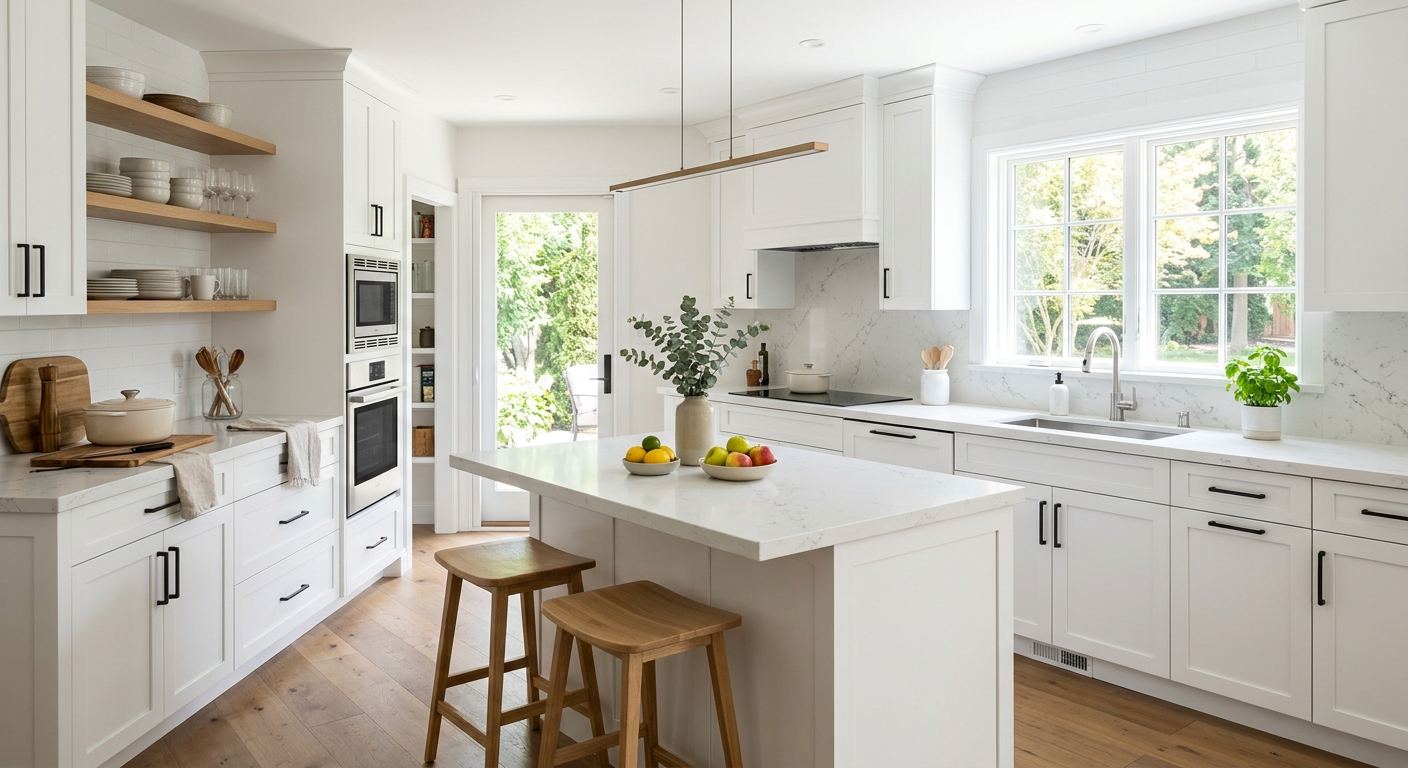
Kitchen renovation options and costs in Kelvin
Kitchen renovations in Kelvin start with one reality: you’re renovating a small-town market (Population: 1,890, per Statistics Canada, 2021 Census), but you’re still buying materials and labour that are priced off the Lower Mainland–Southwest. In higher-value pockets of the region, homeowners often lean into a more design-led look—because the renovation spend is easier to justify on resale. That same expectation shows up in Kelvin too, especially when the home’s value and buyer profile align with mid-range to premium finishes. The result is that even kitchens of the same size can swing materially in total cost depending on cabinetry tier, counter choice, and whether you’re changing the layout.
Climate isn’t usually the main driver of kitchen prices in this part of British Columbia; it’s more about market finish expectations and the availability of specialised trades. Coastal moisture and temperature swings can affect how finishes perform over time, but contractors typically address that with correct ventilation, proper sealing behind tile, and moisture-tolerant underlayment. In the Lower Mainland–Southwest, access to contractors and supply lines can also influence timing, which indirectly affects labour pricing.
In Kelvin, demand tends to cluster where older homes need practical updates—especially around central Kelvin residential streets where homeowners refresh kitchens to keep pace with modern buyer expectations. With that context, the options below will help you compare realistic scopes before you request quotes.
| Renovation Tier |
What's Included |
Typical Duration |
Price Range |
| Cosmetic refresh (paint, hardware, new appliances only) |
Cabinet repaint or touch-ups, new hardware, new appliances (no plumbing/gas moves), minor caulking, basic countertop polish/cleaning as applicable |
3–7 days |
$8,000–$20,000 |
| Mid-range full renovation (new cabinets, counters, sink, tile) |
Semi-custom or quality stock cabinets, new countertops, sink and faucet swap, backsplash tile, flooring transition/repairs, plumbing reconnect, basic lighting refresh |
3–5 weeks |
$40,000–$80,000 |
| High-end full renovation (custom cabinets, stone counters, island) |
Fully custom millwork, stone counters (quartz/stone), island with seating, enhanced backsplash detailing, upgraded hardware, more complex lighting, refined layout changes |
6–10 weeks |
$90,000–$120,000 |
| Cabinet refacing only (new doors + drawer fronts, same boxes) |
Remove doors/adjusters, install new fronts, update hinges/soft-close where needed, repaint/finish match, limited hardware changes |
1–3 weeks |
$12,000–$30,000 |
| Countertop swap only (laminate to quartz or stone) |
Remove and dispose of existing counters (where feasible), fabricate/install new laminate-to-quartz/stone, seal where required, reconnect sink (no layout change) |
3–10 days |
$3,000–$12,000 |
| Backsplash tile installation only |
Remove existing backsplash (if any), surface prep, tile install, grout/seal, edge finishing, caulking at transitions |
2–5 days |
$1,500–$6,000 |
Prices are estimates only and vary by project scope, site access and material selection.
What affects the price of kitchen renovation in Kelvin
Even when you ask for the “same” kitchen renovation in Kelvin, Lower Mainland–Southwest quotes can vary by roughly 30–50% across British Columbia because pricing is driven less by climate and more by local home value, income expectations, and the finish tier buyers expect. Contractors also price complexity differently—so two kitchens with different layouts, plumbing routes, or cabinet designs can land far apart even if the square footage looks similar.
In higher-value parts of the Lower Mainland–Southwest market, homeowners commonly move to quartz or stone counters and semi-custom cabinetry, because the upgrade is easier to recover on resale. In more modest scenarios, laminate and stock cabinets dominate: the upfront cost is lower, while the kitchen still looks refreshed. Layout changes are where uncertainty concentrates—removing a wall, adding an island, or moving a gas line can add labour, inspections, and trade coordination, regardless of whether you choose a $40,000–$80,000 mid-range package or a full $90,000–$120,000 premium build.
Concrete Kelvin examples: (1) If your existing countertop edge is non-standard or your sink cut-out doesn’t match the new unit, countertop fabrication and template work can add time (and sometimes change the countertop price). (2) If your home has older plumbing runs, moving the sink location can require additional supply/drain labour and wall access, which inflates cost even in “cosmetic” projects. (3) If you upgrade to a heavier stone top, installers need more precise cabinet reinforcement and level-checking, especially in kitchens that have older subfloors.
Across the region, contractor availability and material lead times can also swing timelines, which sometimes changes how labour is scheduled. That’s why your quote should separate scope categories—not just bundle everything into one number.
| Price Factor |
Why It Matters |
Cost Impact |
| Cabinet tier — stock vs. semi-custom vs. fully custom millwork |
Custom sizing, finish options, and hardware quality affect labour hours and fabrication cost |
$10,000–$45,000 swing on total project |
| Countertop material — laminate vs. quartz vs. granite vs. stone |
Material price, thickness/edge options, and installation complexity change total cost |
$3,000–$12,000 for swap-only; can be higher in full builds |
| Layout change — wall removal, island add, plumbing/gas move |
Structural work, trade coordination, and additional rough-in work raise unpredictability |
Often $5,000–$25,000 extra versus “like-for-like” |
| Appliance package tier — builder vs. mid-range vs. pro-grade |
Dimensions, electrical requirements, and ventilation needs affect installation |
$2,000–$15,000 difference depending on package |
| Flooring — refinish existing vs. full replacement |
Subfloor condition and required transitions can add demo and install time |
$1,500–$8,000 depending on whether full removal is needed |
| Backsplash — ceramic tile vs. marble vs. full-height slab |
Cut complexity, pattern alignment, and heavier material handling change labour |
$1,500–$6,000 for typical tile; higher for slabs |
| Electrical — new circuits for island, under-cabinet lighting |
Licensed electrical work and inspection scheduling affect both time and cost |
$800–$5,000+ depending on circuits and lighting scope |
| Permit fees and licensed trade requirements |
Required permits and inspections add administrative steps and licensed labour |
Varies, but layout/plumbing/gas work adds the most |
Permits & regulations in British Columbia
In British Columbia, a cabinet and countertop swap typically doesn’t require a permit. That’s because you’re usually replacing finishes and fixtures without changing the underlying plumbing, gas, electrical, or structure. However, when your Kelvin project goes beyond “like-for-like,” permits and licensed trades commonly come into play.
Work that typically does require a permit and licensed trades includes: moving or modifying plumbing supply/drain lines (for sink relocation or re-routing), relocating a gas stove or making changes related to gas appliances, removing a load-bearing wall (structural changes), adding or upgrading electrical circuits (for an island receptacle plan or under-cabinet lighting tied to new wiring), and any project that changes the way services enter and operate in the kitchen. Gas work must be completed by a licensed gas fitter, and electrical work must be completed by a licensed electrician; both require inspections.
How homeowners verify contractors before signing: (1) Ask for the contractor’s licence details and confirm the trade credential is active for the scope. (2) Request a current certificate of liability insurance; ensure the coverage is in force for the renovation period. (3) For work involving injury risk and typical trade mobilization, confirm appropriate coverage and clearance documentation for workers through the contractor’s paperwork. (4) Ensure the contractor clearly states who will pull permits (and who is responsible) in writing—permit responsibility should be spelled out in the contract, not left implied. Finally, verify any clearance letters or inspection responsibility are clearly assigned so you’re not stuck at close-out.
Cabinets, countertops and layout decisions in Kelvin
In Kelvin, the three decisions that most affect your final cost and long-term satisfaction are: (1) cabinet tier, (2) countertop material, and (3) whether you change the layout. Cabinet tier drives most of the variation because it controls how quickly the project can be scheduled, how well the finish matches your room, and how seamlessly the kitchen looks when buyers compare it to newer builds in the Lower Mainland–Southwest. Stock cabinets are fastest and cheapest, semi-custom is the practical mid-range option, and custom millwork gives the best fit but costs more and takes longer.
Countertop choice should be balanced between durability, maintenance, and realistic pricing in British Columbia. Quartz is a common mid-range “sweet spot” because it handles daily use well and generally needs less day-to-day maintenance than natural stone. Laminate is budget-friendly and can look great with the right design, but it’s more sensitive to heat and can be less forgiving when you’re installing around older cabinet frames. If you want natural character, granite or butcher block can be striking—but they require different care routines and, with marble, extra caution in a family kitchen.
Layout changes are the “justify-or-rethink” category. Adding an island or removing a wall can make sense when it improves circulation and seating—particularly if your current kitchen feels tight at peak use. But moving plumbing or relocating a gas line is where budgets can jump unpredictably. As a dollar example: upgrading from a laminate countertop to quartz is often an incremental upgrade you can plan for within the general countertop band (commonly $3,000–$12,000 for the install-only portion), whereas adding an island with new services can push you toward the higher full-renovation range (often closer to $90,000–$120,000) because the job becomes more than a materials swap.
Take climate seriously, even when it’s not the main cost driver: proper ventilation and sealed transitions behind tile and countertops are the difference between a kitchen that stays crisp for years and one that shows wear sooner.
| Option |
Durability |
Maintenance |
Best For |
Price Range |
| Stock cabinets (big-box) |
Good for everyday use; fit depends on your existing dimensions |
Wipe clean; check alignment of doors over time |
Speed, budget control, straightforward layouts |
$12,000–$28,000 |
| Semi-custom cabinets (local dealer) |
Very good durability; improved options for storage and finishes |
Minimal upkeep; soft-close hardware typically reduces wear |
Most Kelvin projects aiming for a modern look |
$22,000–$55,000 |
| Custom cabinets (local millwork shop) |
Excellent fit and build quality; best for awkward spaces |
Routine cleaning; hinges/hardware serviceable where built |
Design-led layouts and maximum storage performance |
$45,000–$85,000 |
| Laminate countertop |
Moderate durability; can be vulnerable to heat and impact |
Wipe daily; avoid hot pans directly and be gentle with seams |
Refresh budgets and rentals where cost control matters |
$3,000–$6,500 |
| Quartz engineered countertop |
High durability; resistant to staining and everyday wear |
Soap and water routine; avoid abrasive pads |
Family homes wanting a “set-and-forget” surface |
$6,000–$12,000 |
| Granite / natural stone countertop |
High durability; strong resistance to scratches |
Typically needs sealing; clean with stone-safe products |
Homeowners who want natural pattern variety |
$7,000–$14,000 |
| Butcher block countertop |
Durable but can mark; best with proper care and cutting boards |
Oil/seal maintenance; protect from standing water |
Warm, traditional looks and daily food prep users |
$4,500–$10,500 |
| Marble countertop |
Beauty-focused; more sensitive to etching and staining than quartz |
Frequent care; consider sealing and careful cleaning |
Design statements and lower “rough-use” households |
$10,000–$18,000 |
How to choose a kitchen renovation contractor in Kelvin
Choosing a contractor in Kelvin is mostly about proving they’re accountable, not just giving you a price. In British Columbia, start by verifying trade credentials that match the work. For electrical tasks (new circuits, island receptacles, under-cabinet lighting tied into new wiring), confirm the electrician is licensed and active, and request their details before work begins. For gas-related changes (if your stove or range hood involves gas), ensure a licensed gas fitter is involved. Ask for the contractor’s liability insurance certificate and check that coverage matches the project start/end dates and includes renovation work. You should also confirm workers’ coverage/clearance documentation as provided by the contractor—ask for proof and keep copies.
Next, get 2–3 itemised written quotes. You want labour and materials broken down by cabinet install, countertop template/fab/install, plumbing reconnects, backsplash tile labour, electrical scope, disposal, and any permit-related tasks. Avoid lump sums that don’t list what’s excluded. Read the scope carefully: disposal included or not, permit pull included or assigned to you, patching and painting responsibilities, and whether appliance delivery/installation is included. Warranty matters too: look for a workmanship warranty length, plus clarity on product/manufacturer warranties and whether they’re transferable to you as the homeowner.
Finally, protect your budget with a payment schedule. Don’t pay more than about 10–15% upfront; keep a holdback until close to completion and confirm final sign-off. Get the start date and completion estimate in writing, and insist on a single point of contact for scheduling changes.
- Confirm licences for the trades involved (electrical and gas where applicable) before signing.
- Request a liability insurance certificate and verify project dates.
- Ensure coverage/clearance documentation for workers is provided and matches the scope.
- Ask for 2–3 itemised quotes with labour and materials line items.
- Check that demo, disposal, and site clean-up are explicitly included.
- Confirm who pulls permits and whether permit fees are included.
- Verify warranty: workmanship duration and what it covers.
- Confirm manufacturer warranty terms and whether they pass to you.
- Look for a detailed materials list (cabinet brand/grade, countertop thickness, tile type).
- Require a written timeline with start date and practical completion window.
- Use a payment schedule with a 10–15% maximum upfront and a holdback to completion.
- Ask for references of similar Kelvin projects (layout changes, stone counters, or tile work).
In Kelvin, red flags to watch for include: vague scopes that omit disposal or patch-and-paint duties, quotes that don’t specify cabinet/countertop grades, contractors who won’t provide insurance/warranty details in writing, and schedules that guarantee start dates without addressing material lead times for cabinets and stone.
Frequently asked questions — kitchen renovation in Kelvin
Custom vs stock cabinets — is custom worth it?
In Kelvin and across the Lower Mainland–Southwest, custom cabinets are worth it when your kitchen has challenging dimensions, a layout that needs perfect alignment, or you want higher-end finishes and storage solutions that stock lines don’t match. If your goal is primarily a refresh and you’re staying close to the existing layout, stock cabinets can deliver strong value with faster scheduling. Semi-custom often hits the best balance for many homeowners—cleaner design upgrades without the long lead times typical of fully custom millwork. Price-wise, it’s common to see stock cabinet packages start in the low tens of thousands, while fully custom can move much higher. For many projects, keeping cabinetry and counter upgrades aligned with a mid-range full renovation budget helps you avoid scope creep. (Statistics Canada, 2021 Census)
How do I choose a kitchen contractor in Kelvin?
Choose a Kelvin kitchen contractor by verifying the right credentials for the work being done and by demanding itemised documentation. Start with liability insurance and trade licensing for electrical and gas scopes, and keep copies of certificates in your files. Then compare 2–3 quotes that separate labour and materials, including disposal, electrical rough-ins, countertop template/fabrication, and whether permits are pulled by the contractor or by you. Read exclusions line-by-line: flooring transitions, drywall patching, backsplash waterproofing details, and appliance installation responsibilities. Also confirm warranty coverage for workmanship and the manufacturer terms for cabinets and countertops. If a quote only gives a single lump sum and doesn’t list materials, that’s usually a sign you’ll pay later through change orders. Finally, keep payment conservative—typically no more than 10–15% upfront, with a holdback until the job is complete.
What order do kitchen renovation steps happen in?
The usual order keeps the trades efficient and avoids rework. First comes site protection, demolition, and rough-in verification (plumbing/gas/electrical), especially if you’re changing a layout. Next, cabinets go in after the rough-ins are confirmed so the installer can reference accurate measurements. Countertop templating comes after cabinets are level and securely installed; then countertop fabrication and install happens, followed by sink/faucet connections. Flooring and backsplash typically come before final trim and caulking—often tile installation is scheduled so it can integrate cleanly with countertop edges. Appliances are installed last, including any final electrical adjustments and ventilation checks. If your project is in the $40,000–$80,000 mid-range band, this sequence usually keeps timelines predictable. For higher-end builds, scheduling can extend due to custom cabinetry and stone lead times, but the order stays similar to prevent costly redo.
Can I live at home during a kitchen renovation in Kelvin?
Often yes, but it depends on the disruption level and the scope. In Kelvin, many homeowners live at home during cosmetic refreshes or cabinet refacing because the work is usually contained and disruptions are shorter. With a full renovation that includes removing counters, relocating services, and installing new flooring and tile, living at home is still possible, but you should plan for a temporary kitchen setup (microwave/tea kettle, limited food prep, and a clear path for water access). Expect noise during demolition and cabinet install, and keep dust control measures in place—especially with tile cutting. The time range matters: a mid-range full renovation can run 3–5 weeks, while higher-end projects can stretch to 6–10 weeks, which affects how feasible everyday cooking is. If your renovation includes gas or electrical changes, ensure inspections are scheduled promptly to avoid delays.
Should I renovate my kitchen before selling in Kelvin?
For Kelvin homeowners preparing to sell, the question is less “should you renovate” and more “will the improvement match buyer expectations at your likely selling price.” In the Lower Mainland–Southwest, buyers often respond well to clean, modern cabinetry and durable counters. A cosmetic refresh or refacing can boost appearance without overspending, and it may align better with the ROI goal when your budget is tighter. If you’re planning a mid-range full renovation, many sellers focus on semi-custom cabinets and quartz-like durability because daily usability helps sell the story. Price-wise, staying inside the $40,000–$80,000 mid-range band is often more realistic for resale-focused projects than jumping straight to premium custom millwork at the higher end of the market. Climate matters indirectly: good ventilation and sealing around tile and counters reduce early wear and help the kitchen look “new” longer. (Statistics Canada, 2021 Census)
What's the most popular kitchen style in Kelvin right now?
In Kelvin and throughout the Lower Mainland–Southwest, the most requested style tends to be modern transitional: clean lines, shaker-style doors, warm neutrals, and practical storage layouts. Homeowners frequently choose semi-custom cabinetry in neutral tones and pair it with durable counters such as quartz, because it reads contemporary without being too trendy. Hardware upgrades—soft-close hardware, updated pulls, and under-cabinet lighting—are also common because they make the kitchen look higher-end without changing the entire layout. When budgets allow, island additions and better sightlines between cooking and dining are popular, especially because they translate well for both day-to-day living and showings. If you’re planning within a mid-range full renovation scope ($40,000–$80,000), you can usually achieve this look with careful material selection and a layout that improves flow. For premium builds ($90,000–$120,000), the style typically becomes more design-led with custom millwork and stone detailing.