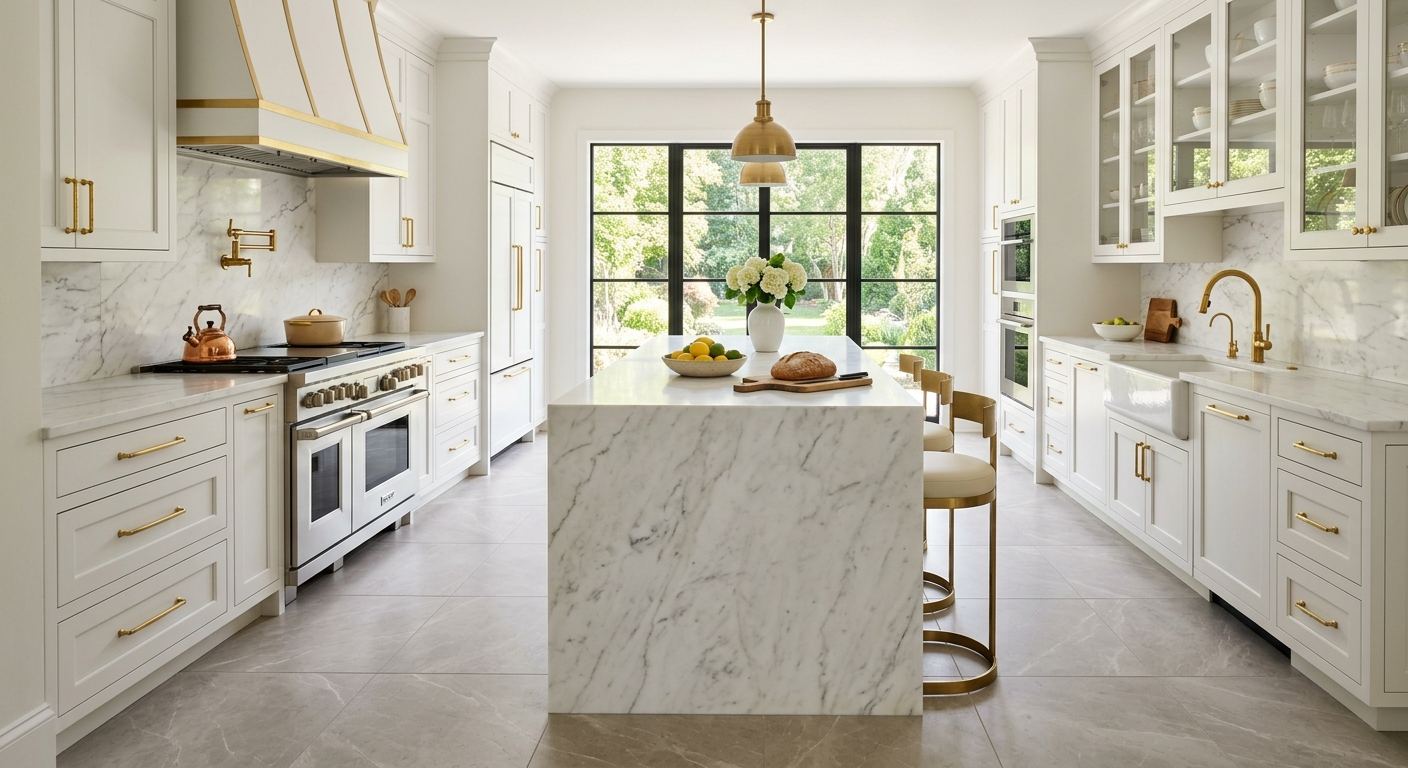
Kitchen renovation options and costs in Telkwa
Telkwa homeowners typically choose kitchen upgrades that match how they live now, but also how buyers will judge the home later. With a median household income of $101,000 (Statistics Canada, 2021 Census) and a homeowner rate of 88.4%, many projects in Telkwa lean practical and long-lasting—especially in the 30-plus-year housing stock where 41.1% of homes were built before 1981 (Statistics Canada, 2021 Census). In the Nechako economic region, the price you’ll see is driven more by finishes and scope than by climate alone: contractors price custom cabinetry and quartz or natural stone higher because that finish tier tends to be the default in higher-value homes, not because the winter itself is harder on materials. That said, Telkwa’s freeze-thaw cycles and heavy snow seasons can affect scheduling and logistics—delivery windows and jobsite drying time matter, and crews often plan around accessibility after storms.
Local demand is especially steady around the Telkwa townsite, where renovations are frequent in lived-in homes and working timelines are tight. If your goal is to keep the existing footprint and update the look, pricing stays closer to the “cosmetic refresh” band; if you’re changing cabinetry layout, adding an island, or upgrading counters and tile throughout, budgets move into the mid- to upper-range common in the Nechako area. Use the tier guide below to compare quotes before you start comparing line items with your contractor.
| Renovation Tier |
What's Included |
Typical Duration |
Price Range |
| Cosmetic refresh (paint, hardware, new appliances only) |
Paint/trim touch-ups, new pulls/handles, appliance swap (no plumbing/gas moves), minor caulking/finishes |
3–7 days |
$5,000–$15,000 |
| Mid-range full renovation (new cabinets, counters, sink, tile) |
New cabinets (semi-custom or quality stock), new countertops, sink + faucet, backsplash tile, plumbing hook-ups as needed, new under-cabinet finishing |
3–5 weeks |
$35,000–$60,000 |
| High-end full renovation (custom cabinets, stone counters, island) |
Fully custom millwork, quartz or natural stone counters, island base/top, full backsplash/tile detailing, upgraded lighting/cabinet accessories |
5–8 weeks |
$70,000–$90,000 |
| Cabinet refacing only (new doors + drawer fronts, same boxes) |
Refaced doors/drawers, new hardware, new finish on cabinet faces, selective countertop edge refresh (if needed), rework around existing footprint |
1–3 weeks |
$8,000–$25,000 |
| Countertop swap only (laminate to quartz or stone) |
Removal and disposal, new countertop install, new sink cut-out if staying compatible, backsplash detail as part of the countertop scope (if specified) |
2–5 days |
$3,500–$15,000 |
| Backsplash tile installation only |
Tile supply/installation, surface prep, grout/seal where applicable, trim edges, caulking at changes of plane |
3–7 days |
$2,500–$12,000 |
Prices are estimates only and vary by project scope, site access and material selection.
What affects the price of kitchen renovation in Telkwa
In the Nechako region (including Telkwa and nearby communities like Smithers and Vanderhoof), it’s common to see quotes for the “same kitchen” differ by 30–50%. The usual reasons aren’t climate damage or labour availability alone—they’re finish tier and scope, plus how much the contractor needs to rework rough-ins. Even in British Columbia, local home values and the typical household income determine what homeowners are willing to pay for a showpiece kitchen, which nudges many projects toward semi-custom cabinetry and quartz at the mid-to upper end, while tighter budgets tend to favour stock cabinets and laminate tops. In high-value Nechako-area markets, buyers often expect quartz or stone on resale, so owners choose upgrades knowing the cost is easier to recoup. In more modest pockets, laminate and stock cabinets deliver better “ROI-per-dollar” because the visual update is still strong even without layout changes.
Here are three Telkwa examples of how real conditions swing pricing. First, older homes (41.1% built before 1981) may have out-of-square walls and shifting cabinet bases, which can add framing labour even when you keep the same footprint. Second, adding an island almost always triggers new electrical planning and sometimes plumbing considerations; if you move a gas range or re-route a hood, trades and inspection timing can add cost quickly. Third, if your project starts right after heavy snowfall or during wet shoulder seasons, drying time and site protection can slow progress—labour gets paid for days, not just hours. As a result, a full renovation might sit around $35,000–$60,000 when the layout stays mostly intact, but it can stretch toward $70,000–$90,000 when the job includes custom cabinetry and a true island build.
| Price Factor |
Why It Matters |
Cost Impact |
| Cabinet tier — stock vs. semi-custom vs. fully custom millwork |
Cost rises with material quality, door styles, internal components, and how precisely boxes fit your layout |
Typically shifts total budget by tens of thousands; cabinet installation/refacing premiums can swing projects 25–60% |
| Countertop material — laminate vs. quartz vs. granite vs. stone |
Material price and fabrication complexity; corners, thickness, and seam placement drive labour |
Can move countertop installation from the low range up to the top end; higher-end stone often adds significant fabrication time |
| Layout change — wall removal, island add, plumbing/gas move |
Rough-in adjustments, structural considerations, and scheduling with licensed trades |
Often the single biggest unpredictable cost; frequently adds several thousand to many tens of thousands |
| Appliance package tier — builder vs. mid-range vs. pro-grade |
Electrical and ventilation needs, dimensions, and installation complexity |
Can add moderate to high cost; pro-grade models can require additional planning for fit and venting |
| Flooring — refinish existing vs. full replacement |
Subfloor condition and matching adjacent rooms affect demolition and replacement time |
Refinishing keeps labour lower; full replacement increases removal, prep, and install costs |
| Backsplash — ceramic tile vs. marble vs. full-height slab |
Weight, specialty cutting, and surface prep requirements |
Ceramic is usually lowest; marble and full-height work increase install time and material handling |
| Electrical — new circuits for island, under-cabinet lighting |
Licensed work, new wiring runs, and inspection timelines |
Often adds predictable line-item costs; complexity increases if power routing is difficult |
| Permit fees and licensed trade requirements |
Some scope needs permits, inspections, and specific trade approvals |
Varies by project; can add several hundred to a few thousand, plus scheduling overhead |
Permits & regulations in British Columbia
In British Columbia, a cabinet and countertop swap by itself typically doesn’t require a permit. If you’re just installing new cabinetry, changing countertop material, and keeping plumbing and electrical hookups in the same locations, you can usually proceed without permits. However, Telkwa kitchen renovations often cross into permit territory when the scope changes the building’s services or structure. Moving plumbing supply/drain lines, relocating a gas stove/range, removing a load-bearing wall, or adding new electrical circuits (for example, powering an island or adding significant under-cabinet lighting requiring new runs) generally requires permits and licensed trades.
Step one for homeowners is to confirm responsibility in writing. Ask your contractor: “Who pulls the permit, who schedules inspections, and what is included in my contract?” Step two is to verify contractor licensing and coverage before work begins. For your kitchen project, request proof of license and insurance for the relevant trades: a licensed gas fitter for any gas work and a licensed electrician for electrical modifications. For insurance, ask for a certificate of insurance showing general liability coverage and confirm they can provide clearance letters where applicable. For workers’ protection, ensure coverage aligns with statutory requirements; in practice, you want to see evidence of workers’ compensation coverage through their WSIB/WCB documentation.
Do not rely on verbal assurances—if permits are required, they should be clearly allocated in the written agreement, with timelines so Telkwa inspections don’t derail your start date.
Cabinets, countertops and layout decisions in Telkwa
The three most consequential decisions in a Telkwa kitchen renovation are cabinet tier, countertop material, and whether you change the layout. Start with cabinet tier: stock cabinets are fastest and typically cheapest, but fit is “good enough” for many straightforward layouts. Semi-custom cabinets are the most popular mid-range option in Nechako-area homes because you get better sizing, storage, and door/drawer options without the premium of full custom. Custom cabinets deliver the best fit for older or irregular rooms and can add features like specialized pantry systems—but they’re also the highest cost.
Next is countertop material. Laminate is budget-friendly and durable for day-to-day cooking, but it’s less resistant to heat and cannot match the “stain-resistant, premium look” you get with engineered quartz. Quartz is a strong Telkwa choice because it resists staining and holds up well to routine cleaning, and it’s commonly priced so many renovations land in the mid-to upper range. Granite and natural stone feel premium and can add uniqueness, but they require more attention to sealing and can be priced at the top end once fabrication and edge details are included. Finally, layout changes—like removing a wall, adding an island, or relocating plumbing/gas—can be justified when you’re gaining usable space for traffic flow and seating, not just chasing a trend.
For example, if you’re deciding between mid-range and high-end: upgrading to custom cabinets and stone counters with an island often moves a project from roughly $35,000–$60,000 toward $70,000–$90,000. That difference is justified when the storage problem and bottleneck are real (common in older before-1981 layouts), but it’s not always justified if you’re only updating surfaces and your layout already works.
| Option |
Durability |
Maintenance |
Best For |
Price Range |
| Stock cabinets (big-box) |
Good for standard use; hinges and internal components depend on the grade |
Low—keep hardware adjusted and wipe clean; avoid steam-heavy cleaning near seams |
Fast updates with minimal layout changes |
$8,000–$20,000 |
| Semi-custom cabinets (local dealer) |
Very solid construction with better sizes and options |
Low to moderate—standard cleaning; keep an eye on water exposure around sink |
Most Telkwa renovations targeting good resale appeal |
$20,000–$35,000 |
| Custom cabinets (local millwork shop) |
Highest fit and finish; can use upgrades for drawers and storage organization |
Low—same care as other cabinetry, but more opportunities for specialized hardware |
Irregular rooms, pantry/storage redesign, and premium look |
$35,000–$55,000 |
| Laminate countertop |
Resists scratches reasonably; heat and cutting can damage the surface |
Low—wipe with mild cleaner; use trivets and cutting boards |
Tight budgets and straightforward kitchen footprints |
$3,500–$6,500 |
| Quartz engineered countertop |
High durability; resists staining and everyday impacts well |
Low—no sealing typically required; avoid very hot cookware directly |
Telkwa kitchens where homeowners want a premium look with easier upkeep |
$7,000–$12,000 |
| Granite / natural stone countertop |
Excellent heat resistance; unique veining and strength |
Moderate—may require periodic sealing and careful cleaning of spills |
Premium upgrades and statement kitchens |
$9,000–$15,000 |
| Butcher block countertop |
Good strength but can dent; sensitive to chronic moisture |
Moderate—oil/condition regularly and protect from leaks |
Warm, traditional style and active cooking households |
$5,000–$9,000 |
| Marble countertop |
Beautiful but softer; can etch or stain with acidic foods |
Higher—requires careful cleaning and sealing; avoid spills |
Low-abuse, showcase finishes in higher-end kitchens |
$10,000–$18,000 |
How to choose a kitchen renovation contractor in Telkwa
Choosing the right contractor matters in Telkwa because weather delays and material lead times can turn a simple refresh into a month-long disruption. Start by verifying British Columbia licensing and insurance. For electrical changes, confirm your electrician is licensed by requesting their licence details and trade certification. For gas work, ensure the gas fitter is licensed—gas modifications should never be handled by general labour. Ask every contractor for a certificate of insurance showing general liability coverage (and request updated proof if the job spans months). For worker protection, ask for WSIB/WCB coverage documentation so you’re not left holding risk if an injury occurs on site.
Next, get 2–3 itemised written quotes—not just a lump sum. Your best quotes break labour and materials out line-by-line: demo, rough framing/patching, cabinet supply, countertop fabrication and install, tile, plumbing/electrical allowances, and disposal. Read the scope carefully: what is excluded (subfloor prep, drywall replacement, trim rebuilds), is permit pulling included, and is garbage/disposal part of the contract? Warranty is also critical: ask for workmanship warranty length, plus the product/manufacturer warranties (and whether they’re transferable to future owners if you sell). Plan payments too: never pay more than 10–15% upfront, and hold back a portion until key milestones are complete. Finally, require a written start date and a completion estimate so you can plan around contractor availability and Telkwa delivery schedules.
- Verify trade licences (gas/electrical where applicable) and confirm the permit plan in writing
- Request certificate of insurance and confirm coverage limits
- Confirm workers’ compensation coverage documentation (WSIB/WCB)
- Use itemised quotes with labour and material breakdowns, not allowances only
- Check the demolition scope: who removes, who hauls, and where disposal is included
- Confirm countertop fabrication lead times and responsibility for templating
- Ask who coordinates inspections if permits are required
- Confirm tile scope includes backer prep, waterproofing where needed, and grout type
- Review warranty terms for workmanship and products; ask if warranties are transferable
- Use a payment schedule with milestones; limit upfront payment to 10–15%
- Ask for a project schedule with start/completion dates and change-order process
- Confirm accessibility protections for Telkwa winters (site cover, drying plans, dust control)
Common red flags I see in Telkwa include: vague scopes with lots of “allowances,” no stated responsibility for permits, contractors who won’t provide written warranty details, payment requests beyond 15% before fabrication starts, and quoting that doesn’t include disposal/demolition and protection for flooring and adjacent rooms.
Frequently asked questions — kitchen renovation in Telkwa
Quartz vs granite countertops — which is better?
In Telkwa and across British Columbia, “better” depends on how you cook and maintain the surface. Quartz is engineered, non-porous in typical applications, and resists staining well, which keeps daily cleaning simple—especially in homes built before 1981 where older plumbing finishes can sometimes mean slower leak detection. Granite is natural stone with excellent heat tolerance and unique veining, but many homeowners need to stay on top of sealing and careful cleaning to prevent stains. If your budget sits in the countertop swap range of $3,500–$15,000, quartz often lands in a sweet spot for durability and look. For a premium statement with natural variation, granite can be worth the extra attention. Either way, insist on templating accuracy and a proper seam/edge plan for your layout.
Should I reface or replace my cabinets?
Refacing is usually the better choice when your cabinet boxes are solid, your layout is working, and you want a fast, cleaner upgrade. If your existing boxes have swelling, water damage near the sink, or you’re trying to fix awkward storage, replace is often the more cost-effective long-term move. In Telkwa, many homeowners choose refacing first to manage budget while still getting updated door styles and hardware. A typical cabinet refacing-only scope can land around $8,000–$25,000, while full cabinet replacement is more often reflected in mid-range to high-end full renovation budgets. Ask your contractor to assess box condition, reveal gaps and alignment, and explain whether refacing will correct major misalignment or if replacement will be necessary for the best finish.
Do I need a permit for a kitchen renovation in British Columbia?
Generally, a cabinet and countertop swap without moving plumbing, gas, or electrical circuits doesn’t require a permit in British Columbia. You typically do need permits and licensed trades when you move supply/drain lines, relocate or modify gas appliances (including changes to how a range operates or ventilation tied to gas use), remove a load-bearing wall, or add new electrical circuits (for example, powering an island or major lighting upgrades). For Telkwa homeowners, the practical step is to ask your contractor, before signing, who is pulling the permits and scheduling inspections. You should also confirm the relevant trade licences (gas fitter and electrician) and request insurance certificates. Clear written responsibility is the difference between a smooth timeline and a delayed install when inspections are missed.
What's the ROI on a kitchen renovation?
ROI varies by how close the renovation matches buyer expectations in the Nechako area. In higher-value homes, buyers often expect a more premium finish tier—quartz or natural stone counters and better cabinetry—so the kitchen cost is more likely to be recovered at resale. In more budget-sensitive homes, ROI is strongest when the renovation improves layout function and visual quality without overbuilding; laminate or stock cabinets plus smart updates can still read “updated” to buyers. Because Telkwa’s housing stock includes a lot of older homes (41.1% built before 1981) but the area remains relatively small, projects that fix usability issues (storage, traffic flow) tend to outperform purely cosmetic work. A full renovation budget that aligns with typical bands—like $35,000–$60,000 for many mid-range jobs—often balances impact and affordability. Your contractor should help you decide what buyers in your specific neighbourhood are paying for.
How do I budget for a kitchen renovation?
Budgeting starts with choosing the scope tier and then building a realistic allowance for the “unseen” work: demo, patching, drywall repair, floor prep, disposal, and trade coordination. In Telkwa, even if you keep the footprint, older walls can be out of square, so plan extra labour for fit and finish. If you’re aiming for a refresh, cosmetic-only projects are typically far lower than full work—while most full renos in the Nechako region land in the broader $35,000–$90,000 range depending on cabinets and counters. Use the bands to set expectations: for example, mid-range full renovations often fall near $35,000–$60,000, while high-end scopes with island builds and stone counters tend to move toward $70,000–$90,000. Get itemised quotes, keep a contingency for layout surprises, and ensure disposal and permit timelines are included so you don’t get “hit” at the end.
Can I move my kitchen sink or stove?
Yes, but moving them is where permits and licensed trades become likely, and where costs become less predictable. In British Columbia, shifting plumbing supply/drain lines usually requires permits and work by qualified trades, because drain slopes, venting, and leak risk must be handled correctly. Moving a stove can also involve gas work; that should be done by a licensed gas fitter with inspections as required. In Telkwa’s older homes, routing new lines can require more wall opening and patching than homeowners expect, especially where finishes date back decades. If you want to control cost, keep major fixtures in the same general location when possible and only adjust as needed. Your contractor can map the existing rough-ins and show you the likely budget impact versus a countertop-only or backsplash-only upgrade, which typically avoids these rough-in changes.