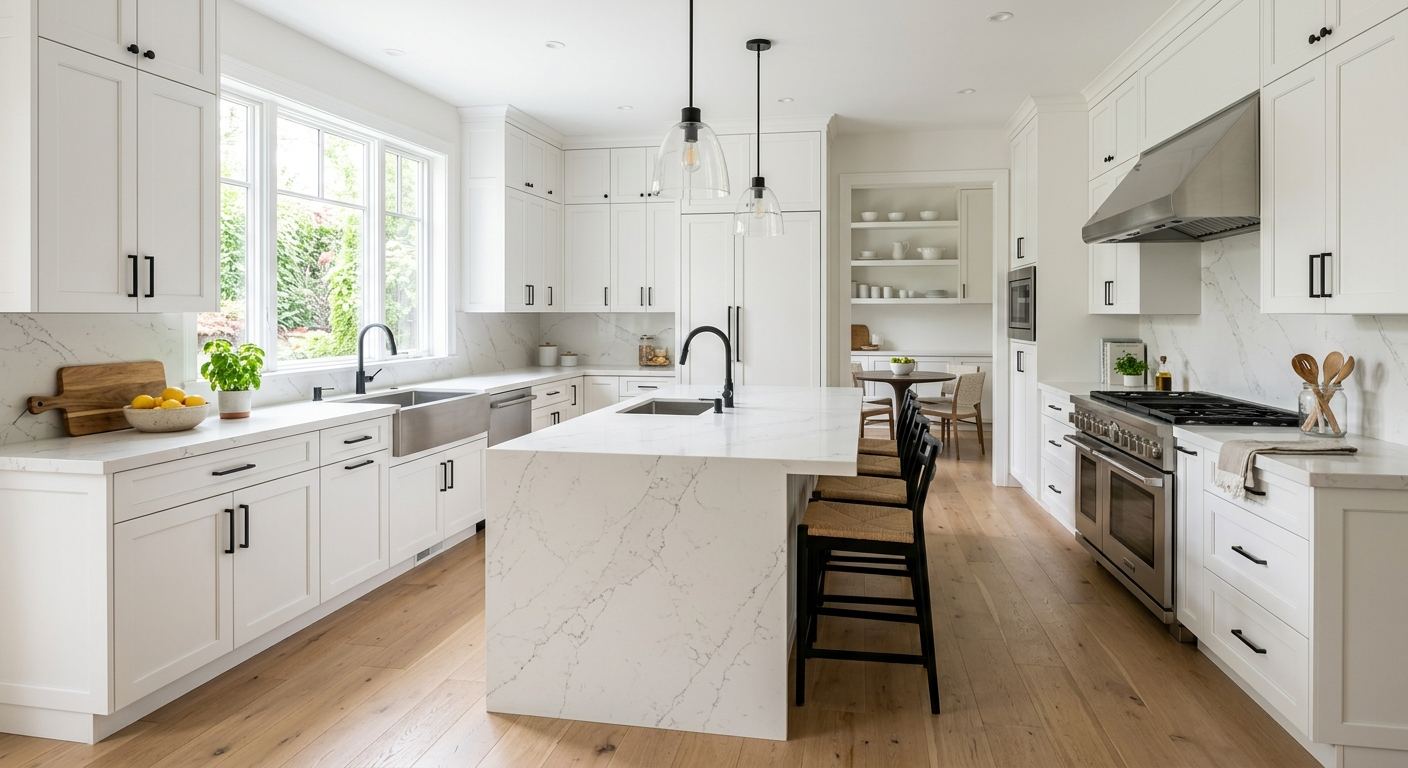
Kitchen renovation options and costs in Douglas
Douglas, British Columbia is a smaller community with a limited housing inventory, which can make contractor scheduling feel “bursty” when multiple renovations hit the same season. That said, kitchen pricing in the Lower Mainland–Southwest is driven less by climate and more by home value and finish expectations—so even in a town like Douglas, the market you’re tied to (Surrey/Abbotsford-side buying patterns and Metro Vancouver resale tastes) influences what homeowners request. With a Douglas population of 7,867 (Statistics Canada, 2021 Census), most projects are practical, owner-led updates rather than large developer-driven rebuilds. Still, the broader Lower Mainland–Southwest pattern holds: when owners expect a higher resale value trajectory, they commonly choose semi-custom cabinetry, upgraded hardware, and quartz or stone counters.
Lower Mainland–Southwest weather doesn’t usually force drastic material changes, but it does matter for moisture control and ventilation—especially in older Douglas homes where past plumbing or venting may be less than ideal. Labour availability can also shift pricing modestly because cabinet installers, countertop fabricators, and tile crews often compete for dates across the region. If you’re renovating around the popular areas and local demand corridors near the Douglas/Deer Lake-side density (where many trades coordinate jobs across nearby communities), you may see quotes that differ more on schedule and sequencing than on “average labour rates.”
To compare scopes, here are realistic Douglas pricing tiers you can use to sanity-check quotes—then we’ll break down what drives the biggest differences in the next section.
| Renovation Tier |
What's Included |
Typical Duration |
Price Range |
| Cosmetic refresh (paint, hardware, new appliances only) |
Cabinet paint or refinishing (no cabinet box changes), new pulls/knobs, caulking/trim touch-ups, appliance swap, basic surface prep |
3–7 days |
$8,000–$25,000 |
| Mid-range full renovation (new cabinets, counters, sink, tile) |
New semi-custom or quality stock cabinets, new counters (quartz or laminate), sink and faucet, backsplash tile, select lighting refresh, flooring patching |
3–6 weeks |
$40,000–$80,000 |
| High-end full renovation (custom cabinets, stone counters, island) |
Fully custom cabinetry/millwork, stone counters (granite/marble or upgraded engineered stone), island build, upgraded hardware, full backsplash to ceiling options, enhanced lighting/electrical allowance |
6–12 weeks |
$90,000–$120,000 |
| Cabinet refacing only (new doors + drawer fronts, same boxes) |
New doors/drawer fronts/trim, updated hardware, alignment/adjustments, existing box assessment and surface prep |
2–4 weeks |
$8,000–$35,000 |
| Countertop swap only (laminate to quartz or stone) |
Remove old surface, template and install new counters, sink cut-out transfer/adjustment (as applicable), sealing for stone |
1–3 weeks |
$3,000–$12,000 |
| Backsplash tile installation only |
Tile supply allowance, wall prep, tile install, grout/sealing, caulk at changes in plane |
4–10 days |
$1,500–$6,000 |
Prices are estimates only and vary by project scope, site access and material selection.
What affects the price of kitchen renovation in Douglas
In Douglas and across the Lower Mainland–Southwest, it’s common to see quotes for the “same” kitchen land 30–50% apart. The biggest drivers aren’t climate surprises; they’re finish tier, cabinet complexity, and how much the plan changes during construction. In higher-value pockets of the Metro Vancouver orbit, homeowners often default to quartz or stone counters and semi-custom cabinetry because the renovation cost is easier to recover on resale. In more modest scopes, laminate and stock cabinets dominate because the goal is improved function and cleanliness without the premium material package. Across British Columbia, that same pattern holds: a refresh can stay relatively restrained, while a full remodel rises quickly once cabinetry, trades, layout changes, and premium finishes are included.
Here are a few Douglas-specific examples of what pushes cost up or down. First, older kitchen plumbing routes sometimes force higher plumbing labour if you’re moving a sink for better sightlines—this can quickly inflate beyond a countertop-only swap budget (often $3,000–$12,000) into a full “mid-range full renovation” scope ($40,000–$80,000) once repairs and wall patching are included. Second, if your home’s existing cabinet boxes are out of level or water-damaged near the dishwasher or under-sink, refacing may require more prep than expected, reducing the savings versus replacement. Third, island additions—even when the room “looks” large enough—can add unpredictable electrical and ventilation work; that’s where budgets often drift because under-cabinet lighting, new circuits, and hood ducting are rarely identical to the previous layout.
Finally, housing stock age matters. In homes built earlier, electrical capacity and venting may not match today’s appliance requirements, and correcting that can add cost regardless of whether you choose laminate or quartz—layout and service upgrades are the truly unpredictable portion.
| Price Factor |
Why It Matters |
Cost Impact |
| Cabinet tier — stock vs. semi-custom vs. fully custom millwork |
Custom sizing, drawer count, materials, and built-in details change labour hours and material cost |
Often shifts projects by $15,000+ on full renos |
| Countertop material — laminate vs. quartz vs. granite vs. stone |
Material price plus template/install complexity and sealing requirements |
Can swing $2,000–$8,000+ for the same footprint |
| Layout change — wall removal, island add, plumbing/gas move |
Triggers structural, plumbing, and sometimes gas/electrical scope; adds demo and patching |
Largest uncertainty; commonly adds $10,000–$25,000+ |
| Appliance package tier — builder vs. mid-range vs. pro-grade |
Higher-end units add installation complexity (handles, panels, venting, wiring needs) |
Typical range can differ by $3,000–$15,000+ |
| Flooring — refinish existing vs. full replacement |
Kitchen renovations often damage edges; matching existing flooring can be difficult |
Can add $1,500–$7,000 depending on what’s reusable |
| Backsplash — ceramic tile vs. marble vs. full-height slab |
Tile labour complexity, substrate prep, and material cut waste |
Commonly adds $1,500–$6,000+ for backsplash only scopes |
| Electrical — new circuits for island, under-cabinet lighting |
More devices/lighting means more wiring, potential new breakers, and revisions |
Often adds $1,000–$6,000+ |
| Permit fees and licensed trade requirements |
Permits and inspections add admin time and can require specific licensed trades |
Usually adds a few hundred to several thousand depending on scope |
Permits & regulations in British Columbia
In British Columbia, many straightforward kitchen updates don’t require permits. Cabinet and countertop swaps—where you’re keeping plumbing, gas lines, and the electrical layout the same—typically don’t trigger permits, and contractors can often proceed without the permit workflow. However, you should plan for permits (and licensed trades) when you change the services. Moving plumbing supply or drain lines, relocating a gas stove or range hood with gas, removing a load-bearing wall, or adding new electrical circuits for things like an island receptacle cluster or under-cabinet lighting usually requires a permit and inspections.
Gas work must be done by a licensed gas fitter, and electrical work must be performed by a licensed electrician—both will typically pull permits as part of the trade scope and schedule inspections. Before you sign, confirm which items your contractor will permit and who is responsible for the paperwork in your written contract—responsibility can affect cost and scheduling, especially if a scope expands mid-project.
For homeowners in Douglas, verifying a contractor’s status is a simple three-step process:
- Licence check: ask for the trade licences for relevant trades (gas/electrical) and confirm they match the project scope using provincial online registry listings.
- Insurance check: request a certificate of insurance for liability (and ensure the coverage is active for your dates).
- Coverage check: confirm whether workers’ compensation coverage applies (commonly WSIB-style coverage in other provinces; in BC this is WCB) and request documentation/clearance when available.
Do it early, not after demo—your contract should also state what happens if permit requirements change.
Cabinets, countertops and layout decisions in Douglas
For most Douglas homeowners, three decisions determine both how the kitchen looks and how the final cost lands: (1) cabinet tier, (2) countertop material, and (3) whether you change the layout. In the Lower Mainland–Southwest resale-minded market, buyers generally expect a clean, modern profile—so stock cabinets can work when you keep the design practical and the budget tight, but semi-custom and custom options win when you want better storage, better alignment, and tailored cabinet widths around existing service locations.
Countertop choice is similar. Laminate can be a cost-effective way to refresh quickly, while quartz or granite/stone offers the appearance and performance buyers tend to prefer in renovated homes around Surrey/Richmond-style finish expectations. In Douglas, the daily realities of a coastal climate—especially humidity swings and occasional dampness near sink/dishwasher zones—mean installation quality and sealing details matter. That’s why, even when two materials cost differently, the “how it’s installed” often determines satisfaction.
Layout is where costs justify themselves or balloon. Removing a wall or adding an island can be worth it when it improves circulation and seating, but moving a sink or stove creates service-line complexity. For example, a countertop-only swap is often within $3,000–$12,000. If you move the sink to support a better island flow, you can easily move into a mid-range renovation scope around $40,000–$80,000, because plumbing work, wall patching, and electrical/lighting revisions typically follow.
Plan around your existing services first, then upgrade cabinetry and counters where the ROI shows up most clearly in resale.
| Option |
Durability |
Maintenance |
Best For |
Price Range |
| Stock cabinets (big-box) |
Solid for everyday use; fit depends on your wall conditions |
Low; focus on keeping doors aligned and joints sealed |
Fast, budget-focused refreshes with minimal changes |
$8,000–$25,000 |
| Semi-custom cabinets (local dealer) |
High durability; better drawer systems and storage planning |
Low; periodic hardware tightening and gentle cleaning |
Most Douglas renovations that balance quality and value |
$20,000–$55,000 |
| Custom cabinets (local millwork shop) |
Excellent durability; best fit around irregular layouts |
Low to moderate; quality hardware and finishing care |
Complex layouts, pantry/desk built-ins, and premium resale finish |
$45,000–$90,000+ |
| Laminate countertop |
Good for light wear; edges and seams need careful protection |
Easy; avoid prolonged standing water at seams |
Lower-cost renovations where you want a fresh look quickly |
$3,000–$6,500 |
| Quartz engineered countertop |
Very durable; resists staining better than laminate |
Low; routine cleaner only, minimal sealing |
Mid-range to high-end upgrades that still feel practical |
$5,500–$10,500 |
| Granite / natural stone countertop |
Excellent heat and scratch resistance with proper selection |
Moderate; periodic sealing depending on stone type |
Premium looks when you want a “real stone” statement |
$7,000–$12,000 |
| Butcher block countertop |
Durable but more sensitive to moisture and cuts |
Moderate; regular oiling and careful wetting |
Warm, casual kitchens where you’re comfortable maintaining |
$4,000–$9,000 |
| Marble countertop |
Beautiful but softer; can etch if used like granite |
Higher maintenance; sealing and gentle cleaning needed |
Design-led kitchens where appearance matters most |
$9,000–$16,000+ |
How to choose a kitchen renovation contractor in Douglas
Choosing the right kitchen contractor in Douglas is mostly about verifying proof and reducing guesswork before you pay for demolition. In British Columbia, confirm licensing where it matters: gas work should be handled by a licensed gas fitter, and electrical work by a licensed electrician. For coverage, request a current certificate of insurance showing liability coverage for your project (and confirm it covers subcontractors as well). Also ask about workers’ compensation coverage documentation/clearance so you’re not left holding risk if a worker is injured on site.
Next, get 2–3 itemised written quotes—not lump sums. A strong quote breaks out labour and materials line-by-line: demo/disposal, rough carpentry, cabinet installation, countertop fabrication allowances, tile prep, electrical allowance, and any permit pull costs. Read the scope carefully and confirm what’s included: is disposal included? Are patching and drywall finishing part of the package? Who covers permit fees if layout changes?
Warranty should be clear and in writing: separate workmanship warranty from product/manufacturer warranties, and confirm whether warranties transfer if you sell. Payment scheduling should also protect you—never pay more than 10–15% upfront, and use a holdback until the final walkthrough and punch-list items are complete. Finally, get a start date and a realistic completion estimate in writing, including lead times for cabinets and countertops, because delays in fabrication are common in the Lower Mainland–Southwest.
- Ask for the contractor’s project references specifically for kitchen renos, not bathrooms only.
- Verify insurance certificate dates match your planned timeline.
- Confirm the electrical and gas trades are licensed for any service changes.
- Require an itemised labour/material breakdown (no “allowance-only” opacity).
- Clarify permit responsibility and whether permit pull is included.
- Confirm disposal/recycling is included in the quote or priced separately.
- Ask who does drywall patching and painting touch-ups (and what finish standard applies).
- Check cabinet inclusions: soft-close hardware, drawer systems, fillers, and toe-kicks.
- Confirm countertop measurement/template responsibility and what happens if templating changes.
- Require a tile scope: waterproofing method, substrate type, and grout/specs.
- Get warranty details in writing (length, coverage, and what voids it).
- Use a contract with a payment holdback and a defined completion walkthrough.
In Douglas, I see red flags when contractors push for large upfront deposits, won’t provide licence/insurance details for relevant trades, write vague “allowances” without product grades, start demo before final measurements/templating dates are locked, or refuse to list exclusions clearly (like patching, electrical tie-ins, and permit scope).
Frequently asked questions — kitchen renovation in Douglas
Should I reface or replace my cabinets?
In Douglas, refacing is usually worth considering when the existing cabinet boxes are solid and level, doors/drawers are the main issue, and moisture damage near the sink/dishwasher is minimal. If your boxes are warped, water-stained, or the layout no longer supports your workflow, replacement typically gives better long-term value. Refacing can also be a scheduling advantage because you may avoid full tear-out and subfloor/cabinet base rebuild work, often keeping budgets closer to the refacing tier (commonly around $8,000–$35,000). That said, if you want new storage features or a redesigned island/pantry integration, replacement is often the cleaner route because you can correct the foundation and re-plan spacing from day one.
Do I need a permit for a kitchen renovation in British Columbia?
Often, no permit is needed for cabinet and countertop swaps if you’re not moving plumbing, gas, or the electrical layout. In British Columbia, you typically do need permits when you relocate plumbing supply or drain lines, move gas appliances or work around gas stove/range hood configurations, remove a load-bearing wall, or add new electrical circuits (for example, new island receptacles or significant lighting upgrades). The practical approach in Douglas is to treat “service changes” as the trigger: if your plan changes where the sink, stove, or wiring runs, expect a permit pathway and licensed trades. Confirm who pulls permits with your contractor in writing before signing—this prevents cost and inspection surprises mid-project.
What's the ROI on a kitchen renovation?
ROI is harder to pin down than people expect, because it depends on what your Douglas home is competing against in the Lower Mainland–Southwest market. Renovations tend to recoup better when they move the kitchen toward what buyers recognize instantly—clean cabinetry, durable counters, good lighting, and functional storage. If your current kitchen is dated but structurally sound, a mid-range full renovation can be a strong move (often $40,000–$80,000) because it upgrades the features buyers negotiate for without the highest custom premium. If you go high-end with custom millwork and stone counters and the plan is still workable for future buyers, ROI can hold, but the “best” ROI usually comes from sensible upgrades plus a layout that makes everyday use easier.
How do I budget for a kitchen renovation?
Budgeting in Douglas works best when you start with your renovation tier and then add realistic allowances for the parts homeowners underestimate: demo/disposal, electrical tie-ins, plumbing adjustments, and patching/finishing. If you’re staying cosmetic—paint, hardware, and new appliances only—start with the cosmetic band (commonly $8,000–$25,000) and keep expectations aligned with what’s possible without service relocation. For a practical rebuild with new cabinets/counters and tile, the mid-range band is a reliable anchor ($40,000–$80,000). Also build a contingency for layout changes: moving a sink or adding an island tends to create cost variability because plumbing, ventilation, and electrical often need revisions.
Can I move my kitchen sink or stove?
Yes, you can move a kitchen sink or stove in Douglas, but the feasibility and cost depend on how far you’re relocating and what’s behind the walls (existing supply/drain routes, venting, gas line locations). Moving a sink typically means new drain and supply runs plus drywall work—often the driver of schedule and cost uncertainty. Moving a stove involves gas and/or electrical considerations; gas-related changes require a licensed gas fitter and a permit pathway in most cases. The key is planning: ask your contractor to review access paths early (crawl space/basement, joists, or soffits) so you’re not surprised by structural or venting constraints. If you’re trying to keep costs closer to a simple countertop swap, that’s where moving the sink can break the budget.
What's the most cost-effective kitchen upgrade?
The most cost-effective upgrade is usually the one that gives the biggest visible “lift” without triggering service work. In Douglas, many homeowners get strong value from a cosmetic refresh (paint + new hardware plus appliances), which can often sit in the $8,000–$25,000 range depending on appliance selection and prep needs. Another highly efficient upgrade is backsplash installation—tile can transform the space quickly, and a tile-only scope commonly falls around $1,500–$6,000 when the wall condition is good. If your cabinets are structurally fine, refacing is also a value play, especially when you want updated fronts without full tear-out. The best “cheap win” still depends on whether your cabinet boxes and underlying moisture conditions are sound.