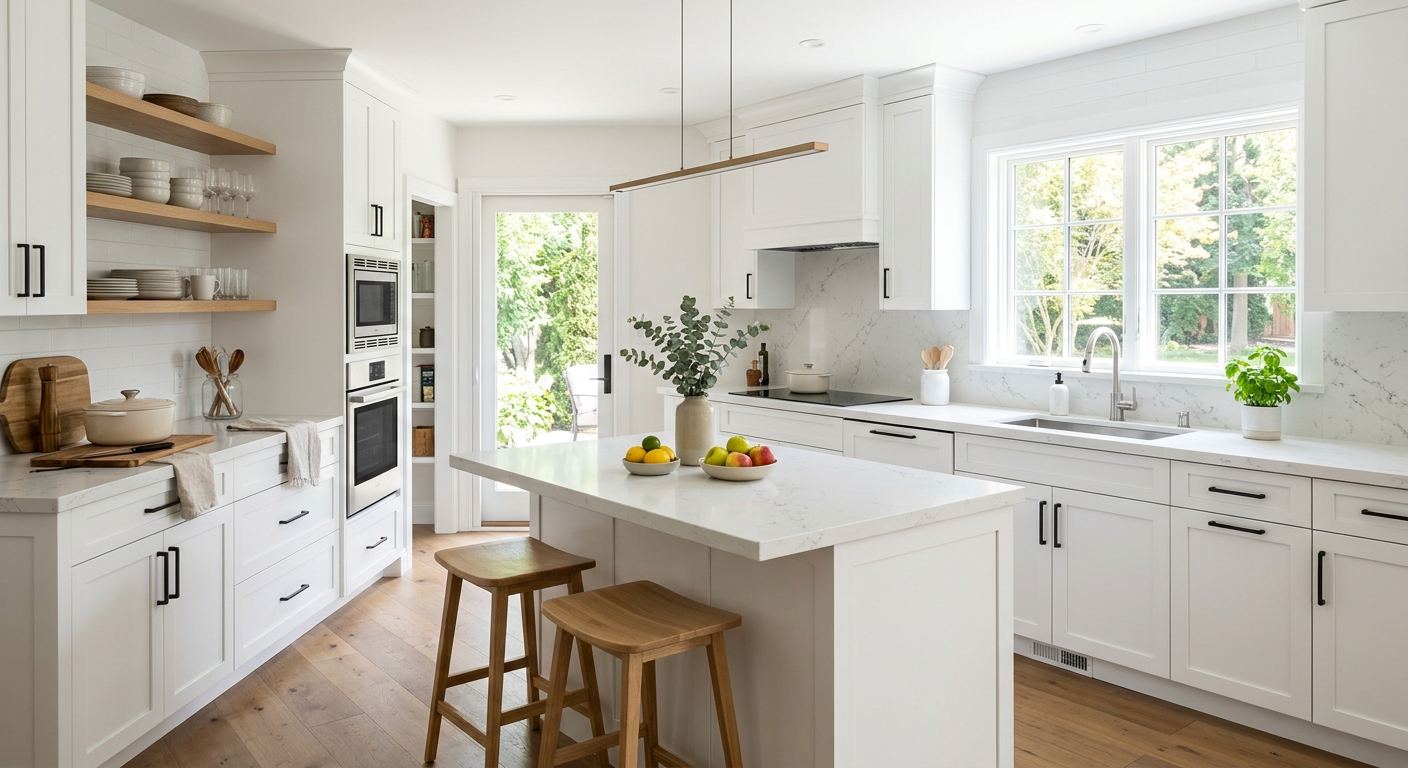
Kitchen renovation options and costs in Fort Nelson
Fort Nelson is where kitchen renovations tend to be practical, not precious—homeowners want strong day-to-day function because the north-facing seasons and temperature swings can be hard on finishes. With a population of 2,611 (Statistics Canada, 2021 Census), the local buyer pool is small, so renovation choices are often guided by resale expectations in the broader Kootenay market rather than by constant contractor availability. In many Kootenay-area homes, owners lean toward “refresh-to-mid-range” upgrades: they’ll keep the footprint, update cabinets and counters, and budget around typical British Columbia mid-range pricing, then decide whether to step up to quartz or natural stone based on how long they plan to stay.
In Fort Nelson, the Kootenay market context matters more for cost tiering than climate mechanics—quotes are usually set by local home values and household income, which influence whether buyers expect laminate/entry quartz or premium, custom millwork. Contractor pricing can also vary simply because more labour-intensive scopes (island builds, drywall/insulation remediation, plumbing or gas moves) are less common and more scheduling-dependent. Trade capacity can be tight during busier seasons, so waiting on cabinet fabrication or specialty stone templates can add time even when installation is fast.
Renovations are especially in demand in the Fort Nelson townsite core, where turnover and resale activity keep kitchen aesthetics and durability at the top of buyer checklists. Use the tiers below as a starting point before you compare itemised quotes.
| Renovation Tier |
What's Included |
Typical Duration |
Price Range |
| Cosmetic refresh (paint, hardware, new appliances only) |
Paint, hardware, faucet replacement (if no plumbing move), appliance swap |
3–7 days |
$8,000–$18,000 |
| Mid-range full renovation (new cabinets, counters, sink, tile) |
New stock or semi-custom cabinets, new countertop, new sink/faucet, backsplash tile, disposal; floor patching |
2–4 weeks |
$30,000–$55,000 |
| High-end full renovation (custom cabinets, stone counters, island) |
Custom cabinets, stone/quartz (premium), island build, feature backsplash, expanded electrical (under-cabinet lighting) |
4–8 weeks |
$55,000–$75,000 |
| Cabinet refacing only (new doors + drawer fronts, same boxes) |
Refacing of existing cabinet boxes, new doors/drawer fronts, hardware, optional new crown/trim |
1–2 weeks |
$12,000–$25,000 |
| Countertop swap only (laminate to quartz or stone) |
Remove old counters, install new countertop, new sink cut-out as needed, basic caulking/seal |
2–5 days |
$7,000–$18,000 |
| Backsplash tile installation only |
Tile layout, set and grout, caulking at edges, minor prep for flatness |
2–6 days |
$1,200–$5,000 |
Prices are estimates only and vary by project scope, site access and material selection.
What affects the price of kitchen renovation in Fort Nelson
In Fort Nelson and across the Kootenay economic region, it’s common to see quotes for the “same” kitchen land 30–50% apart. The biggest driver isn’t climate—it’s what buyers pay for finish expectations and how contractors value risk and scheduling when certain scopes are harder to source or coordinate. Local home values and household income tend to push owners toward laminate and stock cabinets in more modest segments, while higher-value communities justify quartz or stone counters and semi-custom/custom cabinetry because the upgrade costs are easier to recoup on resale. That’s why a mid-range refresh-to-mid-range plan in Fort Nelson might land in the $30,000 to $55,000 band, while a custom, layout-changing job can move quickly into the $55,000 to $75,000 territory.
Even when materials are similar, layout changes add the most unpredictable cost regardless of finish tier. Removing a wall, adding an island, or moving a gas line (or rerouting supply/drain plumbing) forces more carpentry, electrical/plumbing coordination, and inspection-ready rough-in work. In Fort Nelson, a practical example is when older homes have dated subflooring or uneven walls—countertop installation may need extra prep and reinforcement, and tile backsplashes may require additional furring or patching to keep everything flat.
Another common cost swing is countertop weight and template timing. Upgrading from laminate to quartz or natural stone can be a straightforward install, but if the base cabinets need reinforcement or sink/cooktop cut-outs change, labour rises quickly. Lastly, flooring transitions matter: replacing damaged kitchen flooring after demo can add cost in older housing stock, even if the cabinets and counters stay in the original locations.
| Price Factor |
Why It Matters |
Cost Impact |
| Cabinet tier — stock vs. semi-custom vs. fully custom millwork |
Material quality, door styles, interior organization, and lead times vary a lot |
Often the largest swing; can move total by $8,000–$25,000+ |
| Countertop material — laminate vs. quartz vs. granite vs. stone |
Pricing per square foot, thickness/edge profiles, and installation complexity differ |
Typically $2,500–$12,000 depending on material; premium can exceed |
| Layout change — wall removal, island add, plumbing/gas move |
Triggers structural assessment, rough-in work, and trade coordination |
Can add $5,000–$20,000+ even with mid-grade finishes |
| Appliance package tier — builder vs. mid-range vs. pro-grade |
Electrical/gas needs, venting, and trim kits affect labour and cabinetry fit |
Commonly $1,500–$8,000+ depending on package |
| Flooring — refinish existing vs. full replacement |
Demo reveals subfloor conditions; matching transitions and underlayment add time |
May add $2,000–$10,000 |
| Backsplash — ceramic tile vs. marble vs. full-height slab |
Material weight, complexity of cuts, and grout/finishing requirements vary |
Usually $1,200–$5,000; premium can go higher |
| Electrical — new circuits for island, under-cabinet lighting |
New circuits require licensed work, planning, and wall/ceiling access |
Often $800–$3,500+ for typical upgrades |
| Permit fees and licensed trade requirements |
Certain scopes add permit steps and inspection scheduling |
Can add a few hundred to several thousand depending on extent |
Permits & regulations in British Columbia
In British Columbia, the work you can do “permit-free” versus “permit-required” is mainly about whether you’re changing building services (plumbing, gas, electrical) or structure. For most homeowners in Fort Nelson, a cabinet swap and countertop replacement generally do not require a permit—same footprint, same connections, and no changes to plumbing/gas/electrical routing are typically treated as finishing work.
However, you do need permits and licensed trades when you: move plumbing supply or drain lines (sink location changes), relocate a gas appliance connection (stove/range location changes), add or relocate electrical circuits (for island outlets or under-cabinet lighting tied into a new circuit), or remove a load-bearing wall / make structural alterations. Gas work must be performed by a licensed gas fitter, and electrical work by a licensed electrician; both typically require inspections before the next phases can proceed.
How to verify before you sign:
- Ask the contractor for licence details for any gas/electrical scope and confirm the trade licence status on the appropriate online registry.
- Request a certificate of insurance (liability) showing the coverage is active for the project period.
- Ask for confirmation of coverage for workers—ensure they have the correct provincial workers’ compensation coverage (WCB) or equivalent compliance documentation.
- Get the permit responsibility clearly stated in the written contract: who pulls permits, who pays fees, and when inspections occur.
Finally, always request a copy of any clearance/close-out documentation your contractor can provide after inspections are complete.
Cabinets, countertops and layout decisions in Fort Nelson
The three most consequential decisions in a Fort Nelson kitchen renovation are: (1) cabinet tier, (2) countertop material, and (3) whether you change the layout. In the Kootenay resale environment, the look you choose is usually what buyers notice first. Stock cabinets are the fastest path to a clean update, while semi-custom is the most common mid-range sweet spot—better storage, better door/drawer options, and a more “finished” feel without jumping to custom pricing. Custom cabinets are best when you need exact fit for awkward corners, custom appliance garages, or a higher-end island design that needs more millwork attention.
Countertops should be picked with real Fort Nelson wear in mind. Laminate can be cost-effective but is less forgiving if homeowners cut directly on surfaces. Quartz offers a strong balance: it’s stain-resistant and typically easier to maintain than stone. Natural stone (granite/other stone) looks premium and can handle daily use well, but it may require periodic sealing depending on the product and it’s heavier, which can matter for cabinet structure and the base’s levelness in older homes.
Layout changes can justify their cost when they create usable space—an island that improves circulation, or moving the cooktop/sink to support how you actually cook. For example, if you stay within the footprint and upgrade cabinets + counters in a mid-range plan, you might keep the total in the $30,000–$55,000 band. But if you add an island and move plumbing/gas, costs can climb quickly toward the $55,000–$75,000 range because labour, rough-ins, and coordination rise faster than most homeowners expect.
Climate can contribute indirectly: in homes with older ventilation and seasonal humidity swings, careful cabinet installation and sealed edges help protect baseboards and under-counter areas. The market value piece is still the main reason people spend more—buyers tend to pay for modern layouts and durable, updated surfaces.
| Option |
Durability |
Maintenance |
Best For |
Price Range |
| Stock cabinets (big-box) |
Solid for day-to-day use; depends on box quality and installation |
Routine cleaning; limited custom adjustments |
Fast refresh, tight timelines, budget-first renovations |
$12,000–$22,000 |
| Semi-custom cabinets (local dealer) |
Better interior options; improved hardware and fit flexibility |
Easy care; adjustments for common Fort Nelson floor/wall irregularities |
Most mid-range renovations targeting durable storage and resale appeal |
$20,000–$35,000 |
| Custom cabinets (local millwork shop) |
Highest build quality; made for your exact dimensions and layout |
Good long-term care; premium finishes and hardware |
Complex layouts, islands, or “fit-and-finish” upgrades |
$30,000–$55,000 |
| Laminate countertop |
Good for normal use; seams and edges are the weak point |
Wipe clean; avoid standing water at seams |
Best value when you want the look upgrade without stone cost |
$2,500–$6,500 |
| Quartz engineered countertop |
Very durable; resists staining and everyday wear |
Low maintenance; non-porous with proper sealing not usually required |
Mid-range to high-end projects aiming for long service life |
$6,500–$12,000 |
| Granite / natural stone countertop |
Strong, heat-resistant; durability depends on the specific stone and finish |
May require sealing; clean with stone-safe products |
Premium look with natural variation |
$7,500–$14,500 |
| Butcher block countertop |
Durable if maintained; can dent if abused |
Regular oiling/sanding as needed |
Family-friendly kitchens where owners want warmth and periodic upkeep |
$5,000–$10,000 |
| Marble countertop |
Premium look; more susceptible to etching/staining than quartz |
Requires careful cleaning and sealing routines |
High-end aesthetics where the household accepts extra maintenance |
$10,000–$20,000 |
How to choose a kitchen renovation contractor in Fort Nelson
Choosing the right contractor in Fort Nelson is less about the brochure photos and more about verification and clarity. Start by confirming British Columbia licensing for any regulated scope: gas work must be done by a licensed gas fitter and electrical by a licensed electrician. For the contractor itself, ask for proof of liability insurance and, if applicable to their structure, workers’ compensation coverage documentation (WCB/clearance letter equivalents). You can check online licence status where the province posts trade registries, then validate that the certificate of insurance matches the project address and coverage dates.
Next, get 2–3 itemised written quotes. You want line items that separate labour and materials (cabinet supply, countertop fabrication/installation, plumbing or electrical rough-in, tile setting, demolition, disposal). Avoid lump-sum quotes unless they include detailed scope notes. Read the scope carefully: what’s excluded (old cabinet haul-away, subfloor repairs, permit pull), and who is responsible for permits if you’re moving gas/plumbing or adding circuits. Also ask about warranty terms: workmanship warranty length, product manufacturer warranty coverage, and whether the warranty is transferable to future owners.
For payment schedules, a safe approach is to keep initial deposits low—typically no more than 10–15% upfront—and use progress payments tied to milestones. Hold back a portion until the job is complete, cleaned, and any punch-list items are resolved. Finally, request a written start date and a realistic completion estimate that includes expected cabinet/stone lead times.
- Confirm licence status for all regulated trades involved (gas/electrical).
- Verify liability insurance certificate is active and names the right parties.
- Request WCB/clearance documentation for worker coverage.
- Insist on itemised quotes with labour vs materials separated.
- Check what’s included for demolition, haul-away, and disposal.
- Confirm permit pull responsibility in writing if layout changes trigger permits.
- Ask who handles inspection scheduling and re-visits if corrections are needed.
- Make sure countertop fabrication template timing is spelled out.
- Clarify flooring patching/level-up scope after cabinet installation.
- Review warranty: workmanship duration and manufacturer warranty terms.
- Set a payment schedule with a holdback until punch-list completion.
- Require a written start/completion timeline that reflects lead times.
Red flags I see too often in Fort Nelson: contractors who won’t provide licence/insurance paperwork in advance, quotes that omit disposal or subfloor/cut-out prep, “allowances” so vague they can change after ordering, no written warranty terms, and schedules that ignore cabinet or countertop lead times—then blame you when timelines slip.
Frequently asked questions — kitchen renovation in Fort Nelson
Can I move my kitchen sink or stove?
Yes, you can move a sink or stove in Fort Nelson, but it changes the scope more than most people expect. Moving a sink usually means relocating plumbing supply and drain lines, which is a permit-triggering change in British Columbia and must be planned with licensed trades. Moving a stove depends on whether it’s gas or electric: relocating a gas connection requires a licensed gas fitter and inspection steps. Even when the footprint “feels” similar, the wall/floor access for rough-in work can reveal hidden subfloor or framing issues in older housing stock, adding labour.
What's the most cost-effective kitchen upgrade?
The most cost-effective upgrade is usually a cabinet-and-hardware refresh combined with a targeted surface update—like new cabinet doors/drawer fronts (refacing) or a countertop swap—while keeping the plumbing and layout in place. If your existing cabinets are structurally sound, cabinet refacing can keep you in a range of about $12,000 to $25,000, then you can choose a countertop upgrade separately. For many Fort Nelson homeowners, that approach preserves the layout, reduces risk, and still gives a modern look. If you also need backsplash work, backsplash tile installation is often a smaller add-on, commonly around $1,200 to $5,000.
Custom vs stock cabinets — is custom worth it?
Custom cabinets are worth it when your kitchen layout has limitations that off-the-shelf units can’t solve, or when you want a high-end island and tailored storage (pantries, appliance garages, or unusual corner geometry). If you’re doing a mid-range full renovation and want the best value, semi-custom often gives you 80% of the “fit and finish” look without jumping straight to premium pricing. As a reference point, a mid-range full renovation often lands roughly in the $30,000 to $55,000 band, while high-end projects can rise into the $55,000 to $75,000 range when custom millwork and premium stone are included. If you’re staying for resale, buyers tend to reward clean lines, durable counters, and smooth storage—custom can help, but it’s not automatically the best ROI.
How do I choose a kitchen contractor in Fort Nelson?
Choose a contractor based on proof and process: verify British Columbia licence details for any gas or electrical scope, review their liability insurance certificate, and confirm workers’ compensation coverage documentation (WCB/clearance). Then require 2–3 itemised written quotes that break down labour and materials—don’t accept a vague lump sum that hides allowances. In Fort Nelson specifically, ask how they manage lead times for cabinets and stone, because scheduling can affect your completion date even if installation goes quickly. Also confirm in writing who pulls permits when your kitchen changes trigger them, what disposal is included, and what warranty you get for workmanship versus product.
What order do kitchen renovation steps happen in?
A typical order in Fort Nelson is: site measure and design finalize, demo and rough-in prep, then any required plumbing/electrical/gas rough work (when layout changes trigger permits). Next comes cabinet installation and wall prep for backsplashes, followed by countertop templating and fabrication. Once counters are installed, the remaining work usually focuses on backsplash tiling, finishing trim, appliance install, and final caulking/cleanup. Flooring patching/underlayment is often coordinated during cabinet set and before tile where possible. Your exact sequence should be written in the contract so you can align cabinet and countertop lead times with the rest of the trades.
Can I live at home during a kitchen renovation in Fort Nelson?
Often you can live at home during parts of a kitchen renovation in Fort Nelson, but it depends on the scope and how disruptive the work is. A cosmetic refresh or refacing project is usually easier to manage because plumbing/gas may not be touched and the kitchen remains more usable. For a mid-range full renovation, you may need a temporary setup for cooking and dishes while demolition and countertop install happen, and some homeowners choose to move to a basement kitchenette or use a barbeque for a short period. If you’re doing a full renovation with layout changes, plan for more downtime because rough-in work and inspections can extend disruption. In every case, discuss dust control, access, and whether you’ll have a safe food-prep area before the schedule begins.