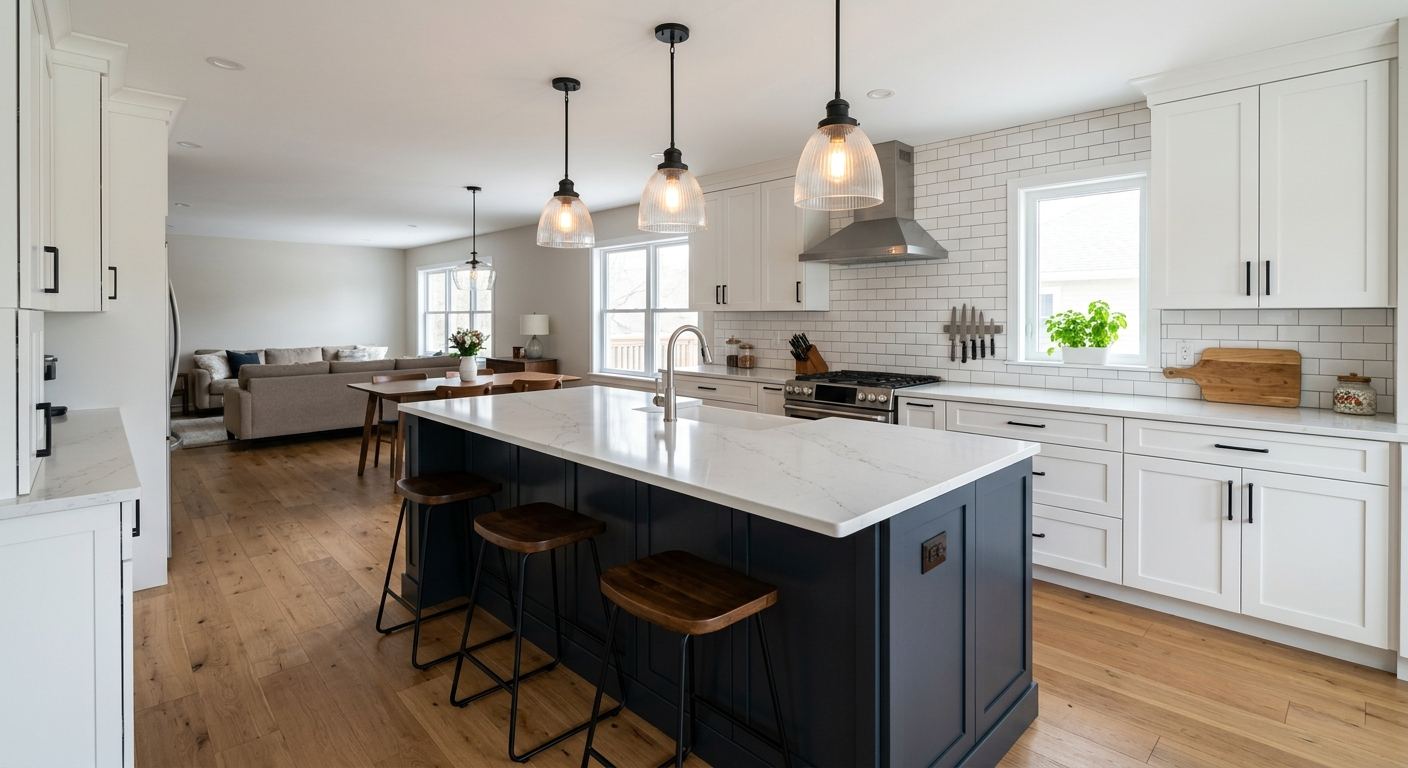
Kitchen renovation options and costs in Blind Bay
Blind Bay homeowners typically have three realistic paths for a kitchen renovation: a cosmetic refresh, a mid-range full rebuild, or a higher-end upgrade with more customized millwork and premium surfaces. In the Lower Mainland–Southwest, the size of your project matters, but so does the finish level buyers will expect—particularly when your home competes in a higher-value resale pool. With a small local population of 2,369 people (Statistics Canada, 2021 Census), there are fewer contractors to choose from nearby, so scheduling and material lead times can affect your total budget even when the scope looks the same on paper. At the same time, Lower Mainland–Southwest pricing is driven more by home value, income, and design decisions than by climate.
British Columbia’s coastal winters bring frequent dampness and indoor humidity swings, which is why cabinet installation quality (shimming, sealing, and ventilation around moisture-prone areas) becomes more important than homeowners expect. On the Lower Mainland–Southwest side, kitchen renovation demand is especially strong in the North Shuswap / Salmon Arm corridor, where trades often serve multiple communities; for Blind Bay, that can mean faster turnarounds when contractors have open slots, and longer lead times when they’re fully booked.
To compare options before you call for quotes, use the price bands below as a starting point for Blind Bay. Then we’ll break down what pushes bids up or down by 30–50% across the region.
| Renovation Tier |
What's Included |
Typical Duration |
Price Range |
| Cosmetic refresh (paint, hardware, new appliances only) |
Cabinet paint or refinishing (if applicable), new hardware, lighting tweaks (like swap-in fixtures), new appliances only, minor caulking/touch-ups |
3–7 days |
$8,000–$25,000 |
| Mid-range full renovation (new cabinets, counters, sink, tile) |
New semi-custom or quality stock cabinets, countertop replacement, sink + faucet, backsplash tile, new under-cabinet task lighting where feasible, removal/disposal, basic plumbing adjustments |
3–6 weeks |
$40,000–$85,000 |
| High-end full renovation (custom cabinets, stone counters, island) |
Custom cabinetry, quartz/stone counters, island with upgraded lighting, higher-end hardware, more extensive backsplash (often to full height in areas), flooring replacement/upgrade, electrical upgrades, more complex layout and trim details |
6–12 weeks |
$85,000–$120,000 |
| Cabinet refacing only (new doors + drawer fronts, same boxes) |
Refacing materials, new doors/drawer fronts, hardware, new soffit/trim where needed, optional paint/repair of visible cabinet surfaces, removal/disposal |
2–4 weeks |
$8,000–$35,000 |
| Countertop swap only (laminate to quartz or stone) |
Template + install of new countertops, sink cut-in (where needed), minor plumbing reconnection, basic backsplash prep |
1–3 weeks |
$3,000–$12,000 |
| Backsplash tile installation only |
Tile supply + install, backer work/leveling as needed, waterproofing at wet areas, removal of existing backsplash if required |
5–10 days |
$1,500–$6,000 |
Prices are estimates only and vary by project scope, site access and material selection.
What affects the price of kitchen renovation in Blind Bay
In Blind Bay and across the Lower Mainland–Southwest, two homes with the same kitchen size can receive quotes that differ by 30–50%. That happens because kitchen pricing is usually anchored to expected finish level and resale outcomes—more than it is to weather. In higher-value Lower Mainland–Southwest areas, homeowners more often choose quartz or stone counters and semi-custom cabinetry (and sometimes custom), because the renovation cost can be easier to recover at resale. In more modest-value contexts, laminate and stock cabinet systems tend to dominate since they provide the best ROI per dollar. Across British Columbia overall, the same contractor labour can also swing based on demand, scheduling, and how many trades you need on the same timeline.
Climate does still matter, but mainly in how it affects build quality rather than the big-ticket pricing itself. For example, coastal humidity and seasonal dampness can expose poorly sealed cabinet bases and cause tile failure if waterproofing and substrate prep are skipped—fixing those issues costs real money. Also, older housing in many parts of the region may have dated electrical panels or undersized circuits for modern under-cabinet lighting and appliance loads, and upgrading electrical can quickly add to your budget.
Concrete examples from recent projects: first, an island added to an existing footprint often stays in the “mid-range full renovation” band ($40,000–$85,000) only if plumbing and electrical can tie into nearby lines without heavy rerouting. Second, if you’re moving a gas line or relocating a major plumbing stack, your project can jump closer to the $85,000–$120,000 “high-end full renovation” band even when cabinetry choices are not premium—because labour trades, permit steps, and wall reconstruction drive the unpredictability.
Next, let’s map the specific price factors contractors use when they build your estimate line-by-line.
| Price Factor |
Why It Matters |
Cost Impact |
| Cabinet tier — stock vs. semi-custom vs. fully custom millwork |
Higher tiers change the number of custom sizes, material quality, and installation complexity |
Can swing most projects by $15,000–$45,000 depending on scope |
| Countertop material — laminate vs. quartz vs. granite vs. stone |
Material cost plus cut complexity, seam planning, and weight handling affect labour and risk |
Often adds $2,500–$10,000+ when moving to quartz/stone |
| Layout change — wall removal, island add, plumbing/gas move |
Structural work and re-routing lines introduce inspections, demolition, framing, and patching |
Typical increase is $8,000–$35,000 for major relocations |
| Appliance package tier — builder vs. mid-range vs. pro-grade |
Premium units can require different clearances, power needs, and ventilation planning |
Can shift $1,500–$12,000+ based on appliance selection |
| Flooring — refinish existing vs. full replacement |
Replacing floors under cabinets is costlier but often necessary for a clean, waterproof finish |
Typically $2,000–$10,000 depending on finish level |
| Backsplash — ceramic tile vs. marble vs. full-height slab |
Natural stone and larger panels add weight, cutting precision, and labour intensity |
Can change by $1,000–$4,000 for upsized results |
| Electrical — new circuits for island, under-cabinet lighting |
Extra circuits, rewiring, and fixture installs add licensed trade labour and inspection steps |
Commonly $1,500–$8,000 depending on complexity |
| Permit fees and licensed trade requirements |
Permits and inspections add admin time and can require specific contractor involvement |
Often adds $500–$3,500, plus scheduling impact |
Permits & regulations in British Columbia
In British Columbia, not every kitchen change needs a permit, but the work that touches plumbing, gas, structure, or electrical usually does. A cabinet or countertop swap typically does not require a permit on its own—if you’re simply replacing surfaces where the existing footprint, plumbing connections, and electrical locations remain unchanged. Similarly, switching finishes like paint, hardware, or adding a standard backsplash is usually permit-free as long as you’re not altering electrical wiring or making structural changes.
By contrast, you should expect permits and licensed trades when you move or add: plumbing supply or drain lines (including changing sink locations), relocate a gas line or make changes involving a gas stove/range hood connected to gas, remove a load-bearing wall or do structural work, or add new electrical circuits (for example, island receptacles, under-cabinet lighting runs, or upgrading panel capacity). Gas work must be performed by a licensed gas fitter, and electrical work by a licensed electrician—both require inspections per provincial expectations.
To verify a contractor in Blind Bay before you sign: first, request their liability insurance certificate and confirm the coverage limits match a renovation of this scope. Next, ask how they handle WSBC/WCB coverage (or their workers’ coverage proof, where applicable) and confirm it matches the trades they use. Then, for licences: check the relevant provincial licence/registry information online, and ask for the certificate details for the specific trade contractor who will do gas or electrical. Always make permit responsibility explicit in your written contract.
Cabinets, countertops and layout decisions in Blind Bay
When planning a kitchen renovation in Blind Bay, I usually tell homeowners to focus on the three decisions that most affect cost and satisfaction: (1) cabinet tier, (2) countertop material, and (3) whether you’ll change the layout. These choices matter in the Lower Mainland–Southwest because buyers often look for clean lines, durable surfaces, and a layout that “uses” space efficiently—especially in resale showings. The coastal climate in British Columbia also rewards good sealing and ventilation, so materials and installation details should suit dampness-prone areas like sink zones and backsplash edges.
Cabinet tier: Stock cabinets are the fastest and cheapest, but you may pay later if you need fillers or compromises. Semi-custom cabinets are the most popular mid-range option because they balance fit and lead times. Custom cabinets offer the best fit, but they’re the most expensive because every box size and detail is planned to your space.
Countertops: Laminate is budget-friendly but is less forgiving if you have heavy daily wear; quartz engineered stone is a common “sweet spot” for durability and low maintenance. Natural stone (granite/stone) is durable too, but cutting/seam placement and installation can raise costs.
Layout changes: Open-concept wall removal and island additions can be worth it when they create real circulation improvements and add seating—yet moving plumbing or gas is where budgets get unpredictable. For example, if you can add an island without moving the main plumbing stack, you may keep the project closer to the $40,000–$85,000 mid-range band. But if moving lines is required, the same island may push you toward the $85,000–$120,000 high-end band even with standard cabinet selections.
Next, use the table to compare options in a practical, homeowner-first way.
| Option |
Durability |
Maintenance |
Best For |
Price Range |
| Stock cabinets (big-box) |
Good for daily use; limited custom fit |
Wipe clean; touch up painted surfaces carefully |
Budget-first refreshes where the layout stays unchanged |
$8,000–$25,000 |
| Semi-custom cabinets (local dealer) |
Very durable; better sizing and door/drawer hardware options |
Routine cleaning; keep sink/backsplash areas sealed |
Most Blind Bay renovations that want a clean, “finished” look |
$20,000–$55,000 |
| Custom cabinets (local millwork shop) |
Excellent fit and build quality; best for awkward layouts |
Durable surfaces; requires proper installation to prevent humidity issues |
High-end remodels and homeowners prioritizing precision storage |
$45,000–$85,000+ |
| Laminate countertop |
Decent scratch resistance; seams can be a weak point |
Quick wipe-down; avoid soaking at seams |
Keeping costs down while upgrading cabinets and appliances |
$3,000–$6,000 |
| Quartz engineered countertop |
High stain resistance and consistent performance |
Easy care; wipe with mild soap; no sealing required |
Most mid-range and high-end projects in British Columbia |
$6,000–$10,000 |
| Granite / natural stone countertop |
Very durable; varies by slab and finish |
Some stones benefit from periodic sealing |
Premium look when you want natural variation |
$8,000–$12,000 |
| Butcher block countertop |
Strong for chopping; needs protection from standing water |
Oil/condition regularly; dry after use |
Warm, rustic kitchens and families who want a working surface |
$4,500–$9,000 |
| Marble countertop |
Beautiful but more sensitive to etching and staining |
Extra care; sealing and prompt cleaning recommended |
Design-led kitchens where maintenance fits your lifestyle |
$9,000–$14,000+ |
How to choose a kitchen renovation contractor in Blind Bay
Choosing the right contractor is less about promises and more about proof. In British Columbia, confirm licence and insurance before work starts. For liability insurance: request a certificate of insurance showing coverage appropriate to your project, and ensure the contractor’s name matches the policy. For coverage of workers, ask for WSBC/WCB proof (or the relevant clearance documentation for the trades involved) so you’re not left holding risk if a worker is injured. Then verify licences for the specific trades that will do gas and electrical work—gas must be done by a licensed gas fitter and electrical by a licensed electrician. Ask for the licence details and the trade’s confirmation documents, not just “we use licensed people.”
Next, get 2–3 itemised written quotes. You want labour and materials separated (cabinet install, demolition, countertop templating, tile setting, disposal, electrical/plumbing allowances), not a single lump sum. Read the scope carefully: what’s excluded (haul-away, drywall patching, permit fees, product pick-up), who pulls permits, and what’s included for disposal. Warranty matters too—ask for the workmanship warranty length and whether product/manufacturer warranties apply to you directly. Also, confirm if warranties are transferable to the next owner if you sell.
For payment schedule, be cautious: never pay more than 10–15% upfront. Hold back a portion until the job is complete and you’ve confirmed punch-list items. Finally, insist on a start date and a completion estimate in writing, including lead times for cabinets and stone.
- Verify BC trade licences for anyone doing gas and electrical; request licence numbers and proof in writing.
- Confirm liability insurance certificate and matching company name before signing.
- Request WSBC/WCB coverage proof/clearance for the contractor and relevant subcontractors.
- Ask for 2–3 itemised quotes (labour vs materials) instead of one lump-sum number.
- Check what’s included for demolition, drywall patching, and finish carpentry at cabinet edges.
- Clarify who handles permits and inspections, and whether permit fees are included.
- Confirm disposal/haul-away is included (especially for cabinets, tile, and packaging).
- Get cabinet and countertop lead times in writing, including templating dates for stone.
- Review the warranty: workmanship duration, product warranties, and transferability.
- Use a payment schedule with limited upfront payment and a holdback until completion.
- Ask how they protect flooring and prevent dust spread during demolition.
- Confirm the timeline includes inspection dates where plumbing/electrical/gas changes apply.
Red flags we see in Blind Bay: contractors who won’t provide insurance/licence proof, quotes that omit permit/disposal details, “too-good-to-be-true” pricing without an itemised scope, forcing large upfront deposits, and timelines that ignore cabinet/stone lead times.
Frequently asked questions — kitchen renovation in Blind Bay
What's the most cost-effective kitchen upgrade?
The most cost-effective upgrade in Blind Bay is usually a change that looks “complete” without moving plumbing or gas. A cosmetic refresh with new hardware and appliances can be the lowest-cost path, especially if your cabinet boxes are still solid. If your layout is fine, pairing a mid-cost aesthetic update (paint/refinish, hardware, and lighting) with a targeted countertop swap can deliver the biggest visual impact per dollar. If you’re planning for a slightly bigger improvement, a backsplash tile installation can also elevate the whole kitchen and typically fits well within $1,500–$6,000 depending on tile type and height. The main value-driver is avoiding costly layout changes; moving sink locations or rerouting lines is where budgets climb quickly in British Columbia.
Custom vs stock cabinets — is custom worth it?
Custom cabinets are worth it when your kitchen has awkward dimensions, strong design goals (like integrated panels, specialty storage, or unique finishes), or when resale appeal in your price tier depends on a very tailored look. If you can work within standard sizing, stock cabinets can be a smart ROI play because they’re faster and cheaper, and they reduce the risk of delays. In Blind Bay and the Lower Mainland–Southwest, many homeowners land on semi-custom as the practical middle: better fit than stock, usually more affordable than fully custom millwork. A simple way to think about it: if upgrading to custom pushes your total renovation toward the $85,000–$120,000 high-end band, make sure the layout and countertop also align—otherwise you may be paying for fit you won’t notice at resale.
How do I choose a kitchen contractor in Blind Bay?
Start by confirming British Columbia requirements are met and that you’re protected. Ask for their liability insurance certificate, and request WSBC/WCB coverage proof (or equivalent clearance documentation) for the contractor and the trades they use. For gas and electrical, verify licences and ask for the trade’s licence details in writing—gas must be done by a licensed gas fitter and electrical by a licensed electrician. Then get 2–3 itemised quotes: labour and materials breakdown, plus allowances for permits, disposal/haul-away, and any patching and repairs. Be wary if a quote is vague on exclusions (for example, what happens to old cabinets, who pulls permits, or whether cabinet installation includes shimming and leveling). A good contractor in Blind Bay will also provide a clear start date, completion estimate, and lead-time plan for cabinets and stone.
What order do kitchen renovation steps happen in?
Most kitchen renovations in British Columbia follow a logical sequence: first, planning and measurements (and permits if required), then demolition and rough-in checks. If you’re moving plumbing/gas/electrical, those trades typically come early after demolition and before surfaces are closed—so wall openings are accessible. Next, cabinets are installed after walls/floors are prepped and level. Countertops require templating (especially for quartz/stone) and are usually installed after cabinet installation, once the base is properly secured. Tile backsplash typically follows countertops so the finishes line up cleanly. Final steps include painting touch-ups, re-installing appliances, caulking/grouting clean-up, and a detailed punch list. This order helps prevent rework, which matters in Blind Bay because humidity can affect how surfaces set and cure.
Can I live at home during a kitchen renovation in Blind Bay?
Often yes, but it depends on how disruptive your scope is. In Blind Bay, a cosmetic refresh or a countertop swap only can usually be handled while you stay home with minimal disruption—shops and trades set up temporarily and work in stages. A mid-range full renovation (new cabinets, counters, sink, and tile) may require you to be flexible: you might need to use a secondary cooking area for a few weeks while demolition and installation occur. If you’re doing a high-end remodel with layout changes, structural work, or significant electrical/plumbing/gas modifications, expect more disruption and plan for some evenings or temporary kitchen alternatives. The key is agreeing upfront on dust control, access routes, waste disposal, and how power/water access will be managed daily.
Should I renovate my kitchen before selling in Blind Bay?
In many Lower Mainland–Southwest markets, a kitchen refresh helps because it signals maintenance and modern finishes—especially if your cabinets and surfaces look tired. For Blind Bay, the decision should match your target buyer and the condition of the home. If your layout is functional, consider upgrades that improve “day one” impressions: new hardware, paint, updated lighting, a refreshed backsplash, or a countertop upgrade. If your cabinets are outdated but structurally sound, refacing can be a lower-cost way to avoid a full rebuild. If major items like cabinets, counters, or damaged flooring are already beyond repair, a full renovation in the mid-range band ($40,000–$85,000) can be justified—provided the scope doesn’t overspend beyond what the local buyer will pay for. Always align decisions with permits and licensed trade work so the renovation is safe and sale-ready.