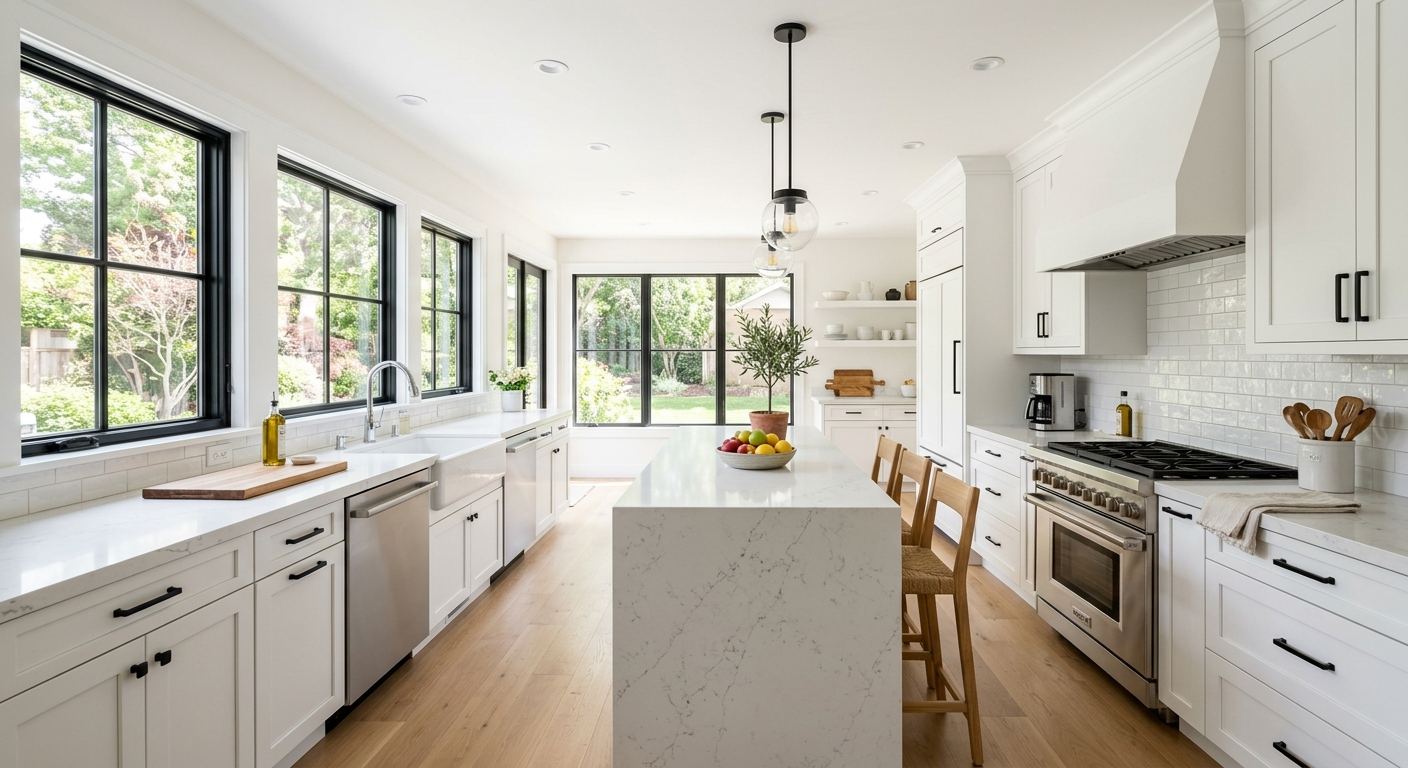
Kitchen renovation options and costs in Ellison
Kitchen renovations in Ellison, British Columbia typically fall into a few clear tiers, and the “best value” choice depends on how far you plan to go from day one. Ellison’s population was 3,094 in 2021 (Statistics Canada, 2021 Census), which means the local work is often scheduled around contractors’ broader Lower Mainland–Southwest routes rather than fast, on-demand availability. In practice, pricing here is driven more by the expected finish level and buyer preferences in the Lower Mainland–Southwest than by climate alone. And because regional households vary in purchasing power—median household income influences what homeowners expect to be installed—projects skew higher when the home value supports a more premium kitchen plan (Statistics Canada, 2021 Census).
In the Lower Mainland–Southwest, contractors and material suppliers can move quickly when the scope is predictable: cosmetic refreshes and straightforward cabinet/counter swaps. Costs can rise faster when jobs involve layout changes (moving a wall, adding an island), or when homeowners choose stone counters and semi-custom cabinetry packages that require more precise measuring and longer lead times. Moisture and temperature swings are still relevant in BC, but Ellison’s renovation costs are usually shaped by market demand: stone and quartz are common because they’re low-maintenance for daily use and hold up well against the wet-season wear patterns seen across the Lower Mainland.
If you’re targeting a practical upgrade that fits the neighbourhood rhythm, you’ll often see demand coming from the broader Ellison/Oakridge corridor where homeowners plan kitchens around resale and family use. From there, it’s easiest to compare realistic budget ranges by renovation tier—see the table below.
| Renovation Tier |
What's Included |
Typical Duration |
Price Range |
| Cosmetic refresh (paint, hardware, new appliances only) |
Cabinet paint or repaint (if walls/cabinet boxes are retained), new hardware, appliance swap (no plumbing/gas relocation), minor patching, basic cleanup |
3–7 days |
$8,000–$25,000 |
| Mid-range full renovation (new cabinets, counters, sink, tile) |
New semi-custom or quality stock cabinets, countertop (quartz or higher-end laminate), new sink/faucet (no major plumbing relocation), backsplash tile, new flooring/trim as needed |
3–6 weeks |
$40,000–$85,000 |
| High-end full renovation (custom cabinets, stone counters, island) |
Fully custom cabinetry/made-to-fit millwork, stone counters (granite/engineered stone or premium natural stone), island build, upgraded hardware, upgraded backsplash (including larger-format tile or slab accents), possible lighting upgrade |
6–10 weeks |
$85,000–$120,000 |
| Cabinet refacing only (new doors + drawer fronts, same boxes) |
Door/drawer-front replacement, veneer/reface of existing boxes where condition allows, new hardware, light prep and sanding, typically no countertop replacement |
1–3 weeks |
$8,000–$35,000 |
| Countertop swap only (laminate to quartz or stone) |
Remove existing counters, install quartz/stone, new edge profile, reconnect sink (no drain move), typically simple backsplash touch-ups |
3–7 days |
$3,000–$12,000 |
| Backsplash tile installation only |
Demo of existing backsplash (if needed), substrate prep, tile install, grouting/sealing where required, caulking at edges |
3–6 days |
$1,500–$6,000 |
Prices are estimates only and vary by project scope, site access and material selection.
What affects the price of kitchen renovation in Ellison
The same kitchen renovation can land 30–50% apart across the Lower Mainland–Southwest and other parts of British Columbia because quotes often react to finish expectations and the complexity of the work—not simply the calendar or the weather. In the Lower Mainland–Southwest, homeowners in higher-value pockets more often choose quartz or stone counters and semi-custom cabinetry because the upgrade is easier to recover on resale. In more modest areas, laminate counters and stock cabinet lines keep ROI realistic, with savings concentrated in material and labour time. Climate plays a smaller role in the pricing equation than market demand, but it still affects execution details (humidity control during finishing, protecting finishes from damp site conditions, and ensuring proper ventilation for long-term performance).
Where the variance shows up most in Ellison is layout and trades coordination. Moving a wall, adding an island, or relocating a gas line creates the largest unpredictability regardless of whether you’re targeting a mid-range renovation around $40,000–$85,000 or pushing toward higher-end totals near $85,000–$120,000.
Two common Ellison cost drivers can move your budget quickly. First, older homes often have electrical that can’t support island lighting/extra outlets without panel work—this can add noticeable labour time and material. Second, many existing cabinets are installed tightly to walls and floors that have minor seasonal movement; that means more shimming, scribing, and careful sealing when new millwork goes in. Even the “simple” counter change can turn into a bigger job if the existing cabinet tops are out of level or if the sink cutout needs adjustment after demo.
Bottom line: in Ellison and the broader Lower Mainland–Southwest, local market expectations steer what finish tier makes sense, while layout and trades scope decide how far your price swings.
| Price Factor |
Why It Matters |
Cost Impact |
| Cabinet tier — stock vs. semi-custom vs. fully custom millwork |
Custom sizing, specialty finishes, and upgraded hardware packages increase shop time and installation precision |
Often the biggest swing: roughly $12,000–$45,000 difference across tiers |
| Countertop material — laminate vs. quartz vs. granite vs. stone |
Material cost plus fabrication/edge profile; heavier natural stones can require extra handling and labour |
Typical delta: $2,000–$8,000+ depending on product and edges |
| Layout change — wall removal, island add, plumbing/gas move |
Trades sequencing, inspections, and possible permit impacts; also increases demo/disposal and patching |
Commonly adds $5,000–$30,000+ even on “same finish” jobs |
| Appliance package tier — builder vs. mid-range vs. pro-grade |
Higher-grade units can require specific cutouts, ventilation planning, and upgraded power |
Roughly $1,500–$10,000+ depending on package and installation complexity |
| Flooring — refinish existing vs. full replacement |
Demo access and subfloor prep; matching transitions and underlayment affect labour |
Typically $1,000–$6,000 for many kitchen-sized scopes |
| Backsplash — ceramic tile vs. marble vs. full-height slab |
Slabs and specialty stone increase handling risk, cutting complexity, and material waste |
Often $500–$4,000+ variance beyond standard tile |
| Electrical — new circuits for island, under-cabinet lighting |
New circuits trigger licensed work and sometimes panel updates; also changes scheduling |
Often $1,500–$8,000 depending on power needs and scope |
| Permit fees and licensed trade requirements |
Permits and inspections are tied to plumbing/gas/electrical/layout changes; affect time and documentation |
Generally $300–$2,500+ in direct fees and administrative time, plus trades coordination |
Permits & regulations in British Columbia
In British Columbia, many “surface level” kitchen changes don’t require permits. Cabinet and countertop swaps typically fall under the category of replacement-in-kind—so removing and installing new cabinets or changing countertops usually does not trigger a permit. However, when you change the systems behind the walls, permits and licensed trades become the governing requirement.
Work that typically DOES require a permit (and must be performed by the correct licensed trade) includes: relocating plumbing supply or drain lines; relocating a gas stove or any gas appliances; adding or changing electrical circuits (for example, adding dedicated circuits for an island, upgrading receptacle locations, or installing under-cabinet lighting that requires new wiring runs); and structural work such as removing a load-bearing wall or altering framing in a way that affects structure.
Work that typically DOES NOT require a permit includes: painting cabinets, swapping hardware, replacing appliances in the same location, installing a backsplash tile, and doing countertop replacement without moving plumbing connections.
For an Ellison homeowner, verify the contractor and the trades step-by-step: (1) ask for licences for each trade involved (gas fitter where gas is present; electrician for electrical); (2) request proof of current liability insurance and the relevant clearance documentation from the insurer; and (3) confirm Workers’ compensation coverage (WCB/clearance) so labour is protected if there’s an incident on site. Put the details in writing—who pulls permits, who schedules inspections, and what each trade is responsible for—before signing the contract.
Cabinets, countertops and layout decisions in Ellison
In Ellison, the three most consequential kitchen renovation decisions are: (1) cabinet tier (stock, semi-custom, or custom), (2) countertop material (laminate, quartz, granite, butcher block, marble), and (3) layout changes (open-concept wall removal, island addition, or plumbing/gas relocation). In the Lower Mainland–Southwest resale market, buyers tend to expect clean sightlines, practical storage, and durable surfaces—so the “right” choice is partly about how your budget will show up in everyday use and partly about what buyers recognize as quality.
Cabinet tier matters because it affects fit, storage density, door styles, and how seamlessly the installation can follow older wall/floor tolerances common in many BC homes. Semi-custom is often the most popular mid-range route because it gives better drawer heights and options for rollouts without the longest custom lead times of fully custom millwork. Countertops should match how you cook: laminate can be cost-effective, but quartz or natural stone often better match the wear-and-tear expectations that come with daily family cooking.
Layout changes are where costs justify (or don’t). If you’re adding an island because you gain circulation and usable prep space, it’s often worth the trade coordination. But if the “island” mainly creates dead space or forces awkward aisle widths, the added plumbing/electrical complexity won’t improve the kitchen experience enough to balance the spend.
Here’s a concrete example: upgrading from laminate counters (with straightforward install) to quartz can move you into an overall countertop-focused range of $3,000–$12,000, and it often pairs well with a mid-range refresh around $40,000–$85,000 when cabinets and backsplash are already aligned. If you’re only changing counters and you keep plumbing where it is, the price premium tends to stay predictable; if you move sink lines to chase a layout, the same countertop choice can become a much larger project.
Ellison’s wet-season conditions and seasonal humidity swings also favour tight sealing, good ventilation, and surfaces that handle splashes and cleaning routines without staining—another reason quartz and quality sealants show up often in Lower Mainland–Southwest renovations.
| Option |
Durability |
Maintenance |
Best For |
Price Range |
| Stock cabinets (big-box) |
Solid day-to-day durability; best when your space is standard and level |
Low—wipe clean; keep hardware tightened |
Fast turnarounds and tighter budgets |
$10,000–$25,000 |
| Semi-custom cabinets (local dealer) |
Very good; improved fit and better internal storage options |
Low—regular cleaning; minor adjustments over time |
Most homeowners aiming for a balanced mid-range remodel |
$20,000–$45,000 |
| Custom cabinets (local millwork shop) |
Excellent; made-to-fit around irregular walls, ceilings, and floors |
Low, assuming quality hardware and sealing are specified |
Unique layouts, full rebuilds, and premium finish targets |
$40,000–$80,000 |
| Laminate countertop |
Good for typical use; can be more vulnerable at seams/edges if not well installed |
Low—avoid harsh abrasives; wipe up spills promptly |
Value-focused refresh where cabinets and layout stay |
$3,000–$6,500 |
| Quartz engineered countertop |
Very strong and consistent; excellent stain resistance for daily cooking |
Very low—routine cleaning only; no sealing |
Most popular upgrade for a noticeable “premium” look |
$6,000–$12,000 |
| Granite / natural stone countertop |
High durability; heat and scratch resistance vary by stone selection |
Moderate—often benefits from periodic sealing depending on product |
Premium aesthetics and a distinctive look |
$8,000–$18,000 |
| Butcher block countertop |
Good with proper care; surface can mark and requires ongoing maintenance |
Moderate—oil conditioning; protect from standing water |
Homey style and those willing to maintain it |
$4,000–$10,000 |
| Marble countertop |
Beautiful but softer than quartz; can etch with acidic spills |
Higher—requires disciplined sealing and careful cleaning |
Low-spill cooking lifestyles and statement kitchens |
$10,000–$22,000 |
How to choose a kitchen renovation contractor in Ellison
Choosing the right contractor in Ellison, British Columbia starts with verifying credentials and getting quotes you can actually compare. First, confirm British Columbia licensing where applicable: gas work must be done by a licensed gas fitter, and any electrical scope must be completed by a licensed electrician. Ask the contractor to provide proof of liability insurance and a WCB/clearance documentation record so you’re not left exposed if an incident happens on site. To check each item, request documents directly, then verify listings through the relevant provincial licence/verification sources and the insurer certificate. A good contractor won’t hesitate—they’ll treat it as standard onboarding.
Next, request 2–3 itemised written quotes with a labour + materials breakdown instead of one lump sum. Make sure the scope is aligned: is disposal included? Is the permit pulling included when needed? Who is responsible for patching and finishing after trades? Also ask for the timeline: get a written start date and an estimated completion date based on material lead times, not just “as soon as possible.”
Finally, review warranty and payment terms. Look for a workmanship warranty length and whether the product manufacturer warranty transfers if you sell your home. For payment schedule, avoid large upfront deposits; staying around 10–15% maximum upfront and holding a portion until completion is common best practice. If a contractor pressures you to sign quickly or refuses a detailed scope review, that’s a sign to slow down.
- Confirm which trade pulls permits and schedules inspections (in writing).
- Get proof of current liability insurance before work starts.
- Verify WCB/clearance documentation for the contractor and any subtrades.
- Ask for BC licence numbers for gas/electrical trades when those scopes apply.
- Use itemised quotes: cabinets, countertops, tile, labour, disposal, and contingency.
- Ensure exclusions are clear (e.g., drywall repair, painting, flooring transitions).
- Confirm demolition and debris removal are included or quoted separately.
- Ask about backsplash and countertop compatibility with your selected cabinets.
- Confirm product lead times and include them in the schedule.
- Review warranty: workmanship length and manufacturer warranty terms.
- Keep payment milestones small; holdback until punch-list items are complete.
- Get start date, completion estimate, and contact process for change orders.
Common red flags I see in Ellison-area kitchen renovations: contracts that don’t clearly name who is pulling permits; quotes that omit disposal and patch-and-paint responsibilities; vague “allowance” numbers without listing the included grade/finish; and warranties that cover labour only with no details on what happens if a product fails early. If you hear “we’ll figure it out later” about plumbing/gas or electrical scope, stop and clarify before signing.
Frequently asked questions — kitchen renovation in Ellison
How do I budget for a kitchen renovation?
Budgeting in Ellison usually starts with your renovation tier, then you add the “unknowns” you can’t see until demo. A cosmetic refresh can be relatively restrained, but a full rebuild is where costs climb quickly in the Lower Mainland–Southwest due to cabinetry, countertop fabrication, and trade coordination. As a practical anchor, many homeowners target either a mid-range full renovation around $40,000–$85,000 or plan higher-end finishes that can reach $85,000–$120,000 when island work and premium millwork/stone are included. Also budget for lead times: if you choose a custom component, timeline changes can affect site readiness and staging. Finally, confirm whether your quote includes disposal, electrical work (if adding outlets/lighting), and any permit-related administration for system changes.
Can I move my kitchen sink or stove?
Yes, you can move a kitchen sink or stove in British Columbia, but it’s usually the biggest driver of permit needs and labour complexity. Moving a sink typically means rerouting plumbing supply and/or drains, which triggers permitting and licensed plumbing work. Relocating a stove that’s gas-powered involves gas line work, which must be done by a licensed gas fitter and generally requires permits and inspections. If you’re planning to move either fixture, ask your contractor for a clear scope breakdown: demolition, wall patching, permit pull responsibility, and inspection scheduling. In Ellison kitchens, the cost impact is often higher in older homes where shutoff valves, venting, or electrical capacity may need updates. The goal is to move efficiently without compromising access for future repairs.
What's the most cost-effective kitchen upgrade?
The most cost-effective upgrade in Ellison is usually the one that delivers the biggest visual change with minimal system disruption. In many cases, a cabinet refacing—new doors and drawer fronts over existing boxes—can refresh the whole look without the labour intensity of a full cabinet tear-out. Another strong value play is a countertop swap to quartz if your cabinet tops are level and your plumbing connections don’t need to move; quartz installs commonly fall within the $3,000–$12,000 countertop band. If your layout is working well already, backsplash tile installation is also a relatively straightforward upgrade at $1,500–$6,000. The key is to avoid “stacking” multiple major changes (layout + plumbing + new cabinets) if your current structure is solid—you’ll protect your budget and still get a meaningful transformation.
Custom vs stock cabinets — is custom worth it?
Custom cabinets can be worth it in British Columbia when your kitchen has irregular dimensions, ceilings that aren’t level, limited wall space, or a layout that needs made-to-fit solutions. In Ellison, older housing stock and small tolerances can make a perfect fit harder with stock. Custom millwork is also a good fit for homeowners who want specific interior storage (pantry pullouts, appliance garages, or specialized drawer heights) and premium finishes. That said, many homeowners get the best balance with semi-custom cabinets: improved fit and storage options without the highest price of fully custom. Cost-wise, cabinet tier differences can be the largest line-item swing in a full renovation. If you’re aiming for the mid-range target around $40,000–$85,000, semi-custom is often the sweet spot; if you’re planning island upgrades and higher-end stone, custom can align with the overall investment profile.
How do I choose a kitchen contractor in Ellison?
Start by confirming licensing and coverage for the trades involved in your project. In Ellison and across British Columbia, gas work must be done by a licensed gas fitter, and electrical changes require a licensed electrician. Ask the contractor for proof of liability insurance and WCB/clearance documentation, and verify licences where applicable through the relevant provincial resources. Next, request 2–3 itemised quotes with a labour and materials breakdown—don’t accept vague allowances that hide the real cost of cabinets, countertops, or tile. Review scope carefully: is disposal included, are permits pulled when required, and who handles punch-list touchups? A fair payment schedule matters too—avoid paying more than about 10–15% upfront and hold back until the job is complete. The contractor should also provide a written start date and timeline based on material lead times.
What order do kitchen renovation steps happen in?
A typical kitchen renovation sequence in Ellison goes in phases, and keeping the order tight prevents rework. First is design finalization and ordering cabinets/counters so lead times are understood. Then you schedule demolition and rough-in work: electrical runs, plumbing/gas changes (if any), and any structural framing steps that require permits. Next comes installation of cabinets, followed by countertops fabrication and template/measure steps. Flooring and tile often land around cabinet installation depending on the product (for example, tile backsplash is usually after counters are set to get clean edges). After that, trim, paint, hardware installation, and final appliance hook-ups occur. Finally, you do inspections where required, plus a detailed punch list. If you’re targeting a countertop-only plan (often within the $3,000–$12,000 band), the steps compress, but the cabinet level check and sealing/finishing still matter for long-term durability in BC’s humid-season conditions.