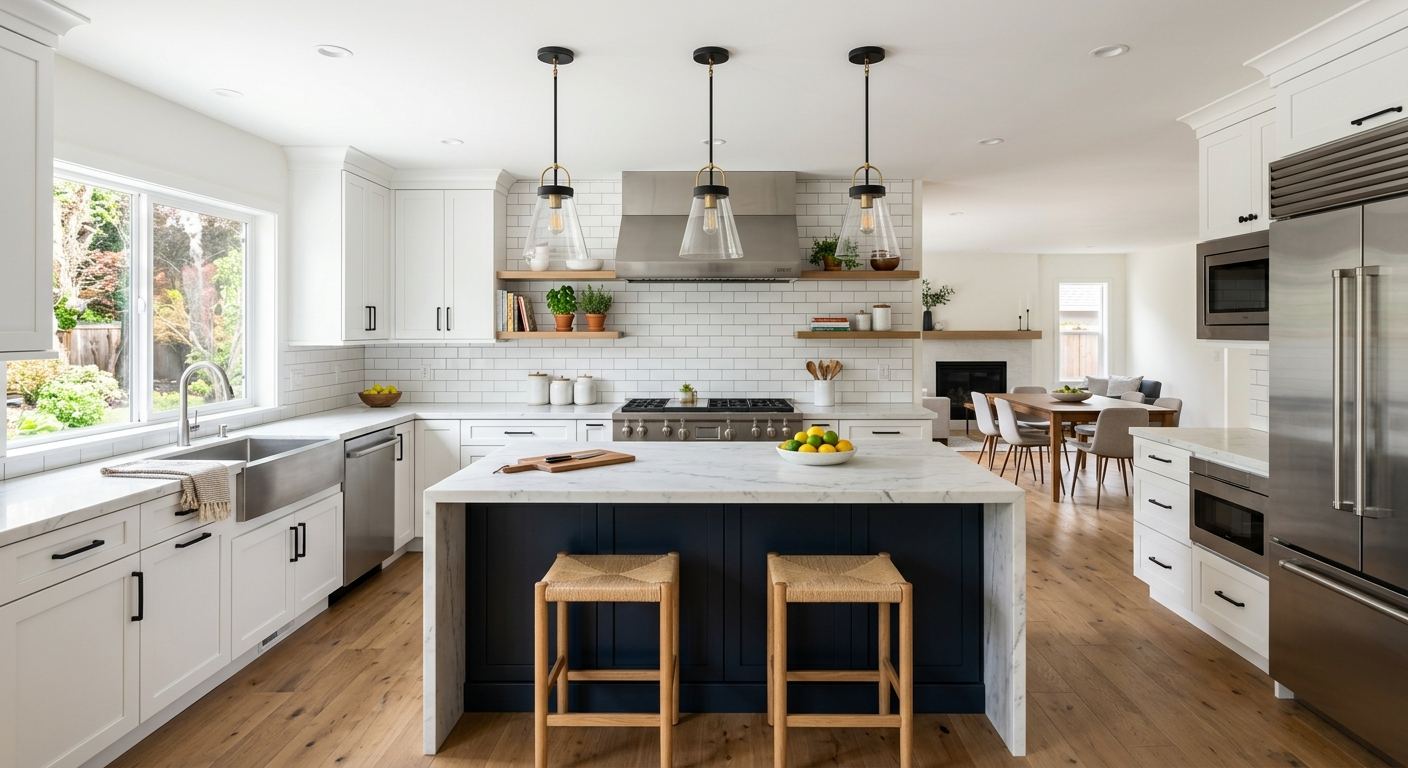
Kitchen renovation options and costs in Westridge
Kitchen renovation in Westridge starts with matching your goals to the right finish tier—and in this community that often means balancing practicality with the kind of look buyers expect across the Lower Mainland–Southwest. Westridge is a smaller area by population (2,521 residents, Statistics Canada, 2021 Census), and that matters because kitchen trades availability and scheduling can be tighter than in larger centres. At the same time, local households plan renovations with resale in mind, especially where home values are higher in the broader Metro Vancouver market and where upgrades like stone counters and upgraded hardware help the kitchen feel “current.” (Statistics Canada, 2021 Census)
In the Lower Mainland–Southwest, pricing is driven more by local home value, household income, and the expected finish level than by the climate itself. Contractors still factor in coastal moisture management (cabinet sealing, proper ventilation, and correct under-sink waterproofing), but the biggest swings usually come from material choices and labour complexity. In higher-value areas nearby, many homeowners lean toward semi-custom or custom cabinetry and quartz or stone counters; in more budget-conscious refreshes, laminate and stock cabinet packages dominate. If you’re renovating in the Westridge area where many homeowners are upgrading older, more compact homes, trades attention is especially in demand around cabinetry and millwork lead times, because those jobs often need more shop work and precise site measuring.
Below is a practical way to compare what different scopes typically cost in Westridge, so you can line up your quote with the outcome you’re aiming for.
| Renovation Tier |
What's Included |
Typical Duration |
Price Range |
| Cosmetic refresh (paint, hardware, new appliances only) |
Cabinet painting or repainting, new pulls/knobs, new fridge/dishwasher/range, minor caulking/trim, backsplash touch-ups (if applicable) |
1–3 weeks |
$8,000–$25,000 |
| Mid-range full renovation (new cabinets, counters, sink, tile) |
New cabinet installation, new countertop and sink, backsplash tile, plumbing tie-ins, disposal and tap swap, flooring refresh where needed |
4–8 weeks |
$40,000–$85,000 |
| High-end full renovation (custom cabinets, stone counters, island) |
Custom cabinetry or premium semi-custom, stone counters, island build, upgraded hardware, integrated lighting, full-height backsplash options, extended electrical/plumbing as required |
8–14 weeks |
$85,000–$120,000 |
| Cabinet refacing only (new doors + drawer fronts, same boxes) |
Door and drawer front replacement, new veneer/face materials, new pulls, optional cabinet interior upgrades, re-sealing |
2–4 weeks |
$8,000–$35,000 |
| Countertop swap only (laminate to quartz or stone) |
Remove old top, install new quartz/stone, new sink cut-out as needed, edge profile upgrade, caulking and sealing, haul-away |
3–7 days |
$18,000–$48,000 |
| Backsplash tile installation only |
Tile supply and installation, proper substrate prep, waterproofing where needed, grout/seal, trim and caulking |
3–10 days |
$1,500–$6,000 |
Prices are estimates only and vary by project scope, site access and material selection.
What affects the price of kitchen renovation in Westridge
In Westridge and across the Lower Mainland–Southwest, the same “kitchen refresh” can land 30–50% apart depending on the finish tier and how much your layout changes. British Columbia pricing isn’t just about climate or distance—it’s about home value and the finish expectations tied to resale. In higher-value pockets of the Lower Mainland, homeowners often default to quartz or stone counters and semi-custom cabinetry because the renovation cost is more easily recovered on resale. In more modest scopes, laminate surfaces and stock cabinetry dominate because they deliver the biggest visual payoff per dollar.
Two things create the biggest quote swings regardless of what the homeowner requests: (1) layout changes and (2) what the trade has to fix once walls open. Moving a gas line, relocating a drain, or adding an island means new plumbing/electrical runs, inspections, and sometimes structural checks. Even if you choose a mid-range budget package, a layout change can push you into full-renovation pricing territory. On the flip side, if you keep plumbing and cabinet locations mostly the same, you can often stay closer to a cabinet/refacing scope or a countertop swap—useful if you’re targeting the most visible areas first.
Concrete examples from this part of BC: (a) older homes around Surrey/Abbotsford-style housing stock in the region commonly have dated electrical at undersized circuits, so adding under-cabinet lighting or an island outlet frequently increases electrical scope; (b) if your kitchen has a compact footprint and you remove a wall to create an open-concept flow, you may need new support work and additional finishes around the new opening—this is usually a labour-driven jump. Finally, the marine climate doesn’t “add cost” directly in the way people fear, but it does increase the importance of moisture management: properly sealing under-sink areas and ensuring correct ventilation helps avoid early cabinet swelling or counter-edge damage, especially with quartz and stone seams.
| Price Factor |
Why It Matters |
Cost Impact |
| Cabinet tier — stock vs. semi-custom vs. fully custom millwork |
Higher tiers require more shop time, better fitting tolerances, and more options for storage and trim |
Often shifts projects by roughly $15,000–$40,000 |
| Countertop material — laminate vs. quartz vs. granite vs. stone |
Material pricing, edge profiles, and fabrication complexity drive cost and installation time |
Typical swing of $3,000–$12,000 for countertop installation alone |
| Layout change — wall removal, island add, plumbing/gas move |
Most unpredictable cost: trades coordination, permit requirements, and opening-up of walls |
Can add $10,000–$35,000 depending on scope |
| Appliance package tier — builder vs. mid-range vs. pro-grade |
Pro-grade models can require venting/clearances and higher electrical service |
Commonly $2,000–$15,000 difference |
| Flooring — refinish existing vs. full replacement |
Kitchen renovations often disturb subfloor and trim; replacing avoids uneven transitions |
Typically $1,500–$7,000 |
| Backsplash — ceramic tile vs. marble vs. full-height slab |
Full-height installs require more materials, prep, and precise wall scribing |
Usually $1,500–$6,000 |
| Electrical — new circuits for island, under-cabinet lighting |
New outlets, lighting runs, and code-compliant circuiting affect labour and parts |
Often $1,000–$6,000 |
| Permit fees and licensed trade requirements |
Required when moving key services (gas, plumbing, electrical), adding inspections and documentation |
Budget $500–$3,500 for fees and admin, plus labour |
Permits & regulations in British Columbia
In British Columbia, you generally don’t need a permit for cabinet and countertop swaps when they’re staying in the same locations. That means replacing existing cabinets, changing doors/fronts (refacing), or installing a new countertop over the existing cabinet base is typically treated as a finishing scope. However, permits and licensed trades enter the picture quickly when you change the “services” behind the scenes: moving plumbing supply or drain lines, relocating gas connections (for a stove/range and certain hood setups), removing a load-bearing wall, or adding electrical circuits/outlets for an island or new lighting layout.
Gas work must be completed by a licensed gas fitter, and electrical work must be completed by a licensed electrician. Both require inspections where applicable. The key point for homeowners in Westridge: always confirm permit responsibility in the written contract—who pulls the permit, who schedules inspections, and what scope triggers them.
To verify a contractor’s credentials step-by-step, ask for (1) their BC licence details for the trades involved (and any associated trade numbers), (2) a current certificate of insurance showing liability coverage, and (3) evidence of appropriate workplace coverage where applicable. Then, request a clearance letter or coverage statement if they use subtrades or have workforce on site. For licensing, check the province’s online registry entry for the specific trade (gas or electrical) and match the name/licence number to the certificate they provide. Don’t rely on a photo of a licence—verify it and keep a copy in your renovation file.
Cabinets, countertops and layout decisions in Westridge
For a Westridge kitchen renovation, three decisions drive the outcome more than almost anything else: cabinet tier, countertop material, and whether you change the layout. First, cabinet tier: stock cabinets are the fastest and usually the cheapest, semi-custom is the most common “best balance” choice in the Lower Mainland–Southwest, and custom cabinets cost the most but can deliver a perfect fit for older layouts and unusual wall conditions. Second, countertop material: laminate is budget-friendly and practical, quartz is a strong low-maintenance choice for busy households, and natural stone (granite/other stone) adds premium look and durability but costs more. Third, layout changes: removing an open-concept wall, adding an island, or relocating plumbing/gas often justifies the cost only if you’re gaining usable space—like better circulation or improved storage—not simply chasing a trend.
Because the Lower Mainland–Southwest resale market often rewards modern, durable finishes, many owners choose mid-range full renovations (often in the $40,000–$85,000 band) with semi-custom cabinets and quartz. If you’re moving plumbing or adding an island, expect the project to start behaving like a full renovation even when your cabinetry plan looks “mid-range.” As for climate: the marine air and humidity changes don’t magically ruin quartz or stone, but they do make ventilation and moisture sealing around sinks more important—especially in homes with older under-sink plumbing runs.
Dollar example: swapping from laminate to quartz on the same cabinet layout often costs an additional $3,000–$12,000 for countertop installation depending on edge profiles and sink cut-outs. If your existing laminate is delaminating or stained near seams, that upgrade is usually worth it because it fixes an actual problem, not just an aesthetic one. But if your laminate counters are already in good shape and you’re not changing other finishes, spending that extra amount may not deliver proportional value compared with using the budget for a new backsplash and better hardware during a cosmetic refresh.
| Option |
Durability |
Maintenance |
Best For |
Price Range |
| Stock cabinets (big-box) |
Solid where installed on level bases; limited custom fit |
Easy to care for; fewer options for storage accessories |
Quick upgrades and tighter budgets |
$8,000–$25,000 |
| Semi-custom cabinets (local dealer) |
Better sizing and upgrades; strong for everyday use |
Wipe-clean finishes; more storage configurations |
Most Westridge renovations targeting a “current” look |
$25,000–$60,000 |
| Custom cabinets (local millwork shop) |
Best fit and finish; designed for irregular spaces |
Durable finishes; higher-end hardware options |
Challenging footprints and premium resale goals |
$60,000–$90,000 |
| Laminate countertop |
Good for daily use but more sensitive at seams/edges |
Wipe clean; avoid prolonged standing water at edges |
Budget-conscious refreshes |
$3,000–$7,000 |
| Quartz engineered countertop |
High resistance to staining and daily wear |
Very low maintenance; best sealed edges and seams |
Busy households and resale-friendly finishes |
$7,000–$12,000 |
| Granite / natural stone countertop |
Extremely durable and heat resistant; variety in porosity |
Periodic sealing may be needed depending on stone |
Premium look with natural variation |
$9,000–$16,000 |
| Butcher block countertop |
Durable but susceptible to nicks and water exposure if neglected |
Oil/condition regularly; prompt drying after spills |
Family kitchens wanting warmth and repairability |
$6,000–$13,000 |
| Marble countertop |
Premium but softer; can etch/stain without careful use |
Higher maintenance; frequent sealing and gentle cleaning |
Low-traffic gourmet kitchens and designer finishes |
$12,000–$22,000 |
How to choose a kitchen renovation contractor in Westridge
Choosing the right contractor in Westridge is mostly about verification and clarity. Start with licensing and coverage for the trades involved: in British Columbia, cabinet installs and countertop fabrication may be managed by the contractor, but any gas or electrical work must be done by the licensed trades. Ask for their insurance certificate showing liability coverage and the name of the insured entity that will be on site. For workforce coverage, request evidence of appropriate workplace coverage and, when available, a clearance letter or similar document that shows coverage is in place. If they’re using subtrades, ask for the subtrade’s licence numbers and insurance directly.
Next, get 2–3 itemised written quotes. The best quotes break labour and materials into line items (cabinets, counters, tile, disposal hook-up, demo, electrical add-ons, permit handling, and disposal/haul-away). A lump-sum quote can hide cost gaps until you’re already committed. Read the scope carefully: what’s excluded (often drywall repairs, ceiling patching, or fridge/floor transitions), who pulls permits (and whether that’s included), and whether disposal/recycling is in the price.
Warranty matters too. Ask for the workmanship warranty length, what’s covered, and whether it’s transferable if you sell. Also confirm product/manufacturer warranties on cabinets, counters, and appliances. For payment, never exceed 10–15% upfront. Use a holdback until key milestones are complete—especially once cabinets are installed and the final tile/electrical details pass inspection. Finally, ensure the schedule has a stated start date and a completion estimate in writing so you can plan around lead times.
- Confirm each trade licence number matches the work they’ll perform in BC
- Request current certificate of insurance and verify coverage dates
- Ask for proof of workplace coverage and/or a clearance letter for active projects
- Get an itemised quote (labour + materials), not a single total line
- Confirm who pulls permits and who schedules inspections
- Check if demolition and disposal/haul-away are included
- Ask what happens if concealed damage is found (water damage, out-of-level walls, wiring)
- Verify warranty terms in writing for both workmanship and products
- Use a payment schedule with small upfront deposit and a holdback
- Review backsplash tile scope: substrate prep, waterproofing, grout/seal responsibilities
- Get a written project timeline including lead times for cabinets and countertops
- Request a clear change-order process and unit-cost rates for extras
Red flags to watch for in Westridge: (1) quotes that omit permits while assuming gas/electrical changes; (2) large deposits over 20% with no milestone-based payments; (3) no written warranty on workmanship; (4) vague disposal/drywall patching exclusions; and (5) refusal to provide licence/insurance documentation or itemised pricing breakdowns.
Frequently asked questions — kitchen renovation in Westridge
Do I need a permit for a kitchen renovation in British Columbia?
In British Columbia, cabinet and countertop swaps that stay in the same location typically do not require a permit, which is why many Westridge refreshes can be handled as finishing work. You’re much more likely to need permits when you move plumbing supply/drain lines, relocate gas for a stove or related hood setup, remove a load-bearing wall, or add new electrical circuits/outlets (for example, an island prep outlet or under-cabinet lighting). Gas work must be done by a licensed gas fitter, and electrical work by a licensed electrician, with inspections where required. Before you sign, confirm in writing who is responsible for pulling permits and coordinating inspections so there’s no surprise during the schedule or payment.
What's the ROI on a kitchen renovation?
Kitchen ROI in Westridge depends less on climate and more on what you upgrade and how well it matches buyer expectations in the Lower Mainland–Southwest resale market. Premium custom millwork and full stone/feature upgrades can cost a lot, but they don’t always outperform a well-planned mid-range renovation that improves layout, storage, and finishes. As a reference point, a mid-range full renovation often sits in the $40,000–$85,000 band, while high-end full work can reach $85,000–$120,000. In practice, the “best ROI” usually comes from spending where the buyer looks first: cabinetry quality, quartz/stone counters, solid lighting, and a clean backsplash—while controlling expensive layout changes unless the space gain is meaningful.
How do I budget for a kitchen renovation?
Budgeting in British Columbia works best when you decide your tier first, then fund the predictable categories. Start with a target range based on scope: cosmetic refreshes with new appliances typically land around $8,000–$25,000, while a mid-range full renovation with new cabinets and counters commonly falls in the $40,000–$85,000 band. Add allowances for the “unknowns” that appear once walls are open—out-of-level framing, older wiring, or undersized plumbing. In Westridge, prioritize moisture management near sinks (proper under-sink sealing and ventilation) because marine conditions can amplify small installation issues over time. Finally, require itemised quotes with disposal and any permit handling noted, so your budget doesn’t get eroded by exclusions.
Can I move my kitchen sink or stove?
Yes, you can move a sink or stove in a Westridge kitchen, but it’s usually the most expensive part of a renovation. Moving a sink requires reworking drain lines and supply lines, which can trigger permits and licensed plumbing work, plus careful coordination to avoid future leaks and trap/venting issues. Relocating a stove typically involves gas line changes (or ensuring venting requirements are met), which must be done by a licensed gas fitter and inspected. Even if you keep finish materials mid-range, the cost can climb toward full-renovation totals because layout changes add labour, inspections, and sometimes structural adjustments. If you want cost control, consider keeping major plumbing/gas locations close to the original footprint and upgrading finishes instead.
What's the most cost-effective kitchen upgrade?
In Westridge, the most cost-effective upgrade is usually the one that improves the look without triggering major service work. Many homeowners find that a cabinet refacing or a targeted countertop upgrade delivers strong visual impact per dollar. If your boxes are solid, cabinet refacing can often fall in the $8,000–$35,000 range, giving you a fresh face without a full tear-out. If your cabinets are staying and your counter surface is the main issue, a countertop swap (for example, laminate to quartz) typically sits within $18,000–$48,000 depending on size and sink/edge complexity. If you want a smaller “quick win,” a backsplash tile installation only can be $1,500–$6,000. The biggest value comes when the upgrade matches your existing layout and avoids moving gas or plumbing.
Custom vs stock cabinets — is custom worth it?
Custom cabinets can be worth it in British Columbia when your kitchen layout is challenging—narrow rooms, out-of-square walls, awkward corners, or you want built-ins that truly maximize storage. In Westridge and the surrounding Lower Mainland–Southwest market, semi-custom often delivers the best balance for most homeowners because it fits well and looks premium without the full premium price of made-to-order millwork. Stock cabinets are usually the fastest and cheapest path, but they may not fit irregular spaces as perfectly. If your renovation budget is closer to a cosmetic refresh or controlled mid-range plan, stock or semi-custom is often the smarter move. If you’re targeting the $85,000–$120,000 high-end band and plan for an island or complex storage, custom can make sense—just be sure the rest of the design and services (electrical, lighting, ventilation) are planned to match.