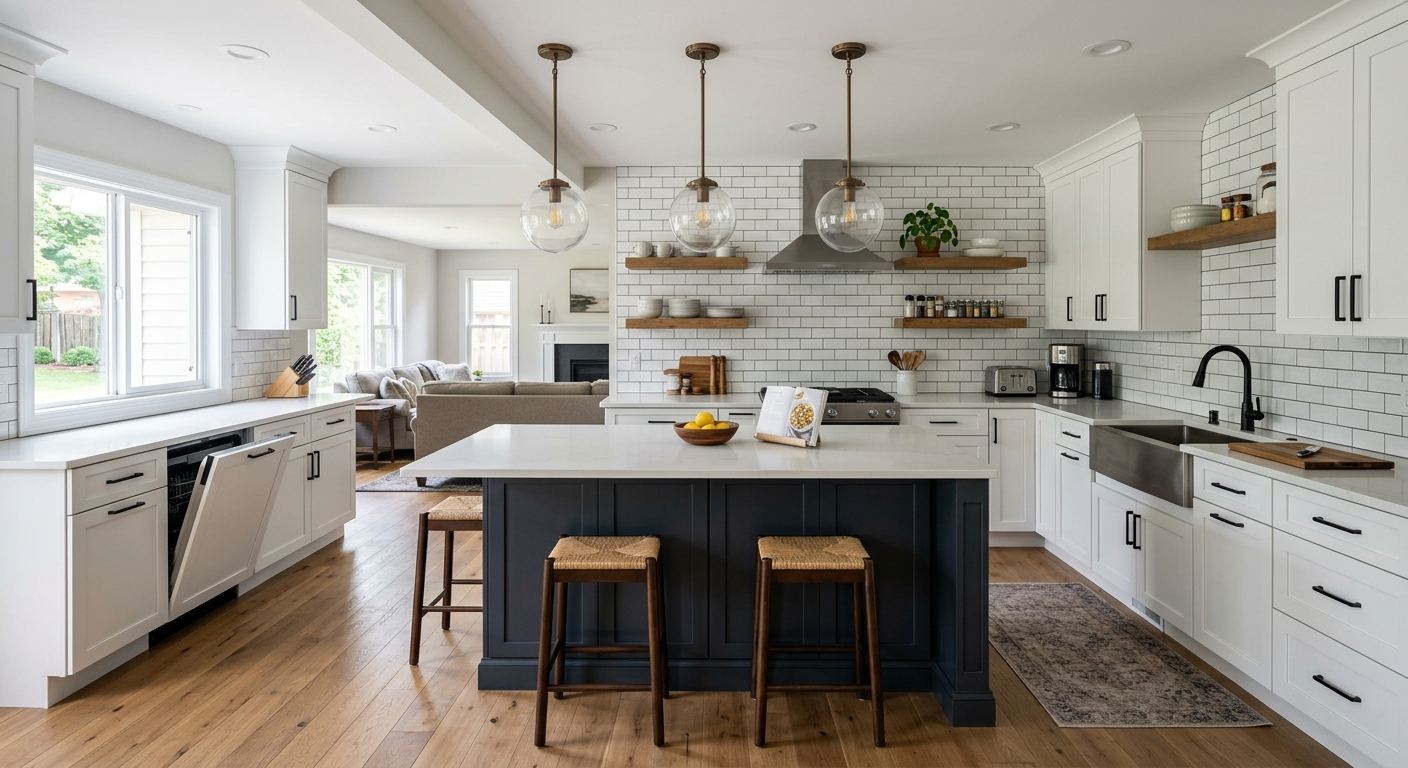
Kitchen renovation options and costs in Shellmont
Kitchen renovations in Shellmont, British Columbia tend to follow a clear “finish-upgrade” path: many homeowners start with a refresh, then move toward new cabinetry and stone-style surfaces once they see how much daily use they’ll get for the cost. With a population of 11,420 (Statistics Canada, 2021 Census), Shellmont sits within the Lower Mainland–Southwest where renovation choices often track what buyers expect at resale. In higher-value pockets across Metro Vancouver, households are more likely to budget for semi-custom or custom cabinetry and quartz/stone counters because that finish tier is easier to justify when you’re selling (Statistics Canada, 2021 Census). Even though climate doesn’t drive cabinetry pricing the way it does in extreme northern zones, moisture swings, winter humidity inside older homes, and wet-season access issues still influence scheduling and material handling.
In the Lower Mainland–Southwest, costs can also vary based on contractor availability. During busy renovation seasons, labour rates and lead times for cabinetry and countertop fabrication tighten, which is why one quote might land lower on a “cosmetic refresh,” while another becomes higher once you add workflow changes like moving plumbing or wiring for an island. Neighbourhoods like Sullivan Station and the wider Surrey/Abbotsford corridor are especially in-demand for kitchen work because families renovate more often as housing ages and grow into longer-term homes.
Below are typical Shellmont pricing bands by renovation tier, so you can compare quotes apples-to-apples before you pick materials and decide how much layout change you want.
| Renovation Tier |
What's Included |
Typical Duration |
Price Range |
| Cosmetic refresh (paint, hardware, new appliances only) |
Cabinet hardware swap, paint/stain touch-ups where applicable, new fridge/range/dishwasher, minor caulking, basic cleanup |
3–7 business days |
$6,000–$18,000 |
| Mid-range full renovation (new cabinets, counters, sink, tile) |
New stock or semi-custom cabinets, new countertop, sink + faucet, backsplash tile, updated flooring transitions as needed, labour and standard disposal |
3–6 weeks |
$40,000–$75,000 |
| High-end full renovation (custom cabinets, stone counters, island) |
Custom/made-to-fit millwork, premium stone or advanced engineered surfaces, island with lighting/power provisions, coordinated backsplash, extended trim/detailing |
6–12 weeks |
$85,000–$120,000 |
| Cabinet refacing only (new doors + drawer fronts, same boxes) |
Door/drawer replacement, face-frame refresh (where applicable), new hardware, new backsplash materials (if selected as an add-on) |
2–4 weeks |
$8,000–$28,000 |
| Countertop swap only (laminate to quartz or stone) |
Remove old counters, new quartz/stone installation, sink cut-out adjustments, reseal/silicone, basic end-cap finishing |
4–10 business days |
$3,000–$12,000 |
| Backsplash tile installation only |
Tile supply/installation, prep and backer board where needed, grout/seal, caulking at edges and around outlets (existing covers) |
2–5 business days |
$1,500–$6,000 |
Prices are estimates only and vary by project scope, site access and material selection.
What affects the price of kitchen renovation in Shellmont
In Shellmont and across the Lower Mainland–Southwest, the same basic kitchen scope can come in 30–50% apart depending on where the finish tier lands and how much construction complexity is added. In British Columbia, contractors price labour and scheduling based on expected finish level, cabinet lead times, and whether trade coordination is “light” (swap surfaces) or “heavy” (rebuild, reroute plumbing/gas and electrical). While climate matters for durability choices, it typically doesn’t change the contractor’s labour cost as much as local housing economics do: in higher-value Lower Mainland areas, homeowners more often choose quartz or stone counters and semi-custom cabinetry because the investment is easier to recover on resale. In more modest scopes, laminate and stock cabinets dominate because they deliver a better cost-to-change ratio.
Two common Shellmont examples: (1) an island addition can quickly add cost even before you touch finishes, because you may need new electrical circuits and possibly plumbing provisions. That unpredictability is why layout changes often push budgets upward more than upgrading from laminate to quartz. (2) in older homes, you can uncover mismatched subflooring or weak wall backing behind tile, which can raise “tile and prep” time—sometimes adding several thousand dollars even if the visible finish looks similar.
As a quick reality check, a mid-range renovation in the $40,000–$75,000 band can shift toward the $85,000–$120,000 range if you move plumbing, add an island, and select custom millwork plus stone counters. In the Lower Mainland’s wet-season conditions, we also plan for drying time and protection of floors and millwork, particularly when there’s drywall repair and tile backer work involved.
| Price Factor |
Why It Matters |
Cost Impact |
| Cabinet tier — stock vs. semi-custom vs. fully custom millwork |
Material quality, door styles, interior options (soft-close, pull-outs) and fit-to-space affect both material and install time |
$10,000–$70,000 |
| Countertop material — laminate vs. quartz vs. granite vs. stone |
Differences in fabrication complexity, seam placement, edge profiles and weight handling drive labour and shop costs |
$3,000–$22,000 |
| Layout change — wall removal, island add, plumbing/gas move |
Rerouting trades and modifying structure or service lines adds coordination and inspection steps |
$8,000–$45,000 |
| Appliance package tier — builder vs. mid-range vs. pro-grade |
Electrical requirements, ventilation performance, finish quality and installation clearances vary by model |
$1,500–$12,000 |
| Flooring — refinish existing vs. full replacement |
Subfloor condition under cabinets and the need for matching transitions can add days of work |
$2,000–$15,000 |
| Backsplash — ceramic tile vs. marble vs. full-height slab |
Tile labour rates and trim detailing differ; large-format or stone backsplashes require careful measuring and support |
$1,500–$8,000 |
| Electrical — new circuits for island, under-cabinet lighting |
New lighting and receptacles drive licensed electrician time and may require panel/box work |
$800–$6,500 |
| Permit fees and licensed trade requirements |
When changes include gas/plumbing/electrical or structural work, permits and inspection scheduling affect cost and timeline |
$500–$5,000 |
Permits & regulations in British Columbia
In British Columbia, many kitchen finish-only updates do not require permits. Cabinet and countertop swaps typically do not need a permit, and replacing existing fixtures in the same locations is often straightforward. Where Shellmont homeowners need to plan for permits is when the work changes services or structure: moving plumbing supply/drain lines, relocating a gas stove or range hood connected to gas, removing a load-bearing wall, and adding new electrical circuits (for example, extra receptacles or under-cabinet lighting beyond what exists) usually require permits and licensed trades.
For gas work, a licensed gas fitter must handle any connection, relocation, or modifications, followed by inspection. For electrical, a licensed electrician must do the circuit work and get it inspected. If you’re opening walls for tile or cabinet backs, the contractor should confirm whether hidden service changes trigger permitting—don’t assume it’s “just carpentry.”
Step-by-step, here’s how a homeowner in Shellmont should verify a contractor’s standing before signing: (1) check the contractor’s licence status and business details using the appropriate online registry for the trade(s) being used; (2) request a current certificate of insurance (liability) showing coverage and effective dates; (3) confirm worker protection coverage (WSIB/WCB) for the trades performing the work; (4) keep a clearance letter or proof document in your records. Finally, ensure the written contract clearly states who pulls permits—this responsibility should be explicit, not assumed.
Cabinets, countertops and layout decisions in Shellmont
The three most consequential decisions in a Shellmont kitchen renovation are cabinet tier, countertop material, and whether you change the layout. Cabinet tier sets the “fit and feel”: stock cabinets are fastest and typically cheapest, semi-custom is the sweet spot for most mid-range budgets, and custom millwork delivers the best fit for odd angles, ceiling heights and maximizing storage. For Shellmont’s market, a practical design note matters: buyers often expect clean lines and efficient storage at the mid-range price point, while higher-end buyers look for custom proportions and premium hardware.
Countertops should match your lifestyle and maintenance reality. Laminate can be cost-effective and is a good option for shorter budgets, but it’s more sensitive to heat and heavy wear. Quartz provides strong durability with relatively low maintenance and is a popular choice in the $40,000–$75,000 mid-range band. Granite/natural stone and marble look premium, but they can require more careful sealing and day-to-day protection from staining and etching. In the Lower Mainland–Southwest, where humidity and wet-season indoor moisture can be a factor in older homes, good installation details and sealing edges around sinks matter as much as material choice.
Layout changes are where costs jump unpredictably. Removing a wall or adding an island can justify the expense when it improves traffic flow and adds functional seating/storage—but if you’re tight on budget, a “no-move” plan (new cabinets and counters without rerouting) often gives the highest return. For example, selecting quartz instead of laminate might add only a few thousand dollars, while adding an island and moving plumbing/electrical can push the total from the mid-range $40,000–$75,000 band toward the $85,000–$120,000 high-end band.
| Option |
Durability |
Maintenance |
Best For |
Price Range |
| Stock cabinets (big-box) |
Solid for everyday use; depends on door/core quality and installation accuracy |
Low; wipe clean and address moisture at seams promptly |
Fast timelines and budget-focused renovations without layout surprises |
$10,000–$20,000 |
| Semi-custom cabinets (local dealer) |
Very durable with better interior options and more flexible sizing |
Low to moderate; soft-close hardware and organization pieces reduce wear |
Most Shellmont homeowners aiming for better storage and resale-ready finishes |
$18,000–$40,000 |
| Custom cabinets (local millwork shop) |
Highest durability from made-to-fit builds and quality joinery |
Low; design features help keep counters/cabinets protected longer |
Challenging spaces, ceiling height matching, and premium design statements |
$35,000–$70,000 |
| Laminate countertop |
Reasonable daily durability; vulnerable to heat and impacts if not careful |
Low upkeep; avoid prolonged heat exposure and standing water at seams |
Cost-conscious refreshes and rental-style budgets |
$3,000–$6,000 |
| Quartz engineered countertop |
High durability; resists staining and typical kitchen wear well |
Low; clean with mild soap, wipe up spills promptly |
Busy households wanting a “set and forget” countertop in resale-ready finishes |
$6,000–$11,000 |
| Granite / natural stone countertop |
Very durable; hardness varies by slab but generally handles daily use |
Moderate; sealing schedule and careful cleaning recommended |
Homeowners who want natural variation and a higher-end look |
$8,000–$14,000 |
| Butcher block countertop |
Durable with proper maintenance; can scar but recovers with refinishing |
Higher; requires oiling and prompt wipe-down to reduce dryness/warping risks |
Families that actually use counters for prep and want a warm, practical style |
$4,500–$9,000 |
| Marble countertop |
Beautiful but softer; more susceptible to etching from acids |
Higher; sealing and careful cleaning are important for appearance |
Lower-traffic kitchens or homeowners ready for maintenance for the look |
$10,000–$18,000 |
How to choose a kitchen renovation contractor in Shellmont
Choosing the right contractor in Shellmont is mostly about verifying who will do the work, proving they’re insured, and ensuring your scope is spelled out clearly. Start with British Columbia licensing by confirming the trades involved: electrical work must be done by a licensed electrician, and any gas-related changes must be done by a licensed gas fitter. Ask each contractor for their certificate of insurance (liability) and proof of worker protection coverage (WSIB/WCB). When you request it, look for current dates, the named insured, and the coverage amounts; if they can’t provide documents promptly, that’s a major warning sign.
Next, get 2–3 itemised written quotes. A solid quote breaks labour and materials line-by-line (cabinets, countertops, demolition, framing/drywall, tile/backsplash, plumbing/electrical allowance, disposal). Avoid “one-number” lump sums unless you truly have a simple cosmetic refresh. Make sure the scope clearly states exclusions: is permit pulling included, is disposal included, and does the quote include adjustments for sink cut-outs, plumbing rough-ins, and under-cabinet lighting wiring provisions?
On warranty, ask for workmanship warranty length and what it covers (for example, tile cracking due to prep failures versus normal wear). Confirm product/manufacturer warranty terms and whether they transfer if you sell your home. Payment schedule matters: never pay more than 10–15% upfront, and hold back a portion until key completion steps are finished. Finally, demand a start date and completion estimate in writing, especially for cabinet lead times and countertop fabrication windows.
- Confirm the exact trades used and whether each is licensed for the work they’ll perform.
- Request and verify liability insurance certificate (and effective dates) before deposits.
- Confirm WSIB/WCB coverage for workers on your site; keep proof on file.
- Use itemised quotes with labour and materials separated, not a single lump sum.
- Ask what’s included for demolition, disposal, and drywall/tile backer prep.
- Confirm whether permits are included in the quote and who is responsible for pulling them.
- Ensure the quote lists appliance allowances (if any) and venting/hood requirements.
- Require a detailed cabinet specification: tier, hardware type, and soft-close options.
- Clarify countertop details: thickness, edge profile, seams, sink cut-out handling.
- Get a written warranty for workmanship and confirm manufacturer warranty transferability.
- Set a payment schedule with staged milestones (foundation/prep, cabinet install, countertop install, final walkthrough).
- Require a realistic schedule that includes lead times for cabinets and stone fabrication.
Red flags I see in Shellmont include contractors who won’t provide insurance/WSIB/WCB proof, vague quotes that don’t spell out disposal or permit responsibility, pressure for large deposits upfront, “change order” surprises where key items weren’t included, and no clear start/completion dates tied to material lead times.
Frequently asked questions — kitchen renovation in Shellmont
How do I know if I need to update my kitchen plumbing in Shellmont?
If your kitchen shows leaks, slow drains, low water pressure at the sink, or corrosion around shutoff valves, it’s a strong sign plumbing should be assessed during a renovation. In Shellmont and across the Lower Mainland–Southwest, older housing stock can hide supply/drain condition issues once walls open for new cabinets and backsplashes. A practical approach is to inspect shutoff valves, check under-sink fittings, and run a pressure/flow test before finalising cabinetry layouts. If you’re staying “no-move” (same sink location and taps), you may only replace minor parts like P-traps and supply lines. If you’re moving the sink, dishwasher, or adding an island with new plumbing, you’ll typically plan for rerouting drain supply work and must account for permitting/licensed trades responsibilities.
What is the difference between a galley and open-concept kitchen?
A galley kitchen is a tight, corridor-style layout with counters on two parallel sides. It often works well in older homes and can keep plumbing and electrical runs relatively compact, which usually helps control cost during a refresh. An open-concept kitchen removes or replaces a wall to connect the kitchen to living space, which commonly changes traffic flow and can require structural checks, new electrical planning, and updated ventilation planning. In Shellmont’s market, open concepts are popular when homeowners want wider sightlines and more social space—those benefits can justify added labour and coordination, but it’s also where budgets can climb quickly. If you’re comparing quotes, ask whether the scope includes wall removal, structural support work, and permitted trade work versus a simpler “cosmetic refresh” in the $6,000–$18,000 band.
How do I get accurate kitchen renovation quotes in Shellmont?
Accurate quotes come from two things: clear scope and itemised pricing. Provide consistent measurements, confirm what you’re keeping (appliances, layout, existing plumbing location), and share your desired cabinet tier and countertop material. Ask each contractor for an itemised breakdown—labour, demo, cabinets, countertops, tile/backsplash, disposal, and any allowances—so you can compare like-for-like. Also ask whether permit pulling is included and who handles it, because plumbing/electrical/gas changes in British Columbia can require permits and licensed trades. For timing, request a start date estimate and note cabinet/counter fabrication lead times. A good comparator is the expected tier range: for example, a mid-range full renovation often falls in the $40,000–$75,000 band, while a high-end full renovation with custom millwork and an island is commonly in the $85,000–$120,000 band. If bids swing wildly, it usually means the scopes aren’t truly equivalent.
What's the best countertop material for a busy Shellmont kitchen?
For busy households in Shellmont and across the Lower Mainland–Southwest, quartz is usually the most practical “best overall” choice: it’s durable, resists staining, and requires relatively low daily maintenance. If you choose quartz, your biggest quality wins come from proper installation—especially at sink edges and seam placement—so moisture doesn’t work into junctions during wet-season humidity changes. Laminate can work if budget is tight, and it can be a solid refresh countertop in a restrained plan, but it’s more sensitive to heat and cutting impacts. Granite/natural stone can also be excellent, though it often needs sealing and more careful cleaning habits. Marble looks high-end but generally takes more maintenance (and can etch from acidic spills). In practice, many homeowners targeting a mid-range budget in the $40,000–$75,000 range select quartz and pair it with semi-custom cabinets for a resale-ready look.
How do I add an island to my Shellmont kitchen?
Adding an island starts with layout and clearances: you’ll want comfortable walkway space and a plan for where the island will draw power and (if needed) plumbing. In British Columbia, adding or relocating electrical circuits for island receptacles and lighting typically requires a licensed electrician and usually involves permitting/inspection steps. If you plan for an island sink or dishwasher, you’ll also be dealing with plumbing supply/drain rerouting, which again impacts permits and scheduling. The cost justification depends on value of the space gain: an island can add seating, storage, and prep area, but if your kitchen already functions well, you may get better ROI by upgrading counters and cabinet hardware first. When you compare quotes, ask explicitly what services are included for the island, and whether labour and trade coordination are priced as part of the scope rather than hidden in change orders.
How much does a kitchen renovation cost in Shellmont?
Kitchen renovation costs in Shellmont typically land in the broader Lower Mainland–Southwest bands depending on finish tier and whether you change the layout. A cosmetic refresh (paint, hardware, and new appliances only) is commonly in the $6,000–$18,000 range. A mid-range full renovation—new cabinets and counters plus a sink and tile—often falls in the $40,000–$75,000 band. High-end full renovations with custom cabinets, stone counters, and an island frequently land in the $85,000–$120,000 range. Countertop swaps alone commonly fall in the $3,000–$12,000 range, while backsplash tile installation only is often $1,500–$6,000. Actual totals vary because layout changes (especially plumbing/gas and electrical updates) add complexity and coordination. For the most accurate expectation, request itemised quotes and confirm what’s included for permits, disposal, and licensed trade work in your written agreement.