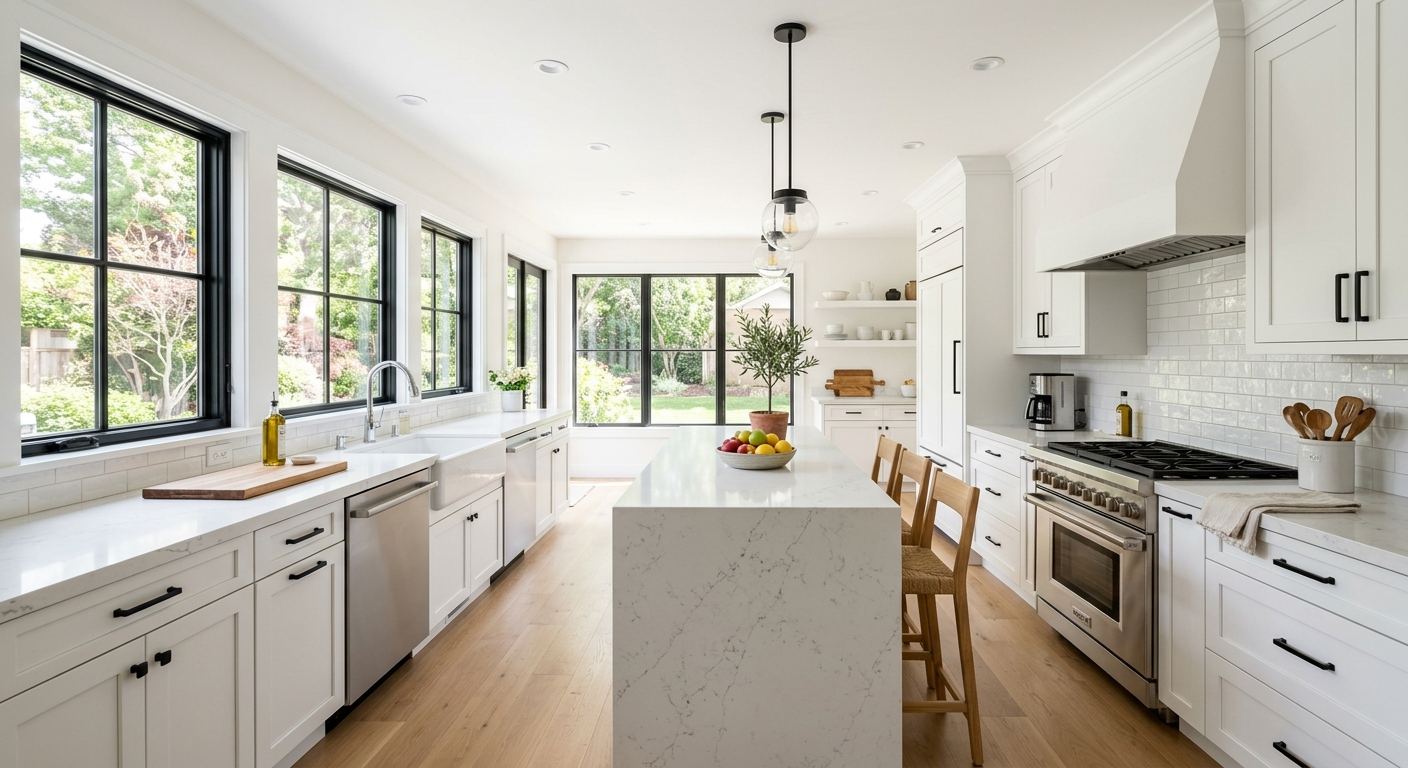
Kitchen renovation options and costs in Richmond Hill
Richmond Hill homeowners usually start their kitchen project by choosing a cost-and-look “tier,” because the Toronto economic region rewards a polished result. With a median household income of about $102,000 (Statistics Canada, 2021 Census) and a mix that includes many family homes—56.7% of dwellings are single-detached—the most common upgrades are designed to hold up to daily use while still reading well for resale. In higher-value pockets, many owners invest a larger share of their home value into the kitchen, which pushes projects toward quartz or natural stone and upgraded appliances more often than in price-sensitive GTA areas.
Toronto-region kitchens also cost more when structural and service work is involved, but not because of weather directly—kitchen pricing is driven by labour demand, material lead times, and the availability of carpenters, plumbers, electricians and gas fitters. Trade scheduling in the GTA can be tight at peak seasons, so timelines and labour portions can shift even when the finish tier stays the same. Demand is especially strong in older housing stock areas and neighbourhoods with ongoing renovations—many homeowners renovate around central pockets such as Oak Ridges, where buyers expect updated cabinets, lighting and durable tops. Once you know your tier, comparing realistic ranges makes it easier to line up design, scope, and scheduling before you call for quotes.
Use the table below to anchor your budget, then we’ll break down what moves prices up or down for Richmond Hill jobs.
| Renovation Tier |
What's Included |
Typical Duration |
Price Range |
| Cosmetic refresh (paint, hardware, new appliances only) |
Paint, hardware swaps, minor caulking/touch-ups, appliance replacement (no plumbing/gas relocation), basic cleaning and adjustments |
3–7 days |
$6,000–$18,000 |
| Mid-range full renovation (new cabinets, counters, sink, tile) |
New semi-custom or upgraded stock cabinets, countertop replacement, new sink and faucet, backsplash tile, flooring patching, and electrical updates as needed |
3–6 weeks |
$25,000–$60,000 |
| High-end full renovation (custom cabinets, stone counters, island) |
Fully custom cabinetry, quartz or natural stone counters, island build-out, upgraded appliance package, enhanced lighting (e.g., under-cabinet), full-height or premium backsplash |
6–12 weeks |
$70,000–$90,000 |
| Cabinet refacing only (new doors + drawer fronts, same boxes) |
Refacing veneer/laminate, new doors/drawers, hardware, alignment and refinishing of existing box structure, optional lighting prep |
1–3 weeks |
$8,000–$28,000 |
| Countertop swap only (laminate to quartz or stone) |
Remove existing counters, fabricate/install new countertops, sink cut-outs and reseal, edge profile upgrade |
2–5 business days |
$3,000–$15,000 |
| Backsplash tile installation only |
Tile supply and install (ceramic/porcelain), layout and cutting, waterproofing/adhesive prep, grouting and sealing |
3–7 days |
$2,000–$10,000 |
Prices are estimates only and vary by project scope, site access and material selection.
What affects the price of kitchen renovation in Richmond Hill
In Richmond Hill and across the Toronto economic region, two quotes for the “same” kitchen can differ by 30–50% because the scope is rarely identical—especially around plumbing, electrical, and how premium the finishes are. The big driver is local affordability and buyer expectation. When homeowners can comfortably plan around higher home values, they often default to quartz or stone counters and semi-custom cabinetry, not laminate or basic stock options. In practice, that finish-tier choice can shift a kitchen renovation into the $25,000–$60,000 band or all the way toward $70,000–$90,000 if you add an island, upgrade lighting, and go with premium materials.
Climate isn’t the main pricing lever for kitchens; Richmond Hill’s renovation costs are more about trade availability and material lead times in the GTA. However, the region’s housing mix matters: 15.1% of homes are built before 1981 (Statistics Canada, 2021 Census), and older layouts often include aging electrical runs, dated plumbing, and walls that may not align neatly with modern cabinet depths. That can mean extra demolition, patching, and rework—costs that show up even when the finish tier looks straightforward.
Here are concrete Richmond Hill examples of what commonly raises or lowers costs:
- Example 1 (raises cost): Bringing a kitchen up-to-date often means new under-cabinet lighting and an updated circuit—if the electrical panel is tight, labour increases.
- Example 2 (raises cost): Switching from laminate to quartz can be quick, but if the sub-surface needs reinforcement or the sink cut-out changes, countertop installation costs rise.
- Example 3 (can lower cost): Keeping the existing cabinet footprint and only upgrading doors, drawer fronts, and hardware can keep you near the cabinet-refacing range rather than moving into a full cabinet replacement.
Regardless of finish choice, layout changes—like removing a wall, adding an island, or relocating a gas line—tend to be the most unpredictable part of the budget, often pushing labour and permit work beyond what homeowners expect from a finish-only plan.
| Price Factor |
Why It Matters |
Cost Impact |
| Cabinet tier — stock vs. semi-custom vs. fully custom millwork |
Higher tiers have better hardware, fit/finish, and options for organizers; custom work also changes wall tolerances and timelines |
Can shift the cabinet portion by several thousand dollars and move the whole project toward mid-range or high-end bands |
| Countertop material — laminate vs. quartz vs. granite vs. stone |
Material price and fabrication/edge complexity vary; natural stone can require extra templating and may increase lead times |
Often a difference of thousands; with installs commonly landing in the $3,000–$15,000 range depending on material and scope |
| Layout change — wall removal, island add, plumbing/gas move |
Structural work and new rough-ins drive the biggest labour swings; concealed work typically multiplies unexpected issues |
Most unpredictable; can add tens of thousands versus a plan that keeps services in place |
| Appliance package tier — builder vs. mid-range vs. pro-grade |
Pro-grade models cost more and may require venting/trim considerations and more precise electrical specifications |
Commonly shifts total budget within the broader renovation range |
| Flooring — refinish existing vs. full replacement |
If subfloors are uneven or damaged, replacement can become necessary rather than patching |
Patch work may keep costs lower; full replacement adds labour and material |
| Backsplash — ceramic tile vs. marble vs. full-height slab |
Premium materials need careful layout, sealing, and more time for cuts and finish work |
Can move backsplash install toward the $2,000–$10,000 band or beyond if full-height and slab-style work is chosen |
| Electrical — new circuits for island, under-cabinet lighting |
Rewiring and adding lighting increases trade time and inspection requirements |
Often noticeable within the overall labour portion; can also affect timeline due to panel capacity checks |
| Permit fees and licensed trade requirements |
Any work that triggers municipal paperwork and licensed sign-off adds administrative and inspection steps |
Direct costs plus scheduling time; typically relevant when plumbing/gas/electrical changes are part of the plan |
Permits & regulations in Ontario
In Ontario, cabinet and countertop swaps generally do not require permits—if you are replacing surfaces and fixtures without changing the underlying plumbing, gas, electrical, or structural elements. The permit picture changes when you alter how the kitchen functions. You typically need permits and licensed trades for work like moving plumbing supply or drain lines, relocating or adding gas appliances/lines (including range or range hood tied to gas), removing a load-bearing wall or doing structural beam work, and adding new electrical circuits (for example, dedicated circuits for an island, new receptacles, or enhanced lighting plans).
Step-by-step, here’s how a Richmond Hill homeowner can verify a contractor is set up properly before signing: (1) Ontario licence/eligibility: ask for the contractor’s trade credentials for the trades involved in the scope, and check the appropriate online registry referenced for their trade category. (2) Liability insurance: request a current certificate of insurance naming you/your property as applicable; your contractor should be able to provide it promptly. (3) WSIB/WCB coverage: confirm the contractor has coverage for workers (or that they are registered/covered as required) and keep the clearance letter/documentation on file for your records. (4) Clear scope responsibility: confirm in writing who pulls permits and pays associated fees, including inspections.
Bottom line: cabinet and countertop replacements are often permit-free, but any rough-in changes are where compliance matters most. Always confirm permit responsibility in the written contract.
Cabinets, countertops and layout decisions in Richmond Hill
The three biggest decisions in a Richmond Hill kitchen renovation are (1) the cabinet tier, (2) countertop material, and (3) whether you change the layout. For cabinets, stock units are the fastest path and the cheapest—useful when you want an upgraded look without major downtime. Semi-custom cabinets are usually the best balance for most GTA buyers: more door/style options, better organization packages, and stronger long-term value in a market where prospective purchasers expect practical storage and a clean cabinet-to-counter reveal. Custom cabinets cost the most, but they shine when your kitchen has awkward wall lengths, older framing irregularities, or you want a built-in island profile that matches the rest of the house.
For countertops, laminate offers budget control but requires careful heat and impact use. Quartz is the workhorse for busy households in the Toronto area: it resists staining and is straightforward to maintain. Granite/natural stone adds distinct character but can involve more sealing and consideration for lifestyle. Butcher block looks warm and can be great for families, though it needs oiling and attention around water exposure. Marble is beautiful but is typically less forgiving for everyday cooking—more suited when you’re prepared for extra maintenance.
Layout changes justify higher costs when they create real space value: removing an open-concept-defining wall for sightlines, adding an island for circulation, or relocating plumbing/gas so the sink or range sits where it improves workflow. For a dollar example, many homeowners find it’s smarter to upgrade from laminate to quartz during a mid-range renovation because quartz replacement often lands in the $3,000–$15,000 range—an upgrade that can feel like a major visual jump without the same cost uncertainty as moving plumbing. By contrast, adding an island and moving rough-ins can push budgets toward the upper end of the $70,000–$90,000 band quickly, especially when electrical circuits and permit steps come into play.
| Option |
Durability |
Maintenance |
Best For |
Price Range |
| Stock cabinets (big-box) |
Good for everyday use; limited flexibility for odd wall dimensions |
Low maintenance; depends on door finish quality |
Fast refreshes, budget-first projects, simple footprints |
$8,000–$25,000 |
| Semi-custom cabinets (local dealer) |
Very good durability; improved hardware options and better fit options |
Low to moderate; normal cleaning and hardware care |
Most Richmond Hill renovations aiming for resale appeal |
$15,000–$45,000 |
| Custom cabinets (local millwork shop) |
Excellent durability; tailored to your kitchen’s exact measurements |
Low maintenance; designed for long-term use |
Complex layouts, built-ins, high-end finish expectations |
$35,000–$70,000 |
| Laminate countertop |
Moderate; can be prone to chipping at edges and heat marks if mishandled |
Low day-to-day effort; avoid prolonged heat exposure |
Budget-controlled upgrades and temporary/refresh scenarios |
$2,500–$6,000 |
| Quartz engineered countertop |
High durability; resistant to staining and everyday wear |
Low maintenance; simple cleaning with non-abrasive products |
Busy kitchens needing a “set it and forget it” surface |
$4,500–$12,000 |
| Granite / natural stone countertop |
High durability; naturally resilient but varies by stone type |
Moderate; sealing and mindful care recommended |
Homeowners who want natural variation and premium character |
$5,500–$14,000 |
| Butcher block countertop |
Medium to high if properly maintained; sensitive to prolonged moisture |
Higher maintenance; requires regular oiling and good wiping habits |
Family-friendly kitchens that lean warm/wood-forward |
$3,500–$10,000 |
| Marble countertop |
Moderate to good; more prone to etching/staining than quartz |
Higher maintenance; protection and careful cleaning needed |
Decorative focus kitchens where you’re ready for extra upkeep |
$7,000–$16,000 |
How to choose a kitchen renovation contractor in Richmond Hill
Choosing the right contractor is where Richmond Hill homeowners protect both their budget and their stress level. Start with verification: ask for their liability insurance certificate and confirm it’s active for the duration of your job, then request proof of WSIB/WCB coverage (or the appropriate clearance document if applicable). For licensed trades (such as gas fitting and electrical), don’t accept “our guy does it”—ask for the trade’s licence details and inspection responsibility as part of the written scope.
Next, get 2–3 itemised quotes. You want a breakdown that separates labour and materials (cabinets, countertops, tile, appliances, demolition, carpentry, electrical, plumbing/gas, and disposal). Avoid lump sums that hide what’s excluded—like drywall patching, subfloor prep, or countertop templating. Ask whether permits are included and who pulls them. Also confirm disposal: will they handle demolition haul-away and recycling, or does it fall to you?
Warranty matters. Make sure you know the workmanship warranty length, what it covers (e.g., cabinet installation, countertop installation, tile cracking due to prep issues), and whether manufacturer warranties transfer to you. Finally, set expectations for payment: never pay more than 10–15% upfront. Use a holdback until completion and final punch-list sign-off, and get your start date and estimated completion window in writing so scheduling stays clear.
- Provide licence/trade credential details for every licensed scope in writing
- Show current liability insurance certificate
- Confirm WSIB/WCB clearance/documentation before work begins
- Quotes must be itemised (materials vs labour), not just a total number
- Clearly list exclusions (old flooring removal, drywall patching, venting changes, disposal)
- State who pulls permits and what inspections are included
- Include countertop templating and fabrication lead-time assumptions
- Confirm backsplash scope: waterproofing, edging, grout type, and caulking details
- Get a defined warranty: workmanship term + manufacturer warranty terms
- Payment schedule with a holdback (and define what triggers release)
- Provide a realistic schedule with milestone dates (demo, rough-in, install, punch)
- Use a written change-order process with pricing for revisions
Red flags I commonly see with kitchen contractors in Richmond Hill: (1) refusing to put permit responsibility and scope exclusions in the contract, (2) only offering a lump-sum price with no itemised breakdown, (3) asking for large upfront payments (beyond 10–15%), (4) vague warranty language that doesn’t specify workmanship coverage, and (5) no proof of insurance or WSIB/WCB documentation when requested.
Frequently asked questions — kitchen renovation in Richmond Hill
How do I get accurate kitchen renovation quotes in Richmond Hill?
For accurate kitchen renovation quotes in Richmond Hill (and the wider Toronto economic region), treat quoting like design—not shopping. Start by sharing photos, your approximate measurements, and your “must-haves” (for example, new quartz counters, under-cabinet lighting, or keeping the existing sink location). Then request 2–3 itemised quotes that separate labour and materials, including demolition, electrical/plumbing changes, tile work, and disposal. If you’re planning electrical circuit changes for an island or relocating plumbing/gas, insist that the contractor explains what triggers permits and whether they’re included. Tie the budget to realistic bands: a typical full renovation commonly ranges from $25,000–$90,000 depending on cabinet tier, countertops and layout. Finally, schedule a site visit so the contractor can check older housing conditions—important in an area where a meaningful portion of homes are older (Statistics Canada, 2021 Census).
What's the best countertop material for a busy Richmond Hill kitchen?
For a busy Richmond Hill kitchen, quartz is often the best “daily driver” choice. It offers a durable surface that handles routine cooking with less fuss than natural stone—quartz is resistant to staining and is generally easier to maintain than granite when you’re busy with family schedules. If you want a premium look without the higher upkeep expectations of some stones, quartz typically lands in the practical countertop install ranges (commonly in the $4,500–$12,000 range depending on size, edge profile and features like sink cut-outs). Granite can be excellent too, but it may require sealing and more careful spot-care. Laminate is budget-friendly and can be fine for lower-use kitchens, but it’s more sensitive to heat and edge damage. Your best material also depends on whether you’re changing the layout—if you’re moving plumbing, countertop templating and timelines matter as much as the material itself.
How do I add an island to my Richmond Hill kitchen?
Adding an island usually involves more than just carpentry—it’s a layout and service decision. First, confirm the clearances for walkways so you don’t create a bottleneck, especially in older Richmond Hill homes where room dimensions can be awkward. Next, plan the island “load”: will it include seating, a dishwasher, a sink, or a cooktop with a hood? Each option changes rough-in work. If you’re moving plumbing supply/drain lines for a sink or relocating gas for a range, that triggers permits and licensed trades. If you’re adding an island with under-cabinet lighting or receptacles, you may also need new electrical circuits by a licensed electrician. Cost-wise, an island can be done inside a mid-range renovation when services remain simple, but if you’re relocating utilities you can quickly move from a mid-range plan toward the upper end of $70,000–$90,000. The key is a coordinated plan so countertops, cabinet base panels, and electrical/plumbing rough-ins line up from day one.
How much does a kitchen renovation cost in Richmond Hill?
Kitchen renovation costs in Richmond Hill typically land in the same GTA budgeting bands, but your exact number depends heavily on finish tier and whether you change layout/services. For a full kitchen renovation, realistic budgets commonly fall from $25,000–$90,000. A cosmetic refresh might be much lower if you’re only doing paint, hardware, and appliances with no plumbing or electrical changes, but most homeowners who replace cabinets/counters and add tile end up in the full-renovation ranges. Cabinet installation or refacing is often a major driver, and countertop installs are another. Layout changes—like adding an island or moving plumbing/gas—tend to increase cost variability and can push you toward the high-end band, especially when permits and inspections are required. Using itemised quotes helps you see whether you’re paying for premium materials (quartz/stone, custom millwork) or for structural/service changes.
How long does a kitchen renovation take in Richmond Hill?
In Richmond Hill, timeline depends on how complex the scope is and how long materials take to fabricate. A cosmetic refresh (paint, hardware, new appliances without major service work) can often be as short as a week. A mid-range full renovation with new cabinets and counters typically takes about 3–6 weeks, assuming cabinet and countertop lead times align and the layout stays mostly intact. High-end projects with custom millwork and stone counters, especially when adding an island and doing electrical/plumbing changes, commonly take 6–12 weeks. If your home is older, demolition sometimes uncovers issues like outdated wiring locations, uneven subfloors, or minor framing misalignments, which can add time even when finishes are planned. Weather doesn’t generally drive kitchen costs, but trade scheduling and material lead times in the GTA do. Ask your contractor for a written schedule with milestones and confirm countertop templating dates so you don’t get idle time between trades.
Quartz vs granite countertops — which is better?
“Better” depends on how you use your kitchen and what kind of maintenance you’re comfortable with. Quartz is usually the better choice for a busy Richmond Hill household because it’s highly durable and generally easier to maintain day-to-day; it’s resistant to staining and typically needs only normal household cleaning. Granite is also durable and offers natural variation and unique character, but it may require sealing and more attentive care to protect against staining depending on the specific stone and finish. Cost-wise, both can fit within common kitchen budgets, but quartz is often a predictable option while natural stone can vary by slab availability and edge/custom cut complexity—countertop install pricing commonly lands in the $4,500–$15,000 range depending on material and scope. If you’re renovating toward a mid-range finish or aiming for a resale-friendly look, quartz is often the safest balance of appearance, performance, and maintenance. If you want the one-of-a-kind look, granite is a great premium option—just plan for the care.