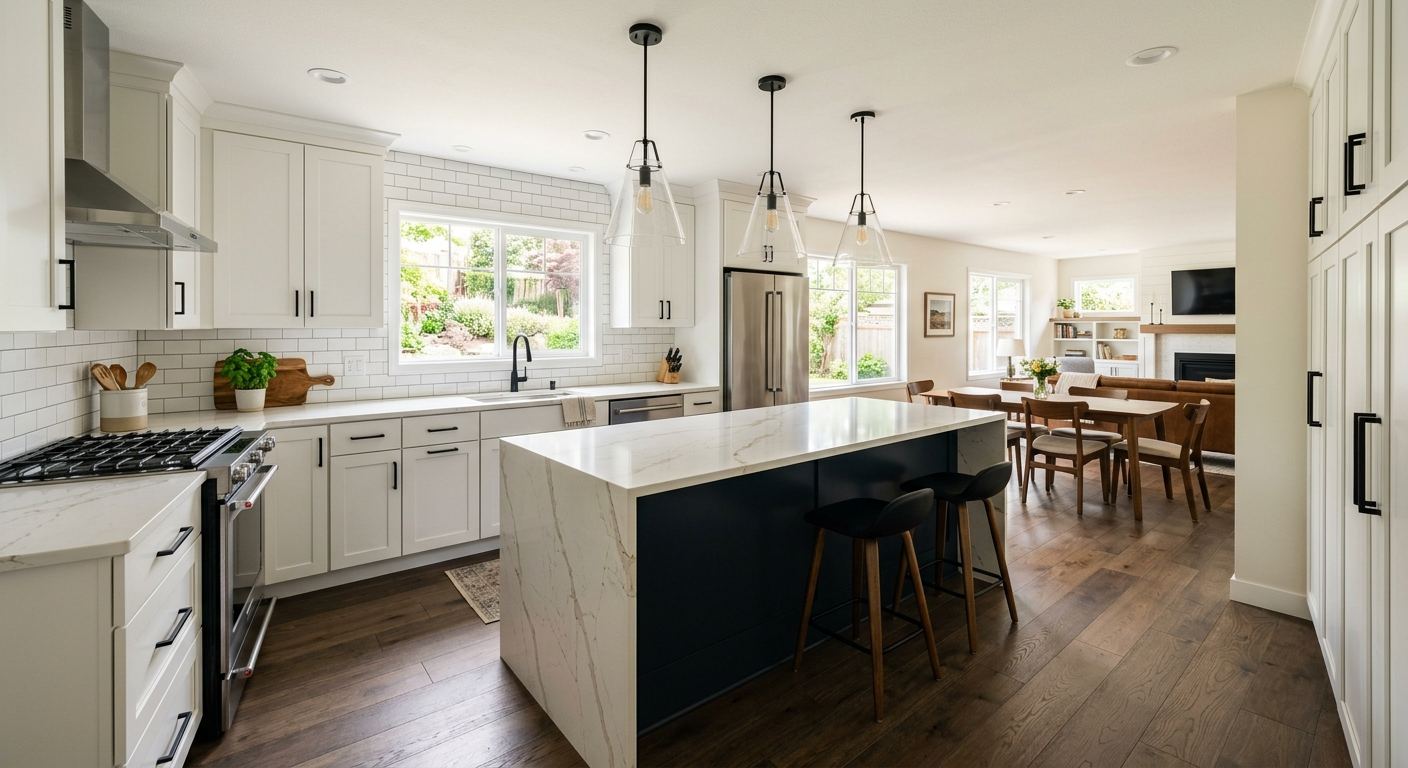
Kitchen renovation options and costs in Steeles
Steeles homeowners typically have a wide range of kitchen renovation options, and costs usually track the finish level and how much the layout changes—not the weather. In Steeles, the local market context matters: the area’s population is 24,623 (Statistics Canada, 2021 Census), and many buyers nearby are in established neighbourhoods where kitchens are expected to look “complete” and contemporary. That expectation pushes more owners toward quartz, upgraded hardware, and semi-custom cabinetry compared with older, smaller-sample “refresh” jobs.
In the Toronto economic region, contractors see different budgeting behaviour based on nearby home values and household purchasing power. Higher-value pockets commonly justify investing roughly 8–15% of home value into a kitchen, while more price-sensitive homeowners often aim for the mid-range. On top of that, Toronto-area supply chains and labour capacity are generally strong, so scheduling is predictable for standard cabinet builds. The biggest local cost sensitivity tends to come from site conditions common in older housing stock—tight hallways, partial basement access for plumbing runs, and the need to protect floors during removal and installation.
Even though Ontario climate doesn’t “drive” renovation pricing directly, it does influence execution: winter indoor humidity swings and cold sub-surfaces can affect adhesive curing for tile and backsplash, and it can slow down caulking and grout timelines if the home isn’t kept at stable temperatures. For Steeles specifically, trade demand is especially high for renovation-and-replacement work in and around the Highway 7 / Steeles Avenue corridor, where families are moving within the area and upgrading for resale. With that in mind, here’s a practical comparison of renovation tiers to help you budget before you request quotes.
| Renovation Tier |
What's Included |
Typical Duration |
Price Range |
| Cosmetic refresh (paint, hardware, new appliances only) |
Cabinet paint/stain (if applicable), new hardware, backsplash touch-up only (if needed), appliance swap (fridge/range/dishwasher range hood as specified) |
1–3 weeks |
$8,000–$18,000 |
| Mid-range full renovation (new cabinets, counters, sink, tile) |
New semi-custom or good-quality stock cabinets, quartz or upgraded laminate countertops, sink + faucet, backsplash tile, new baseboard/trim where needed, disposal connection |
4–7 weeks |
$25,000–$55,000 |
| High-end full renovation (custom cabinets, stone counters, island) |
Fully custom cabinetry, natural stone or premium quartz, island with seating, upgraded lighting (including under-cabinet), tile to ceiling or feature wall, sink relocation |
7–12 weeks |
$65,000–$90,000 |
| Cabinet refacing only (new doors + drawer fronts, same boxes) |
Door and drawer front replacement, new pulls/handles, new veneer finish, minor adjustments, optional crown/trim refresh |
2–4 weeks |
$8,000–$25,000 |
| Countertop swap only (laminate to quartz or stone) |
Remove old tops, template, install new countertop, seam finishing, sink cut-out adjustments if needed |
1–2 weeks |
$3,000–$15,000 |
| Backsplash tile installation only |
Tile supply and installation (ceramic/porcelain), waterproofing prep as needed, grout/caulk, cut-outs for outlets |
5–10 working days |
$2,000–$10,000 |
Prices are estimates only and vary by project scope, site access and material selection.
What affects the price of kitchen renovation in Steeles
In Steeles and across the Toronto economic region, two homeowners can receive quotes that differ by 30–50% for what sounds like the same kitchen. The reason is that “same job” often means different assumptions: which cabinet tier is used (stock vs semi-custom vs custom), whether the countertop is quartz or natural stone, and whether your contractor includes electrical upgrades, disposal rerouting, or permit-ready scope for licensed trades.
Local home values and median household income expectations shape the finish tier far more than climate. In high-value areas, homeowners frequently default to quartz or stone counters and semi-custom cabinetry because the upgrade is easier to recover on resale. In more price-sensitive markets, laminate and stock cabinets dominate, because they deliver a noticeable look for less money while keeping total spend within realistic resale comfort. In Steeles, many projects sit in the mid-range—cabinet and counter packages often land around the $25,000–$55,000 band—while larger layout-driven builds with islands push toward the $65,000–$90,000 high-end range.
Layout changes are the most unpredictable cost regardless of finish. Removing a wall or adding an island sounds “cosmetic” to some homeowners, but it can trigger structural assessment, new footings/bracing, and longer plumbing and electrical runs. For dollar impact, relocating plumbing supply/drain can add multiple days of labour and materials; moving a gas line (if applicable) usually requires a licensed gas fitter and adds inspection and scheduling complexity. Flooring transitions also matter: if you’re replacing or refinishing hardwood or protecting it during demo, labour can increase even when cabinet and counter selections stay budget-friendly.
Concrete Steeles examples I see often: (1) older homes with dated rough-ins sometimes force cabinet adjustments because supply shut-offs are in inconvenient spots; (2) if your kitchen has a narrow staircase or tight turn, hauling in full-height cabinets takes longer and can require floor protection plans; (3) backsplash tile can get more expensive when outlet relocation or additional waterproofing is discovered after demo.
| Price Factor |
Why It Matters |
Cost Impact |
| Cabinet tier — stock vs. semi-custom vs. fully custom millwork |
Tier determines build quality, door styles, adjustability, and fitting time during install |
Small refresh: lower end; full renovation: often the biggest driver (tens of thousands) |
| Countertop material — laminate vs. quartz vs. granite vs. stone |
Material price, edge profiles, and fabrication/seaming complexity change install cost and lead times |
Laminate tends to keep budgets in the low–mid range; quartz/stone moves higher |
| Layout change — wall removal, island add, plumbing/gas move |
Triggers trade involvement, possible permits, and additional rough-in work |
Can jump a project by ~10–30% even with similar finishes |
| Appliance package tier — builder vs. mid-range vs. pro-grade |
Stainless finish quality, ventilation requirements, and fit/finish tolerances vary |
Higher-end units can add several thousand dollars |
| Flooring — refinish existing vs. full replacement |
Demo and replacement add time; matching existing floors can be difficult |
Refinishing usually saves money; replacement can add substantial labour/materials |
| Backsplash — ceramic tile vs. marble vs. full-height slab |
Material cost and installation time scale with weight, cutting complexity, and finish level |
Ceramic is budget-friendlier; slab options move toward the top end of backsplash budgets |
| Electrical — new circuits for island, under-cabinet lighting |
New circuits require licensed work and inspection; lighting adds wiring and fixtures |
Often a few thousand dollars depending on circuit scope and fixture count |
| Permit fees and licensed trade requirements |
Permits, inspections, and licensed scheduling can change timelines and add line-item costs |
Necessary for specific work; can add fees plus coordination labour |
Permits & regulations in Ontario
In Ontario, not every kitchen update triggers permits, but you should assume that any change to plumbing, gas, structural elements, or electrical will. Cabinet and countertop swaps typically do not require a permit because you’re not altering building systems. However, moving plumbing supply or drain lines, relocating a gas stove/range, changing a gas range hood setup (especially if vented with gas-connected components), removing a load-bearing wall, or adding new electrical circuits for an island or additional outlets generally requires permits and licensed trades.
To keep your Steeles renovation smooth, use a simple verification process before you sign: first, confirm the contractor’s Ontario licence information (and that the specific licensed trades are booked for gas work and electrical). Second, ask for a certificate of insurance (liability) naming the job site, and verify coverage limits are appropriate for renovation work. Third, request evidence of WSIB/WCB coverage where applicable and confirm they are reporting in good standing. If subcontractors are used, make sure they provide their own proof of coverage and licences for their scope.
Step-by-step homeowner check: (1) request the contract and scope breakdown; (2) identify every item that mentions plumbing/gas/electrical/structural; (3) ask the contractor what permits are required and who pulls them; (4) verify insurance certificates and WSIB/WCB coverage dates; and (5) keep copies of everything in your project binder so you can reference it if there’s an inspection or warranty claim later. Always confirm permit responsibility in writing—permit pull belongs in the contract, not in verbal assurances.
Cabinets, countertops and layout decisions in Steeles
The three biggest decisions in a Steeles kitchen renovation are cabinet tier, countertop material, and layout. (1) Cabinet tier controls speed, fit, and long-term visual quality: stock cabinets are fastest and cheapest; semi-custom is the most common mid-range choice in Toronto because it balances style with installation efficiency; custom cabinetry is highest cost but can solve awkward spaces and deliver a “built-in” look. (2) Countertops control daily wear and maintenance: laminate can look good on day one but is more sensitive to impact and heat; quartz offers a consistent surface and usually the best care-for-cost balance; granite and natural stone add premium appearance but require more attention and different sealing/maintenance expectations. (3) Layout changes—open-concept wall removal, island addition, or plumbing/gas relocation—are justified only when you’re gaining meaningful usability and can accommodate rough-in work.
Toronto resale buyers often expect modern lines, durable surfaces, and practical storage. That’s why projects in the mid-range ($25,000–$55,000) commonly pair semi-custom cabinetry with quartz or a premium laminate countertop. In contrast, high-end builds ($65,000–$90,000) frequently add an island and upgrade lighting to under-cabinet LEDs, which makes quartz/stone look even better in real-life daylight. Ontario’s winter indoor temperature swings also reinforce good practice: your installer should maintain stable indoor conditions for tile setting and caulking so finishes cure properly and don’t crack prematurely.
A realistic dollar example: if you’re deciding between laminate and quartz on a standard-sized kitchen run, the upgrade can be enough that you can’t treat it as “free”—but it may still be worth it. When the project is already in the mid-range, moving to quartz often costs more than a simple backsplash refresh yet delivers a noticeable quality jump and better day-to-day resilience for a busy household. If your kitchen’s layout is staying the same, spending extra on cabinets and countertops usually performs better for resale than spending the same amount on minor layout tweaks that don’t improve traffic flow.
| Option |
Durability |
Maintenance |
Best For |
Price Range |
| Stock cabinets (big-box) |
Good everyday durability, but fewer sizing options for odd spaces |
Low maintenance; depends on door finish quality |
Fast timelines and budget-first refreshes |
$8,000–$20,000 |
| Semi-custom cabinets (local dealer) |
Excellent durability with better sizing and stronger hardware options |
Low maintenance; easier to fine-tune fit |
Most common Steeles projects aiming for a resale-friendly look |
$18,000–$40,000 |
| Custom cabinets (local millwork shop) |
Highest build precision; best for unique layouts and full-height detailing |
Low maintenance; premium materials often last longer |
High-end renovations with islands and complex storage |
$35,000–$70,000 |
| Laminate countertop |
Decent for normal use; less forgiving for impact and heat |
Wipe clean; avoid abrasive pads and direct hot items |
Budget-conscious updates and smaller refreshes |
$3,000–$7,000 |
| Quartz engineered countertop |
Very durable; strong resistance to everyday staining and chipping |
Minimal—regular cleaner and gentle cloth is usually enough |
Busy families wanting premium look without stone fuss |
$7,000–$15,000 |
| Granite / natural stone countertop |
Highly durable; can handle heat better than many man-made options |
Occasional sealing and careful cleaning to protect the surface |
Premium appearance and a natural variation look |
$10,000–$18,000 |
| Butcher block countertop |
Durable with proper care; can scratch and mark more easily |
Oil and maintain regularly to prevent drying and staining |
Warm aesthetic and homeowners who like upkeep |
$6,000–$14,000 |
| Marble countertop |
Beautiful but more porous; can be more sensitive to acids and staining |
Requires diligent sealing/cleaning and prompt spill wipe-up |
Statement kitchens where the homeowners manage care expectations |
$12,000–$22,000 |
How to choose a kitchen renovation contractor in Steeles
Choosing the right contractor in Steeles comes down to verification, clarity, and risk control. Start with Ontario licensing: ask which trade types are licensed for your project scope (especially gas work and electrical). Next, request proof of liability insurance and make sure the certificate matches the contractor and job location. For coverage, ask for WSIB/WCB documentation (or the applicable clearance evidence) so you’re not stuck covering worker-related liabilities. If a contractor uses subcontractors, insist that they provide their own licence and coverage documentation for their portion of the job.
Then get 2–3 itemised, written quotes. You want line items for labour and materials—not a single lump sum—so you can compare like-for-like: cabinet supply, cabinet install, countertop fabrication/installs, sink cut-outs, tile prep and grout, appliance delivery/haul away, and any allowance for electrical or plumbing changes. Scope clarity matters: confirm what’s excluded (for example, drywall patching beyond a defined scope, permit costs, or demolition disposal). Ask whether the contractor pulls permits where required and whether disposal and haul-away are included.
Warranty and payment scheduling are also key. Use a workmanship warranty stated in years, verify the product/manufacturer warranty terms, and ask whether warranties are transferable if you sell. Payment should stay conservative: never pay more than 10–15% upfront, and hold back a meaningful amount until the job is complete and punch-list items are resolved. Finally, insist on a start date and completion estimate in writing, including dependencies like countertop fabrication lead time.
- Ask for licence and insurance documentation before work begins.
- Confirm WSIB/WCB coverage and that it applies to the crew assigned.
- Request 2–3 itemised quotes with labour and materials breakdowns.
- Check if permit fees and permit pulls are included when required.
- Confirm disposal/haul-away is included (demo, packaging, and old appliances).
- Verify who is responsible for field measurements and countertop templating.
- Ensure electrical/plumbing/gas rough-ins are listed when part of scope.
- Ask about backsplash waterproofing and tile substrate prep process.
- Get a written timeline that includes material lead times.
- Use a clear warranty statement for workmanship and products.
- Keep payments within 10–15% upfront; hold back until punch-list completion.
- Review exclusions carefully: what happens if your site conditions differ?
Concrete red flags I see with kitchen renovation contractors in Steeles: (1) quotes that omit cabinet install time, electrical allowance, or countertop templating; (2) refusal to put permit responsibility in the written contract; (3) missing or outdated insurance/coverage documents; (4) “cash only” payment pressure or asking for large upfront deposits; and (5) vague warranty wording that doesn’t specify workmanship duration or what’s excluded.
Frequently asked questions — kitchen renovation in Steeles
How do I know if I need to update my kitchen plumbing in Steeles?
If you’re in Steeles (Ontario), plumbing updates aren’t always required for a facelift, but they’re often discovered once cabinets come off. Look for signs such as slow drains, frequent shut-off valve issues, leaks under the sink, corrosion at supply lines, or noticeable water staining behind toe-kicks. Homes with older rough-ins may also have pipe runs that don’t align well with modern cabinet base heights. If you’re changing the sink location, adding a dishwasher, or moving the plumbing supply/drain to support an island, you should expect plumbing work and possibly permits. For budgeting, plumbing-related scope can push you upward within your kitchen budget band; for example, a modest refresh can move toward the mid-range if new rough-ins are needed. A contractor should inspect shut-offs and waste lines before finalizing your quote.
What is the difference between a galley and open-concept kitchen?
A galley kitchen is a narrow, corridor-style layout with counters and/or cabinetry on two parallel walls. It’s efficient for workflow and can be easier to renovate because service lines are often already concentrated, but adding an island is frequently difficult without reworking plumbing/electrical or sacrificing walkway space. An open-concept kitchen combines kitchen space with living/dining areas, usually through wall removal or a wider opening, which can change the way buyers evaluate the home’s “feel.” In Steeles, the Toronto resale market often favours kitchens that look bright and connected, so open-concept designs are common in higher spend projects. However, wall removal is a higher-risk scope: it may involve structural review, permits, and licensed trades. If you’re choosing between options, remember that layout changes typically cost more than finish upgrades alone—even if your cabinet tier stays the same.
How do I get accurate kitchen renovation quotes in Steeles?
Accurate quotes in Steeles start with complete information: a site visit, clear measurements, and a written scope that lists what’s included. Ask for an itemised quote showing labour and materials separately for cabinets, countertop fabrication/installation, sink/faucet, backsplash, electrical, plumbing/gas work (if any), tile prep, and disposal. Make sure the contractor includes whether permits are needed and who pulls them. Also confirm exclusions—often overlooked items include drywall patching beyond a set area, floor repairs after demo, and any electrical changes for under-cabinet lighting or island outlets. Finally, insist on realistic allowances for appliances and any upgrades. If you compare quotes using a known band—for example, a full renovation budget of $25,000–$55,000 versus $65,000–$90,000—make sure both proposals use comparable cabinet and countertop tiers so you’re not comparing different scopes.
What's the best countertop material for a busy Steeles kitchen?
For most busy households in Steeles, quartz is often the best balance of durability, look, and low maintenance. It handles everyday staining well, resists many common kitchen mishaps, and doesn’t require the same routine sealing expectations as natural stone. If you want a warmer, wood aesthetic and you’re willing to maintain it, butcher block can work well—just plan for regular oiling and prompt spill care. Laminate is typically more budget-friendly and can fit into lower-cost plans, but it’s generally less forgiving for heat and can be more vulnerable to impact along seams. Granite/natural stone offers premium appearance and strong durability, while marble is beautiful but needs careful cleaning and sealing discipline because it can be more sensitive to acidic spills. If you’re budgeting, quartz often supports a kitchen in the mid-range tier (commonly within the $25,000–$55,000 band), while stone upgrades can push you toward the higher end depending on island size and edge profiles.
How do I add an island to my Steeles kitchen?
Adding an island is most cost-effective when there’s enough room for circulation and when you plan rough-ins early. The key question is whether the island needs plumbing and/or electrical. If you’re adding a sink or dishwasher in the island or planning pendant lighting and outlets, you’re effectively expanding the building systems—this usually increases labour, can require permits, and involves licensed electrical work and, if plumbing is added, plumbing approvals. If you’re only adding a “decorative” island with no services, the scope can be simpler, but you still need to confirm that cabinetry walls and floor support are suitable. In many Steeles homes, tight hallways can also affect delivery and install sequencing. A practical approach: measure aisle clearance first, then decide on service needs. If your island plan nudges your project from a refresh toward a full renovation, it commonly moves you into the $25,000–$90,000 range depending on whether you’re staying mid-range or going high-end with custom cabinetry and premium countertops.
How much does a kitchen renovation cost in Steeles?
For Steeles homeowners, realistic kitchen renovation budgets usually fall between a modest refresh and a full, finish-forward rebuild. A cosmetic refresh (paint, hardware, and new appliances only) often starts around $8,000–$18,000, but that won’t change cabinet boxes or countertop surfaces substantially. For a mid-range full renovation with new cabinets and counters, many projects land in the $25,000–$55,000 range. If you’re aiming for a high-end kitchen with custom cabinetry, stone countertops, and an island plus upgraded lighting, budgets commonly rise into the $65,000–$90,000 range. Final cost depends most on cabinet tier, countertop material, and whether you’re changing the layout (especially moving plumbing/gas or adding electrical circuits). Also account for site factors common to older Toronto-area homes, such as narrow access, dated rough-ins, and the amount of prep needed before tile and finishes can be set.