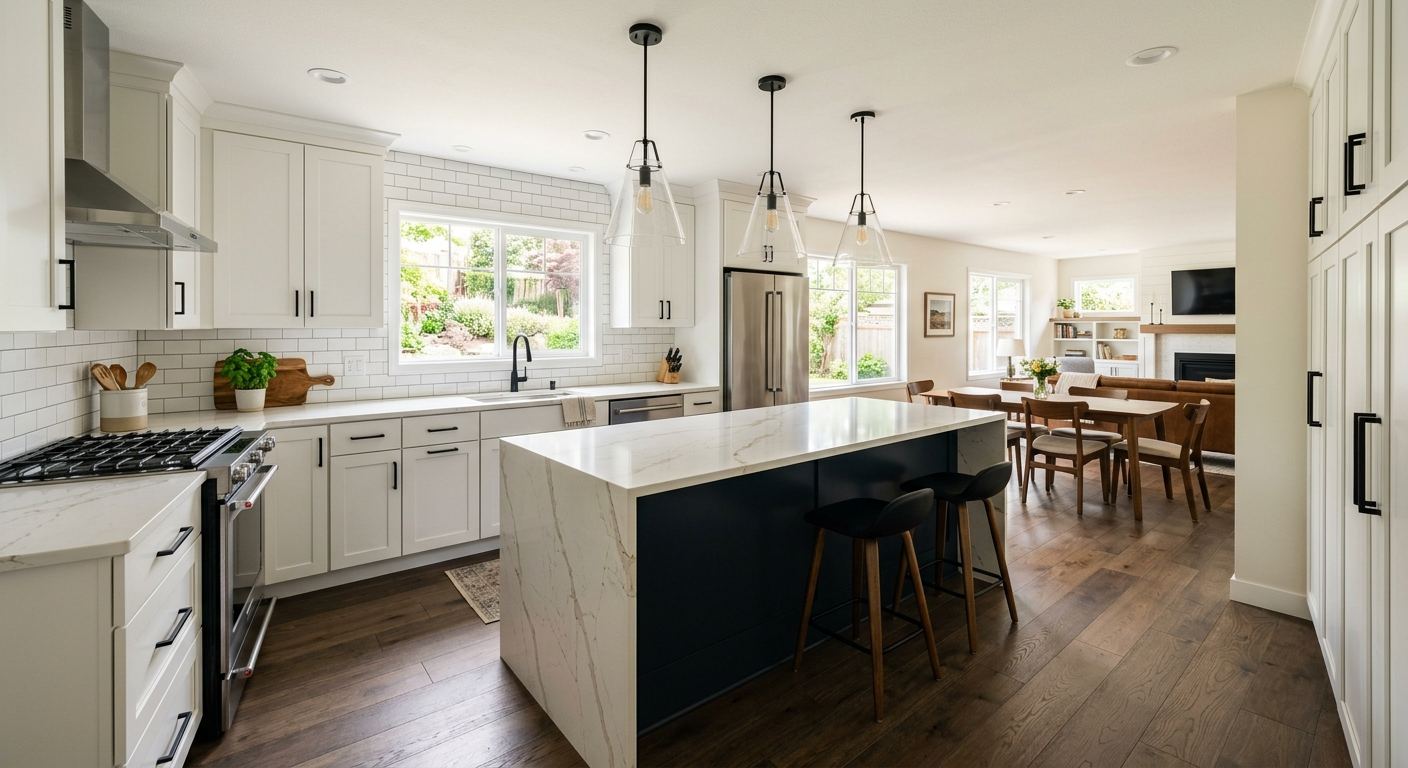
Kitchen renovation options and costs in Stanley Park
Stanley Park, Ontario is a great place to plan a kitchen refresh, especially for homeowners who want a clean, modern look that matches the expectations of the broader Toronto market. With a population of 7,181 residents in 2021 (Statistics Canada, 2021 Census), the neighbourhood has a close-knit feel, and local contractors often stay busy with repeat clients and referrals. In the Toronto economic region, kitchen budgets usually track local home values and the level of finishes people expect—Toronto buyers commonly spend for quality because the improvement is easier to recover at resale. As a rule of thumb used across GTA projects, higher-value pockets tend to invest more heavily, often landing in a range where owners choose quartz or natural stone and upgraded appliances, rather than minimal cosmetic work.
Toronto pricing is also shaped by supply-and-demand: when cabinet shops and countertop fabricators are booked, labour scheduling tightens and installation durations can stretch. Winter conditions add a practical layer too—cold temperatures can slow some trades (like flooring acclimation and certain paint or caulking workflows), and older homes can have surprises behind walls. Demand is especially strong around family-oriented streets and busy corridors where homeowners balance day-to-day living with a full renovation—commonly seen in the broader “Stanley Park / nearby Toronto neighbourhoods” build cycle where designers and installers coordinate cabinet delivery timing.
Below are realistic renovation tiers and what you can expect in Stanley Park, so you can compare quotes apples-to-apples before you book site measurement.
| Renovation Tier |
What's Included |
Typical Duration |
Price Range |
| Cosmetic refresh (paint, hardware, new appliances only) |
Cabinet paint/finish, new hardware, paint touch-ups, appliance replacement (no major plumbing/electrical changes), basic clean-up and re-caulk where needed |
3–7 days |
$6,000–$18,000 |
| Mid-range full renovation (new cabinets, counters, sink, tile) |
New or upgraded semi-custom cabinets, quartz or quality laminate counters, sink + faucet, backsplash tile, new or refreshed flooring plan, standard electrical refresh as needed |
3–6 weeks |
$25,000–$55,000 |
| High-end full renovation (custom cabinets, stone counters, island) |
Fully custom millwork, premium quartz or natural stone (granite/marble), island build, upgraded appliance package, full backsplash (often extended), detailed trim work |
6–10 weeks |
$70,000–$90,000 |
| Cabinet refacing only (new doors + drawer fronts, same boxes) |
Door and drawer front replacement, new veneer/finish on cabinet boxes, hinge adjustments, hardware swaps, basic touch-up and caulking |
1–3 weeks |
$8,000–$25,000 |
| Countertop swap only (laminate to quartz or stone) |
Remove existing top, new quartz/stone template and install, sealing and edge work, sink cut-out changes if needed (no major cabinet moves) |
5–12 business days |
$3,500–$15,000 |
| Backsplash tile installation only |
Surface prep, tile layout and install, grout/seal where needed, trim/edge finishing around outlets (no cabinet or counter replacement) |
3–7 days |
$2,000–$10,000 |
Prices are estimates only and vary by project scope, site access and material selection.
What affects the price of kitchen renovation in Stanley Park
Two homeowners in Stanley Park can receive quotes that differ by 30–50% for what looks like “the same kitchen,” and it’s usually not because of the season—it’s because of what’s hiding inside the scope and how the contractor prices risk. In the Toronto economic region, home values and household expectations steer what finish tier people choose far more than climate. When homeowners are aiming to match or improve resale value, they often default to quartz or stone counters and semi-custom cabinetry, even if the layout stays similar. In more price-sensitive situations, laminate and stock or refaced cabinets become the cost-control lever because the ROI target is “upgrade feel without overbuilding.” In both cases, labour rates and material pricing are broadly consistent across the GTA, but the finish tier and scope complexity change your total quickly.
Layout work is the most unpredictable: removing a wall, adding an island, or moving plumbing or a gas line can swing costs regardless of whether you choose mid-range counters around $25,000–$55,000 or you push into a higher-end build near $70,000–$90,000. For concrete Stanley Park examples, older kitchens sometimes have out-of-plumb walls that require more labour hours for cabinet alignment; also, tight downtown-style footprints can force extra framing, custom toe kicks, or rework around existing vents. Finally, winter scheduling can lengthen the job slightly—tile and flooring installs need stable conditions, and some adhesives and sealants perform best when the space can be kept within workable temperature ranges.
| Price Factor |
Why It Matters |
Cost Impact |
| Cabinet tier — stock vs. semi-custom vs. fully custom millwork |
Quality of hinges, internal storage, finish durability, and how much custom fitting is required on site |
Large swing: cabinet portion alone can vary by roughly 2–3x between stock and fully custom |
| Countertop material — laminate vs. quartz vs. granite vs. stone |
Material cost, templating complexity, edge profiles, and install crew requirements |
Medium to large swing: laminate is lowest; natural stone tends to push higher-end budgets |
| Layout change — wall removal, island add, plumbing/gas move |
Extra framing, potential structural assessment, and trade coordination for rough-in and inspections |
Can add major unplanned costs; often the biggest driver of quote variation |
| Appliance package tier — builder vs. mid-range vs. pro-grade |
Width/fit differences, ventilation requirements, power needs, and spec-specific installation time |
Moderate: appliance pricing varies widely, but labour changes are usually smaller than layout changes |
| Flooring — refinish existing vs. full replacement |
Subfloor condition and how difficult it is to blend transitions after removing cabinets |
Moderate: full replacement often increases both material and labour |
| Backsplash — ceramic tile vs. marble vs. full-height slab |
Surface prep time, tile cutting complexity, and material weight/handling |
Small to medium, but full-height or slab work can become a large portion |
| Electrical — new circuits for island, under-cabinet lighting |
Licensed electrician time, new wiring runs, and coordination with countertop/cabinet install |
Usually adds noticeable cost when outlets/lighting are moved or added |
| Permit fees and licensed trade requirements |
Permits and inspections increase admin time and can require schedule adjustments |
Small to medium, but can add delays if work isn’t planned early |
Permits & regulations in Ontario
In Ontario, many typical kitchen cosmetic updates and finish swaps can be done without a permit—cabinet and countertop swaps are the usual example. However, when you change the plumbing or gas system, remove load-bearing walls, or add electrical work, permits and licensed trades are commonly required. Moving a water supply or drain line, relocating a gas stove or altering a gas-fired appliance setup (including some range hood scenarios), removing a load-bearing wall, or adding new circuits (for an island receptacle cluster or under-cabinet lighting with new feed) are the kinds of work that generally trigger permit requirements and inspections.
For Stanley Park homeowners, the safest approach is to treat permits as a scope item, not a contractor “surprise.” Step one: before signing, ask the contractor to list each task and identify whether it is permit-required. Step two: confirm trades are licensed—gas work should be performed by a licensed gas fitter, and electrical work by a licensed electrician. Step three: verify proof of coverage. Request a current certificate of insurance (and WSIB/WCB clearance where applicable) and ask how they will handle site safety and inspections.
Finally, confirm in writing who pulls the permit, who schedules inspections, and what happens if an inspection reveals needed corrections. Clarity here protects you from cost overruns during an already time-sensitive countertop or cabinet schedule.
Cabinets, countertops and layout decisions in Stanley Park
Your three most consequential decisions in a Stanley Park kitchen renovation are: (1) cabinet tier, (2) countertop material, and (3) layout changes. Cabinet tier impacts fit, storage options, and how fast the project can be completed. Stock cabinets are typically fastest and cheapest, semi-custom is the most popular mid-range choice because you get better door/style options and some sizing flexibility, and fully custom millwork is where you pay for a perfect fit and premium interiors.
Countertop choice is where maintenance meets budget. Laminate is economical and durable for everyday use, while quartz offers a strong balance of stain resistance and lower maintenance. Natural stone like granite or marble looks high-end and can perform well, but marble in particular needs more care (sealing and quicker clean-up of acidic spills). Climate affects install practicality more than material performance: in Toronto winters, keeping consistent indoor temperatures supports curing timelines for adhesives, grouts, and sealants, and that reduces rework risk.
Layout decisions are where space gains become worth the cost. If you add an island or open an underused wall, you’re improving flow for daily living and aligning with what many Toronto buyers expect in updated kitchens. But moving plumbing or a gas line is often the point where the budget jumps fastest—sometimes more than upgrading finishes. For example, swapping from laminate to quartz might add several thousand dollars, but relocating plumbing can add labour and trade coordination costs that can push the project toward the higher tier instead.
| Option |
Durability |
Maintenance |
Best For |
Price Range |
| Stock cabinets (big-box) |
Durable for daily use; less flexibility for odd wall lines |
Easy; touch-ups depend on finish type |
Quick refresh with standard measurements |
$8,000–$18,000 |
| Semi-custom cabinets (local dealer) |
Very good daily durability with better hardware and finish options |
Easy—typical wipe-down and standard hardware care |
Most Stanley Park renovations aiming at resale-ready upgrades |
$18,000–$35,000 |
| Custom cabinets (local millwork shop) |
High durability with tailored storage and tighter build fit |
Easy to maintain; best results with proper ventilation and cleaning |
Unique layouts, premium interiors, and perfect fit |
$35,000–$70,000 |
| Laminate countertop |
Good for everyday cooking; edges are the vulnerability point |
Low; avoid burning and prolonged wetness at seams |
Budget-conscious projects that still look updated |
$3,000–$7,000 |
| Quartz engineered countertop |
Very durable; resistant to stains and everyday wear |
Low; routine soap-and-water care |
Busy households needing a “set it and forget it” surface |
$7,000–$12,000 |
| Granite / natural stone countertop |
Strong durability; heat tolerance varies by stone type |
Moderate; typically benefits from periodic sealing |
Premium look with natural variation in veining |
$10,000–$15,000 |
| Butcher block countertop |
Durable with proper care; can dent if abused |
Higher care; oiling and prompt spill management |
Warm, casual styles and kitchens with mindful maintenance |
$6,000–$11,000 |
| Marble countertop |
Beautiful but softer; can scratch and etch |
Higher care; sealing and fast cleanup for acidic foods |
Statement kitchens where appearance is the priority |
$12,000–$18,000 |
How to choose a kitchen renovation contractor in Stanley Park
Choosing the right kitchen renovation contractor in Stanley Park starts with proof, not promises. First, verify Ontario licensing: electrical work must come from a licensed electrician, and gas work requires a licensed gas fitter. Ask for their contractor licence details where applicable and confirm the company’s liability coverage. Request a certificate of insurance and, where relevant to the job scope and staffing, WSIB/WCB clearance documentation. Step-by-step, you can check licensing and coverage by reviewing the certificates you’re given, then cross-referencing any licence identifiers online through Ontario trade registries.
Next, collect 2–3 itemised written quotes with a clear breakdown of labour and materials—don’t accept vague “includes cabinetry and install” wording. Make sure the scope is specific: what is excluded (removal/disposal, subfloor repair, drywall patching, caulking, trim), whether the permit is included, and who handles any inspection scheduling. Pay attention to timelines: the start date and estimated completion should be written, not discussed only verbally.
For payment, never pay more than 10–15% upfront. Hold back a portion until key milestones are complete (cabinet install verified, countertop templated/installed, punch list resolved). Finally, confirm warranty terms: workmanship coverage length, manufacturer warranty for cabinets/countertops, and whether the warranty is transferable to you if ownership changes.
- Ask for licences/coverage before signing: liability insurance and WSIB/WCB status.
- Get 2–3 itemised quotes (labour + materials), not a single lump sum.
- Confirm who pulls permits and whether permit fees are included.
- Clarify disposal: does the price include demo haul-away and recycling?
- Check exclusions: lighting fixtures, trim, patch/paint, underlayments, and flooring transitions.
- Verify cabinet tolerances and how they handle out-of-square walls.
- Confirm countertop lead times and who pays if fabrication delays occur.
- Ask about product warranties and whether they transfer on resale.
- Require a written start date and a completion estimate.
- Insist on a detailed change-order process with written approvals.
- Make sure electrical/plumbing/gas subs are scheduled and coordinated.
- Use a reasonable payment schedule with a holdback until punch list completion.
Red flags I watch for in Stanley Park are: quotes that are not itemised (you can’t compare apples-to-apples), refusal to provide insurance or trade proof, a “we’ll handle permits” promise without details of who is responsible, unrealistic timelines that ignore cabinet/counter lead times, and payment requests that exceed 10–15% upfront without milestone-based releases.
Frequently asked questions — kitchen renovation in Stanley Park
How do I choose a kitchen contractor in Stanley Park?
Start by comparing 2–3 itemised, written quotes so you can see labour and materials separately. In Ontario (including Stanley Park), you should also verify licensing and coverage: electrical work must be done by a licensed electrician, gas-related work by a licensed gas fitter, and the company should provide liability insurance documentation and WSIB/WCB clearance where relevant to the job. Ask who pulls permits and whether permit fees are included, because plumbing/gas/electrical changes are where costs can jump. Finally, choose a contractor who can explain schedule details—cabinet and countertop lead times—so the project doesn’t stall mid-way. If your scope is closer to a mid-range budget (for example, $25,000–$55,000), insist the quote reflects realistic coordination, not just a rough estimate.
What order do kitchen renovation steps happen in?
A typical order in Ontario kitchens is: (1) site measurement and final design confirmations, (2) demolition and protection of the rest of the home, (3) rough-in for plumbing/electrical (only where needed), (4) inspections if permits are required, (5) drywall patching/repairs and prep work, (6) flooring updates or subfloor corrections, (7) cabinet install and level/fit checks, (8) countertop templating and fabrication, (9) countertop install, sink set, and final caulking/sealing, (10) backsplash tile and trim, and (11) final appliance hookups and punch list. Even if your budget is in the cosmetic range, sequencing matters—paint and hardware should align with cabinet finish cure times. In practice, Toronto projects often slow down when countertop templates aren’t scheduled promptly, so a contractor who locks dates early usually protects your timeline.
Can I live at home during a kitchen renovation in Stanley Park?
Many homeowners do stay in their home during a renovation in Stanley Park, especially for cosmetic refreshes or cabinet/countertop-only work. However, for full renovations (new cabinets, tile, sink changes, or any plumbing/electrical adjustments), living arrangements depend on dust control, access, and how much of the kitchen you’re without. A good contractor sets up a functional “safe kitchen” zone—microwave/coffee area, temporary sink access if feasible, and clear pathways. Expect short disruption windows during demolition and cabinet install. Winter timing in Ontario can also affect ventilation and drying; dust containment and temperature stability help trades finish without rework. If you’re planning a mid-range full reno around $25,000–$55,000, discuss how long you’ll be without a usable sink and what temporary cooking setup they can support.
Should I renovate my kitchen before selling in Stanley Park?
Often yes—if you can target visible upgrades buyers pay attention to (cabinets, counters, lighting, and a clean layout). In the Toronto market, updated kitchens commonly help sellers present the home credibly, but you want to match the neighbourhood’s “expected finish tier.” If you overspend on fully custom millwork or premium stone without enough “comparables” support, you may not recover the full cost. That’s why many homeowners balance ROI with durable upgrades: semi-custom cabinets and quartz are a popular sweet spot, and a full renovation budget can land in the mid-to-high range (for example, $70,000–$90,000 for larger custom builds). Before signing, ask your contractor to suggest a finish tier that fits your home type and likely buyer profile, then get at least one quote for a more modest alternative so you can compare resale risk.
What's the most popular kitchen style in Stanley Park right now?
Right now, many Stanley Park and broader Toronto homeowners are leaning toward bright, modern-leaning kitchens: clean-lined cabinetry, matte or satin finishes, and quartz counters that look consistent and easy to maintain. Semi-custom cabinets are especially common because they balance design flexibility with a budget that doesn’t require fully custom millwork. In terms of layout, open-concept flow and practical island seating remain popular, but even when homeowners don’t fully remove walls, they often improve function with better lighting, storage upgrades, and an updated backsplash that ties the room together. Style choices usually correlate with budget tier—cosmetic refreshes focus on hardware/paint, while higher-end projects gravitate to stone counters and fuller custom details. If you’re aiming for a higher-end finish level, plan for the cost range that supports premium surfaces (often in the $70,000–$90,000 band for full renovations).
How do I know if I need to update my kitchen plumbing in Stanley Park?
You typically need plumbing updates if you’re moving fixtures, noticing recurring issues, or uncovering hidden deterioration during demo. If you’re keeping the sink in the same location and only swapping cabinets and counters, many homeowners can avoid extensive plumbing work. But if you’re changing the sink location, adding or relocating a dishwasher, upgrading tap style that requires different connections, or you suspect galvanized/old supply lines, plan for more than “just a countertop.” Also, any permit-required plumbing changes must be handled by qualified trades. A contractor should inspect under-sink shutoffs, supply lines, drain condition, and the venting arrangement before you lock in the design. In older Toronto housing stock, cold-weather water cycling can expose weak seals over time—so it’s wise to budget for repairs once walls are open, even if your initial goal was a mid-range refresh around $25,000–$55,000.