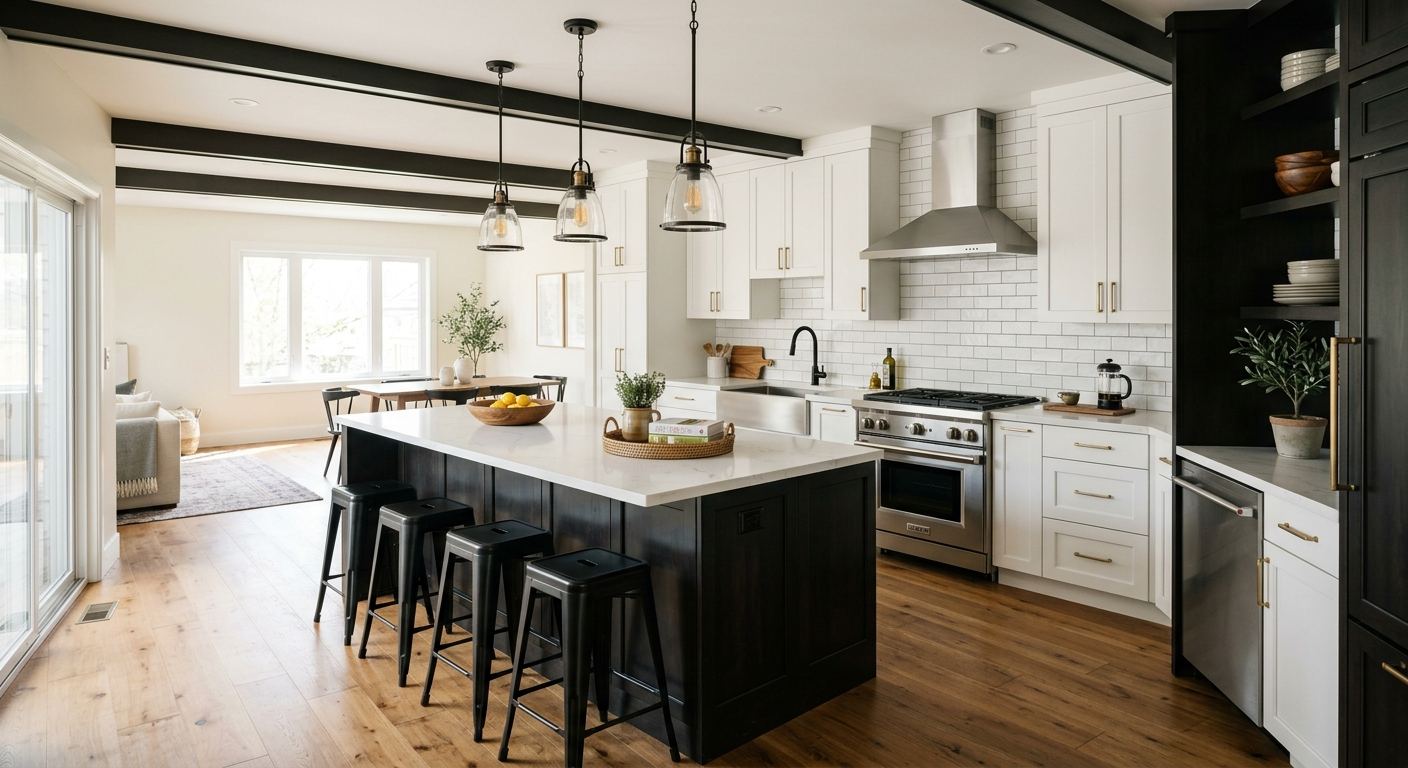
Kitchen renovation options and costs in Sarnia
Sarnia is a busy renovation market, and your kitchen budget here usually tracks the home you’re renovating and the resale expectations in the Windsor–Sarnia economic region—not the day-to-day weather. With a 2021 population of 72,047 and a median household income of $77,500 (Statistics Canada, 2021 Census), many homeowners plan kitchens as durable, mid-market upgrades that still feel “new” when they sell. In Sarnia, there’s also a strong share of owner households (21,935 homeowner households, 68.1% of households own), which typically means renovations are value-focused and scheduled carefully around long-term use.
Across Windsor–Sarnia, higher resale areas often justify better finishes (more quartz and semi-custom cabinetry), while more modest homes lean toward laminate or good-quality stock cabinets. Climate plays a secondary role: humidity and winter temperature swings can be hard on lower-quality particleboard shelves and can stress poorly sealed caulking at tile transitions, but overall the bigger drivers are material tier and labour availability. Homes built before 1981 make up 71.0% of the housing stock (Statistics Canada, 2021 Census), so older plumbing/electrical runs can add hidden costs when you open walls—even if your visible finishes are mid-range.
One neighbourhood where kitchen work is particularly in demand is Point Edward, where many owner-occupied homes are being refreshed to keep layouts functional and finishes modern for resale. If you’re comparing options right now, the table below gives the most common tiers and what you can realistically expect to pay in Sarnia.
| Renovation Tier |
What's Included |
Typical Duration |
Price Range |
| Cosmetic refresh (paint, hardware, new appliances only) |
Cabinet paint or restyle, new cabinet hardware, appliance swap, minor caulking/trim touch-ups, light fixture refresh |
3–7 days |
$6,000–$15,000 |
| Mid-range full renovation (new cabinets, counters, sink, tile) |
New cabinet install (stock or semi-custom), countertop and sink installation, backsplash tile, new faucets, ventilation re-fit (if needed), basic lighting updates |
3–6 weeks |
$25,000–$55,000 |
| High-end full renovation (custom cabinets, stone counters, island) |
Custom millwork, stone counters, island build, upgraded lighting plan, higher-end backsplash (tile feature or slab-look), possible layout refinishing including plumbing/gas relocation |
6–10+ weeks |
$55,000–$90,000 |
| Cabinet refacing only (new doors + drawer fronts, same boxes) |
Door and drawer front replacement, new hardware, new toe-kick trim (where required), re-install/fit adjustments, optional sink/faucet swap |
1–3 weeks |
$8,000–$30,000 |
| Countertop swap only (laminate to quartz or stone) |
Removal and install of new countertop, undermount sink connection adjustments, standard cut-outs for cooktop, basic sealant at transitions |
2–5 days |
$3,000–$15,000 |
| Backsplash tile installation only |
Remove existing finish (as required), tile supply and install, grout/seal at wet edges, caulking at countertop corners |
3–7 days |
$2,000–$8,000 |
Prices are estimates only and vary by project scope, site access and material selection.
What affects the price of kitchen renovation in Sarnia
In Sarnia and the broader Windsor–Sarnia region, two homeowners can receive quotes that differ by 30–50% for the “same” kitchen because contractors price risk, finish tier, and uncertainty differently. Local home values and median income steer expectations: when buyers can recoup more of the renovation on resale, homeowners more often choose quartz or stone counters and semi-custom cabinetry. In that scenario, the kitchen tends toward mid- to upper-tier specifications, and cabinetry typically becomes a larger portion of the budget. Where budgets are tighter, laminate countertops and stock cabinets dominate because they deliver a refreshed look without pushing the project into the higher bands.
That’s why a complete remodel in the $25,000–$55,000 range often includes good cabinets plus durable counters, while higher-end work with an island and premium stone pushes beyond that. Layout changes are the biggest wildcard regardless of finish level. Moving a wall, adding an island footprint, or relocating plumbing and gas lines can add trades time, wall repairs, and inspection steps—so even “moderate” finishes can become mid-market costly.
Concrete Sarnia examples we see often: (1) Older homes (many built before 1981) frequently have dated knob-and-tube remnants or undersized circuits, which increases electrical labour when adding under-cabinet lighting or upgrading to a hood vent strategy. (2) Homes near the waterfront or with older insulation details can experience seasonal moisture cycling, so we recommend proper backer board and membrane at wet-edge tile lines—cheap tile prep becomes expensive later. (3) During winter, countertops and adhesives need appropriate scheduling and ventilation to avoid cure delays, which can shift timelines more than the price, but it can still change labour scheduling costs.
| Price Factor |
Why It Matters |
Cost Impact |
| Cabinet tier — stock vs. semi-custom vs. fully custom millwork |
Material quality, hardware options, fit tolerances, and door/drawer design drive labour and cabinet pricing |
Can swing the largest portion of the budget; often the difference between a $25,000–$55,000 remodel and a higher-end project |
| Countertop material — laminate vs. quartz vs. granite vs. stone |
Durability, thickness, edge profiles, and fabrication complexity |
Typically another major variable; quartz is usually a mid-high cost step up from laminate, with natural stone higher |
| Layout change — wall removal, island add, plumbing/gas move |
More demo, structural/finishing work, and additional licensed trades time |
Often the most unpredictable; can add substantial labour and material beyond the countertop/cabinet line items |
| Appliance package tier — builder vs. mid-range vs. pro-grade |
Delivery, fit requirements, and electrical/venting changes vary by model |
Pro-grade packages can increase costs via venting, electrical, and specialized installs |
| Flooring — refinish existing vs. full replacement |
Subfloor condition, leveling, and match to countertop and cabinet base lines |
Refinish/refit can keep costs controlled; full replacement raises demo and install scope |
| Backsplash — ceramic tile vs. marble vs. full-height slab |
Prep quality, pattern matching, and material fragility affect labour time |
Can move a backsplash-only job from the lower band toward the upper band |
| Electrical — new circuits for island, under-cabinet lighting |
New outlets, lighting runs, and code-compliant circuit capacity require licensed electrician time |
Can add meaningful labour and materials even with “standard” finishes |
| Permit fees and licensed trade requirements |
Permit administration and inspection scheduling impacts cost certainty |
Varies by scope; layout/plumbing/gas changes are the most likely to require permits |
Permits & regulations in Ontario
In Ontario, a straightforward cabinet and countertop swap usually does not require a permit—because you’re not changing the location of plumbing/drain lines, relocating gas, removing a structural element, or adding new electrical circuits. That said, many “routine” kitchen projects become permit-relevant once you change the kitchen’s function: moving a sink supply or drain, relocating a stove or cooktop, changing venting tied to combustion appliances, or adding circuits for new island outlets and lighting are common examples that trigger permit/inspection requirements.
Typically requires permits and licensed trades: moving plumbing supply or drain lines; relocating gas for a stove or gas range; installing or changing major ventilation tied to gas appliances; removing a load-bearing wall; adding new electrical circuits/outlets (including island receptacles) and any code-driven rewiring changes. Typically does not require permits: painting/restyling cabinets, replacing cabinet boxes/doors in place, swapping countertops, installing a backsplash, and replacing an appliance with the same type of connection where no new circuits or service changes are made.
Step-by-step, here’s how Sarnia homeowners can verify a contractor before signing:
- Ask for their Ontario business details and check licensing/trade standing for involved trades (not just the renovation company).
- Request a Certificate of Insurance (liability) and confirm the policy is active; ask who the homeowner is protected from (named insured/added insured where applicable).
- Verify WSIB/WCB coverage where required for workers performing renovation work—request clearance evidence or documentation.
- Confirm in writing which work the contractor pulls permits for versus which permits you or a trade contractor are responsible for.
- Ensure the contract names trades, inspection milestones, and scheduling responsibility.
Cabinets, countertops and layout decisions in Sarnia
For most Sarnia kitchens, the three decisions that move both comfort and cost are: (1) cabinet tier, (2) countertop material, and (3) layout changes. Your choices should match the Windsor–Sarnia resale market expectations. When you’re targeting mid-market buyers, semi-custom cabinetry is often the sweet spot: it improves door styles, internal storage and fit while staying closer to stock pricing than full custom millwork. If your goal is maximum fit for an older home with walls that aren’t perfectly square, custom cabinets can be worth it—especially where you need tight reveals around existing features.
Countertops are where maintenance expectations matter. In Ontario’s freeze–thaw cycle, countertops take daily abuse from thermal shock (hot cookware landing on stone) and moisture management at seams. Laminate can handle day-to-day use but is more sensitive to edge damage and water intrusion at cuts. Quartz is the more consistent “set it and forget it” upgrade for busy households. Natural stone (granite/other stone) can be durable but still needs proper sealing habits and careful stain management. Butcher block feels warm and traditional, yet it requires ongoing oiling and good wipe-down discipline—particularly near sinks and dishwasher edges.
Layout changes are the one area where cost can be justified quickly, or not at all. Adding an island or opening a wall can improve flow for entertaining and family routines, but it becomes cost-effective only when the space gain is real (enough clearance for circulation and appliance access). For a quick dollar example: upgrading counters from laminate into quartz might fit a countertop-only band (often several thousand dollars), while reworking plumbing/gas to support a new island is typically where budgets jump into full renovation scope, even if cabinetry stays mid-tier. In older Sarnia homes (71.0% built before 1981), that hidden plumbing/electrical reality makes layout plans worth designing early.
| Option |
Durability |
Maintenance |
Best For |
Price Range |
| Stock cabinets (big-box) |
Solid for daily use; limited sizing options can reduce perfect fit |
Low—typical cleaning; rely on correct installation for longevity |
Fast timelines and controlled budgets |
$8,000–$20,000 |
| Semi-custom cabinets (local dealer) |
Better door/drawer options and storage layouts; strong longevity when installed well |
Low to moderate; choose durable finishes and quality hardware |
Most Sarnia mid-range remodels and resale-friendly upgrades |
$15,000–$35,000 |
| Custom cabinets (local millwork shop) |
Highest fit and finish; best for odd spaces, older framing, and built-in features |
Low—long lifespan with proper care and hardware use |
When you need maximum customization and cabinet-to-wall perfection |
$30,000–$60,000+ |
| Laminate countertop |
Good everyday durability; edges are the weak point if exposed to water |
Low—avoid soaking seams and protect edges |
Budget-conscious kitchens wanting a refreshed look |
$3,000–$7,000 |
| Quartz engineered countertop |
Very durable against staining and daily wear; consistent performance |
Low—routine cleaning; manage heat with trivets |
Busy households and buyers expecting “premium but easy” |
$7,000–$14,000 |
| Granite / natural stone countertop |
Hard and long-lasting; performance varies by stone selection |
Moderate—typically requires sealing and prompt stain cleanup |
Owners wanting natural pattern and high-end curb appeal |
$9,000–$18,000 |
| Butcher block countertop |
Durable with proper care; susceptible to water/impact without maintenance |
Higher—regular oiling and mindful sink-edge sealing |
Casual, warm aesthetics; homeowners willing to maintain |
$4,000–$10,000 |
| Marble countertop |
Beautiful but softer; can etch/scratch more easily |
Moderate to higher—requires sealing and careful cleaning habits |
Statement kitchens where homeowners accept more maintenance |
$12,000–$25,000+ |
How to choose a kitchen renovation contractor in Sarnia
Choosing the right contractor in Sarnia is mostly about verification and clarity. Start by asking for proof of Ontario licensing where applicable for involved trades, plus liability insurance and WSIB/WCB coverage for workers. To check: look for an active insurance Certificate of Insurance (liability), confirm the policy limits are appropriate, and request WSIB/WCB clearance documentation (or evidence of coverage) before work begins. If a contractor can’t provide paperwork or gets vague, that’s usually a budgeting problem waiting to happen.
Then get 2–3 itemised written quotes. You want a breakdown that separates labour from materials (cabinet install, countertop fabrication/install, tile labour, electrical scope, plumbing changes, disposal, and any site protection). Avoid vague lump sums that don’t show what’s included. Read the scope line by line: is permit pulling included if it’s required? Is drywall repair and painting included after demo? Is disposal (dump fees, hauling) included or billed separately? A good contract also explains warranty terms—workmanship warranty length, product/manufacturer warranty, and whether warranties are transferable if you sell your home.
Finally, protect your cash flow. A payment schedule should generally stay conservative—never pay more than 10–15% upfront, and hold back the final portion until the job is complete and items are corrected. Make sure the timeline includes a start date and a realistic completion estimate in writing so you can plan around work orders and material lead times.
- Confirm insurance certificate and check it’s current for the renovation period.
- Verify WSIB/WCB coverage evidence or clearance documentation.
- Request trade details for gas, electrical, and plumbing scopes (and who is responsible).
- Get 2–3 itemised quotes (labour + materials), not one all-in number.
- Ensure the contract lists inclusions/exclusions (disposal, drywall patching, painting, caulking).
- Ask who pulls permits and who pays permit fees if required.
- Confirm warranty length for workmanship and which manufacturer warranties apply to cabinets/counters.
- Clarify whether warranties are transferable to the next homeowner.
- Check the payment schedule: 10–15% upfront max, and holdback until punch list complete.
- Insist on a written start date and completion target, including allowance for material lead times.
- Verify jobsite protection and dust control measures (especially for older homes with sensitive finishes).
- Ask for references or photos of similar Sarnia kitchens with comparable scope and layout changes.
Red flags I see with Sarnia-area kitchen contractors: (1) no proof of insurance or WSIB/WCB, (2) quotes that don’t separate electrical/plumbing/tile labour from materials, (3) “no permits needed” statements even when plumbing or gas is moving, (4) vague timelines with no material lead-time assumptions, and (5) pushing large deposits upfront or refusing to include warranty terms in writing.
Frequently asked questions — kitchen renovation in Sarnia
What's the ROI on a kitchen renovation?
ROI depends on how closely your upgrade matches buyer expectations in Sarnia and whether you change the layout or just refresh finishes. In the Windsor–Sarnia market, kitchens that look modern and function well typically recoup more than purely cosmetic changes—especially when cabinets and countertops are updated to durable, easy-care materials. That said, not every “premium” choice pays back dollar-for-dollar. Many homeowners in Sarnia spend mid-range budgets (often within the $25,000–$55,000 band) because semi-custom cabinetry and quartz-like performance are easier to justify on resale than highly customized, niche layouts. If your renovation involves moving plumbing or gas, ROI can still be strong, but you should prioritize a practical layout and avoid overbuilding square footage you can’t use.
How do I budget for a kitchen renovation?
Budgeting starts with your scope and finish tier, then a realistic allowance for the unknowns—especially in older Sarnia homes where 71.0% were built before 1981 (Statistics Canada, 2021 Census). Begin by deciding which tier you’re doing: cosmetic refresh, mid-range full renovation, or high-end with an island and premium counters. A mid-range full renovation often lands around the $25,000–$55,000 range, while countertop swaps and refacing can stay much lower if you’re not moving plumbing. Build in a contingency for electrical/plumbing corrections and for drywall repair after demo. Also separate “hard costs” (cabinets, counters, tile) from “site costs” (disposal, site protection, patch/paint). If you want to stay on budget, lock in cabinet and countertop selections early—fabrication and lead times affect labour scheduling.
Can I move my kitchen sink or stove?
Yes, it’s possible in Sarnia kitchens, but whether it’s practical depends on the wall structure, existing plumbing/drain routing, and whether you have gas. Moving a sink usually means changes to plumbing supply and drainage; moving a stove may involve gas relocation and venting considerations. In Ontario, these changes commonly require permits and licensed trades, and you’ll want the contractor to confirm permit responsibility in the written contract before work begins. The budget impact is also significant because you’re not only paying for materials—you’re paying for labour to open walls, patch and finish, and comply with inspections. If you’re trying to stay closer to a $25,000–$55,000 mid-range remodel, consider keeping plumbing largely in place and reallocating storage or adding an island that doesn’t force a full re-route.
What's the most cost-effective kitchen upgrade?
For many Sarnia homeowners, the most cost-effective upgrade is typically a countertop and hardware refresh, followed by a backsplash—because they deliver high visual impact without the disruption of moving plumbing or extensive electrical. If your cabinets are structurally sound, cabinet refacing (new doors and drawer fronts) can also be one of the best value routes. A countertop swap only can often fit within the $3,000–$15,000 band depending on the material and sink/cut-outs, and backsplash tile installation only often falls around the $2,000–$8,000 range. These upgrades are especially appealing in older homes where opening walls triggers surprises. If you want one “smart spend,” pick a durable countertop material you can live with daily—quartz is a common choice for busy households.
Custom vs stock cabinets — is custom worth it?
Custom cabinets are worth it when your kitchen has challenges that stock can’t solve—unusual wall conditions, tight dimensions, or the desire for built-ins that standard sizes can’t match. In Sarnia, many homes were built before 1981, and those older framing realities can make “perfect fit” a lot harder without custom millwork. That said, for many renovations, semi-custom or well-installed stock is the ROI-friendly option because buyers mainly notice the look, storage function, and how smoothly doors align. A typical mid-range remodel (commonly $25,000–$55,000) often pairs semi-custom cabinets with quartz countertops to create a premium feel without the highest millwork price. If you’re targeting resale and want broad appeal, custom is best reserved for specific problem areas or if you’re doing a full high-end renovation.
How do I choose a kitchen contractor in Sarnia?
Choose a contractor by verifying credentials, comparing itemised quotes, and locking down scope details. First, ask for Ontario licensing details for involved trades and request proof of liability insurance and WSIB/WCB coverage (or clearance evidence) before work starts. Next, get 2–3 itemised written quotes that break down labour and materials—especially for cabinetry install, countertop fabrication/install, tile labour, and any electrical/plumbing changes. Read the exclusions: disposal, drywall patching, painting, permit pulling responsibility, and site protection should be explicit. Confirm warranty coverage: workmanship warranty length, manufacturer warranty coverage, and whether warranties transfer if you sell. Finally, use a conservative payment schedule—generally no more than 10–15% upfront, and hold back until the punch list is complete and verified.