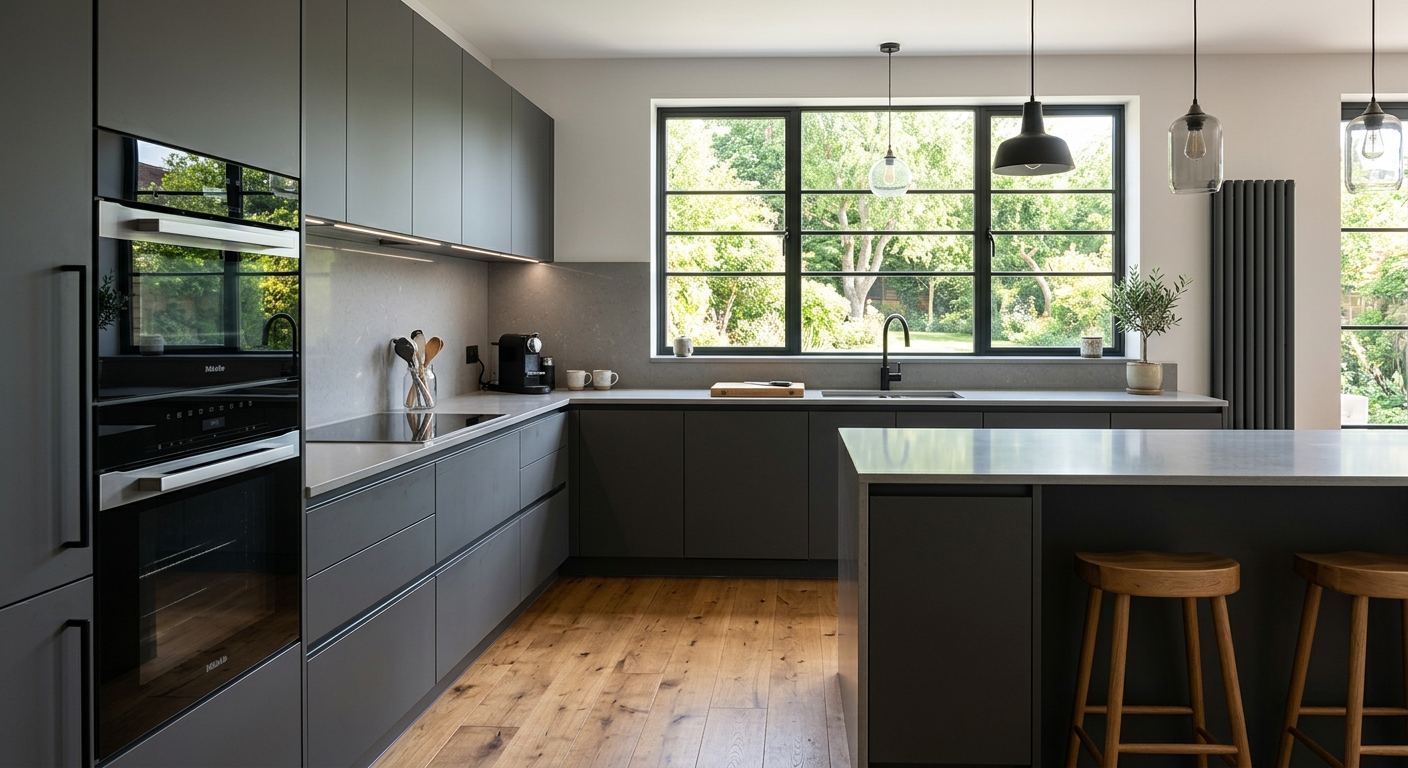
Kitchen renovation options and costs in Kapuskasing
Kapuskasing homeowners typically plan kitchen renovations around how the work will fit their budget and resale expectations, and the “right” finish tier often tracks household buying power more than anything else. In 2021, Kapuskasing had 8,057 residents, with 2,525 homeowner households (66.6% owning), and the local median household income was about $69,000 (Statistics Canada, 2021 Census). That income level doesn’t mean everyone chooses the same materials—but it does influence whether most projects land in the $30,000–$80,000 full-renovation band or stay closer to mid-range upgrades.
In the Northeast market context, contractor availability and scheduling are shaped by longer winter construction logistics: trades have to manage moisture control, heating, and drying times, especially once walls and flooring come open. Still, climate mostly affects how crews plan the work, not whether homeowners choose quartz versus laminate. In Kapuskasing’s older housing stock—85.4% of homes were built before 1981—electrical systems, venting routes, and cabinet box sizing often require extra labour, which can push “same-scope” quotes upward.
Demand is especially steady in older in-town areas near downtown and established residential pockets where many homes were built for a different layout. Homeowners there often refresh the look with new lighting, backsplash, and appliances before deciding whether to replace counters and cabinets. From there, you can compare renovation tiers and timeframes in the table below.
| Renovation Tier |
What's Included |
Typical Duration |
Price Range |
| Cosmetic refresh (paint, hardware, new appliances only) |
Cabinet paint or refinish, new hardware, backsplash update (small section), new appliances (no plumbing/gas changes) |
1–2 weeks |
$5,000–$15,000 |
| Mid-range full renovation (new cabinets, counters, sink, tile) |
New semi-custom or quality stock cabinets, countertop replacement, sink install, backsplash tile, updated lighting, flooring refresh |
3–6 weeks |
$30,000–$55,000 |
| High-end full renovation (custom cabinets, stone counters, island) |
Custom cabinetry, quartz/stone countertops, island (often with extra electrical), premium backsplash, upgraded flooring and lighting |
6–10+ weeks |
$55,000–$80,000 |
| Cabinet refacing only (new doors + drawer fronts, same boxes) |
New cabinet doors/drawer fronts, hinge upgrades, re-lamination where needed, new hardware, optional light moulding |
1–3 weeks |
$6,000–$25,000 |
| Countertop swap only (laminate to quartz or stone) |
Remove/replace old counters, new quartz/stone or upgraded laminate, seam layout, backsplash top trim as needed |
3–7 days |
$3,500–$15,000 |
| Backsplash tile installation only |
Demo/patching, tile setting, grout/seal (if required), caulking at countertops and corners |
3–7 days |
$2,500–$12,000 |
Prices are estimates only and vary by project scope, site access and material selection.
What affects the price of kitchen renovation in Kapuskasing
In Kapuskasing and the wider Northeast/Ontario buying pool, two homeowners can book the “same” kitchen renovation and still see quotes that vary by 30–50%. The difference usually isn’t the finish alone—it’s what each contractor assumes about the hidden conditions: the condition of existing framing, subfloors, electrical capacity, and how much plumbing/gas work is required. Even if you choose the same cabinet tier, labour rates, scheduling, and how a contractor sequences demolition and inspections can shift the final budget.
Local market affordability affects finish selection far more than climate. In stronger value markets, homeowners often default to quartz or premium stone counters and semi-custom cabinetry because the cost is easier to recoup on resale; in more modest settings, laminate and stock cabinets are common to protect return on investment. In Kapuskasing’s older housing stock (85.4% built before 1981), it’s typical to see dated rough-ins, so layout changes and tie-ins can cost more than expected.
Concrete examples from kitchen pricing: (1) If a wall is removed to open the kitchen, the project may shift from a mid-range $30,000–$55,000 full renovation into a higher total because support, finishing, and sometimes electrical rework are required. (2) Upgrading to a quartz countertop typically fits within the $3,500–$15,000 countertop band, but if your backsplash height, sink cut-outs, or uneven cabinet tops require additional prep, the cost can land near the upper end. (3) In winter, crews may need extra time for drying between stages—especially when patching plaster/drywall and adjusting flooring underlay—so timelines and labour hours can increase.
Across these variables, layout changes and utility movement remain the most unpredictable expenses, regardless of whether the final finishes land closer to entry-level or the $55,000–$80,000 high-end range.
| Price Factor |
Why It Matters |
Cost Impact |
| Cabinet tier — stock vs. semi-custom vs. fully custom millwork |
Different lead times, fit/finish quality, and flexibility for non-standard dimensions |
Stock typically keeps budgets lower; semi-custom often fits best for mid-range full renovations; custom can add substantial millwork and installation time |
| Countertop material — laminate vs. quartz vs. granite vs. stone |
Material cost, fabrication complexity, and edge/seam choices affect labour and install |
Laminate is usually lowest cost; quartz/stone moves projects toward the upper $3,500–$15,000 countertop band |
| Layout change — wall removal, island add, plumbing/gas move |
Triggers framing/support work, utility relocation, and additional inspections |
Can be the largest swing factor and pushes totals up even when cabinet/counter tiers stay the same |
| Appliance package tier — builder vs. mid-range vs. pro-grade |
Power draw, ventilation needs, and fit tolerances vary by tier |
Pro-grade appliances can increase electrical/venting labour and coordination time |
| Flooring — refinish existing vs. full replacement |
Subfloor prep and damage discovery after demolition change labour |
Refinish is often cheaper; full replacement can raise costs when subfloor is compromised |
| Backsplash — ceramic tile vs. marble vs. full-height slab |
Material weight, cutting complexity, and waterproofing details |
Full-height or premium materials can push backsplash budgets toward the higher $2,500–$12,000 range |
| Electrical — new circuits for island, under-cabinet lighting |
Additional outlets, lighting runs, and code-compliant circuit planning |
More electrical work increases the unpredictability of labour and inspection scheduling |
| Permit fees and licensed trade requirements |
Certain work requires inspections and permits; licensed trades are scheduled and billed |
Typically adds cost and timeline, especially when trades must coordinate around demolition |
Permits & regulations in Ontario
For most homeowners in Kapuskasing, the key is knowing which kitchen changes can be handled without permits and which ones trigger Ontario permit/inspection requirements. In general, cabinet and countertop swaps are typically considered “finishing work” and often do not require permits. That includes replacing cabinets, replacing countertop materials, and installing a new backsplash as long as you’re not altering major building services.
Permits are commonly required when you change plumbing supply or drain locations, move a gas stove or relocate a gas line, remove a load-bearing wall, or add new electrical circuits (for example, extra outlets for an island, or significant under-cabinet lighting runs that require circuit work). Gas work must be performed by a licensed gas fitter, and electrical work must be done by a licensed electrician, with inspections completed before the work is covered.
Before you sign anything, confirm permit responsibility in writing—who pulls the permit, who schedules inspections, and what your contractor includes in their scope. As a homeowner, you can verify a contractor’s legitimacy and coverage in a practical order: (1) ask for their licence details and check their credentials through Ontario’s public online licence information, (2) request a current certificate of insurance showing general liability (and name you as additional insured if applicable), and (3) confirm WSIB/WCB coverage where relevant to the contractor and any subcontractors. If they can’t provide clear documentation, that’s a strong signal to pause.
Cabinets, countertops and layout decisions in Kapuskasing
The three decisions that most strongly determine your budget and your end result in Kapuskasing are: (1) cabinet tier, (2) countertop material, and (3) layout changes. These choices also align with what Northeast buyers expect across price points—newer buyers in higher price brackets typically look for modern, durable surfaces and clean lines, while budget-focused renovators prioritize reliability and good storage over luxury stone.
Cabinet tier first: stock cabinets are fastest and usually lowest cost, but they’re less forgiving for older 1950s–1970s wall and floor irregularities that show up after demolition. Semi-custom cabinets are the most popular mid-range option because they offer better sizing and door styles while still fitting many $30,000–$55,000 full renovation budgets. Custom cabinetry costs more, but it can be worth it when you need non-standard storage (pantries, appliance garages) or a layout that must accommodate out-of-square conditions.
Countertops next: laminate is the economical route, but it won’t deliver the same resale “wow” as quartz. A quartz countertop swap typically sits in the $3,500–$15,000 band; if you pair it with upgraded cabinets and improved lighting, you’re often building toward that mid-range/full renovation feel. Granite/stone and marble look premium, but they require more careful maintenance planning and seam/edge detailing choices. In Kapuskasing’s winter climate, keeping moisture and salt exposure away from cabinet edges and sink zones is also a practical durability factor—especially in older homes with older seals.
Finally, layout. Opening an area, adding an island, or moving plumbing/gas lines is the decision that can justify cost if it meaningfully improves workflow and storage. If the goal is only to refresh, spend your dollars on cabinet doors, backsplash, and counters before moving walls or utilities.
For example: if you’re debating a $10,000 countertop upgrade versus a layout change, choosing quartz within the $3,500–$15,000 band is often the smarter “value per dollar” move—while moving plumbing or gas is the item that can push totals beyond a planned $30,000–$55,000 scope without increasing usable storage.
| Option |
Durability |
Maintenance |
Best For |
Price Range |
| Stock cabinets (big-box) |
Solid for standard sizes; can struggle with out-of-square walls |
Low day-to-day care; finish chips are easier to touch up than deep damage |
Quick refreshes and tighter budgets |
$6,000–$18,000 |
| Semi-custom cabinets (local dealer) |
Better sizing flexibility; strong construction options for sink and dishwasher loads |
Low routine maintenance; hardware upgrades improve longevity |
Most mid-range full renovations in Kapuskasing |
$15,000–$35,000 |
| Custom cabinets (local millwork shop) |
Highest fit quality and material options; best for challenging layouts |
Low to moderate; depends on finishes and hardware selection |
When you want built-ins, exact storage planning, and perfect fit |
$30,000–$55,000 |
| Laminate countertop |
Decent for everyday use; seams and heat can be weak points |
Wipe clean; avoid prolonged heat and water at seams |
Entry-level upgrades and rental/investment refreshes |
$3,500–$6,500 |
| Quartz engineered countertop |
Very durable surface; strong resistance to stains and everyday wear |
Low maintenance; clean with standard non-abrasive cleaners |
Most value-minded homeowners choosing a modern look |
$6,500–$12,500 |
| Granite / natural stone countertop |
Excellent heat and scratch resistance; variation in slabs |
May require periodic sealing depending on the stone |
Premium look with long-term performance |
$9,000–$15,000 |
| Butcher block countertop |
Durable but sensitive to standing water and deep dents |
Needs oiling/maintenance; protect seams near sink |
Warm, traditional kitchens and those willing to maintain surfaces |
$5,000–$10,000 |
| Marble countertop |
Beautiful but more susceptible to etching and staining than quartz |
Higher care; requires sealing and careful cleaning habits |
Statement kitchens where aesthetics are the priority |
$10,000–$15,000+ |
How to choose a kitchen renovation contractor in Kapuskasing
Choosing the right contractor in Kapuskasing starts with proof of Ontario compliance and good project controls. Verify Ontario licensing/credentials where applicable, and request liability insurance documents before work begins. For coverage, ask for current certificate of insurance and confirm WSIB/WCB coverage for the contractor and any subcontractors who will be on site. If they won’t provide documents or they provide outdated paperwork, keep looking—kitchen projects can turn messy when coverage and scheduling are unclear.
Next, insist on 2–3 itemised, written quotes that separate labour from materials (cabinets, countertops, tile, under-cabinet lighting, disposal, and any allowances). A lump-sum number hides risks. Carefully read the scope for what’s excluded: permit pulling included or not, disposal/hauling included or not, floor protection, patching/painting responsibilities, and whether electrical/plumbing/gas work is handled by their licensed subs. Ask about timeline assumptions too—lead times for cabinets and stone fabrication can be the real schedule driver.
Warranty matters: confirm the workmanship warranty length, what it covers, and whether product/manufacturer warranties transfer to you after installation. For payment, keep it controlled—never pay more than 10–15% upfront, and use a holdback until the job is complete and verified. Get the start date and estimated completion date in writing so you’re not guessing mid-project.
- Ask for proof of Ontario licensing (where relevant) and current insurance before signing.
- Confirm WSIB/WCB coverage for their staff and subcontractors.
- Get 2–3 itemised quotes with labour and material breakdowns, not just allowances.
- Clarify who pulls permits and who pays permit fees if required.
- Confirm disposal/hauling is included for cabinets, demolition debris, and packaging.
- Request a detailed demolition-to-install sequence (and what happens after rough-ins).
- Ask about countertop templating dates and how changes are handled before fabrication.
- Verify warranty: workmanship duration, product warranty coverage, and transferability.
- Set a payment schedule with a holdback until punch list items are complete.
- Ensure the contract includes exclusions and change-order pricing rules.
- Check how they protect floors/walls and manage dust during winter.
- Ask who is the project lead and how issues are communicated day-to-day.
Red flags I see too often in Kapuskasing kitchen builds: they won’t provide insurance/coverage paperwork, they quote without site measurement or without identifying allowances, they refuse to itemise labour/materials, they demand large upfront payments (beyond 10–15%), or they can’t give a realistic timeline that accounts for cabinet and countertop lead times.
Frequently asked questions — kitchen renovation in Kapuskasing
Can I move my kitchen sink or stove?
Yes, you can move a sink or stove in Ontario, and in Kapuskasing many homeowners do—especially when they want better workflow. However, moving services is where costs become unpredictable. Relocating plumbing supply/drain lines typically requires a permit and licensed plumbing work, and moving gas (stove/range hood with gas) requires a licensed gas fitter with inspections. Even if you start with a mid-range plan around $30,000–$55,000, moving utilities can push you higher if walls need opening, framing adjustments, or new venting/electrical circuits are required.
What's the most cost-effective kitchen upgrade?
For Kapuskasing kitchens, the most cost-effective upgrade is usually a “high-impact, low-mess” combination: refinish cabinets or replace doors (refacing) plus updated hardware, then add a new backsplash and modern lighting. If your layout is working and your cabinet boxes are solid, cabinet refacing only can keep budgets in the $6,000–$25,000 range and still dramatically change the look. Another strong option is a countertop swap—upgrading to quartz often lands in the $6,500–$12,500 neighbourhood, which can refresh the whole kitchen without the disruption of moving plumbing or gas lines. Full renovations are sometimes worth it, but they usually belong when the existing layout or storage truly isn’t working.
Custom vs stock cabinets — is custom worth it?
Custom cabinets can be worth it in Kapuskasing when you’re dealing with out-of-square walls, non-standard appliances, or you want built-in storage (pantry systems, appliance garages, specialized corner drawers). That said, most homeowners achieve the best value with semi-custom cabinets for mid-range budgets because they balance fit and lead time. Stock cabinets are typically the fastest and cheapest route, but they can create gaps and extra trim if the existing room is uneven—common in older homes built before 1981. If your goal is a project within roughly $30,000–$55,000, semi-custom plus a quartz countertop upgrade often gives the best “buyer appeal per dollar,” while custom tends to push you toward the top end of the full-renovation band.
How do I choose a kitchen contractor in Kapuskasing?
Start by confirming the contractor’s documentation: liability insurance and WSIB/WCB coverage (for them and subcontractors), plus the proper Ontario credentials for trades involved. Then get 2–3 itemised quotes that break out labour and materials—especially for cabinets, countertops, tile, electrical work, and disposal. In Kapuskasing, ask whether cabinet and countertop lead times are accounted for and whether the contract states who pulls permits (if you’re moving plumbing/gas or adding electrical circuits). Also check warranty details and the payment schedule—avoid anything that asks for heavy upfront payment beyond about 10–15%. Finally, insist on a written timeline with a completion estimate and a process for change orders.
What order do kitchen renovation steps happen in?
A typical order for a Kapuskasing renovation is: design/measurements, demolition, rough-ins (plumbing/gas/electrical as required), insulation/drywall repairs, flooring prep/installation, cabinet installation, countertop templating (for stone or quartz), countertop fabrication, then final touches like backsplash, trim, lighting, and appliance hookup. Winter conditions mean we pay extra attention to drying times and moisture control before installing floors and cabinetry. If you’re doing a counter-only upgrade, the order is simpler: schedule teardown, prep the base, template the new countertop, fabricate, then install and finish with caulking at the sink and backsplash transitions. The key is sequencing—good contractors line up trade inspections and material lead times so you don’t lose weeks waiting on one component.
Can I live at home during a kitchen renovation in Kapuskasing?
Often, yes—especially for cosmetic updates, refacing, or countertop/backsplash-only projects. In Kapuskasing, most homeowners stay in the home during mid-range work like new cabinets and counters, as long as the contractor plans dust control and protects flooring and entrances. However, if you’re doing a full renovation involving wall removal, major layout changes, or extensive plumbing/gas/electrical work, it can be harder to manage day-to-day cooking. In those cases, you may need a temporary setup (microwave, kettle, small fridge) and a clear plan for safe access and cleanup. If your contractor estimates a full renovation in the $30,000–$80,000 range, ask how they’ll maintain a usable workflow while demolition and inspections are underway.