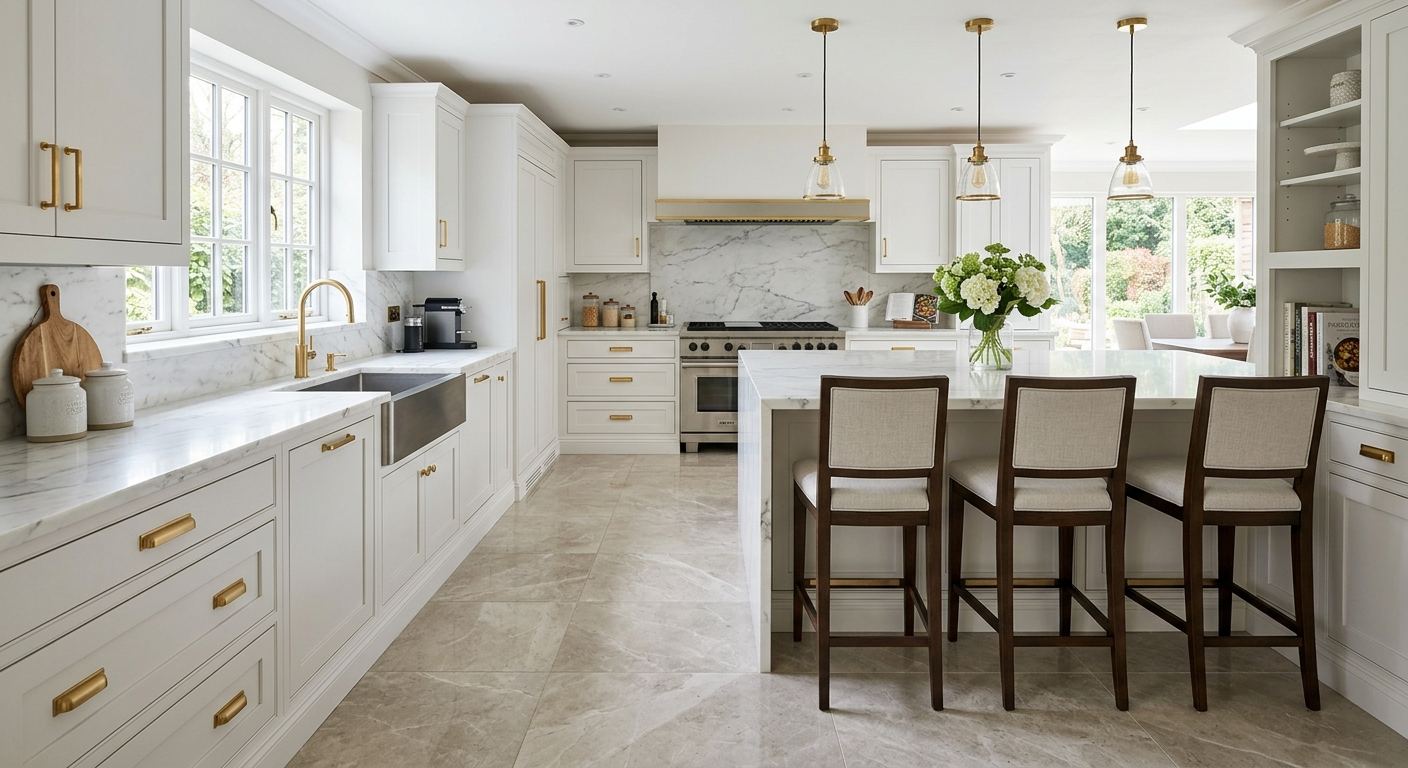
Kitchen renovation options and costs in Goderich
Kitchen renovations in Goderich tend to follow two predictable tracks: “refresh and enjoy,” or “turn the kitchen into a showpiece.” Homeowners are making these decisions with the local housing profile in mind—Goderich has 7,881 residents and about 65.1% of households are owner households (Statistics Canada, 2021 Census). With a 2020 median household income of $69,500 (Statistics Canada, 2021 Census), many clients select finishes that look upscale on resale without overreaching on budget.
In the Stratford–Bruce Peninsula region, the cost isn’t driven by extreme climate swings so much as by market expectations and trade availability between towns. Contractors and cabinet shops can be busier in higher-demand pockets, so labour scheduling and material freight can affect turnaround times. Homes built before 1981 make up 73.7% of the local housing stock, which often means older electrical, dated plumbing runs, and non-standard cabinet dimensions—small changes there can nudge the project toward the higher end of the range, even when finishes stay mid-range.
Renovations are especially in demand around the downtown core and along the waterfront-adjacent areas where homeowners aim for modern, bright kitchens that photograph well for listing season. From there, the budget usually gets decided by cabinet tier and countertop choice—quartz and natural stone bring the biggest surface upgrades—then by whether you keep the layout or change it. Use the table below to map your goals to a realistic budget band.
| Renovation Tier |
What's Included |
Typical Duration |
Price Range |
| Cosmetic refresh (paint, hardware, new appliances only) |
Cabinet paint or refinishing, new hardware, appliance swap (fridge/range/dishwasher), caulking/touch-ups, basic prep and scheduling |
3–7 days |
$5,000–$15,000 |
| Mid-range full renovation (new cabinets, counters, sink, tile) |
Semi-custom or mid-grade stock cabinets, countertop (laminate or quartz), sink and faucet, backsplash tile, new flooring prep, standard plumbing/electrical adjustments, appliance allowance |
2–4 weeks |
$35,000–$55,000 |
| High-end full renovation (custom cabinets, stone counters, island) |
Fully custom cabinetry, quartz or natural stone countertops, island build-out, upgraded backsplash (higher-end tile or stone), enhanced lighting, sink/faucet upgrade, floor replacement allowance, more extensive finish carpentry |
4–7 weeks |
$60,000–$90,000 |
| Cabinet refacing only (new doors + drawer fronts, same boxes) |
Refacing panels, new doors/drawer fronts, upgraded hardware, new soffit/trim where needed, re-seal joints, paint-touch where required |
1–2 weeks |
$8,000–$25,000 |
| Countertop swap only (laminate to quartz or stone) |
Remove existing surface, install new countertop, sink cut-outs as needed, basic backsplash tile allowance or clean-up, reinstall faucets and seals |
2–5 days |
$3,000–$12,000 |
| Backsplash tile installation only |
Surface prep, tile install, grout/seal, edges/trim, cutting around outlets and switches, caulking, minor patching |
2–5 days |
$1,500–$7,000 |
Prices are estimates only and vary by project scope, site access and material selection.
What affects the price of kitchen renovation in Goderich
In Stratford–Bruce Peninsula and across Ontario, you can see quotes for the “same kitchen” vary by 30–50%—and it’s usually not because contractors are cutting corners. It comes down to what’s changing behind the walls (and who absorbs that uncertainty), plus how homeowners choose to spend based on local market pull. In higher-priced pockets of the broader region—where more buyers expect custom or semi-custom looks—many homeowners choose quartz or natural stone and step up cabinet tier. That upgrade cost can be easier to justify because the renovation isn’t just for your enjoyment; it’s positioned for resale. With a local median household income of $69,500 (Statistics Canada, 2021 Census), a lot of Goderich homeowners aim for a balanced mid-range plan rather than “fully custom everywhere.”
On the practical side, layout decisions add the most unpredictable costs regardless of finish level. Removing a wall, adding an island, or moving a gas line/plumbing run means electrical and rough-in work, inspections, and sometimes structural support. Even with the same cabinet and countertop band—say, a mid-range full renovation at $35,000–$55,000—a “layout-neutral” plan can stay closer to the lower half, while a plan with plumbing/gas moves often lands near the top.
Concrete Goderich examples I commonly see: older homes built before 1981 (73.7% of the stock, Statistics Canada, 2021 Census) often have wiring that doesn’t align with today’s kitchen loads, so adding under-cabinet lighting or upgrading to more circuits can trigger added electrical work. Also, small differences in foundation settlement or floor level can mean more labour to true cabinets and countertops—cost is higher if installers have to spend extra time on shimming and redo tolerances. Finally, site access near older neighbourhood streets can increase labour time for material handling, which nudges labour-heavy scopes upward even when materials are mid-range.
| Price Factor |
Why It Matters |
Cost Impact |
| Cabinet tier — stock vs. semi-custom vs. fully custom millwork |
Cabinet tier drives material quality, door/drawer construction, interior organization, and fit/finish complexity |
Can swing a full kitchen by $10,000–$25,000 depending on scope |
| Countertop material — laminate vs. quartz vs. granite vs. stone |
Material density, thickness, edge profiles, and fabrication/installation requirements vary widely |
Often a $2,000–$8,000 spread on the same layout |
| Layout change — wall removal, island add, plumbing/gas move |
Changes force rough-in work, possible structural components, and more trades coordination |
Typically adds $7,000–$25,000 uncertainty to the high-impact items |
| Appliance package tier — builder vs. mid-range vs. pro-grade |
Appliances affect installation details, electrical specs, and fit around custom cabinetry |
Can add $1,500–$10,000 depending on brand and venting type |
| Flooring — refinish existing vs. full replacement |
Kitchen demolition creates the need to level, replace transitions, and address subfloor readiness |
Typically $1,500–$8,000 difference |
| Backsplash — ceramic tile vs. marble vs. full-height slab |
Tile complexity (pattern alignment) and higher-end materials increase cutting and material waste |
Often $500–$5,000 variation within the backsplash line item |
| Electrical — new circuits for island, under-cabinet lighting |
More outlets, lighting, and under-cabinet circuits require extra rough-in time and licensed work |
Frequently adds $800–$3,500+ depending on the number of circuits |
| Permit fees and licensed trade requirements |
Some kitchen changes trigger permits and inspections; documentation and scheduling add overhead |
Can add several hundred to a few thousand dollars depending on scope |
Permits & regulations in Ontario
In Ontario, many “swap-in” kitchen finishes don’t require a permit—cabinet and countertop replacements typically fall into the no-permit category because you’re not changing the building’s services or structure. If you’re only changing flooring, painting, replacing doors/drawer fronts (refacing), or installing a new backsplash, that’s generally straightforward from a permit standpoint.
However, you do need permits and licensed trade involvement when you’re moving or altering services or structural elements. Examples that typically require permits include: moving plumbing supply lines or drain lines; relocating a gas stove or changing the gas connection for a range/oven; removing a load-bearing wall; adding or relocating electrical circuits (for example, new island outlets, under-cabinet lighting circuits, or adding more dedicated circuits); and any work that changes the way electrical/gas/plumbing is configured.
For a Goderich homeowner, verify a contractor’s credentials step-by-step before you sign: (1) ask for the contractor’s liability insurance certificate of insurance and confirm the policy is active for the project period; (2) ask how they manage WSIB/WCB coverage for their own workers (and sub-trades), then request proof or a clearance letter if applicable; (3) confirm the specific licence for trades involved—gas work must be done by a licensed gas fitter and electrical work by a licensed electrician—and that permits/inspections are coordinated when required. The final test is in the contract: permit responsibility (who pulls it, what’s included) and inspection scheduling should be written clearly.
Cabinets, countertops and layout decisions in Goderich
When you’re renovating a kitchen in Goderich, three choices drive most of the long-term value: (1) cabinet tier, (2) countertop material, and (3) layout changes. First, decide cabinet tier based on time and fit. Stock cabinets are the fastest and cheapest, but they often require more compromise in sizing. Semi-custom cabinets are the popular mid-range option because they deliver better storage and a closer match to real room dimensions—often the sweet spot for homeowners targeting resale without the top-end budget. Custom cabinets give you the best fit and storage planning, but they’re the highest cost and require more design time.
Second, countertop material. Laminate is budget-friendly and practical for day-to-day use, but quartz typically offers the “best balance” of durability and appearance for resale. Granite and natural stone look premium and perform well, but they usually cost more for fabrication and installation and may require different maintenance routines depending on the finish. In kitchens near the waterfront-adjacent areas, I often recommend surfaces that handle daily cleaning cycles without fuss—quartz tends to stay consistent with minimal upkeep.
Third, layout. Open-concept wall removal, island addition, and moving plumbing/gas are where the costs can jump. A layout change is most justified when it improves traffic flow and creates a functional work triangle, not just because you “want it open.” Here’s a real budget-style example: upgrading from laminate to quartz on a mid-range kitchen might fit into the $35,000–$55,000 band, while adding an island plus plumbing/gas relocation is more likely to push a project toward the higher end—closer to $60,000–$90,000—even if cabinet tier stays semi-custom.
Stratford–Bruce Peninsula buyers often respond best to modern lighting, clean lines, and durable surfaces. That’s why the most common approach is: prioritize cabinet tier and countertop quality first, and only spend on layout changes when the space gain is clearly measurable.
| Option |
Durability |
Maintenance |
Best For |
Price Range |
| Stock cabinets (big-box) |
Solid for normal use; durability depends on door construction and finish quality |
Low; clean and tighten hardware as needed |
Speed, tight budgets, and straightforward layouts |
$8,000–$18,000 |
| Semi-custom cabinets (local dealer) |
Better hinges/frames and more storage planning for everyday wear |
Low; wipe clean and address spills promptly |
Most Goderich mid-range renovations aiming for resale-friendly upgrades |
$18,000–$35,000 |
| Custom cabinets (local millwork shop) |
Highest fit and material options; best for unusual dimensions and heavy-use kitchens |
Low to moderate; quality hinges/finishes last longer with proper care |
High-end kitchens with specific storage goals and custom detailing |
$35,000–$65,000 |
| Laminate countertop |
Good for everyday cooking; edges and seams need care |
Low; avoid standing water at seams and use cutting boards |
Budget-focused renovations that want a clean look fast |
$2,000–$5,000 |
| Quartz engineered countertop |
Very durable and stain-resistant; great resistance to daily wear |
Low; wipe clean with standard cleaners |
Best balance of durability and resale appeal in a busy household |
$4,000–$10,000 |
| Granite / natural stone countertop |
Highly durable and heat-tolerant; varies by slab |
Moderate; may require periodic sealing depending on the stone |
Premium look when you want natural variation in the slab |
$5,000–$12,000 |
| Butcher block countertop |
Durable for cutting; can mark or scratch without maintenance |
Moderate; oiling and routine care to prevent drying |
Casual warmth (farmhouse style) and homeowners who maintain surfaces |
$3,000–$7,000 |
| Marble countertop |
Beautiful but softer; more susceptible to etching from acids |
Higher; requires careful cleaning habits and seal management |
Statement kitchens where appearance matters most |
$7,000–$14,000 |
How to choose a kitchen renovation contractor in Goderich
Choosing the right contractor in Goderich is mostly about proof, not promises. Start by verifying Ontario compliance: ask for (1) liability insurance certificate of insurance (confirm coverage is active and appropriate for the project), and (2) WSIB/WCB coverage proof for their workers (or a clearance letter where applicable). Then confirm the licensed trades involved: gas work must be by a licensed gas fitter and electrical work by a licensed electrician. Don’t rely on verbal confirmation—request documents before the work starts.
Next, get 2–3 itemised, written quotes. The best quotes show labour and materials separately (cabinets, counters, installation labour, plumbing/electrical allowances, demolition and disposal, and any permit-related line items). Avoid “lump sum only” proposals when the scope is complex—kitchens often change once demolition reveals older wiring or out-of-square framing. Reading exclusions is just as important as reading inclusions: ask what’s excluded (removal of old flooring, subfloor repairs, patching drywall, cabinet toe-kick adjustments, grout/caulking details), whether permits are included if required, and whether disposal is part of the price.
For warranty, demand both: workmanship warranty length and product/manufacturer warranty terms, and ask whether warranties are transferable if you sell your home. For payment schedules, never pay more than 10–15% upfront; hold back a portion until key milestones are complete. Finally, require a start date and completion estimate in writing, with a process for changes to timelines if materials arrive late.
- Confirm liability insurance certificate is current and matches the job location.
- Request proof of WSIB/WCB coverage or clearance documentation.
- Verify gas and electrical work will be performed by the correct licensed trades.
- Get 2–3 itemised quotes (labour + materials), not only lump sums.
- Ask whether cabinet measurements are verified on-site before fabrication.
- Check exclusions: disposal, drywall patching, subfloor repairs, caulking/grouting.
- Confirm permit responsibility in writing (who pulls it and what’s included).
- Require product warranty details and workmanship warranty length, in the contract.
- Use a staged payment schedule with holdback until completion.
- Demand a written start date and a completion target tied to material lead times.
- Ask for a change-order process with pricing documented before extra work starts.
- Confirm who handles jobsite cleanup and daily protection for floors and valuables.
Red flags I commonly see around kitchen renos in Goderich: (1) refusal to provide insurance/WSIB documentation; (2) no written scope with unclear exclusions; (3) asking for large upfront deposits (beyond 10–15%); (4) vague timelines with no discussion of countertop/cabinet lead times; and (5) “permit-free” promises even when plumbing, gas, load-bearing walls, or electrical circuits are changing.
Frequently asked questions — kitchen renovation in Goderich
Quartz vs granite countertops — which is better?
For most homeowners in Goderich, quartz is the easiest “better” because it’s consistent, very stain-resistant, and low-maintenance. Granite is also durable and heat-tolerant, and its natural variation can look amazing in photos—especially with a light backsplash—but it may require periodic sealing depending on the slab and finish. Cost-wise, quartz typically fits the mid-range upgrade path where countertop swaps are often budgeted in the $3,000–$12,000 band, while granite/natural stone can push higher once fabrication and edges are considered. In older homes built before 1981 (73.7% of the local housing stock, Statistics Canada, 2021 Census), quartz is often the practical choice because it tolerates everyday cleaning habits and reduces “maintenance surprises.”
Should I reface or replace my cabinets?
If your existing cabinet boxes are solid, refacing can be the smarter move: you swap doors, drawer fronts, and finishes while keeping the structure—usually landing in the $8,000–$25,000 range. Replacement makes sense when boxes are warped, damaged by prior leaks, or poorly set for modern storage (common in older Goderich kitchens). Also consider how much you want to change the layout: refacing keeps the footprint more predictable. For resale, buyers often notice doors, hardware, and countertop/backsplash first; refacing plus a countertop update can look like a full renovation without matching the higher cabinet-and-install total of a full cabinet replacement. A contractor can assess box condition during teardown before you decide.
Do I need a permit for a kitchen renovation in Ontario?
Usually, you don’t need a permit for straightforward swaps like cabinet replacement and countertop installation. In Ontario, permits typically come into play when you change services or structure—such as relocating plumbing supply/drain lines, moving gas connections for a stove/range or range hood with gas, removing a load-bearing wall, or adding electrical circuits for island outlets or new lighting circuits. If your plan includes any of those “behind-the-wall” changes, expect licensed trades and inspections. For a Goderich homeowner, the key step is making sure permit responsibility is written in your contract: ask whether the contractor will pull the permit, schedule inspections, and which work is included in their responsibility. This prevents surprises and clarifies who covers compliance costs.
What's the ROI on a kitchen renovation?
ROI varies, but in a mid-market town like Goderich, buyers tend to pay attention to visible quality—cabinets, countertops, and updated lighting—then practicality (storage and layout). In practical terms, kitchen renos often make the biggest difference when they modernize the kitchen without over-customizing beyond the home’s overall price tier. A kitchen refresh can improve appeal, but the more durable, higher-ticket upgrades (like quartz countertops and semi-custom or custom cabinet tiers) typically support better buyer confidence during listing season. If your budget aligns with the common full-renovation bands—like $35,000–$55,000 for a mid-range full renovation—your chances of ROI are generally stronger than if you spend far above the market expectations for the home size. The best ROI usually comes from a layout that works and finishes buyers recognize immediately.
How do I budget for a kitchen renovation?
Budgeting starts with your tier choice and then adding “real-world” contingencies. For Goderich homeowners, the common baseline for a full renovation is $35,000–$70,000, but older homes (73.7% built before 1981) often uncover wiring, plumbing, or framing issues that can move costs upward—especially if you add circuits or relocate services. If you’re keeping the layout, you’ll usually land closer to the mid-range band; if you’re moving plumbing/gas or removing a wall, plan toward the higher end. A practical approach is to separate: cabinets, countertops, demolition/disposal, flooring, electrical/plumbing allowances, and backsplash/tile. Also plan for lead times (cabinet fabrication and countertop templating). Finally, reserve a contingency for site conditions so one “surprise” doesn’t derail your project.
Can I move my kitchen sink or stove?
You can, but the cost and permitting requirements depend on what you’re moving and how far. In Ontario, moving a sink usually means relocating plumbing supply and drain lines, which typically requires permits and licensed plumbing work; moving a stove can involve gas line relocation, which must be done by a licensed gas fitter and also typically triggers permits/inspections. In Goderich’s older housing stock (many homes are pre-1981), routing lines through existing bays can be more complex because of non-standard framing and older service runs. If you move them only a short distance and the route is straightforward, costs can stay within a typical renovation plan. If you want a significant relocation or structural changes, budget more because it’s not just the plumbing/gas—it’s the electrical circuits, rough-in coordination, and drywall/finish restoration that follow.