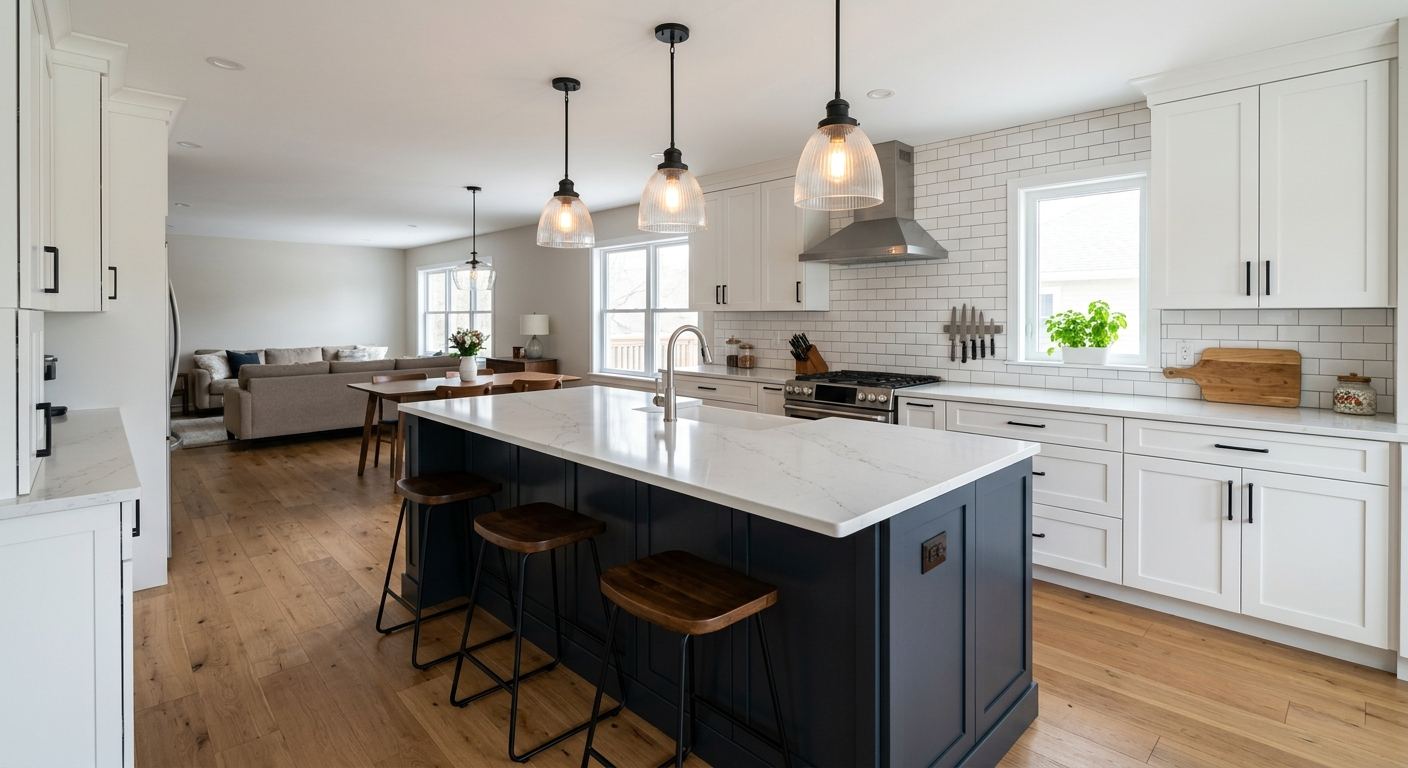
Kitchen renovation options and costs in Palmerston-Little Italy
In Palmerston-Little Italy, kitchen renovations tend to follow two tracks: a cost-conscious refresh for homeowners staying put, and a higher-finish upgrade when you’re planning to capture Toronto resale value. With a population of 13,826 (Statistics Canada, 2021 Census), this neighbourhood supports a steady flow of trade work and cabinet/showroom partners, especially around busy streets where replacements can’t disrupt access for long. Pricing in Toronto is also strongly tied to household purchasing power and local home economics—owners in higher-value pockets typically budget more per project because the kitchen is one of the most visible upgrades at sale. In practice, this means many full renovations land closer to the mid-range-to-high end of the regional bands, while cosmetic work stays comparatively economical.
Across the Toronto economic region, the main reason projects vary is finish tier rather than climate. In other words, labour and material pricing stay fairly consistent, but homeowners choose different levels of cabinetry, countertops, and appliances. Winter conditions still matter for logistics: delivery and install scheduling can tighten when streets are slushy and scaffolding/hoisting is harder, so contractors may price in a bit of schedule risk. That said, the biggest driver of cost is design scope—especially whether you change the footprint, move plumbing, or add electrical circuits. In Palmerston-Little Italy, the trade is especially in demand near the commercial strips where homeowners often need rapid scheduling and clean jobsite control.
Use the table below to compare common options and realistic cost expectations, then we’ll break down what moves a quote up or down.
| Renovation Tier |
What's Included |
Typical Duration |
Price Range |
| Cosmetic refresh (paint, hardware, new appliances only) |
Cabinet paint or stain touch-up, new pulls/knobs, new refrigerator/range/dishwasher, minor caulking and trim, basic appliance install |
1–3 weeks |
$8,000–$20,000 |
| Mid-range full renovation (new cabinets, counters, sink, tile) |
Semi-custom or stock cabinets, quartz or good laminate countertops, sink and faucet, backsplash tile, under-cabinet lighting (optional), plumbing refresh as needed |
4–8 weeks |
$25,000–$55,000 |
| High-end full renovation (custom cabinets, stone counters, island) |
Fully custom cabinetry, natural stone (granite/marble/solid-slab look), larger format tile, island construction, upgraded appliance package, structural detailing and enhanced lighting |
8–14 weeks |
$65,000–$90,000 |
| Cabinet refacing only (new doors + drawer fronts, same boxes) |
Door/drawer replacement, new panels, fresh hardware, refinished or updated finish on existing cabinet carcasses, select trim updates |
2–4 weeks |
$8,000–$20,000 |
| Countertop swap only (laminate to quartz or stone) |
Remove old tops, template, install new quartz/stone, add edge profile, reconnect sink/cooktop where applicable, reseal and caulk |
1–2 weeks (plus template time) |
$4,500–$14,000 |
| Backsplash tile installation only |
Surface prep, waterproofing membrane where needed, tile supply and install, grouting, sealing, trim detailing |
3–7 days |
$2,000–$10,000 |
Prices are estimates only and vary by project scope, site access and material selection.
What affects the price of kitchen renovation in Palmerston-Little Italy
Even when two homeowners ask for “the same kitchen,” quotes across Toronto and the province can differ by 30–50% because the risks and hidden work aren’t identical. In Palmerston-Little Italy, the variance usually comes from local home economics and finish expectations: in higher-value markets within the Toronto economic region, homeowners often default to quartz or stone counters and semi-custom cabinetry because the cost is easier to recoup at resale. In more price-sensitive areas around the region, laminate and stock cabinet systems stay common because they deliver a strong refresh for less. Practically, that’s why a full renovation can start around the mid-$20k for modest changes and climb into the $80k+ range when you add custom millwork, premium surfaces, or structural work.
Layout decisions are the “wild card” regardless of finish tier. Removing a wall, adding an island, or moving a gas line can trigger plumbing, venting, and electrical changes—plus additional labour coordination between trades. For example, an older Toronto housing stock sometimes has outdated shutoffs or undersized supply runs; when that’s uncovered, plumbing updates can push a job from a countertop-only plan into a broader mid-range renovation ($25,000–$55,000). On the other hand, homes with accessible ducting and straightforward cabinet walls can keep costs closer to the lower end of the band because the cabinet base layout doesn’t require rerouting.
Here are a few concrete ways Palmerston-Little Italy conditions typically shift costs: tight city street access can affect delivery staging and hoisting logistics; existing tile and lath/old mortar may raise demolition time before a backsplash or floor can be redone; and kitchens with older 60-amp service may require electrical planning before you add island circuits or under-cabinet lighting. Use the factors below to see what usually drives the biggest swings in your quote.
| Price Factor |
Why It Matters |
Cost Impact |
| Cabinet tier — stock vs. semi-custom vs. fully custom millwork |
Higher tiers offer better fit, more options for interiors, and sturdier construction, but require more fabrication time and site coordination |
$8,000–$40,000 spread across cabinet portions |
| Countertop material — laminate vs. quartz vs. granite vs. stone |
Material cost and fabrication complexity increase with premium surfaces; edges, thickness, and seams add labour and template time |
$3,000–$15,000 for installed countertops |
| Layout change — wall removal, island add, plumbing/gas move |
Structural and trade coordination expands scope beyond finishes; permits and inspection time often follow |
$5,000–$25,000 depending on what moves |
| Appliance package tier — builder vs. mid-range vs. pro-grade |
Pro-grade models cost more and may require higher spec electrical/venting and more precise cabinet openings |
$2,000–$12,000 |
| Flooring — refinish existing vs. full replacement |
If you keep flooring, you often pay for careful protection and selective repairs; replacing involves demo, subfloor prep and new materials |
$1,500–$10,000 |
| Backsplash — ceramic tile vs. marble vs. full-height slab |
Premium stone and larger format installs increase material cost, cutting complexity and handling |
$2,000–$10,000 |
| Electrical — new circuits for island, under-cabinet lighting |
Upgrading circuits and adding GFCI/lighting increases electrician time and may trigger permit/inspection requirements |
$1,000–$6,000 |
| Permit fees and licensed trade requirements |
When scope crosses into plumbing, gas, structural, or electrical modifications, Ontario permitting and inspection add cost and scheduling lead time |
$500–$5,000 plus trade overhead |
Permits & regulations in Ontario
In Ontario, a cabinet and countertop swap is usually straightforward from a permitting standpoint—most homeowners can replace cabinets, laminate, quartz, or stone without pulling a permit. However, once you move the systems behind the walls, permits and licensed trades become the rule. If you change plumbing supply or drain lines, relocate a gas range or range hood connected to gas, remove a load-bearing wall, or add new electrical circuits (for an island outlet run, new lighting layout, or thicker-demand appliances), you’ll typically need permits and inspections. Gas work must be done by a licensed gas fitter, and electrical work must be done by a licensed electrician; both trades require inspections when applicable.
For a Palmerston-Little Italy homeowner, the practical verification steps are simple and worth doing before you sign:
- Ask the contractor which specific items require permits in writing (don’t accept “we’ll handle everything” without a list).
- Confirm the electrician and gas fitter licence details for the named subcontractors.
- Request proof of liability insurance and WSIB/WCB coverage (clear certificates, not just a policy number).
- Keep copies of permit applications/permit numbers if your scope requires them.
- Verify clearance letters or inspection sign-offs where the contractor provides gas/electrical modifications.
Always confirm permit responsibility with the contractor in your contract—who pulls the permit, who pays the fees, and what the schedule includes—so there are no surprises mid-project.
Cabinets, countertops and layout decisions in Palmerston-Little Italy
In Palmerston-Little Italy, the three consequential decisions usually are: (1) cabinet tier, (2) countertop material, and (3) whether you change layout. Start with cabinets. Stock cabinets are the fastest route and typically cost less, but they can limit storage and fit. Semi-custom cabinets are the most popular mid-range choice because you get better drawer options and more style flexibility without the long lead times of full custom. Custom cabinets provide the best fit for older Toronto layouts, but they’re the highest cost—worth it when your space has awkward corners, non-standard wall angles, or you want a full built-in system.
Next: countertops. Laminate is budget-friendly and acceptable for many homeowners, but it’s less forgiving for heat and impact. Quartz engineered countertops are a strong Toronto resale-friendly option because they’re durable, stain-resistant, and relatively low-maintenance. Granite/natural stone adds premium visual appeal with heat resistance, but sealing and care matter. Butcher block can be beautiful for warm, lived-in kitchens; however, it needs regular maintenance and is more sensitive to moisture cycles common to older homes.
Finally, layout. Open-concept wall removal or adding an island can be justified when you gain actual functionality—more circulation, better appliance placement, and space for seating. If your goal is mostly appearance, you’ll usually get better value staying closer to a countertop-and-cabinet refresh rather than paying for plumbing/gas/electrical moves.
Here’s a realistic dollar example: upgrading from laminate to quartz on a typical mid-sized kitchen can be a “worth it” spend within a countertop swap band (roughly $3,000–$15,000 installed). If you instead add an island and move plumbing/gas, you can easily push the project into the $65,000–$90,000 high-end territory even with the same countertop choice, because trade coordination and structural/electrical work drive the budget more than the surface does.
| Option |
Durability |
Maintenance |
Best For |
Price Range |
| Stock cabinets (big-box) |
Solid for everyday use; fewer custom options for interiors and corner solutions |
Low day-to-day care; hinges and adjustments may be needed as the home settles |
Time-sensitive refreshes and smaller budgets |
$8,000–$18,000 |
| Semi-custom cabinets (local dealer) |
Very good build quality with improved drawer systems and better fit options |
Low maintenance; easier to upgrade interiors (pull-outs, dividers) |
Most homeowners balancing resale appeal and affordability |
$15,000–$35,000 |
| Custom cabinets (local millwork shop) |
Best structural fit and storage layout; tailored to irregular walls and ceilings |
Low care; finish touch-ups depend on material system |
Complex footprints and built-ins for a premium finish |
$30,000–$55,000 |
| Laminate countertop |
Good for daily wear; can be more vulnerable to heat and knife impacts at seams/edges |
Wipe clean; avoid prolonged heat exposure; watch edge integrity |
Budget refreshes where appearance matters most |
$3,000–$6,500 |
| Quartz engineered countertop |
High durability and stain resistance for everyday cooking |
Minimal maintenance; resealing usually not required |
Resale-friendly upgrades and busy households |
$6,500–$12,500 |
| Granite / natural stone countertop |
Very durable with strong heat tolerance; variations in pattern are normal |
Typically benefits from periodic sealing depending on stone selection |
Premium look with robust performance |
$8,500–$15,000 |
| Butcher block countertop |
Durable with proper care; can scratch and needs protection from water |
Regular oiling/sanding schedule; treat spills promptly |
Warm styling and food-prep kitchens |
$4,500–$10,000 |
| Marble countertop |
Beautiful premium surface; can be more susceptible to etching from acids |
More care required (gentle cleaners; sealing depending on product) |
High-end, statement kitchens |
$10,000–$18,000 |
How to choose a kitchen renovation contractor in Palmerston-Little Italy
Choosing the right contractor in Ontario comes down to proof, not promises. Start by verifying licensing: confirm the contractor’s credentials where applicable and, for subcontracted trades, verify the electrician and gas fitter licences for any electrical or gas scope. Next, request liability insurance and confirm WSIB/WCB coverage—your goal is to ensure that if something goes wrong on-site, you’re not left holding the bag. Ask for certificates of insurance and coverage documentation before work begins, and keep copies for your records.
Then get 2–3 itemised written quotes. A real quote should separate labour and materials, show allowances where exact products aren’t selected, and list what’s included for demolition, disposal, and install sequencing. Scope clarity matters a lot in older Toronto homes where hidden conditions can appear: ask whether permit pulling is included (if needed), whether drywall repairs and paint are included after cabinet install, and whether the contractor handles site protection and cleanup daily.
Warranty is another differentiator. Look for a workmanship warranty length (for installation and repairs) and confirm product/manufacturer warranties, including whether the warranty transfers if you sell the home. Payment schedule should be conservative—never pay more than 10–15% upfront. Hold back a final portion until completion and punch-list items are done. Finally, insist on a start date and completion estimate in writing so winter scheduling and material lead times don’t quietly stretch your timeline.
- Confirm licence details and that subcontractors are properly certified for their scope.
- Request liability insurance and WSIB/WCB clearance documents before signing.
- Get quotes with labour/material line items, not one lump sum.
- Ask what’s included for demolition, disposal, and drywall patching.
- Confirm whether permit fees and inspections are included where required.
- Verify appliance installation scope (leveling, hookups, cut-outs).
- Clarify countertop template and seam responsibilities.
- Check how change orders are priced and documented.
- Review who orders materials and who pays for stock backcharges.
- Ask for a workmanship warranty in writing and what it covers.
- Use a holdback and don’t rush payment before a punch list is complete.
- Require a schedule with install milestones and lead-time assumptions.
Red flags I see often in Palmerston-Little Italy: contractors who won’t provide insurance/coverage proof, quotes that omit disposal or drywall patching, “permit included” claims without listing permit-requiring work, vague timelines with no start/end dates, and payment terms that ask for more than 20% upfront without a signed schedule and clear milestones.
Frequently asked questions — kitchen renovation in Palmerston-Little Italy
Can I live at home during a kitchen renovation in Palmerston-Little Italy?
Often, yes—especially for a cosmetic refresh or a mid-range renovation where the work can be sequenced room-by-room. In Palmerston-Little Italy, many homeowners remain in the home during cabinet installs and countertop templating because those phases are usually manageable with daily cleanup. Where it becomes harder is during full demo (removing old cabinets/tile), plumbing/gas changes, or electrical rough-in, because you may lose a functional sink, stove, or power outlets for short periods. Practically, we plan a “kitchen downtime window” and set up a temporary work area. If you’re targeting a project around the mid-$20k range, it’s commonly feasible to stay—just expect some schedule disruption.
Should I renovate my kitchen before selling in Palmerston-Little Italy?
If you plan to sell soon, focus on upgrades that buyers recognize quickly: clean cabinetry, durable counters, and a modern backsplash. In Toronto’s resale market, kitchens that look dated can slow showings, while kitchens that feel well-finished (especially quartz-style countertops and updated hardware) tend to photograph better and feel move-in ready. That said, don’t overbuild. A reasonable refresh can keep you aligned with the mid-range bands (for example, $25,000–$55,000 for a typical full renovation). If your goal is resale speed, avoid major footprint changes unless the space truly unlocks usability—structural and plumbing/gas moves can increase risk and timing.
What's the most popular kitchen style in Palmerston-Little Italy right now?
Right now, many homeowners in Palmerston-Little Italy are gravitating toward modern transitional kitchens: flat-panel or simple shaker cabinet fronts, warm neutral tones, and quartz countertops with a soft veining pattern. You’ll also see a lot of practical layout choices—because Toronto homes vary, buyers like storage-heavy designs that feel brighter even in compact spaces. Lighting is a big part of what people call “style,” so under-cabinet lighting and updated fixtures often move the look without triggering major demolition. At different budgets, the style shifts: lower-cost projects may stay with laminate or stock systems, while higher budgets typically move to semi-custom or custom cabinetry and premium stone effects within the higher-end renovation band ($65,000–$90,000).
How do I know if I need to update my kitchen plumbing in Palmerston-Little Italy?
You often don’t know until the cabinets come down. Common triggers include slow drains, frequent leaks under the sink, dated shutoffs that don’t hold pressure, and mismatched fittings when you replace the faucet. Older installations sometimes have supply lines that are stiff or difficult to reconnect cleanly, which can force updates during countertop or cabinet swaps. If you’re moving the sink location, changing drain routing, or upgrading to a different dishwasher configuration, expect plumbing work to be part of the scope. For homes where you’re mostly in the $25,000–$55,000 mid-range range, plumbing refresh is commonly a “probable add” even when finish selections stay the same.
What is the difference between a galley and open-concept kitchen?
A galley kitchen is a linear layout with two opposing runs of cabinetry and counter space, often with a narrow walkway. It tends to work well for smaller Toronto homes, but it can feel tight if you’re adding an island (which usually requires space). An open-concept kitchen removes walls or barriers to connect the kitchen to living/dining areas, improving sightlines and traffic flow. Open-concept designs are popular for resale because they feel brighter and more social, but they can be more expensive if the wall is load-bearing or if plumbing/gas/electrical must be rerouted. If you’re staying in a refresh tier, you can modernize a galley with new cabinets and counters without changing the footprint and keep costs closer to the mid-range bands.
How do I get accurate kitchen renovation quotes in Palmerston-Little Italy?
To get accurate quotes, start by providing the right information: clear measurements, photos, and a short list of “must-haves” (cabinet style, countertop material, appliance tier, and whether you’re moving the sink). Then ask for 2–3 itemised written quotes that show labour and material breakdowns, with allowances where product selections aren’t final. Confirm what permits are included if your scope involves moving plumbing supply/drain lines, relocating gas work, removing a load-bearing wall, or adding electrical circuits. A good contractor will also show how they handle disposal and post-install patch/paint. If you’re comparing budgets, keep finish tier consistent—moving from laminate to quartz or upgrading cabinetry can shift your total into a different band (for example, from mid-$20k toward $80k+), so apples-to-apples details matter.