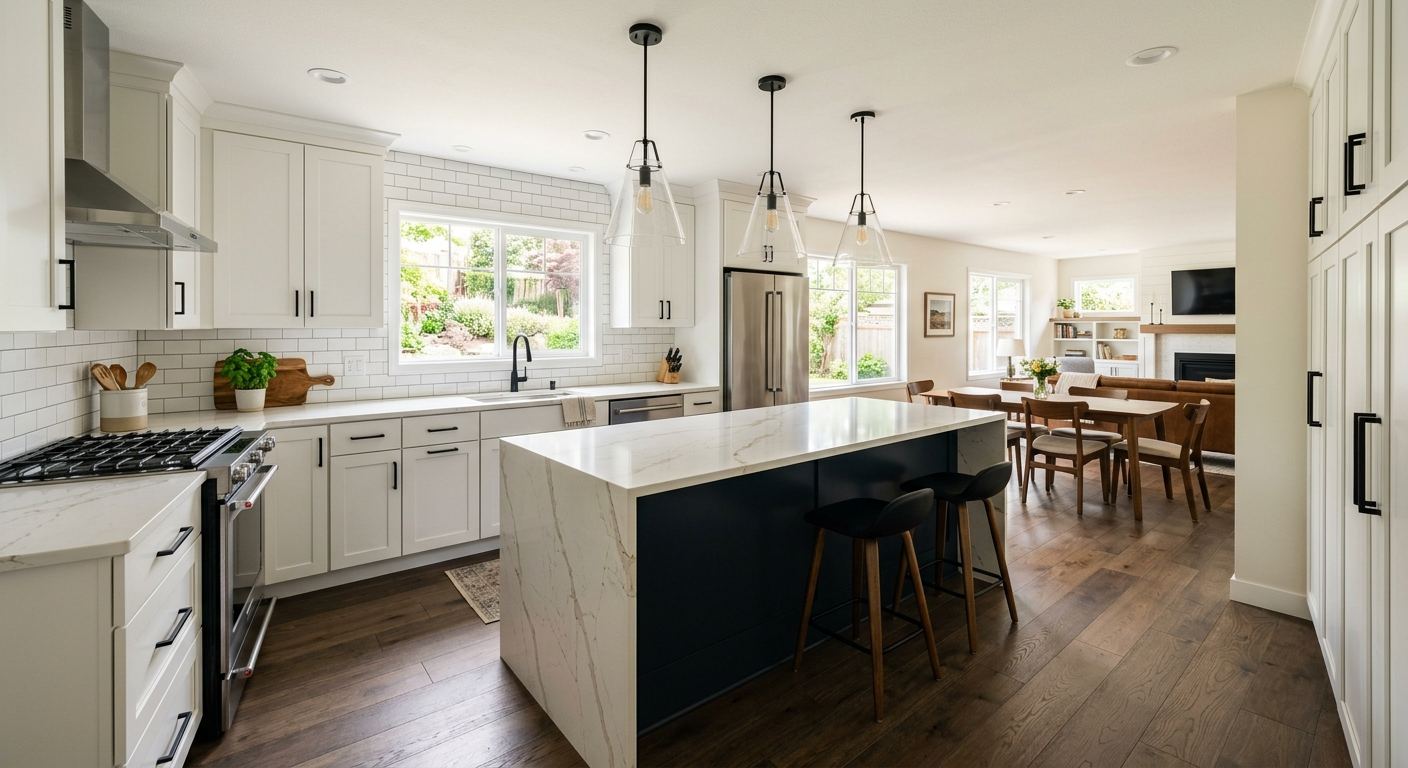
Kitchen renovation options and costs in Parkwoods-Donalda
Parkwoods-Donalda homeowners are often comparing kitchen renovation quotes because the neighbourhood’s mix of family homes and larger, higher-value properties pushes most projects toward upgrades that look “move-in ready.” With a 2021 population of 34,805 for the area, there’s steady demand for trades, which can tighten scheduling during peak spring–summer window. In Toronto’s housing market, many owners treat the kitchen as a value driver—commonly targeting finishes that fit how buyers evaluate condition and storage.
Local market expectations matter more than climate for pricing in this region. Toronto-area buyers frequently expect updated cabinetry, durable counters, and a modern backsplash, and those expectations tend to rise with neighbourhood home values. In practice, we see finish choices tracking the broader Toronto economic region (not so much weather-driven labour differences), with higher-value pockets more likely to choose quartz or natural stone and semi-custom or custom cabinetry. That’s consistent with how homeowners invest a meaningful share of property value into the kitchen when they believe the upgrade will be visible and recoverable at resale.
Project cost also responds to availability and site logistics. Older Toronto houses around Parkwoods-Donalda can have narrower hallways, older electrical panels, and dated plumbing runs that make demolition slower than on newer builds. If your kitchen has weak subflooring or a long countertop span, contractors may recommend structural checks before new stone is installed—this adds time, but it prevents future cracking and settling issues.
Below is a realistic comparison of common renovation routes, so you can anchor your next quote against the right scope and finish tier.
| Renovation Tier |
What's Included |
Typical Duration |
Price Range |
| Cosmetic refresh (paint, hardware, new appliances only) |
Cabinet paint or refinishing where applicable, new pulls/hinges, appliance swap, minor caulking and trim touch-ups; no cabinet reconfiguration and no countertop replacement |
1–2 weeks |
$8,000–$18,000 |
| Mid-range full renovation (new cabinets, counters, sink, tile) |
Semi-custom or stock cabinets, quartz or good laminate countertops, new sink and faucet, backsplash tile, updated plumbing fixtures, and partial electrical updates (task lighting typically) |
3–6 weeks |
$35,000–$65,000 |
| High-end full renovation (custom cabinets, stone counters, island) |
Fully custom millwork, natural stone (granite or marble) or premium quartz, island build (often with new electrical), upgraded appliance package, full-height or designer backsplash, and more extensive finish carpentry |
6–10+ weeks |
$70,000–$105,000 |
| Cabinet refacing only (new doors + drawer fronts, same boxes) |
Refacing panels, new doors/drawer fronts, new hardware, optional laminate or new countertop add-on (countertop not included if you keep existing) |
1–3 weeks |
$8,000–$35,000 |
| Countertop swap only (laminate to quartz or stone) |
Remove and dispose of old top, install new countertop, re-seal and adjust sink cut-outs as needed; backsplash not included unless stated |
3–7 days |
$3,000–$15,000 |
| Backsplash tile installation only |
Tile supply and installation, wall prep, grout/seal where required, patching minor imperfections |
4–10 days |
$2,000–$10,000 |
Prices are estimates only and vary by project scope, site access and material selection.
What affects the price of kitchen renovation in Parkwoods-Donalda
In Toronto—and across Ontario—two quotes for the “same” kitchen can land 30–50% apart because the real drivers are finish tier, demolition complexity, and how much of the rough-in is being changed. The Toronto economic region tends to price kitchens in line with home values and homeowner purchasing power, so higher-value neighbourhoods more often move quickly to quartz or stone counters and semi-custom cabinetry. In more price-sensitive areas, many owners choose laminate or refacing to keep budgets predictable while still improving the look.
For Parkwoods-Donalda, this means finish choices frequently do more to move your total than climate does. Even though winter conditions in Ontario affect drying times and some site logistics, contractor availability and material lead times are the bigger swings in cost. If you’re aiming for a mid-range full renovation around $35,000–$65,000, you’re usually selecting stock or semi-custom cabinetry with quartz or laminate and keeping the layout close to the original. If you’re stretching into the high-end $70,000–$105,000 range, the project typically includes an island, upgraded electrical, and custom millwork that demands more shop time and tighter on-site tolerances.
Concrete examples we see locally: (1) relocating a sink to improve workflow can add plumbing excavation and repair time, especially in older slabs or subfloors, raising labour unpredictably; (2) adding under-cabinet lighting or island power often requires new circuits, which can increase electrical labour and scheduling; and (3) replacing a worn-out subfloor or shimming uneven base cabinets can prevent countertop cracking—worth it, but it’s not always included in lower bids.
Layout changes remain the most variable regardless of finish tier. Moving a gas line for a stove, adjusting venting, or removing a load-bearing wall can also trigger more inspection steps and higher labour exposure.
| Price Factor |
Why It Matters |
Cost Impact |
| Cabinet tier — stock vs. semi-custom vs. fully custom millwork |
Higher tiers add custom dimensions, upgraded hardware, and more precise dovetail/fit; they also affect installation time |
~+$10,000 to +$35,000 depending on scope |
| Countertop material — laminate vs. quartz vs. granite vs. stone |
Material cost, fabrication complexity, and durability/edge profiles drive price; heavier stone can require extra support and careful installation |
~+$3,000 to +$25,000 |
| Layout change — wall removal, island add, plumbing/gas move |
Changes affect rough-in, structural work, permits, and rework risk |
~+$8,000 to +$30,000+ in common scenarios |
| Appliance package tier — builder vs. mid-range vs. pro-grade |
Pro-grade units often require higher electrical capacity, venting considerations, and premium install details |
~+$2,000 to +$12,000 |
| Flooring — refinish existing vs. full replacement |
Hiding under-cabinet transitions, matching levels, and removing old tile/laminate can add labour and disposal |
~+$1,500 to +$8,000 |
| Backsplash — ceramic tile vs. marble vs. full-height slab |
Full-height coverage increases prep and detailing; natural stone often needs sealing and more precise cutting |
~+$1,000 to +$10,000 |
| Electrical — new circuits for island, under-cabinet lighting |
Upgrades require licensed work and inspection readiness; more penetrations increase patching and labour |
~+$800 to +$6,000+ |
| Permit fees and licensed trade requirements |
Permits and inspections add admin time; licensed trades increase coordination cost |
~+$500 to +$5,000 depending on scope |
Permits & regulations in Ontario
In Ontario, not every kitchen change triggers a permit. Typically, cabinet and countertop swaps—like installing new doors, refacing cabinets (keeping the existing cabinet footprint), or replacing laminate with quartz—often do not require permits, because you’re not altering major systems. However, you do need permits and licensed trades when you change rough-ins or structural conditions. Common permit-requiring work includes moving plumbing supply/drain lines (like relocating a sink), relocating a gas appliance or modifying gas lines for a stove, removing a load-bearing wall, and adding new electrical circuits—especially for an island (GFCI/RCD considerations, new receptacles, and under-cabinet lighting tied into a new circuit).
For Parkwoods-Donalda homeowners, the verification process should be straightforward and documented. Step 1: ask your contractor for their Ontario business details and relevant trade licensing—then confirm against the appropriate online registry references they provide. Step 2: request a current certificate of insurance (liability) naming the project address; confirm the coverage is active on the start date. Step 3: ensure WSIB/WCB coverage is in place for the contractor and any subcontractors doing work onsite; you should be given proof before work begins.
Finally, make sure the contract clearly states who pulls permits (and who pays). If your project involves gas, plumbing, or electrical rough-in changes, it should be spelled out in writing before demolition starts.
Cabinets, countertops and layout decisions in Parkwoods-Donalda
In a Parkwoods-Donalda kitchen renovation, the biggest outcomes usually come from three decisions: (1) cabinet tier, (2) countertop material, and (3) whether you change the layout. Toronto buyers—especially in move-up neighbourhoods and family-oriented pockets—tend to judge kitchens by how complete and cohesive they look: consistent cabinet fronts, clean countertop edges, and a layout that makes day-to-day use easier. Climate plays a secondary role; Ontario’s freeze–thaw cycles don’t directly determine cabinet or counter durability, but older homes can have moisture-related issues under floors and around exterior walls that contractors must address before installing new cabinetry and stone.
Cabinet tier sets your baseline for longevity and fit. Stock cabinets are the fastest and least expensive, but you may compromise on storage depth and door style. Semi-custom is the most popular mid-range path in Toronto because it balances lead times and options. Custom cabinets deliver the tightest fit and best storage planning, especially when dealing with uneven walls common in older housing stock.
Countertops drive the “premium look” and maintenance experience. Laminate is budget-friendly, quartz is the practical middle ground, granite/stone adds character but requires proper sealing/handling, and butcher block is warm but needs more ongoing care. Layout changes are different: adding an island or opening the room can justify cost if it improves traffic flow and seating, but moving plumbing or gas lines tends to be the least predictable expense.
Here’s a real budgeting example: if you’re at $35,000–$65,000 for a mid-range renovation and you upgrade from laminate to quartz, the countertop portion often lands within the $3,000–$15,000 band, which is usually an easy, high-visibility upgrade. By contrast, switching to fully custom cabinets and adding a stone island typically pushes you toward the high-end band near $70,000–$105,000, because the lead time, fabrication, and additional trades work add up.
| Option |
Durability |
Maintenance |
Best For |
Price Range |
| Stock cabinets (big-box) |
Good durability for standard use; hinges and soft-close vary by model |
Low maintenance; minor touch-ups for dings |
Fast timelines and tight budgets with a straightforward layout |
$8,000–$25,000 |
| Semi-custom cabinets (local dealer) |
Typically stronger build and better internal organization; easier to match dimensions |
Low maintenance; follow care instructions for finishes |
Most Parkwoods-Donalda projects balancing cost, style, and storage |
$18,000–$45,000 |
| Custom cabinets (local millwork shop) |
Highest fit and finish; best for odd dimensions and premium hardware |
Low maintenance; premium finishes may show wear if not maintained |
Maximizing storage and achieving a “built-in” look buyers notice |
$35,000–$75,000+ |
| Laminate countertop |
Good for everyday use; can scratch and is less resistant to heat and heavy impacts than stone |
Wipe clean; avoid hot pans directly; be mindful of seam edges |
Budget refreshes while keeping the kitchen functional for resale |
$3,000–$6,500 |
| Quartz engineered countertop |
High durability; resistant to staining and everyday wear |
Low maintenance; no annual sealing required |
Busy households that want a premium look without extra upkeep |
$6,500–$12,000 |
| Granite / natural stone countertop |
Very durable surface; natural variation and edge detailing are strengths |
Periodic sealing recommended depending on stone; care for heavy spills |
Homeowners who want unique veining and a high-end finish |
$8,000–$15,000 |
| Butcher block countertop |
Can dent or scratch; durability improves with oiling and proper cutting habits |
Requires regular oiling and careful heat protection |
Warm, family-friendly kitchens where you’ll maintain the surface |
$5,000–$10,000 |
| Marble countertop |
Beautiful but softer than granite/quartz; can etch if acids touch the surface |
Higher maintenance—sealed and cleaned carefully to prevent staining |
Statement kitchens where appearance is prioritized and maintenance is acceptable |
$10,000–$18,000 |
How to choose a kitchen renovation contractor in Parkwoods-Donalda
Choosing the right contractor in Ontario starts with proof, not promises. First, verify Ontario licensing for any trades that will be doing permitted electrical, gas, or other regulated work—your contractor should be able to provide the licence details for their subcontractors. Next, confirm liability insurance coverage for the project dates; ask for an up-to-date certificate of insurance and check that it corresponds to the job address. Finally, verify WSIB/WCB coverage: you should receive documentation showing workers are covered for worksite injury risk.
Get 2–3 itemised written quotes, not lump sums. Itemised quotes should separate labour from materials and list key scopes like cabinet install, drywall/patching, countertop fabrication coordination, tile work, and electrical add-ons. Ask whether permits are included, who pulls them, and whether disposal/garbage removal is part of the contract. Kitchen renovations often fail on these details because “minor” exclusions (like tile underlayment prep or sink cut-out adjustments) can create change orders mid-job.
Warranty matters too. Confirm the workmanship warranty length (and what it covers), the product/manufacturer warranty terms, and whether warranties transfer if you sell the home. For payment scheduling, never pay more than 10–15% upfront; hold back a portion until completion and walk-through. Timeline expectations should be documented with a start date and estimated completion, including lead-time assumptions for cabinets and stone.
- Ask for licence proof and confirm it applies to the exact work you’re doing.
- Request certificate of insurance showing coverage dates that cover demolition through installation.
- Confirm WSIB/WCB coverage for all workers and subtrades, with documentation.
- Get itemised labour + materials breakdown (no single “kitchen package” number).
- Ensure cabinet, countertop, and appliance allowances are specific (brand/model or written allowance).
- Clarify permit responsibility in writing—who pulls it and who pays fees.
- Confirm disposal included or billed separately (demo, packaging, tile waste).
- Ask how they handle site protection and dust control during demolition.
- Confirm timeline assumptions for cabinet fabrication and countertop templating.
- Review change-order process: what triggers it and how pricing is approved.
- Verify warranty: workmanship duration, manufacturer warranty, and transferability.
- Set payment milestones tied to tangible completion (rough-in done, cabinets installed, counters templated, final trim).
Red flags to watch in Parkwoods-Donalda: (1) they won’t provide insurance/WSIB proof, (2) they quote only a “lump sum kitchen” without listing what’s included, (3) they won’t confirm whether permits and licensed trades are included when plumbing/electrical/gas moves are planned, (4) they rush you to sign without a written change-order policy, and (5) they ask for large upfront payments beyond 10–15%.
Frequently asked questions — kitchen renovation in Parkwoods-Donalda
Do I need a permit for a kitchen renovation in Ontario?
In Ontario, simple cosmetic work—like painting, replacing cabinet doors where boxes stay put, and swapping countertops—often does not require a permit. Permits are typically required when you change major systems: moving plumbing supply/drain lines (for a new sink location), relocating gas appliances or modifying gas lines, removing a load-bearing wall, or adding new electrical circuits (commonly for an island or new receptacles/lighting). In Parkwoods-Donalda, older homes sometimes have hidden challenges in rough-ins, so it’s smart to assume that layout changes may trigger permitting even if the finish upgrades are straightforward. Always confirm who pulls permits in the contract, and ensure licensed trades do the regulated portions.
What's the ROI on a kitchen renovation?
ROI varies, but kitchens are one of the renovations that most consistently affects buyer perception—especially when the upgrade improves layout function and makes the space feel modern. In the Toronto market, many homeowners choose finishes that align with expected buyer standards, which can be a stronger selling point than “trend” materials alone. Practically, if you keep scope sensible (for example, a mid-range renovation typically landing in the $35,000–$65,000 band), you’re less likely to over-invest relative to what the home can recapture at sale. High-end, fully custom builds near $70,000–$105,000 can still sell well, but ROI depends on whether the upgrades match the overall property value and the rest of the home’s condition. (Statistics Canada, 2021 Census)
How do I budget for a kitchen renovation?
Start by defining your tier: cosmetic refresh, mid-range full renovation, or high-end full renovation. Then budget “knowns” first: cabinets, countertops, sink/faucet, backsplash, and labour for installation. In Ontario, the finish tier is the main cost driver—so if you choose quartz instead of laminate, you should expect the countertop portion to move into the $6,500–$12,000 range rather than staying closer to $3,000–$6,500. Next, set aside an allowance for unpredictables: site access, old plumbing/electrical updates, and subfloor or wall patching. A common mistake in Parkwoods-Donalda is underestimating costs for layout changes. Moving plumbing or adding electrical for an island can swing totals by thousands even when cabinets and counters stay the same.
Can I move my kitchen sink or stove?
Yes, but moving a sink or stove is where projects most often change pricing and scheduling. Moving a sink usually involves relocating drain and supply lines and ensuring proper venting—this commonly triggers permits and licensed plumbing work. Moving a stove can be even more involved if it’s a gas appliance: relocating gas lines typically requires a licensed gas fitter and inspection readiness. In Parkwoods-Donalda, older home layouts can add complexity if you encounter outdated rough-ins, uneven floors, or wiring/plumbing runs that don’t line up with the new cabinet plan. Cost-wise, the finish tier might stay the same, but the rough-in changes can be the biggest unpredictable portion of a quote—often adding time and labour beyond what homeowners expect.
What's the most cost-effective kitchen upgrade?
The most cost-effective upgrade is usually the one that creates the biggest visual change with the least rough-in work. For many Parkwoods-Donalda homes, that’s upgrading cabinet fronts through refacing and pairing it with a new countertop and updated hardware. Cabinet refacing-only projects often land in the $8,000–$35,000 range, depending on door styles, finish, and whether you add any electrical or backsplash changes. If your cabinets are structurally fine but look dated, refacing plus a countertop swap can outperform full replacement by saving on demolition and installation time. Another budget-friendly win is a backsplash upgrade; tile installation is commonly in the $2,000–$10,000 band and can modernize the entire room. If you can avoid moving plumbing/electrical, your budget usually stretches further.
Custom vs stock cabinets — is custom worth it?
Custom cabinets can be worth it when you have a problem to solve—odd wall dimensions, tight layout constraints, or you want storage planning that standard sizes can’t deliver. In Parkwoods-Donalda, many homes have older framing and uneven walls, so semi-custom or custom can reduce gaps and improve long-term usability. That said, custom is rarely the best first move if your goal is budget control. Stock cabinets are typically the fastest and cheapest path, while semi-custom is the most common mid-range balance for buyers. If your renovation is targeting the mid-range $35,000–$65,000 band, semi-custom with quartz can be the sweet spot for value and resale appeal. If you’re building toward the high-end $70,000–$105,000 band and want an “architectural” kitchen, custom often feels more justified.