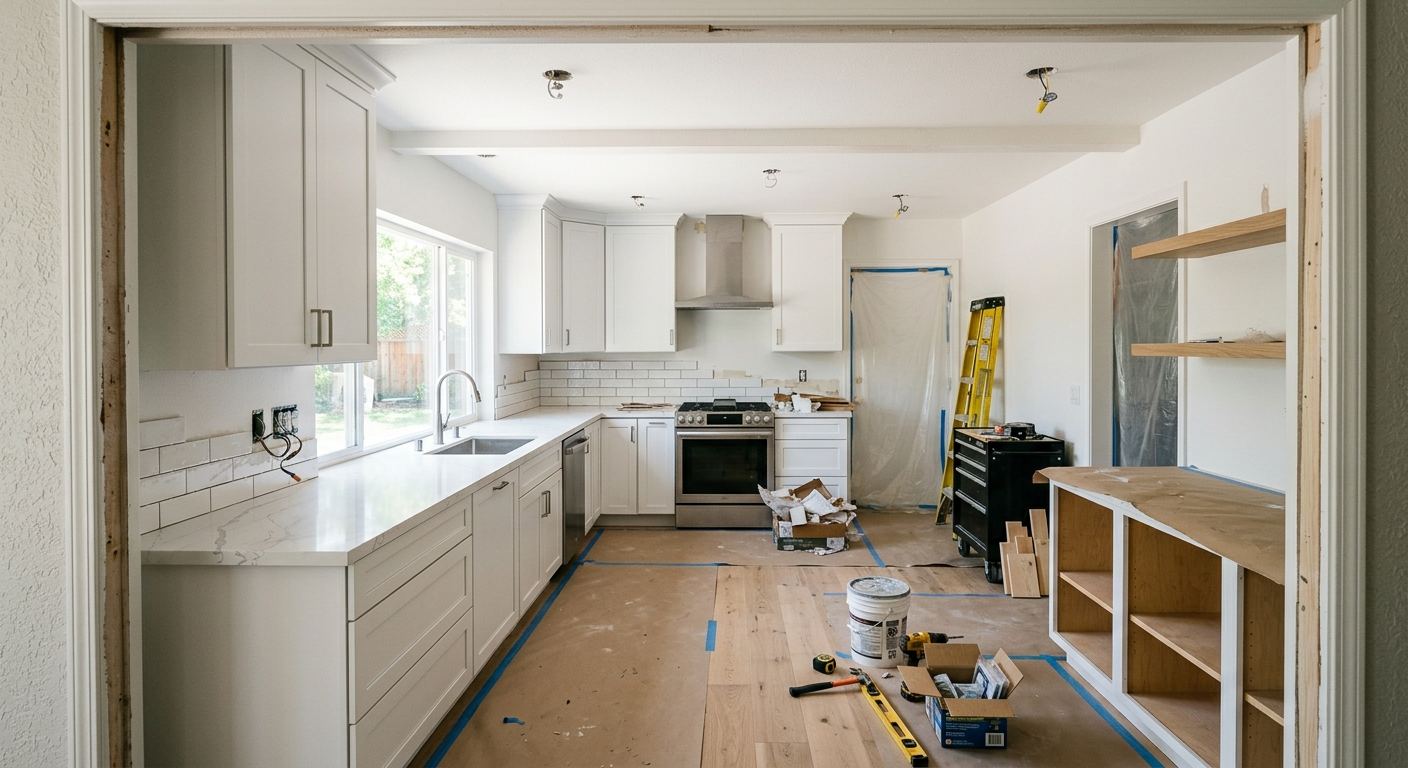
Kitchen renovation options and costs in Owen Sound
Kitchen renovations in Owen Sound tend to follow a fairly predictable pattern: homeowners with higher incomes and higher-value properties more often pursue the “looks-and-feels-new” option, while others focus on ROI-friendly upgrades. In the Stratford–Bruce Peninsula economic region, the median household income is $63,200 (Statistics Canada, 2021 Census), and Owen Sound’s housing mix includes 5,735 homeowner households, with 58.0% of households owning their home (Statistics Canada, 2021 Census). That matters because kitchen finishes are one of the first things buyers evaluate, so many owners upgrade to match what they believe will hold resale value.
Cost is also influenced by what local trades can reliably schedule. In smaller centres around Owen Sound, cabinetry and stone suppliers can be excellent, but freight and lead times still affect the overall budget more than in GTA suburbs. The good news is that Grey and Bruce markets usually land in the national mid-range for turnkey kitchens, and the day-to-day climate swings don’t “wear out” finishes faster than elsewhere—your biggest cost drivers are still cabinetry tier, countertop choice, and any plumbing/electrical relocation. Most older homes (72.4% built before 1981) may also require extra care when removing tile, reinforcing old framing, or rerouting lines, which pushes labour toward the higher end if you’re changing the layout.
In Owen Sound, demand is especially strong in the downtown and harbour-adjacent areas, where older housing stock and frequent resale activity lead to more kitchen updates and consultations. Use the tiers below to estimate a realistic budget before you compare contractor quotes.
| Renovation Tier |
What's Included |
Typical Duration |
Price Range |
| Cosmetic refresh (paint, hardware, new appliances only) |
Wall paint or refinishing, cabinet hardware, appliance swap (range/refrigerator/dishwasher), light cleaning/caulking, basic trim touch-ups |
3–7 days |
$4,000–$12,000 |
| Mid-range full renovation (new cabinets, counters, sink, tile) |
New cabinet installation, new countertop and sink/faucet, backsplash tile, under-cabinet prep/finish, flooring transition work, basic plumbing/electrical adjustments as needed |
3–6 weeks |
$35,000–$55,000 |
| High-end full renovation (custom cabinets, stone counters, island) |
Custom or semi-custom cabinetry, stone countertops, island with enhanced framing, higher-end backsplash, upgraded electrical for island lighting/outlets, deeper finish package |
6–10 weeks |
$60,000–$70,000 |
| Cabinet refacing only (new doors + drawer fronts, same boxes) |
Door/drawer replacement, new hardware, new trim details, repainting existing cabinet boxes as needed, limited countertop/backsplash updates |
1–3 weeks |
$8,000–$20,000 |
| Countertop swap only (laminate to quartz or stone) |
Removal of existing surface, new countertop supply/installation, edging, cut-outs for sink/cooktop, resealing and caulking, backsplash touch-in if included |
3–10 days |
$3,000–$12,000 |
| Backsplash tile installation only |
Tile supply and installation, backer prep, grouting, trim/edge finishing, around electrical outlets and vents as required |
2–5 days |
$1,500–$7,000 |
Prices are estimates only and vary by project scope, site access and material selection.
What affects the price of kitchen renovation in Owen Sound
Two homeowners can receive quotes that differ by 30–50% for what sounds like the “same” kitchen because pricing in the Stratford–Bruce Peninsula region reflects local supply timing, trade availability, and how often older Owen Sound homes require problem-solving during demolition. Across Ontario, quotes also swing with workmanship rates, how much of the job involves licensed work (plumbing/gas/electrical), and whether your contractor includes contingencies for dated framing or hidden subfloor issues.
In Owen Sound, local home values and median income shape the finish tier far more than climate. Where buyers expect a more premium look—often tied to stronger resale pockets—owners tend to choose quartz or stone counters and semi-custom cabinetry because the added cost is easier to defend at resale. In more modest-value setups, laminate countertops and stock cabinet systems are common because they deliver the “new kitchen” effect without overextending. Even within the same city, homeowners moving from the mid-range full renovation budget (often around $35,000–$55,000) to higher-end scopes (commonly $60,000–$70,000) typically do so because they’re also upgrading cabinetry and surface materials, and because they’re adding an island or changing the layout.
Layout changes are the unpredictable part regardless of finish level. Removing a wall can mean structural assessment, beam installation and drywall/paint complexity; adding an island often means new electrical and sometimes changes to plumbing access. In older homes built before 1981 (72.4% of dwellings), we commonly see unexpected subfloor patching after tile removal, and that can add several days of labour even when the countertop choice stays mid-range.
Two other Owen Sound realities that move pricing: first, contractor scheduling and material lead times can increase carry costs for clients, especially for custom millwork. Second, if you’re moving a gas range connection or upgrading exhaust/hood ducting, the job naturally shifts upward toward the higher-end ranges because licensed trades are required and inspections are part of the timeline.
| Price Factor |
Why It Matters |
Cost Impact |
| Cabinet tier — stock vs. semi-custom vs. fully custom millwork |
Material quality, door/drawer design, tolerances, and how well the system fits uneven walls |
Stock keeps budgets closer to mid-range; semi-custom and custom commonly push cabinetry costs up sharply and add install time |
| Countertop material — laminate vs. quartz vs. granite vs. stone |
Material price, thickness/edge options, fabrication time, and weight handling |
Countertop swaps can range from entry-level to “budget-doubling” surface upgrades; expect big jumps when moving to quartz/stone |
| Layout change — wall removal, island add, plumbing/gas move |
Structural work, new framing, altered drainage/venting, and line rerouting |
Often adds the most uncertainty; can move a job from one budget tier to the next even if finishes stay similar |
| Appliance package tier — builder vs. mid-range vs. pro-grade |
Electrical demands, install complexity, finish matching, and warranty/service differences |
Appliances can add several thousand dollars and may require additional electrical or ventilation details |
| Flooring — refinish existing vs. full replacement |
Subfloor condition after demo and how flooring transitions are handled at cabinets |
Replacing flooring usually increases labour and materials; refinishing can reduce cost but may be limited by damage |
| Backsplash — ceramic tile vs. marble vs. full-height slab |
Waterproofing requirements, weight, pattern layout complexity, and edge finishing |
Full-height or premium stone installs can significantly raise backsplash budgets beyond basic tile |
| Electrical — new circuits for island, under-cabinet lighting |
Licensed electrical work, additional outlets, lighting transformers, and code-compliant placement |
Electrical additions commonly raise the “unseen” portion of the budget even when cosmetics stay simple |
| Permit fees and licensed trade requirements |
Third-party inspections, scheduling, and trade coordination |
Permits and inspections don’t usually make a small refresh expensive, but they add cost and time for complex scope |
Permits & regulations in Ontario
In Ontario, a straightforward cabinet and countertop swap typically does not require a permit. That means replacing cabinets in the same footprint and installing new laminate or quartz tops usually stays on the “no permit” side of most renovations. However, the moment you move plumbing supply/drain lines, relocate a gas appliance connection, remove a load-bearing wall, or add electrical circuits, permits and licensed trades are generally required. For Owen Sound homeowners, the key is understanding that the permit trigger is based on the type of work, not the overall kitchen style.
Here’s what typically DOES require a permit or licensed work: moving or extending drain lines, changing sink location, installing or relocating a dishwasher (when plumbing is altered), relocating a gas stove/range connection, rerouting a vent hood where ducting changes, removing or modifying load-bearing walls (often requiring structural review), adding new electrical circuits for an island, and installing new under-cabinet lighting that includes new wiring. What typically does NOT require a permit: replacing existing cabinets with like-for-like work in the same location, swapping countertops, repainting walls, and installing a backsplash when you’re not changing electrical boxes.
Step-by-step verification you can do before work starts: (1) Ask for the contractor’s proof of Ontario licence/registration where applicable for the scope, (2) request a certificate of insurance and verify the coverage limits match your project risk, (3) confirm WSIB/WCB coverage for their workers, and (4) for licensed trades, ask for their licence details and inspection/clearance letter process when the permit applies. Always confirm in writing who pulls the permit; contractor responsibility should be explicit in your contract.
Cabinets, countertops and layout decisions in Owen Sound
The three decisions that most directly determine whether your Owen Sound kitchen looks “right” years from now are cabinet tier, countertop material, and whether you change the layout. In the Stratford–Bruce Peninsula area, buyers at different price points tend to expect consistent finishing: at the mid-range level, semi-custom or well-built stock cabinets plus quartz-look surfaces hold their appeal; at the higher end, custom cabinetry, statement islands, and stone countertops become the norm. Because many homes were built before 1981 (72.4% of dwellings), wall lines and floor levels can be imperfect—so choosing the right cabinet system can reduce costly rework.
Cabinet tier choice: stock cabinets are fastest and typically cheapest, but they fit best when the walls are relatively square. Semi-custom cabinets (the most popular mid-range option) offer better sizing and trim flexibility while keeping timelines reasonable. Custom cabinetry gives the closest fit and the best design control, especially for awkward corners, but it costs more and usually adds lead time.
Countertop material: laminate is a budget-friendly surface, and it works well if you’re careful with heat and sharp impacts. Quartz is the practical “upgrade” in most renovations—more durable than laminate for everyday life and usually easier to maintain than natural stone. Granite and other natural stones look premium but need more attention to sealing and chip protection at edges. Butcher block can be beautiful in heritage-style kitchens and can be refinished, but it requires disciplined care around moisture.
Layout changes should be justified by space gain. For example, adding an island often triggers electrical work and may require careful planning around traffic flow. If your overall scope is in the $35,000–$55,000 mid-range band, you can often upgrade from stock cabinets to semi-custom and choose quartz within that envelope—without necessarily adding structural complexity. If you’re pushing into $60,000–$70,000 high-end territory, that’s when a full island buildout plus stone countertops and a higher cabinet tier typically becomes worth it for resale appeal.
| Option |
Durability |
Maintenance |
Best For |
Price Range |
| Stock cabinets (big-box) |
Good durability; best on straight, level walls and standard sizes |
Low maintenance; focus is on door alignment and proper installation for longevity |
Speed, predictable pricing, and straightforward layouts |
$8,000–$20,000 |
| Semi-custom cabinets (local dealer) |
Very good durability with improved sizing options and sturdier finishing details |
Low maintenance; often easier to make minor adjustments for older-home quirks |
Most Owen Sound mid-range renovations aiming for a “tailored” look |
$15,000–$35,000 |
| Custom cabinets (local millwork shop) |
Excellent durability; premium hardware options and superior fit for irregular spaces |
Low day-to-day maintenance, but higher-quality hinges/drawers mean better long-term feel |
Owners who want a precise plan, unique storage solutions, and long-term permanence |
$25,000–$45,000 |
| Laminate countertop |
Moderate durability; can chip or wear at edges with impact or heat exposure |
Easy to clean; avoid hot pans and protect seams/edges |
Budget-focused refreshes where the cabinet look is the priority |
$3,000–$6,000 |
| Quartz engineered countertop |
High durability for daily use; resistant to stains and typical kitchen wear |
Very low maintenance; no sealing required for most quartz products |
Homeowners wanting a premium look without natural-stone upkeep |
$6,000–$12,000 |
| Granite / natural stone countertop |
High durability; varies by stone type, but generally handles daily use well |
Requires periodic sealing and careful edge/chip protection |
Premium aesthetic seekers, especially for feature islands |
$7,000–$14,000 |
| Butcher block countertop |
Good durability if maintained; sensitive to moisture and heat compared with quartz/stone |
Needs regular oiling/sanding refinishes and careful wet-area protection |
Heritage and farmhouse styles where upkeep is part of the plan |
$4,500–$10,000 |
| Marble countertop |
Beautiful but comparatively softer; more prone to etching and staining |
Higher maintenance; sealing and careful cleaning are essential |
Low-abuse display kitchens or where homeowners understand maintenance needs |
$8,000–$16,000 |
How to choose a kitchen renovation contractor in Owen Sound
Choosing the right contractor in Owen Sound comes down to confirming three things early: Ontario licensing/qualification for the work they’re doing, liability insurance, and WSIB/WCB coverage. Start by asking for proof of insurance before any work begins—an updated certificate of insurance is the simplest document to request. Next, verify WSIB/WCB coverage for their workers (or confirm the appropriate coverage paperwork) so you’re not exposed if someone is injured on your property. For licensed trades involved in your scope, ask each trade for their licence details and confirm they’ll provide inspection documentation when permits apply.
Get 2–3 itemised written quotes. You want a breakdown that separates labour and materials, not one lump-sum number. Ensure cabinet supply, countertop fabrication, backsplash installation, demolition/disposal, electrical/plumbing allowances, and any contingency are clearly listed. Read the scope line-by-line: confirm what’s excluded (for example, subfloor repairs, drywall patching, moving appliances you didn’t budget for, or extra electrical outlets). Confirm whether permits, inspections, and disposal are included or billed separately.
Warranty matters: ask for the workmanship warranty length and whether product warranties carry through if you sell the home later. Payment schedule should be conservative—never pay more than 10–15% upfront, and use a holdback until the job is complete and you’ve inspected finish quality. Finally, request a start date and a completion estimate in writing, including how the contractor manages cabinet/countertop lead-time delays.
- Ask for proof of liability insurance and confirm the coverage limits before signing.
- Verify WSIB/WCB coverage for the contractor’s workers.
- Confirm Ontario licence/qualification for the scope (especially electrical, gas, and structural work).
- Require 2–3 itemised quotes with labour and materials broken out.
- Check who pulls permits and who pays permit fees when required.
- Confirm disposal/haul-away is included (especially tile, cabinets, and old appliances).
- Ask what’s included in site protection (floor protection, dust control, trim masking).
- Verify countertop template/fabrication timelines and how delays affect your schedule.
- Confirm warranty: workmanship duration, product/manufacturer warranty, and transferability.
- Use a payment schedule with no more than 10–15% upfront and a meaningful holdback.
- Request a written change-order process for any scope additions.
- Insist on an end-to-end schedule showing rough-in, cabinet install, countertop install, and finishing.
In Owen Sound, common red flags include: vague “all-in” pricing with no breakdown, refusing to provide insurance/coverage documentation, skipping permit responsibility clarity in writing, promising countertop/cabinet timelines without acknowledging lead time, and offering a payment schedule that asks for large upfront deposits.
Frequently asked questions — kitchen renovation in Owen Sound
Custom vs stock cabinets — is custom worth it?
In Owen Sound, custom cabinets are worth it when you have an older-home layout that doesn’t line up well, unusual corners, or a design that needs precise measurements (like a true integrated hood surround or a perfectly matched island). With 72.4% of dwellings built before 1981 (Statistics Canada, 2021 Census), uneven walls and floors can make stock cabinets harder to install cleanly without extra adjustments. That said, most homeowners who want a strong resale-friendly look can get excellent results with semi-custom in the mid-range band. If you’re working with a full renovation budget around $35,000–$55,000, moving from stock to semi-custom often gives the biggest “visual upgrade per dollar.” Custom becomes most defensible when the storage design and fit quality are non-negotiable.
How do I choose a kitchen contractor in Owen Sound?
Start locally and verify documentation. Ask any contractor in Owen Sound for proof of liability insurance, WSIB/WCB coverage, and confirmation of licensing/qualification for the work they perform. Then compare apples to apples: request 2–3 itemised quotes that separate labour from materials (cabinets, countertops, backsplash tile, plumbing/electrical allowances). Carefully check scope inclusions like permit responsibility, disposal/haul-away, and site protection. A reputable contractor will also provide a workmanship warranty and explain what happens if cabinets or countertops arrive late. As a rule of thumb, if someone can’t clearly explain how their quote aligns to your targeted budget tier—whether that’s closer to a $35,000–$55,000 mid-range renovation or higher-end $60,000–$70,000 scope—keep looking.
What order do kitchen renovation steps happen in?
In Ontario, the safest order is usually: demo and rough-in coordination first, then the licensed work, then cabinets and counters, then finishing. Practically, your contractor should confirm whether any plumbing supply/drain changes or electrical circuit additions are needed before ordering cabinets. After demolition, the plumbers/electricians do rough-ins while framing and drywall work is still accessible. Next comes cabinet installation (leveling and fixing), then countertop templating/fabrication, and then installation of countertops with sink/cooktop cut-outs. Backsplash tile follows once the counters are in and the wall is properly prepped. Appliances come last so you’re not installing and uninstalling them during finishing. Your timeline depends on lead times; you can’t “force” countertop fabrication, so schedule carefully around realistic delivery dates.
Can I live at home during a kitchen renovation in Owen Sound?
Often yes, but it depends on how invasive the demo and rough-in phases are and whether you’re relocating plumbing/gas or changing electrical circuits. For cosmetic refreshes (paint/hardware and new appliances only), staying in the home is usually straightforward. For mid-range full renovations—especially those that involve cabinet removal, tile replacement, and sink changes—many homeowners choose partial living arrangements: keeping access to a second bathroom, using a temporary cook area, and protecting floors from dust. If your layout change includes wall removal or an island add with electrical rough-ins, the work is typically harder to contain and more disruptive. In Owen Sound’s older housing stock, expect some surprises behind walls; that can extend noisy work even if finishes stay mid-range (for example, within $35,000–$55,000). A good contractor will plan dust control and set daily access expectations.
Should I renovate my kitchen before selling in Owen Sound?
In most Owen Sound scenarios, a kitchen refresh done strategically is a positive move, but “before selling” needs a timeline and a budget that matches buyer expectations. Buyers often respond to modern layouts, clean surfaces, and durable finishes more than to high-end ornamentation. If you’re considering a full renovation, aim for improvements that photograph well and hold up to everyday use—quartz countertops and durable cabinet systems are usually safer bets than very high-maintenance natural stone choices. If your budget is limited, you can still compete by doing a mid-range full refresh (commonly $35,000–$55,000) or by upgrading key elements like countertops plus hardware. Keep in mind Ontario’s older homes: pre-1981 build issues can create surprises during demolition, so reno timing matters. If you’re within a year or less of selling, discuss scope that reduces schedule risk.
What's the most popular kitchen style in Owen Sound right now?
Right now, many homeowners in Owen Sound are leaning toward bright, clean, transitional looks: shaker-style fronts, warm neutrals, and practical layouts that maximize prep space. In resale-focused renovations, semi-custom cabinetry paired with quartz countertops and a simple, modern backsplash is a common winning combination because it reads “updated” without excessive upkeep. Islands are also popular, but only when the room size allows comfortable circulation—especially in older homes where walls may not align perfectly. Colour choices often follow what buyers in smaller centres expect: fewer ultra-trendy finishes and more durable, timeless tones. Budget-wise, this style is achievable in the $35,000–$55,000 mid-range tier; the higher-end $60,000–$70,000 tier tends to add custom millwork details, more elaborate stone, and expanded lighting or hardware features.