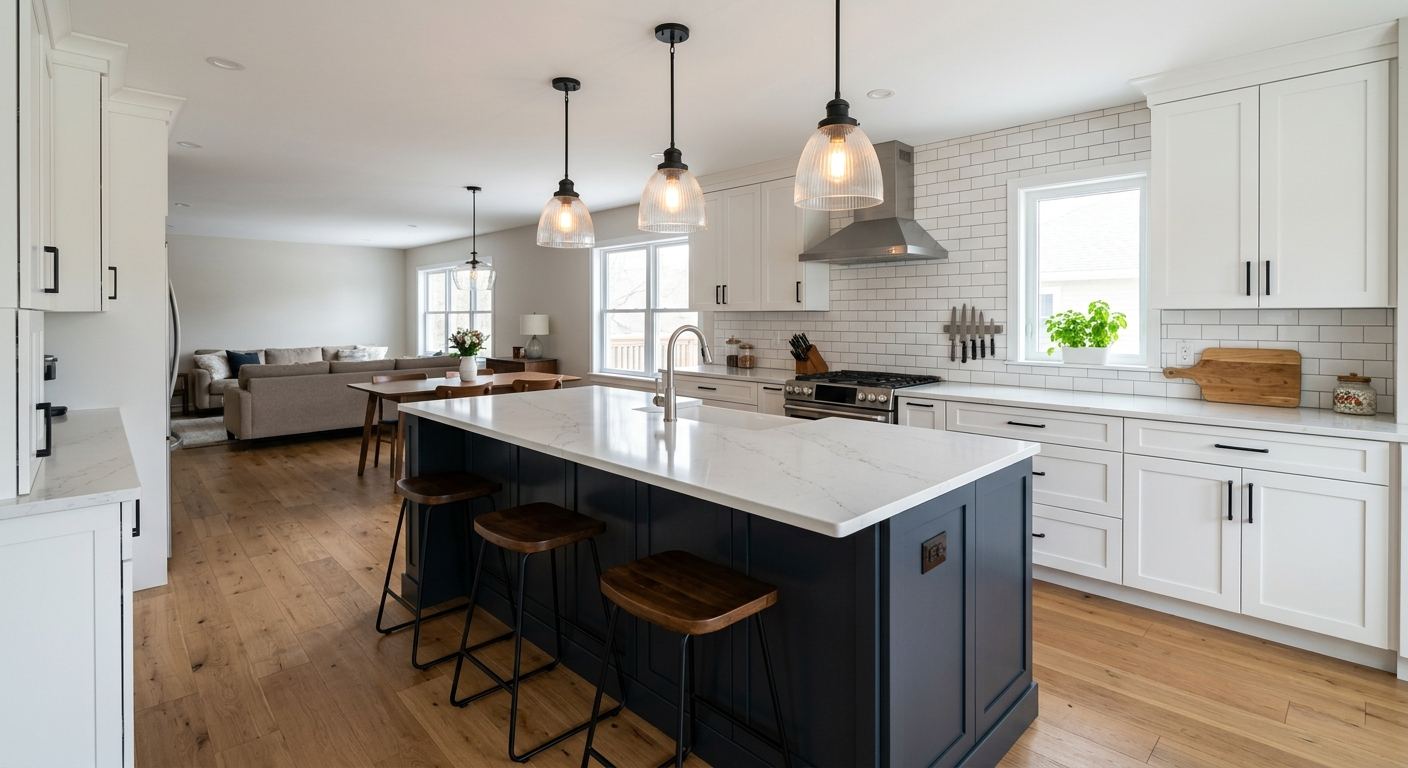
Kitchen renovation options and costs in Waterfront Communities-The Island
In Waterfront Communities-The Island, kitchen renovations tend to follow the same budgeting logic as the rest of central Toronto: the project’s scope and finish choices matter far more than weather. With a 2021 population of 65,913, you’ll see steady demand from homeowners in apartment-style condos, townhouse pockets, and older pre-war and post-war housing around the waterfront and King/Queen corridor. Two local signals also influence expectations. First, the Toronto economic region has higher-value ownership patterns, so many homeowners aim to protect resale appeal; second, owners often target a kitchen spend that aligns with the way buyers price turnkey homes. In practical terms, it’s common to see owners invest closer to mid-to-high shares of property value into cabinetry and countertops rather than treating the kitchen as a quick refresh.
Toronto’s “real world” climate affects logistics more than material performance: freeze–thaw cycles and humid summers can slow caulking and tile acceptance, and older ductwork or exterior venting can reveal surprises once walls open. Availability can also tighten in peak renovation months, which slightly shifts scheduling and labour rates when trades are booked out.
Neighbourhood demand is especially noticeable around the Queen West and King West strip, where turnover and resale staging drive requests for quartz, upgraded hardware, and modern lighting. From that baseline, it becomes easier to compare tiers side-by-side—so the next section breaks typical inclusions, timelines, and price bands for each renovation option.
| Renovation Tier |
What's Included |
Typical Duration |
Price Range |
| Cosmetic refresh (paint, hardware, new appliances only) |
Cabinet paint or stain (existing boxes), new pulls/hinges, new backsplash (small area) optional, appliance swap, re-caulk and touch-ups, basic labour coordination |
5–10 business days |
$25,000–$35,000 |
| Mid-range full renovation (new cabinets, counters, sink, tile) |
New semi-custom or stock cabinets, laminate-to-quartz or quartz countertops, sink and faucet, new backsplash tile, disposal and plumbing hookups, under-cabinet lighting wiring allowance |
3–6 weeks |
$45,000–$70,000 |
| High-end full renovation (custom cabinets, stone counters, island) |
Fully custom millwork, stone counters (natural stone or premium quartz), island build, upgraded appliance package, extensive backsplash (to ceiling or feature wall), flooring and trim allowance, coordinated electrical/plumbing changes |
6–10 weeks |
$70,000–$90,000 |
| Cabinet refacing only (new doors + drawer fronts, same boxes) |
Refaced door and drawer fronts, veneer or panel replacement, new hardware, repaint/finish correction, add-ons like soft-close, existing box modifications only if needed |
1–3 weeks |
$8,000–$22,000 |
| Countertop swap only (laminate to quartz or stone) |
Remove and dispose old tops, template and install new quartz/stone, sink cut-out updates (as needed), new edging, silicone/caulk line replacement |
4–12 business days |
$3,000–$15,000 |
| Backsplash tile installation only |
Demo of existing backsplash (if included), wall prep, tile supply and install (ceramic/porcelain), grout/seal where appropriate, electrical cover plates coordination |
3–8 business days |
$2,000–$10,000 |
Prices are estimates only and vary by project scope, site access and material selection.
What affects the price of kitchen renovation in Waterfront Communities-The Island
In Waterfront Communities-The Island, it’s normal to see quotes for the “same” kitchen vary by 30–50% across Toronto and Ontario. The biggest reason isn’t climate—it’s finish tier and the number of trades-hours hidden in real site conditions. Local home values and median household income patterns strongly influence what owners choose: in higher-value pockets of the Toronto market, many homeowners default to quartz or natural stone counters and semi-custom cabinetry because buyers often treat those upgrades as visible proof of care. In more price-sensitive parts of the wider GTA, the ROI strategy shifts toward laminate or stock cabinets and selective layout tweaks, keeping budgets in the mid-range (for example, many full renovations land around the $25,000–$90,000 band depending on scope).
Two practical examples show how Toronto conditions move pricing even when the “design” is similar. First, older housing stock can have out-of-plumb walls and undersized electrical boxes under cabinets; correcting those issues increases cabinet installation time and sometimes requires additional electrical work. Second, if your home has dated venting or constrained make-up air, switching appliances or relocating a hood can trigger extra planning for duct runs, which is labour-intensive even before materials are counted.
Layout changes are the most unpredictable cost driver regardless of finish level. Removing a wall, adding an island, or moving plumbing/gas lines can shift the budget more than upgrading from laminate to quartz, because you’re paying for demolition, patching, inspections, and rerouting. Weather can still affect schedules—Toronto humidity and seasonal temperatures can slow drying and tile-set timelines—but it usually changes duration more than the total bill.
| Price Factor |
Why It Matters |
Cost Impact |
| Cabinet tier — stock vs. semi-custom vs. fully custom millwork |
Material quality, door construction, internal fittings, and how precisely the system fits your space |
Can change total spend by the biggest margin within a full reno (roughly the difference between low–mid and high-end tiers within the $25,000–$90,000 range) |
| Countertop material — laminate vs. quartz vs. granite vs. stone |
Material pricing, fabrication complexity, edge profiles, and weight/handling requirements |
Countertop-only budgets often sit in the $3,000–$15,000 range, but premium stone can push toward the high end |
| Layout change — wall removal, island add, plumbing/gas move |
Demolition, structural review, rerouting lines, patching and inspection steps |
Typically adds the most unpredictability; can move a project from “mid-range refresh” toward high-end full renovation economics |
| Appliance package tier — builder vs. mid-range vs. pro-grade |
Electrical requirements, venting needs, and fit/finish expectations |
Small cosmetic tier changes can be relatively contained; pro-grade upgrades can noticeably increase total budget |
| Flooring — refinish existing vs. full replacement |
Protected adjacent flooring is less expensive than full removal/rebuild to match cabinet height transitions |
Partial protection/refinish keeps costs lower; full replacement adds labour and material allowances |
| Backsplash — ceramic tile vs. marble vs. full-height slab |
Material hardness, cutting complexity, and finishing (grout vs. stone polishing) |
Backsplash tile installation commonly falls in the $2,000–$10,000 range depending on coverage and material |
| Electrical — new circuits for island, under-cabinet lighting |
New outlets, lighting, and load planning add licensed trade time |
Can add meaningful cost even when cabinetry and counters stay mid-range |
| Permit fees and licensed trade requirements |
Required approvals, inspections, and scheduling for gas/electrical changes |
Usually modest compared to custom millwork, but the process can expand timeline and labour staging |
Permits & regulations in Ontario
In Ontario, a cabinet and countertop swap generally does not require a permit. That means replacing cabinets, changing countertop surfaces, swapping a sink, and installing a standard backsplash are typically treated as renovation finishing work. However, if your kitchen work involves any of the items below, permits and licensed trades are often required: moving plumbing supply or drain lines, relocating or adding gas components (for example, changing the stove location or modifying a gas range hood setup), removing a load-bearing wall or making structural modifications, and adding new electrical circuits (for example, outlets for an island, or new wiring for under-cabinet lighting when it requires circuit work).
Step-by-step, here’s how a homeowner in Waterfront Communities-The Island can verify contractor readiness in Ontario. First, ask the contractor to provide their Ontario licence/business number details (as applicable to their trade scope), plus a certificate of insurance showing liability coverage and proof of workers’ compensation coverage (WSIB/WCB). Next, request the specific permit handling plan: who pulls permits, who schedules inspections, and what the contractor is responsible for in writing. Finally, confirm the contractor’s role for licensed trades—gas work must be done by a licensed gas fitter, and electrical work must be done by a licensed electrician, with inspections completed before you close walls.
Always confirm permit responsibility before signing—contract language should clearly state who is pulling permits, what inspections are included, and who pays if work is rejected.
Cabinets, countertops and layout decisions in Waterfront Communities-The Island
When you’re planning a kitchen renovation in Waterfront Communities-The Island, three choices drive the outcome more than anything else: (1) cabinet tier, (2) countertop material, and (3) layout changes. For cabinetry, stock options are the fastest and cheapest because the boxes and sizing are standardized. Semi-custom cabinetry is the most popular mid-range choice in Toronto because it balances fit, storage upgrades, and lead times. Custom cabinets cost more, but they’re the best route when you want perfect alignment to ceiling lines, custom appliance garages, or a layout that’s difficult to fit with standard modules.
For countertops, laminate is the budget-friendly option, while quartz is the practical upgrade for most resale-minded homeowners—durable surfaces with low maintenance and consistent looks. Granite/natural stone adds character and value perception, but it can require more care depending on the finish and sealing. Butcher block can feel warm and “heritage,” though it needs more maintenance than quartz, especially with Toronto’s wet winters transitioning into humid summers.
Layout changes are where costs can justify themselves. If adding an island improves circulation, creates seating, or solves a workflow issue, the investment is easier to defend at resale. But if the work means moving plumbing/gas and opening multiple walls, the dollars can climb quickly.
Concrete example: if you’re comparing a countertop-only upgrade, many homeowners can stay within a countertop swap budget of about $3,000–$15,000. If that change is paired with a full cabinet replacement and a tile backsplash, you’re typically moving toward the mid-range full renovation band (often in the $45,000–$70,000 zone), which is the point where the room’s “before-and-after” impact becomes obvious to buyers.
| Option |
Durability |
Maintenance |
Best For |
Price Range |
| Stock cabinets (big-box) |
Solid for daily use; depends on hinge quality and finish durability |
Low—wipe clean; touch up minor nicks with matching finish if available |
Fast projects, tight budgets, rental or pre-sale staging where speed matters |
$20,000–$35,000 |
| Semi-custom cabinets (local dealer) |
Very good durability; stronger fitting options and better storage hardware |
Low—typical cabinet care; adjust soft-close hardware as needed over time |
Most Toronto homeowners who want an upgraded look without custom pricing |
$35,000–$55,000 |
| Custom cabinets (local millwork shop) |
Highest durability potential with tailored construction and hardware selection |
Low—best maintained with proper cleaning products; repairs are easier when custom parts exist |
Challenging layouts, ceiling-to-floor detailing, unique storage needs |
$55,000–$80,000 |
| Laminate countertop |
Good for general use; edges are the most vulnerable area |
Low—avoid prolonged standing water at seams and protect from heat sources |
Budget-friendly refresh where appearance matters more than premium feel |
$3,000–$6,000 |
| Quartz engineered countertop |
Very high durability; resists staining and everyday wear |
Low—routine cleaning only; less concern about sealing compared with natural stone |
Resale-friendly upgrade that stays practical in Toronto’s busy households |
$6,000–$12,000 |
| Granite / natural stone countertop |
High durability; performance varies by stone type and finish |
Moderate—may require periodic sealing and careful protection from certain stains |
Homeowners who want unique veining and a premium “natural” look |
$8,000–$15,000 |
| Butcher block countertop |
Good impact resistance; can scratch and show wear with heavy use |
Higher—oil/conditioning schedule and careful drying after use |
Warm, farmhouse-style kitchens where owners embrace maintenance |
$5,000–$10,000 |
| Marble countertop |
Premium look; softer surface can etch with acids and sharp impacts |
Higher—requires diligent sealing and quick cleanup of spills |
Design-forward kitchens where owners want luxury aesthetics |
$10,000–$15,000 |
How to choose a kitchen renovation contractor in Waterfront Communities-The Island
Choosing the right contractor in Ontario starts with verification. Ask for proof of liability insurance and proof of workers’ compensation coverage (WSIB/WCB) before work begins, and confirm the company’s coverage is current for the project dates. Then confirm trade licensing for any regulated scopes: electrical work should be performed by a licensed electrician, and gas work by a licensed gas fitter. If a contractor handles everything as a “single window,” they should still show you the licensed subcontractors (or their own licensing where applicable) and how inspections are covered.
Next, get 2–3 written, itemised quotes—not a single lump-sum line. The best quotes break labour and materials separately, list allowances (appliances, flooring transitions, plumbing fixtures), and state what’s included for disposal and protection of your home. Ask whether permits are included in the price and who is responsible for scheduling inspections.
Warranty matters in kitchens because workmanship issues often show up after cabinets settle or after backsplash grout cures. Request the workmanship warranty length, what it covers (for example, cabinet alignment, caulking failures, tile cracking), and whether product/manufacturer warranties transfer to you if you sell. For payments, use a schedule that keeps the upfront amount to around 10–15%, and hold back a portion until the job is complete and cleaned.
Finally, demand a start date and an estimated completion date in writing. In Waterfront Communities-The Island, lead times can be affected by cabinetry and stone fabrication, so a realistic timeline is part of protecting your budget.
- Request COI (certificate of insurance) and verify liability coverage limits match the project scale.
- Confirm WSIB/WCB coverage is active and corresponds to the contractor/team performing work on your site.
- Ask which permits are required for your exact scope and whether the contractor pulls them.
- Verify licensed trades in writing for electrical and gas work (who, licence role, and inspection responsibility).
- Insist on itemised quotes: labour hours, materials line items, and allowances clearly listed.
- Confirm disposal: what is hauled away, what is recycled, and whether dumpster fees are included.
- Check inclusions for site protection (floor coverings, door protection, dust control barriers).
- Review what’s excluded in the scope (demo beyond cabinets, patching drywall, ceiling repairs, trim).
- Clarify backsplash coverage limits (to outlets, full-height feature wall, or partial height).
- Ask for start date, milestone dates, and expected countertop/fab template dates.
- Get warranty details in writing: workmanship length, product warranty terms, and transferability.
- Agree to a payment schedule with no more than 10–15% upfront; hold back until punch list completion.
Red flags specific to kitchen renos in Waterfront Communities-The Island: quoting without an itemised scope (no allowances, no line-by-line breakdown); refusing to provide proof of WSIB/WCB and insurance; “handling” electrical or gas without naming licensed trades; vague timeline language like “should be ready soon” with no start/completion dates; and requiring large upfront payments that exceed 10–15%.
Frequently asked questions — kitchen renovation in Waterfront Communities-The Island
How do I choose a kitchen contractor in Waterfront Communities-The Island?
Start by verifying Ontario requirements and practical readiness. Ask for their liability insurance certificate and proof of WSIB/WCB coverage before any site work begins. For electrical or gas changes, require named licensed trades and confirm inspection responsibility in the contract. Then compare 2–3 itemised quotes—labour and materials broken out, not just a lump sum. Make sure permits are clearly addressed: which work requires them and who pulls them. If you’re targeting a mid-range full renovation, you’ll often see projects discussed around the $45,000–$70,000 band depending on cabinets and layout changes, so compare scope depth, not just the total.
What order do kitchen renovation steps happen in?
In Waterfront Communities-The Island projects, the usual sequence is: site protection and measurements/templates, then demolition and rough-in work. If you’re moving plumbing or adding electrical circuits, licensed rough-in comes early so walls and floors can be closed properly. After rough-ins, the contractor completes framing/patching and installs cabinets (with correct shimming and alignment), followed by countertops templating and fabrication. Once countertops arrive, installation happens next, then sink/faucet connections and backsplash tile installation. Flooring tie-ins and final trim/caulking come last, followed by appliance install, final clean-up, and a punch list. This sequencing helps avoid redoing work if measurements drift.
Can I live at home during a kitchen renovation in Waterfront Communities-The Island?
Often, yes—especially for cosmetic updates, countertop swaps, or backsplash-only work. For a full renovation, staying in the home may still be possible if you have at least a temporary sink setup and a protected area for meals. The trade-off is dust management and access: removing cabinets and installing new flooring can disrupt day-to-day routines. In older Toronto housing, we sometimes find additional electrical/plumbing corrections once walls open, which can extend the no-kitchen period. If your scope stays within a refresh tier or cabinet refacing, you can typically plan for a shorter disruption. If you’re moving into a full renovation budget like the $45,000–$70,000 mid-range tier, plan conservatively for more staging time and better protection.
Should I renovate my kitchen before selling in Waterfront Communities-The Island?
Many homeowners renovate before listing because kitchens sell homes—and buyers in Ontario often look for durable surfaces, clean lines, and updated lighting. However, the “right” timing depends on your market position and the level of finishes you can afford. If your kitchen only needs a refresh, a cosmetic approach can improve appearance without the disruption of major trades work. If cabinets are worn or layouts are awkward, a mid-range full renovation tends to produce a more meaningful photo-ready transformation that buyers expect in central Toronto. That said, avoid overbuilding: if the neighbourhood’s price point makes premium custom millwork hard to recoup, you may be better investing in quartz and a solid semi-custom cabinet upgrade rather than full custom. A contractor can help you align the scope to expected buyer preferences.
What's the most popular kitchen style in Waterfront Communities-The Island right now?
Right now, the most requested styles in Waterfront Communities-The Island lean toward modern transitional: simple shaker or slab fronts, warm neutral palettes (greige/white/soft grey), and brighter lighting under cabinets to make the space feel larger. Quartz countertops are frequently chosen for their consistent look and low maintenance, especially for households that host year-round. Many projects also feature an island for seating—when the space supports it—because it matches how people use kitchens in condos and townhouses around central Toronto. If you’re staying budget-focused, stock or semi-custom cabinets with updated hardware still deliver the look. If you’re going high-end, homeowners often move into stone counters and custom cabinetry details to create a distinctive centerpiece.
How do I know if I need to update my kitchen plumbing in Waterfront Communities-The Island?
You may need updates if you’re moving the sink location, adding a dishwasher where there wasn’t one, or replacing older shut-offs and supply lines. In Waterfront Communities-The Island, many kitchens in older homes have dated valves, undersized lines, or drain hookups that don’t align cleanly with new cabinet layouts. Also, if your renovation plan includes removing sections of drywall or changing cabinet heights, it’s common to discover slow drains or leaks that were “good enough” before the remodel. A good contractor will include an inspection step: confirm shut-off condition, check drain slope, verify venting as needed, and plan for plumbing rough-in updates when required. If you’re making these changes, expect permits and licensed trade involvement when applicable.