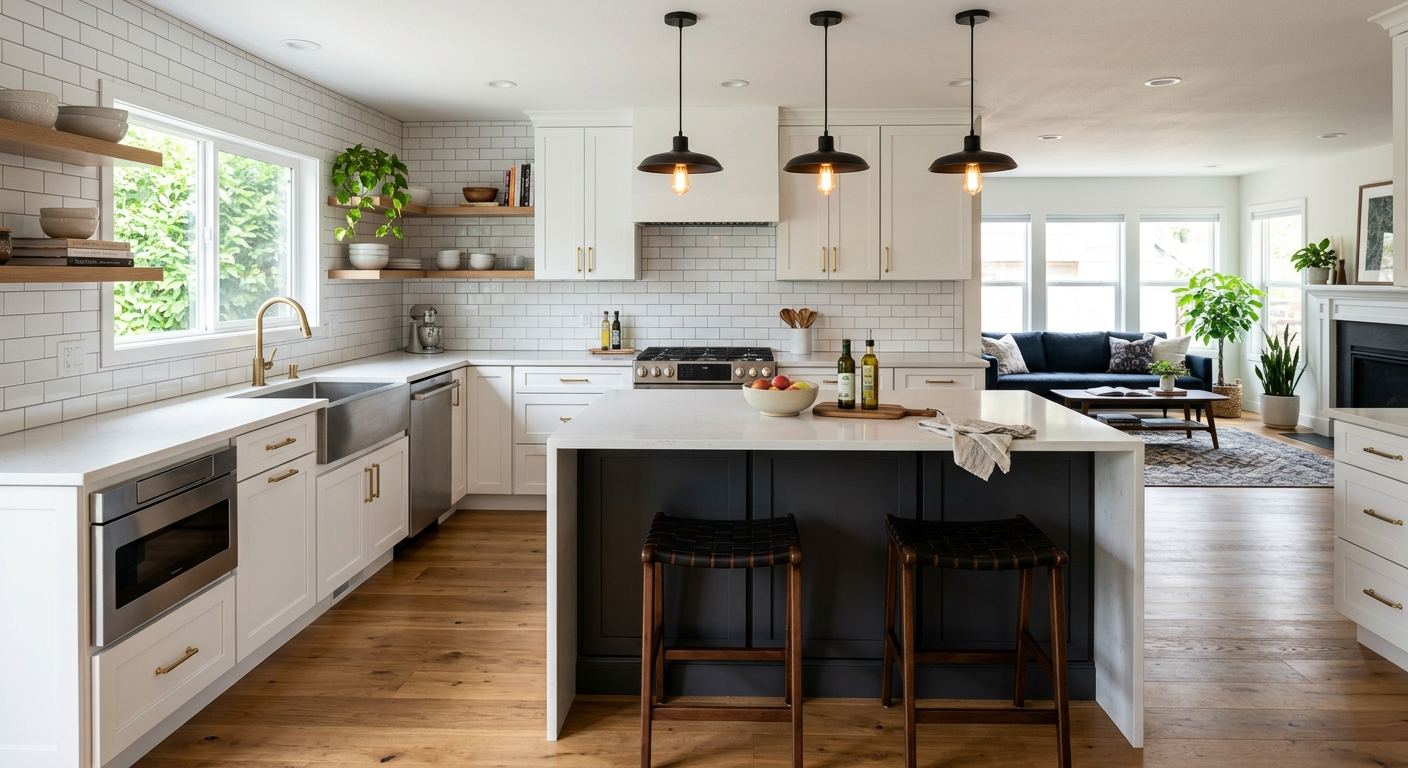
Kitchen renovation options and costs in Dufferin Grove
Dufferin Grove is a neighbourhood where kitchen renovations tend to be planned as much for resale appeal as for day-to-day function. With a 2021 population of 11,785 in the area profile (Statistics Canada, 2021 Census), the demand is steady, and homeowners are usually comparing multiple quotes before committing. In the Toronto economic region, buyers consistently expect a modern, durable finish tier—often driven by local housing values and household purchasing power (Statistics Canada, 2021 Census). In practice, higher-value pockets around central Toronto and well-located streets frequently steer projects toward custom or semi-custom cabinetry and quartz or natural stone, because the kitchen upgrade is an easy “visual sell” when the home goes on the market. Many owners target a finish package that lands in the mid-to-high portion of the regional bands for full kitchens.
Unlike northern climates, Toronto’s day-to-day weather isn’t what usually inflates kitchen budgets. Costs rise more from market factors: contractor availability, steady competition among finish suppliers, and labour pricing that tracks GTA demand. Still, Ontario’s freeze–thaw cycles matter indirectly—if your kitchen sits on an older slab or the home has minor subfloor movement, you may need extra prep, shimming, or underlayment to keep new counters and cabinet reveals tight. This is why accurate site measurement and moisture checks are common in older Dufferin Grove homes.
In Dufferin Grove, demand is especially high near the lively commercial corridor around Dundas Street West and the subway-connected lanes where families update kitchens to match the neighbourhood’s active lifestyle and resale expectations. Below is a practical comparison of renovation tiers so you can align your scope to a realistic budget.
| Renovation Tier |
What's Included |
Typical Duration |
Price Range |
| Cosmetic refresh (paint, hardware, new appliances only) |
Paint/stain touch-ups, cabinet hardware, appliance replacements (no plumbing/electrical moves) |
5–10 business days |
$9,000–$18,000 |
| Mid-range full renovation (new cabinets, counters, sink, tile) |
Semi-custom or quality stock cabinets, quartz or laminate counters, new sink, backsplash/tile, disposal and minor fixture updates |
3–5 weeks |
$25,000–$55,000 |
| High-end full renovation (custom cabinets, stone counters, island) |
Fully custom cabinetry, quartz/natural stone counters, island build, upgraded appliance package, full-height or premium backsplash, enhanced lighting/electrical |
6–10 weeks |
$60,000–$90,000 |
| Cabinet refacing only (new doors + drawer fronts, same boxes) |
New door/drawer fronts, new trim details, rework to fit, existing cabinet boxes retained, includes basic hardware |
2–4 weeks |
$8,000–$25,000 |
| Countertop swap only (laminate to quartz or stone) |
Removal and install of new countertop, seam layout, undermount sink integration if applicable, edge finishing |
4–8 business days |
$5,000–$15,000 |
| Backsplash tile installation only |
Tile selection and installation, thinset/grout, caulking at edges, basic surface prep (no cabinet work) |
3–7 business days |
$2,000–$10,000 |
Prices are estimates only and vary by project scope, site access and material selection.
What affects the price of kitchen renovation in Dufferin Grove
In Toronto and across Ontario, two homeowners can receive quotes that differ by 30–50% for the “same” kitchen because the budget is driven less by weather and more by home value expectations, finish tier, and how much hidden work is discovered once walls and flooring open up. In the Toronto economic region, many owners treat the kitchen as a resale investment—higher-value markets commonly push renovations toward quartz or natural stone counters and semi-custom cabinetry, because those finishes are straightforward to market and easier for buyers to interpret at a showing. In more price-sensitive areas of Mississauga and Brampton, projects often stay closer to mid-range pricing (for example, mid-range full renovations around $25,000–$55,000) with laminate or selective upgrades to protect ROI.
Layout changes are the most unpredictable cost regardless of finish level. Moving a sink to an island, removing a wall, adding an island, or relocating a gas line forces additional demolition, framing, and licensed trade work. Even a small electrical add (like a new circuit for an island or under-cabinet lighting) can require new wiring runs and inspection time, which affects labour schedule and sometimes countertop timelines.
Concrete Dufferin Grove examples we see often: (1) older homes with out-of-square walls can increase install time because cabinets must be scribed and shimmed for tight reveals; (2) if your current counter edges are water-damaged near the window or exterior wall, you may need subfloor or wall prep before new stone goes in; (3) basements below sometimes sit closer to the kitchen footprint, so plumbing work can be easier or, if access is tight, significantly more labour-intensive. For many homeowners, the decision to jump from mid-range to high-end (for example, $60,000–$90,000 for custom/stone/island packages) is justified only when the layout gain and long-term durability are aligned with the neighbourhood’s buyer expectations.
| Price Factor |
Why It Matters |
Cost Impact |
| Cabinet tier — stock vs. semi-custom vs. fully custom millwork |
Material quality, hardware, internal build, and fit/finish tolerance change labour time and material cost |
Can swing budgets by roughly $10,000–$30,000 within a full renovation |
| Countertop material — laminate vs. quartz vs. granite vs. stone |
Pricing per square foot and fabrication/seaming complexity affect both materials and installation labour |
Often adds $3,000–$12,000 when upgrading tiers |
| Layout change — wall removal, island add, plumbing/gas move |
Triggers structural, plumbing, and sometimes gas and electrical scope; increases demolition and rework |
Commonly the biggest swing factor at $5,000–$25,000+ |
| Appliance package tier — builder vs. mid-range vs. pro-grade |
Dimensions, venting requirements, and trim kits can require extra labour and parts |
Can shift $1,500–$8,000+ |
| Flooring — refinish existing vs. full replacement |
Removal/reinstall coordination with cabinet base and countertop install affects sequencing and time |
Typically $2,000–$10,000+ |
| Backsplash — ceramic tile vs. marble vs. full-height slab |
Tile complexity, grout lines, pattern matching, and slab fabrication impact install time and waste |
Often $2,000–$10,000+ |
| Electrical — new circuits for island, under-cabinet lighting |
Licensed work, inspection scheduling, and wiring runs affect both timeline and cost |
Usually $800–$5,000+ |
| Permit fees and licensed trade requirements |
Permit administration and inspection scheduling can add fees and coordination time |
Often $500–$3,000+ depending on scope |
Permits & regulations in Ontario
In Ontario, many “like-for-like” kitchen changes typically do not require permits—cabinet installation or refacing and countertop swaps are usually treated as finishing work. However, the moment you change plumbing, gas, structure, or electrical, you’re often entering permit-required territory. Moving water supply or drain lines, relocating a stove or range hood where gas is involved, removing a load-bearing wall, or adding new electrical circuits (for example, island receptacles or new lighting circuits) typically requires permits and licensed trades. Gas work must be completed by a licensed gas fitter, and any electrical work must be done by a licensed electrician, both with the required inspections.
For a homeowner in Dufferin Grove, the best practice is to verify contractor responsibility before you sign anything. First, ask the contractor (in writing) what permits are required for your exact scope and who will pull them. Next, confirm that the gas fitter and electrician will provide their licence details and that they will book inspections where needed. Then, check liability insurance and WSIB/WCB coverage: request a certificate of insurance (COI) showing general liability and confirm the business is properly covered for work performed in Ontario. For WSIB/WCB, obtain written proof of coverage status or clearance that matches your contractor’s obligations.
Finally, keep everything in the contract: scope, permit responsibility, inspection expectation, and disposal. If the contractor can’t clearly state “what permit, by whom, and when,” treat it as a red flag.
Cabinets, countertops and layout decisions in Dufferin Grove
The three most consequential choices in a Dufferin Grove kitchen renovation are cabinet tier, countertop material, and whether you’ll adjust the layout. First, pick your cabinet tier: stock is fastest and usually cheapest, semi-custom is the most popular mid-range option for Toronto-area resale, and custom is highest cost but delivers the tightest fit for irregular spaces common in older homes. Second, choose a countertop material by balancing durability and maintenance. Laminate can be budget-friendly but is less resistant to heat and impacts than engineered stone; quartz offers a strong middle ground with consistent appearance and low maintenance. Granite and natural stone are premium and visually distinctive, while butcher block adds warmth but requires ongoing care to protect against moisture and daily wear.
Third, decide on layout changes—open-concept wall removal, island addition, or plumbing/gas relocation. These are the upgrades that can change how you live in the space, but they’re also where costs jump unpredictably. In resale terms, an island can be a selling point, yet the ROI depends on whether the new layout improves flow and clearances rather than just adding square footage.
Because Toronto resale buyers often expect modern finishes at the $25,000–$55,000 mid-range and higher-end $60,000–$90,000 tiers, you can justify upgrades when they match your budget. Example: if your cabinet boxes are sound but the doors and drawers are dated, refacing can redirect funds into quartz counters—an approach that’s usually smarter than replacing “everything” when your structure is fine. Conversely, adding an island while moving plumbing/gas may be hard to justify unless the space gain is meaningful and you’re already planning a premium finish tier.
| Option |
Durability |
Maintenance |
Best For |
Price Range |
| Stock cabinets (big-box) |
Good for everyday use; limited custom fit |
Low—keep hinges adjusted and wipe regularly |
Cost-controlled refreshes with predictable timelines |
$8,000–$18,000 |
| Semi-custom cabinets (local dealer) |
Better build quality and more sizing options |
Low—routine cleaning, periodic hardware checks |
Most homeowners targeting modern resale appeal mid-range |
$15,000–$35,000 |
| Custom cabinets (local millwork shop) |
Highest tolerances; tailored storage and finish |
Low—durable finishes; care per finish type |
Unusual layouts and premium buyer expectations |
$30,000–$60,000+ |
| Laminate countertop |
Moderate; can chip or scorch with misuse |
Easy cleaning; avoid heat directly |
Budget-first kitchens and rental-style timelines |
$3,000–$7,000 |
| Quartz engineered countertop |
High; very resistant to staining and daily wear |
Low—typical wipe-down only |
Best balance of durability and consistent resale look |
$6,000–$12,000 |
| Granite / natural stone countertop |
High; natural hardness but varies by slab |
May require periodic sealing depending on stone |
Statement looks and premium finishes |
$7,000–$15,000 |
| Butcher block countertop |
Good if cared for; sensitive to standing water |
Requires oiling/maintenance and careful drying |
Warm, casual style and frequent cooking households |
$4,500–$10,000 |
| Marble countertop |
Premium look; softer and more prone to etching |
Higher—needs sealing and careful use to avoid etches |
Low-abuse kitchens seeking luxury appearance |
$8,000–$18,000 |
How to choose a kitchen renovation contractor in Dufferin Grove
Choosing the right contractor in Dufferin Grove starts with proof, not promises. In Ontario, confirm licensing and coverage before work begins: ask for the contractor’s liability insurance certificate (COI) and review that it matches the work being done at your address. Next, confirm WSIB/WCB coverage status—request documentation that shows the contractor is covered for employees or provide the proper clearance letter where applicable. For plumbing, gas, and electrical scope, insist that each licensed trade provides their own licence details and inspection/permit handling where required.
Then get 2–3 itemised written quotes. A good quote separates labour and materials (cabinetry, counters, tile, disposal, wiring allowance) and should clearly list product brands/models and quantities. Avoid vague totals that lump everything together without explaining allowances. Read the scope for exclusions: is permit pulling included, who pays for it, and is demolition and disposal included? Confirm how countertop templates and cabinet lead times are handled so you don’t end up paying for downtime.
Warranty matters too. Ask for the workmanship warranty length (and what it covers), plus manufacturer warranties on cabinetry, countertops, and appliances. Also clarify whether warranties are transferable if you sell the home. Finally, payment schedule should protect you: never pay more than 10–15% upfront, and hold back a final portion until completion and punch-list signoff. Get a written start date and a realistic completion estimate tied to material lead times.
- Verify contractor licence/registration details and confirm the correct legal business name on the quote and invoice.
- Request and review COI for general liability; ensure it lists coverage for the project.
- Confirm WSIB/WCB coverage or provide the proper clearance documentation.
- Require trade-specific documentation for gas and electrical scopes (licence details and inspection handling).
- Get itemised quotes with labour + materials breakdown and clear allowances.
- Ask who pulls permits and whether permit fees are included in the estimate.
- Confirm disposal and dump fees are included (or explicitly excluded with an allowance).
- Confirm cabinet fabrication and countertop template dates to avoid schedule surprises.
- Review the warranty terms in writing, including what counts as workmanship vs product failure.
- Use a staged payment schedule: 10–15% deposit max, progress payments, holdback at completion.
- Insist on a written timeline with start date, milestone dates, and estimated completion.
- Ensure the contract includes a punch-list process and rework timeline.
In Dufferin Grove, common red flags include: quoting without itemising material selections or allowing “assumed” specs; promising a start date without acknowledging cabinet/counter lead times; refusing to provide COI or WSIB/WCB proof; and burying exclusions like disposal, permit costs, or backsplash prep in small print.
Frequently asked questions — kitchen renovation in Dufferin Grove
How long does a kitchen renovation take in Dufferin Grove?
Typical timelines in Ontario vary mostly by material lead times, not by weather, and in Dufferin Grove the schedule is often driven by cabinet fabrication and countertop template-to-install timing. A cosmetic refresh (paint, hardware, and new appliances only) is commonly 1–2 weeks. A mid-range full renovation usually lands around 3–5 weeks, while high-end projects with custom millwork and an island can run 6–10 weeks. Delays usually come from cabinet backorders, countertop fabrication queues, or permitting/inspection scheduling if you’re moving plumbing/gas or adding electrical circuits. If your layout includes wall removal or a plumbing/gas move, plan for extra coordination time in the permit-inspection window.
Quartz vs granite countertops — which is better?
Quartz is often the practical “better” choice for many Toronto-area kitchens because it’s consistent in appearance, resistant to staining, and typically requires only routine cleaning with mild soap. Granite is also durable and premium-looking, but natural slabs vary, and some stones benefit from periodic sealing depending on the finish and porosity. In resale terms, quartz is a common expectation at the mid-range tier, while granite/natural stone shows up more often in higher-end $60,000–$90,000 style projects where homeowners want a unique look. If you cook heavily and want low-maintenance reliability, quartz usually wins; if you want distinctive veining and don’t mind higher-care routines, granite is a strong option. Your contractor should also recommend an edge profile and seam strategy based on your kitchen layout.
Should I reface or replace my cabinets?
Refacing is a smart option when your cabinet boxes and frames are still solid, square, and properly anchored—common in many older Dufferin Grove homes where only the doors and finishes look dated. It can also help you keep your project in a more affordable band, because you’re usually spending far less than a full replacement cabinet install. Replacing makes more sense if your boxes are sagging, the layout is outdated, or you need major storage redesign (pull-outs, different heights, or new corner solutions). If you’re comparing outcomes, think about what buyers notice: fresh doors, good hardware, and new counters can deliver a “new kitchen” effect without the disruption of full demolition. If you’re aiming for a mid-range kitchen (often $25,000–$55,000), refacing plus quartz can be an efficient combo.
Do I need a permit for a kitchen renovation in Ontario?
In Ontario, many cabinet and countertop swaps typically do not require permits, especially when you’re doing finishing work and not altering core systems. However, permits and licensed trades are commonly required when you move plumbing supply/drain lines, relocate a gas stove or connect/modify gas-related components, remove a load-bearing wall, or add new electrical circuits (such as island receptacles or new lighting circuits). For homeowners in Dufferin Grove, the key step is confirming permit responsibility in your contract—ask the contractor what permits are needed for your exact scope and who will pull them. Also confirm that gas work is done by a licensed gas fitter and electrical work by a licensed electrician, with inspections completed as required.
What's the ROI on a kitchen renovation?
ROI in the GTA depends heavily on how much you spend relative to your home’s value and whether the finish tier matches what local buyers expect. In Toronto-area markets, many homeowners aim to invest a meaningful share of property value into the kitchen because it’s one of the first rooms buyers evaluate. In practice, kitchens that land in the mid-range—often around $25,000–$55,000 with durable finishes like quartz and improved layout—tend to be easier to justify at resale compared to projects that overshoot the home’s target buyer segment. High-end custom kitchens can perform well when the design is timeless and functional, but ROI drops if the upgrades feel “too personal” or if the layout changes don’t improve day-to-day flow. The most reliable approach is aligning your scope with resale expectations and keeping structural changes (plumbing/gas/electrical moves) to what you truly need.
How do I budget for a kitchen renovation?
Start by choosing your renovation tier, then build out from there. If you’re doing a refresh—paint, hardware, and new appliances only—budget in the low range for speed and impact. For a mid-range full renovation with new cabinets, counters, a sink, and tile, plan around $25,000–$55,000. If you want custom cabinetry, stone counters, and an island with upgraded electrical/lighting, high-end full renovations commonly land in the $60,000–$90,000 range. From there, allocate contingency for unknowns once walls and flooring are opened, especially in older housing stock. Also separate your “must-haves” (layout, storage, countertop durability) from “nice-to-haves” (premium backsplash patterns, very high-end appliances). A good contractor should provide itemised quotes with clear allowances so you can adjust without guessing.