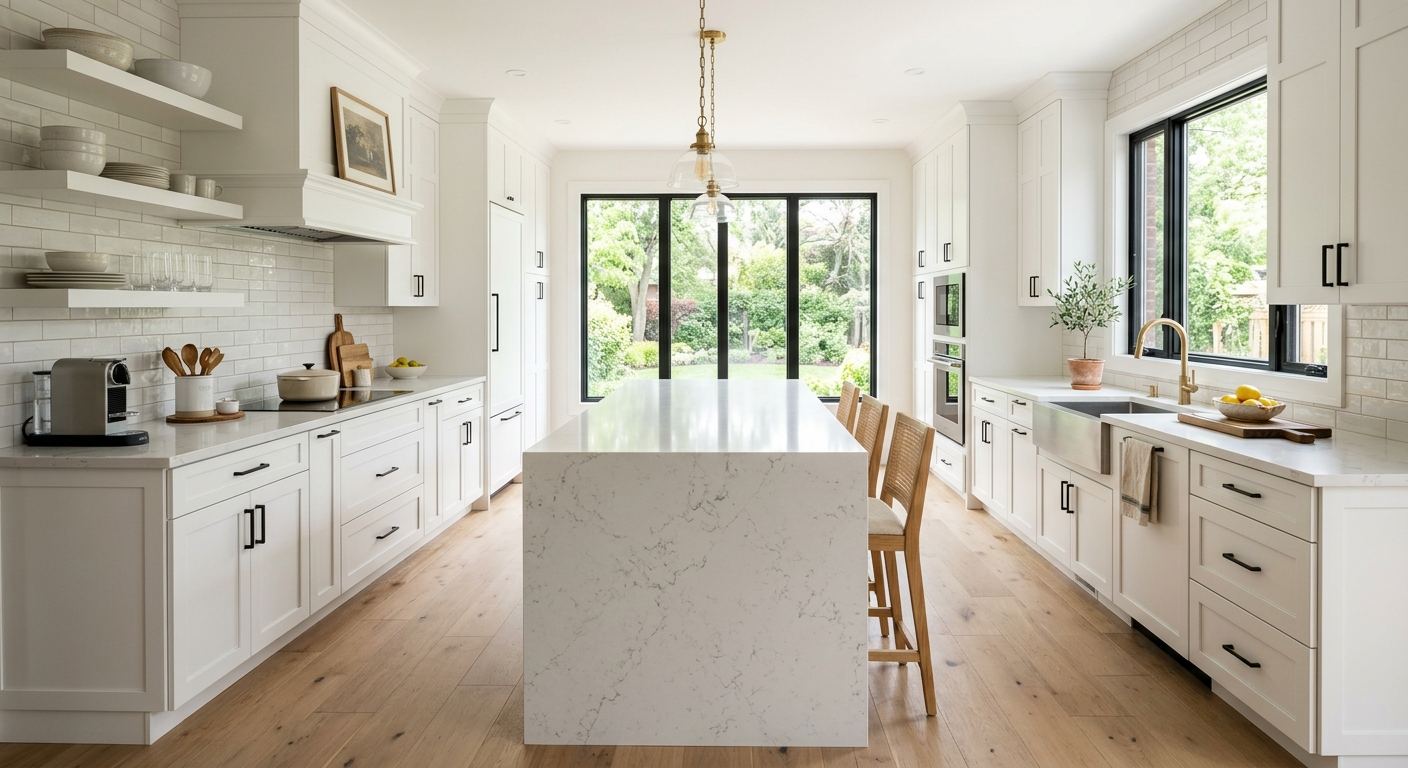
Kitchen renovation options and costs in The Beaches
Kitchen renovations in The Beaches are shaped by a market where homeowners often plan their upgrades around lifestyle first, and resale value second. With a local population of 21,567 (Statistics Canada, 2021 Census), and Toronto-area demand pulling kitchen trades consistently, scheduling and lead times can affect your total project timeline and sometimes your material costs. In higher-value pockets of the GTA, many owners target finish levels that look “new” and stay timeless—because the kitchen is one of the rooms buyers inspect first. In practice, that means you’ll see more quartz, upgraded hardware, and custom or semi-custom cabinetry than you might in more price-sensitive areas.
Ontario’s kitchen costs in general are also influenced less by weather and more by market behaviour: when home values are higher, homeowners more readily invest a larger share of project spend into cabinets, stone countertops, and appliance packages. The cost of labour and common line-items (demo, millwork installation, countertop templating, backsplash tile) is relatively uniform across the Toronto economic region, but higher-end finish choices and more complex layouts push total budgets upward quickly—from mid-$20k refreshes into $80k+ full renovations.
In The Beaches, trade demand is especially strong around the Woodbine/Queen and Balmy Beach areas where older housing stock means more frequent cabinet-and-counter swaps, plus deeper updates (lighting, ventilation, and floor tie-ins) to bring kitchens up to current buyer expectations. From there, the best way to compare options is by renovation tier, so here are realistic ranges you can use when reviewing quotes.
| Renovation Tier |
What's Included |
Typical Duration |
Price Range |
| Cosmetic refresh (paint, hardware, new appliances only) |
Paint, cabinet hardware, appliance swap, minor caulking/trim touch-ups, basic cleaning/adjustments (no cabinet rebuild) |
3–7 days |
$4,000–$12,000 |
| Mid-range full renovation (new cabinets, counters, sink, tile) |
Semi-custom or stock cabinets, countertop replacement (laminate or quartz), sink/faucet, backsplash tile, new flooring tie-in as needed, standard plumbing hookups |
2–4 weeks |
$25,000–$60,000 |
| High-end full renovation (custom cabinets, stone counters, island) |
Custom millwork, premium stone counters (granite/marble/stone), island with upgraded electrical/lighting, upgraded appliance package, full-height backsplash option, broader layout work |
4–8 weeks |
$65,000–$90,000 |
| Cabinet refacing only (new doors + drawer fronts, same boxes) |
Remove/replace doors and drawer fronts, rework hardware, refinish/coat exposed box frames, new trim and matching panels, basic countertop/backsplash adjustments if required |
1–2 weeks |
$8,000–$35,000 |
| Countertop swap only (laminate to quartz or stone) |
Remove old top, install new countertop, sink cut-outs/transfer, new caulking and finishing; backsplash/underlay may be separate depending on scope |
4–10 days |
$3,000–$15,000 |
| Backsplash tile installation only |
Demo/light prep, tile supply and installation (standard patterns), grout/seal work, electrical cover adjustments as needed |
3–7 days |
$2,000–$10,000 |
Prices are estimates only and vary by project scope, site access and material selection.
What affects the price of kitchen renovation in The Beaches
In Toronto and across Ontario, it’s normal to see quotes for the “same” kitchen renovation vary by 30–50%. The biggest driver isn’t the contractor’s hourly rate—it’s the finish tier you choose, how much of the existing system you keep, and whether you’re changing plumbing, gas, or electrical. Two projects can start with the same cabinet layout but end up far apart in cost once you include things like new circuits for island lighting, venting updates, or moving a dishwasher/toe-kick plumbing line.
Local home values and household purchasing behaviour shape the typical finish tier more than climate does. In higher-value GTA pockets, homeowners often default to quartz or natural stone counters and semi-custom cabinetry because it’s easier to justify the spend at resale—especially when kitchens are updated to buyer-ready standards. In more price-sensitive areas, laminate and stock cabinets can dominate to protect ROI. In The Beaches specifically, many homes are older, so “hidden” condition differences show up quickly behind walls and under old flooring.
Concrete examples that push costs up (or down) in The Beaches include: (1) outdated supply lines—if shutoffs or drain routing are not accessible, trades may need more labour and restoration work; (2) electrical capacity—adding under-cabinet lighting or an island outlet sometimes triggers new circuits, which is typically not part of a cosmetic scope; (3) countertop complexity—larger islands and unusual corners raise template and fabrication time, especially if you’re moving from a $3,000–$15,000 countertop swap into a full high-end plan.
As a result, you’ll commonly see mid-range full renovations land in the $25,000–$60,000 band, while structural and finish upgrades (custom millwork, stone, and an island) swing projects into the $65,000–$90,000 territory. Next, let’s break down the price factors contractors use behind the scenes.
| Price Factor |
Why It Matters |
Cost Impact |
| Cabinet tier — stock vs. semi-custom vs. fully custom millwork |
Tier determines build time, material quality, interior options (organizers, drawers), and fit for imperfect walls/ceilings |
Low–moderate to very high; often the largest cost swing besides layout |
| Countertop material — laminate vs. quartz vs. granite vs. stone |
Material drives slab cost, edge complexity, seam requirements, and fabrication tolerances |
Laminate lowest; quartz mid; stone can add notable fabrication and installation time |
| Layout change — wall removal, island add, plumbing/gas move |
Changes affect structural work, rough-in plumbing/gas routing, electrical planning, and inspection timelines |
Typically the most unpredictable increases regardless of finish tier |
| Appliance package tier — builder vs. mid-range vs. pro-grade |
Premium models may require different clearances, ventilation specs, and install adaptations |
Can raise total budget quickly; affects both cost and cabinet/counter sizing |
| Flooring — refinish existing vs. full replacement |
Older substrates can crack, stain, or fail under new cabinetry loads and transitions |
Refinish keeps costs down; full replacement increases labour and material |
| Backsplash — ceramic tile vs. marble vs. full-height slab |
Material weight, cutting/installation time, and waterproofing preparation vary widely |
Tile is mid; marble/large-format or full-height can add significant labour |
| Electrical — new circuits for island, under-cabinet lighting |
Lighting and new outlets often require certified rough-in and inspection coordination |
Moderate to high depending on number of circuits and panel capacity |
| Permit fees and licensed trade requirements |
Work involving plumbing, gas, electrical, or structural elements triggers permits and certified trades |
Adds administrative cost and can affect scheduling; scope-dependent |
Permits & regulations in Ontario
In Ontario, many straightforward “swap” jobs typically do not require permits, but anything involving rough-in systems or structural changes usually does. Cabinet and countertop swaps generally fall into the low-regulation category—if you’re not moving plumbing, gas lines, or changing the electrical layout, you can often proceed without permits for the installation itself. Likewise, a straightforward backsplash replacement is usually treated as a finish-only task.
Where permits and licensed trades do come in is when you move or add infrastructure. For example, relocating a sink supply or drain line, moving a gas stove or changing the venting for a gas range hood, removing a load-bearing wall, or adding new electrical circuits (like island outlets or dedicated under-cabinet lighting) typically requires permits and inspections. Gas work must be performed by a licensed gas fitter; electrical work must be done by a licensed electrician. If your contractor proposes relocating a gas cooktop or adding a new hood duct pathway, don’t sign off until permit responsibility is clearly confirmed.
How homeowners in The Beaches should verify compliance: (1) ask for the contractor’s Ontario licence details (where applicable for the trade scope) and their certificate of insurance; (2) request WSIB/WCB clearance letters; (3) verify that any subcontractors provide their own insurance and credentials. A good contractor will provide these documents before start date, and they’ll assign permit pull responsibility clearly in your written contract.
Cabinets, countertops and layout decisions in The Beaches
For most homeowners in The Beaches, the three most consequential decisions are: cabinet tier, countertop material, and whether you’ll change the layout. Start with cabinets because they define storage capacity, daily usability, and how the kitchen “reads” to buyers. Stock cabinets are typically the fastest and cheapest option, semi-custom is usually the most popular mid-range choice, and custom cabinetry gives the tightest fit—especially valuable in older homes where walls and floors may not be perfectly square.
Next is countertop material. Laminate can be a cost-effective choice for a refreshed look, while quartz is a practical “Ontario workhorse” because it resists staining and handles routine cleaning well. Granite and other natural stones are premium visually, but they can require different maintenance routines. In a neighbourhood where many kitchens are older, choosing durable materials also helps manage the day-to-day reality of incoming moisture and cleaning habits—particularly around sinks, dishwashing areas, and near exterior-facing windows.
Finally, layout changes should be justified by space gain. Opening up a wall for a more open-concept flow, adding an island, or relocating plumbing/gas can be worth it, but those moves carry the highest uncertainty in total cost and schedule. For example, if you’re deciding between a mid-range full renovation around the $25,000–$60,000 range versus a higher-end plan at $65,000–$90,000, the price difference is often less about cabinets alone and more about the combined effect of island electrical, plumbing adjustments, and premium stone fabrication.
Make these decisions with resale in mind. Buyers in Toronto commonly expect clean lines, a functional island or clear peninsula option, and durable, modern surfaces—so spend first where you’ll feel it daily and where it photographs well.
| Option |
Durability |
Maintenance |
Best For |
Price Range |
| Stock cabinets (big-box) |
Good for standard dimensions; can look dated faster if hardware/finishes are basic |
Easy to clean; rely on quality hinges and soft-close options for longevity |
Quick refreshes and tight budgets |
$8,000–$25,000 |
| Semi-custom cabinets (local dealer) |
Very strong fit and better drawer/cabinet interior options; handles small site irregularities better |
Routine cleaning only; choose durable finishes and quality hardware |
Most Toronto-area homeowners balancing value and look |
$15,000–$40,000 |
| Custom cabinets (local millwork shop) |
Highest-quality fit, better use of odd corners/ceilings, longest lifespan when built right |
Minimal day-to-day care; hinges and finishes determine long-term appearance |
High-end builds and complex spaces |
$30,000–$65,000+ |
| Laminate countertop |
Moderate; can chip or scorch and may not handle hot pans as well |
Simple cleaning; avoid prolonged moisture at seams |
Budget-friendly swaps when boxes and layout stay stable |
$3,000–$8,000 |
| Quartz engineered countertop |
High durability and strong stain resistance; handles daily use well |
Low maintenance; no sealing required; still use cutting boards and protect from extreme heat |
Busy households wanting a modern, low-fuss surface |
$6,000–$14,000 |
| Granite / natural stone countertop |
Very durable with excellent heat tolerance; natural variation adds premium character |
Often benefits from periodic sealing depending on stone type |
Premium look and long-term durability |
$8,000–$15,000 |
| Butcher block countertop |
Solid but needs protection from water and repeated moisture exposure near sink areas |
Oil treatment and careful drying; use mats for wet work |
Warm, casual kitchen styles and homeowners who like upkeep |
$4,000–$10,000 |
| Marble countertop |
Beautiful but softer; more susceptible to etching and staining if not maintained |
Higher maintenance; sealing and prompt wipe-down required |
Design-forward kitchens where aesthetics matter most |
$10,000–$20,000+ |
How to choose a kitchen renovation contractor in The Beaches
Choosing the right kitchen renovation contractor in The Beaches comes down to three things: proof of credentials, clarity of scope, and realistic scheduling. Start by verifying Ontario licensing and trade coverage relevant to your project. Ask for their liability insurance certificate and confirm they carry WSIB/WCB coverage (or a clearance letter where applicable) so you’re not exposed to unpaid-worker risk during construction. Then, request documentation from any subcontractors—especially electricians and licensed gas fitters if your plan includes electrical additions, venting, or gas changes.
Next, get 2–3 itemised written quotes rather than lump sums. The best quotes break out labour and materials separately—cabinet supply, countertop fabrication, plumbing/electrical allowances, demolition/disposal, tile installation, and any site protection. Read what’s excluded: sometimes disposal, dust control, permit pulls, old material haul-away, or drywall patching is not included. Also confirm whether the contractor schedules countertop templating and installation tightly—late templates are a common reason projects overrun.
Warranty matters too. Ask for the workmanship warranty length, what it covers, and whether product/manufacturer warranties are transferable if you sell your home. For payment, use a sensible schedule: never pay more than 10–15% upfront, and hold back funds until the job is substantially complete and deficiencies are corrected. Finally, get start date and completion estimate in writing, tied to your countertop and cabinet lead times.
- Confirm liability insurance limits and request the certificate of insurance before work begins.
- Request WSIB/WCB clearance letters (and verify subcontractors provide their own coverage).
- Insist on itemised quotes: labour, materials, allowances, and exclusions listed separately.
- Ask who pulls permits (and ensure it’s stated in the written contract when required).
- Confirm disposal/haul-away is included for demo materials.
- Verify countertop measurements (templating) dates and who is responsible for re-templating if needed.
- Check warranty terms for both workmanship and products (and whether coverage transfers to new owners).
- Ensure schedule includes inspections if plumbing/gas/electrical permits are part of the scope.
- Ask about dust protection and floor protection methods during demolition.
- Look for a clear change-order process with pricing and timelines for scope additions.
- Confirm how water shutdowns and gas shutdowns will be handled during the transition period.
- Review finish specifications: cabinet finish name/colour, countertop slab source, and tile pattern details.
Red flags I commonly see with kitchen renovators in The Beaches include: quotes that are only lump-sum with no line-item allowances, vague exclusions around permits and disposal, refusing to provide insurance/WSIB documentation, starting without a written schedule that matches cabinet/counter lead times, and pressuring you for large deposits beyond 10–15% upfront.
Frequently asked questions — kitchen renovation in The Beaches
What order do kitchen renovation steps happen in?
In most The Beaches kitchen renovations, the order is designed to keep rough-in work coordinated and avoid damage to finished surfaces. Typically, you start with design confirmation, then demo and site protection, followed by rough-ins (plumbing supply/drain, electrical wiring, and any gas work if applicable). Next comes installation of base cabinets and framing adjustments, then countertop templating and fabrication. After counters are installed, the project usually moves into finishing: backsplash tile, trim, caulking, hardware installation, and appliance hookups. Flooring patching or full replacement is often completed either right after cabinet install prep or before backsplash depending on your contractor’s detailing. If you’re budgeting a mid-range full renovation in the $25,000–$60,000 band, the biggest “schedule risk” is often countertop templating timing, not cabinet installation itself.
Can I live at home during a kitchen renovation in The Beaches?
Yes, many homeowners in The Beaches live at home during a renovation, but it depends on how disruptive your scope is. Cosmetic refreshes (paint, hardware, and new appliances only) are often easiest to manage because the kitchen remains functional with minor interruptions. For a full renovation, the household typically uses an alternate cooking area while cabinets and counters are out. Good contractors set up dust control and protect floors and vents; they also plan water shutoff windows and safe pathways around the work zone. If your project involves moving plumbing or gas lines, expect longer interruptions because licensed trade scheduling and inspections can add days. If you’re aiming for a full refresh near the $25,000–$60,000 range, plan for at least a couple weeks of reduced kitchen use, especially around countertop and backsplash installation.
Should I renovate my kitchen before selling in The Beaches?
Often, yes—if your kitchen is outdated or in poor condition, a well-planned update can help show your home at its best. That said, you should match your finish tier to local buyer expectations in The Beaches and the broader Toronto resale market. In higher-value GTA pockets, homeowners frequently choose durable, modern finishes like quartz counters and semi-custom cabinetry because buyers recognize those upgrades. If your goal is resale and your current cabinets are structurally sound, a cabinet refacing approach (often $8,000–$35,000) with a countertop swap can deliver a noticeable “new kitchen” look without overbuilding. On the other hand, if your layout is inefficient or you need to address plumbing that’s already failing, it may be better to renovate first rather than try to sell with ongoing maintenance issues. Your best move is to prioritize kitchens that photograph well and feel functional in daily use.
What's the most popular kitchen style in The Beaches right now?
Right now in The Beaches, the most common trend is a bright, clean-lined modern look with warm finishes—often shaker-style cabinetry, matte hardware, and a neutral palette that suits both older homes and contemporary interiors. Many homeowners pair semi-custom cabinetry with quartz countertops because it delivers a durable, low-maintenance surface that still looks premium. Black accents around faucets and lighting are also popular, especially when balanced with lighter cabinet tones. Islanders and open sightlines remain in demand because they make entertaining easier in Toronto-area homes with active family life. Style-wise, the key is choosing timeless colours and finishes so you’re not locked into a trend. If your quote is headed toward the higher end (for example, full renovations in the $65,000–$90,000 band), you’ll usually see more custom millwork detailing and upgraded stone or natural features.
How do I know if I need to update my kitchen plumbing in The Beaches?
You may need plumbing updates if you’re noticing slow drains, leaks under the sink, recurring odours, rust staining around supply lines, or persistent water shutoff issues. Older Toronto-area homes can have plumbing runs that don’t match modern dishwasher requirements or don’t drain efficiently, and those problems become obvious once cabinets and countertops are removed. If you’re moving a sink location or changing appliance hookups (like relocating a dishwasher), plumbing changes are usually required regardless of whether lines “look fine” today. A contractor should inspect shutoff valves, drain routing, and access points before finalizing your scope. If your plan includes moving plumbing/gas, remember that permits and licensed trade requirements typically apply, and that can affect both cost and timeline. For homeowners comparing quotes, plumbing-related allowances are one of the most important line items to confirm early.
What is the difference between a galley and open-concept kitchen?
A galley kitchen is a narrower, corridor-style layout where cabinetry lines run along two parallel walls with a central passage. It’s efficient for cooking and cleanup, and it can work well in tighter older homes, including many found around The Beaches. An open-concept kitchen removes barriers so the kitchen flows into a dining or living space, which improves sightlines and social interaction, but it often requires more complex structural coordination if walls are removed. Open-concept renovations frequently involve electrical planning for new lighting/outlets and more detailed ventilation or ducting decisions, especially if you’re changing cooktops or range hoods. From a cost perspective, staying with a galley layout often helps keep projects in the mid-range, while converting to open-concept typically adds higher uncertainty due to rough-ins and inspection needs.