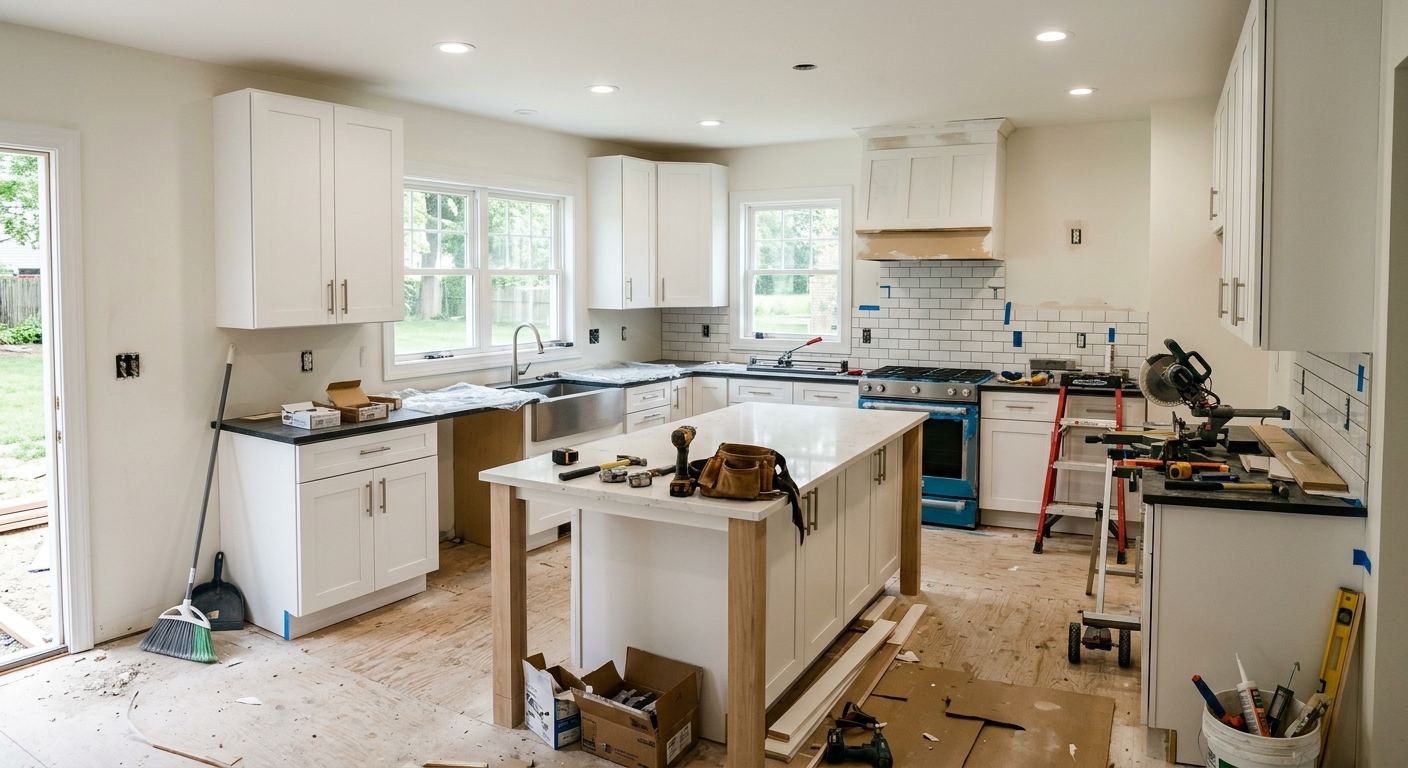
Kitchen renovation options and costs in Brooklin
Brooklin homeowners typically have several kitchen renovation paths to choose from, and the right one depends on how much change you want—just a refresh, a practical mid-range upgrade, or a full custom rebuild. With Brooklin’s population of about 25,000 (Statistics Canada, 2021 Census), there’s steady demand for contractors serving the Toronto economic region, especially among families and downsizers updating their forever kitchens for resale. In this market, many renovations trend toward higher-finish expectations because owners are often protecting a significant portion of home value; in GTA pockets, homeowners commonly invest a kitchen share in the 8–15% range when they’re aiming for a premium look. That reality pushes options like quartz countertops, better appliance packages, and semi-custom cabinetry toward the top of the shortlist.
Cost in Toronto isn’t driven much by local “weather” the way it is in some climates; instead, the driver is labour availability and material pricing concentrated in the same urban supply chain. In addition, Brooklin’s older housing stock in some pockets means some projects start with uneven walls, dated electrical, or patchy subflooring—issues that can add time even when the finish level looks similar. Neighbourhood demand can be especially strong around the Brooklin–Clarington corridor, where crews stay busy between spring and fall and timelines tighten.
To compare realistic budget ranges, use the table below as a starting point and then match the tier to your scope, materials, and whether you’re changing plumbing, gas, or electrical.
| Renovation Tier |
What's Included |
Typical Duration |
Price Range |
| Cosmetic refresh (paint, hardware, new appliances only) |
Cabinet paint or new hardware, backsplash refresh (if already tiled), new fridge/range/dishwasher (like-for-like), minor caulking and trim touch-ups |
3–7 days |
$6,000–$18,000 |
| Mid-range full renovation (new cabinets, counters, sink, tile) |
Semi-custom or stock cabinets, countertop replacement, new sink and faucet, backsplash tile, flooring refresh (patch or partial replace), electrical allowances for standard updates |
3–6 weeks |
$25,000–$65,000 |
| High-end full renovation (custom cabinets, stone counters, island) |
Fully custom millwork, quartz or natural stone, island build, upgraded appliance package, expanded lighting, more detailed backsplash (e.g., full-height accent), potential plumbing/gas relocation |
6–12 weeks |
$70,000–$90,000 |
| Cabinet refacing only (new doors + drawer fronts, same boxes) |
New door and drawer fronts, new veneer, hinges/hardware upgrades, optional interior rework, paint/finish matching, labour for prep and installation |
1–3 weeks |
$8,000–$35,000 |
| Countertop swap only (laminate to quartz or stone) |
Remove existing top, install new engineered or natural stone/quartz, reseal/finish edges, adjust sink and cooktop fit, disposal and basic countertop trim |
3–10 days |
$3,000–$15,000 |
| Backsplash tile installation only |
Prep, tile supply and labour allowance, waterproofing membrane where required, grouting and sealing, trim finishing |
3–7 days |
$2,000–$10,000 |
Prices are estimates only and vary by project scope, site access and material selection.
What affects the price of kitchen renovation in Brooklin
Even when two Brooklin homeowners describe the “same” kitchen, quotes can easily differ by 30–50% across the Toronto region because contractors price risk and unknowns differently. Two common examples: one contractor includes electrical rough-ins and fixture upgrades in their estimate, while another prices them as allowances; or one assumes your existing boxes and subfloor are serviceable, while another plans for repairs once walls and cabinets come off. In Ontario’s GTA labour market, finish tiers—stock versus semi-custom versus fully custom—also have a direct relationship to how much time crews spend on milling, fitting, and install precision.
Local home values and household purchasing power shape the typical finish tier far more than climate. In higher-value pockets of the Toronto region, homeowners often default to quartz or natural stone counters and semi-custom cabinetry because the kitchen upgrade is easier to justify at resale. In more price-sensitive areas of outer Mississauga and similar commuter markets, many projects stay mid-range with laminate or refaced cabinets, keeping budgets closer to the $25,000–$65,000 range for full renovations. That’s why finish selection is usually the biggest lever, while layout changes are the biggest cost uncertainty.
Here’s what tends to raise costs in Brooklin: relocating plumbing for a new sink often triggers drain/supply work plus tile rework; moving a gas cooktop or changing a range hood vent route (if you’re adding ducting) increases both labour and permit scope; and adding an island typically means new electrical for outlets and possibly under-cabinet lighting. Conversely, costs can drop when you keep the existing cabinet footprint and simply upgrade surfaces—countertops alone often land in the $3,000–$15,000 band, and a refacing approach can keep cabinet work in the $8,000–$35,000 range.
Housing age matters too: kitchens in older Ontario homes may need subfloor leveling and electrical updates, which can add material and labour even before cabinets go in. The key is to pick a tier, then decide whether layout and services justify stepping up the budget.
| Price Factor |
Why It Matters |
Cost Impact |
| Cabinet tier — stock vs. semi-custom vs. fully custom millwork |
Higher tiers cost more up front and require more custom fitting; they also add installation time for alignment and detailing |
Can shift a full-renovation budget by roughly 20–40% |
| Countertop material — laminate vs. quartz vs. granite vs. stone |
Material pricing and fabrication/templating complexity increase with stone; heavier slabs can require additional care for installs |
Typically swings countertop line items by several thousand dollars |
| Layout change — wall removal, island add, plumbing/gas move |
Structural work, new framing, and service reroutes add labour, inspections, and schedule risk |
Often the most unpredictable; may be the difference between mid-range and high-end |
| Appliance package tier — builder vs. mid-range vs. pro-grade |
Premium appliances can require stronger ventilation, more electrical considerations, and more expensive trim matching |
Commonly adds $3,000–$15,000 depending on brand and complexity |
| Flooring — refinish existing vs. full replacement |
Kitchen demo can damage adjacent flooring; replacement costs vary by subfloor condition and underlayment needs |
May add $2,000–$8,000 to keep a level, sealed finish |
| Backsplash — ceramic tile vs. marble vs. full-height slab |
Premium stone and full-height installs increase material cost and require more precise prep and waterproofing |
Can move backsplash-only work toward the upper end of the $2,000–$10,000 band |
| Electrical — new circuits for island, under-cabinet lighting |
More outlets, lighting, and dedicated circuits increase wiring, testing, and inspection scope |
Frequently adds several thousand dollars when expanding circuit count |
| Permit fees and licensed trade requirements |
Permits and inspection time add cost and administrative steps; specialized licensed trades can change labour allocation |
Can add meaningful overhead when plumbing/gas/electrical scope expands |
Permits & regulations in Ontario
In Ontario, not every kitchen change triggers permits, but the ones that do can affect both cost and schedule. Typically, a cabinet swap (including refacing) and a countertop replacement do not require permits when you’re not altering the building’s services. Where you do cross the line is when you move plumbing supply/drain lines, relocate gas connections, remove a load-bearing wall, or add electrical circuits. In those cases, permits are commonly required, and the work must be completed by the appropriate licensed trades for the discipline.
Step-by-step, here’s how a Brooklin homeowner should verify a contractor is doing the right work under the right rules. First, confirm the exact tasks in writing: ask “Does this estimate include permits, and who pulls them?” Second, check the contractor’s liability insurance certificate (they should provide a current COI) and ensure it matches the scope. Third, confirm WSIB/WCB coverage for their workers (or the proper equivalent documentation). Fourth, for regulated trades, verify the gas work is done by a licensed gas fitter and electrical by a licensed electrician; both should provide proof of licensing for their portion of the project. Finally, request inspection and permit responsibility details be spelled out in the contract—don’t leave it as a vague “we’ll handle it.”
If the contractor can’t clearly explain what’s permit-free versus permit-required for your specific layout, that’s a schedule and cost risk you want to resolve before signing.
Cabinets, countertops and layout decisions in Brooklin
In a Brooklin kitchen renovation, three decisions tend to determine most of your result: (1) cabinet tier, (2) countertop material, and (3) whether you change the layout. Cabinet choice sets your look and your timeline. Stock cabinets usually go in fastest and cost least, but they can limit your ability to tailor door styles, internal organizers, and fit around off-square walls common in older homes. Semi-custom cabinets are the popular mid-range option because you get better sizing flexibility and functional features without paying for full custom milling. Custom cabinets deliver the best fit and bespoke storage, but they raise both material and labour time due to designing, fabricating, and fine-tuning.
Countertops are the second major cost lever. Laminate offers affordability and good performance when the substrate is solid, while quartz is popular for its stain resistance and consistency. Granite/natural stone offers unique character but needs more maintenance planning. Butcher block can warm up a kitchen but requires thoughtful sealing and care around moisture and heat. Marble looks high-end but is more sensitive to etching, so it’s best for homeowners who treat it like a finish, not a “set and forget” surface.
Layout changes are where budgets swing. Opening up space, adding an island, or moving plumbing/gas can be justified when it creates real daily value—better traffic flow, more counter space, or improved cook/work zones for family routines. For example, you might spend an extra $8,000–$15,000 to move a sink and add an island pathway if it corrects an inefficient layout; if you’re only trying to refresh the look, spending that same amount on quartz and better cabinet storage may deliver stronger “value-per-dollar” for resale in the Toronto market.
Because the Toronto resale market rewards updated, cohesive finishes, pairing semi-custom or custom cabinetry with durable countertops is the most reliable way to land in a buyer-friendly tier—especially in renovations targeting the $25,000–$65,000 mid-range versus the $70,000–$90,000 premium bracket.
| Option |
Durability |
Maintenance |
Best For |
Price Range |
| Stock cabinets (big-box) |
Solid for everyday use; durability depends on box construction and hinges/adjustments |
Low; mainly hardware care and cleaning |
Quick turnarounds and budget-focused upgrades with minimal layout changes |
$8,000–$18,000 |
| Semi-custom cabinets (local dealer) |
Good durability; better door and drawer construction options and stronger customization |
Low to moderate; normal cleaning and occasional adjustment |
Most Brooklin renovations seeking a tailored look without fully custom pricing |
$18,000–$35,000 |
| Custom cabinets (local millwork shop) |
Excellent durability with superior fit, hardware integration, and storage planning |
Low; built to last, but quality hardware should be cared for properly |
Challenging dimensions, high-end finishes, and islands or built-ins |
$35,000–$55,000 |
| Laminate countertop |
Decent daily durability; edges and seams require careful handling to avoid moisture issues |
Low; avoid prolonged soaking at seams and use cutting boards |
Budget refreshes and resale-focused projects that need cost control |
$3,000–$8,000 |
| Quartz engineered countertop |
High durability; very resistant to stains and scratches compared to many surfaces |
Low; routine cleaning with non-abrasive products |
Busy households wanting a premium look with minimal maintenance |
$7,000–$15,000 |
| Granite / natural stone countertop |
Very strong and heat-tolerant; performance varies by stone type and finish |
Moderate; sealing and stain management per stone recommendations |
Homeowners who want natural variation and a more classic stone feel |
$8,000–$18,000 |
| Butcher block countertop |
Durable if treated well; can be dented but recovers with sanding/refinishing |
Moderate; regular oiling/sealing and more mindful heat/water use |
Family kitchens where warmth and food prep matter |
$4,000–$12,000 |
| Marble countertop |
Beautiful but softer than quartz/granite; susceptible to etching and etch marks |
Higher maintenance; needs careful cleaning and sealing strategy |
Low-traffic kitchens or homeowners comfortable with upkeep for a luxury look |
$10,000–$22,000 |
How to choose a kitchen renovation contractor in Brooklin
Choosing the right contractor in Brooklin is less about flashy marketing and more about proof: Ontario licensing (for regulated trades), liability insurance, and WSIB/WCB coverage. Your contractor should be able to provide documentation on request. For example, confirm that the trades handling gas work (if you’re relocating a cooktop or making changes to a gas range/venting) use a licensed gas fitter, and that electrical tasks are done by a licensed electrician. Ask for their certificate of insurance and ensure coverage is current for the project dates. For worker protection, request WSIB/WCB clearance documentation and verify it aligns with the scope and who is performing the work.
Next, get 2–3 itemised quotes—not one lump-sum number. The best estimates break labour and materials separately (cabinet supply, installation labour, countertop fabrication/templating, tile labour, electrical allowances, disposal, and any permit line items). Read the scope carefully: ask what’s excluded, whether permit pulling is included, who pays for disposal/dumpster fees, and whether demolition is included in the price. Warranty matters too: ask for the workmanship warranty length, whether product/manufacturer warranties are provided in writing, and if they’re transferable if you sell the home.
For payments, never pay more than 10–15% upfront. Hold back a portion until key milestones are complete (often cabinets installed, counters templated/installed, and final finishes inspected). Finally, demand a written timeline with a start date and an estimated completion date, not just a “we’ll be done soon” expectation.
- Confirm each quote includes demolition, debris removal, and final cleaning.
- Ask if permits are included where needed and who is responsible for pulling them.
- Request the electrical scope in writing (outlets, island circuits, under-cabinet lighting).
- Verify gas work responsibility in the estimate (who moves/adjusts connections).
- Check warranty: workmanship duration plus product warranty details.
- Insist on an itemised labour vs materials breakdown (no “allowance only” pricing).
- Confirm countertop templating lead times and whether your schedule accounts for fabrication.
- Ask how they handle off-square walls and subfloor leveling before cabinet install.
- Ensure they provide a disposal plan and where waste is hauled.
- Review payment schedule: maximum 10–15% upfront; milestone-based progress payments.
- Get a start/completion estimate in writing, including key dependencies (permits, lead times).
- Request references from similar Brooklin or GTA kitchens with comparable scope and finish tier.
Concrete red flags in Brooklin include: (1) refusing to provide proof of insurance or WSIB/WCB coverage; (2) offering a low “lump sum” with vague allowances for electrical, plumbing, or permits; (3) asking for more than 30% upfront without signed milestones; (4) skipping written timelines and warranty terms; and (5) claiming cabinet refacing or countertop swaps are “permit-free” without confirming whether you’re moving plumbing, gas, or adding circuits.
Frequently asked questions — kitchen renovation in Brooklin
What's the most cost-effective kitchen upgrade?
In Brooklin, the most cost-effective upgrade is usually improving the “front face” of the kitchen without triggering major rework. A cabinet refacing project (new doors and drawer fronts over existing boxes) is often a strong value path because it can deliver a noticeable look change while avoiding the demolition and installation time of a full cabinet replacement. Pairing refacing with a countertop refresh can also keep you in a sensible budget range—many homeowners spend within the $8,000–$35,000 band for refacing and then layer in countertop installation within the $3,000–$15,000 band depending on material. If your budget is tighter, a high-impact backsplash refresh and hardware upgrade can be done quickly and with lower risk. The biggest cost savings typically come from keeping the plumbing and electrical footprint the same, so you don’t pay for reroutes or permits when you only want a visual refresh.
Custom vs stock cabinets — is custom worth it?
Custom cabinets can be worth it in Brooklin when you need a truly tailored fit, like dealing with off-square walls, awkward alcoves, or a specific island/built-in layout. Stock cabinets are the cheapest and fastest, but they can limit storage options and sometimes require compromises with sizing around your room. If you’re targeting resale in the Toronto economic region, buyers often respond to cohesive, clean lines—semi-custom frequently hits the sweet spot for most projects. As a rule of thumb, custom becomes a better investment when your layout already supports the upgrade (good sight lines, meaningful storage improvements, and a finish plan that matches higher-end countertops). If you’re unsure, consider starting with semi-custom: you can often achieve a premium look while keeping your broader kitchen budget closer to the mid-range band (for many full renovations, $25,000–$65,000), reserving the top end ($70,000–$90,000) for homes where the entire scope supports a premium build.
How do I choose a kitchen contractor in Brooklin?
Choose a contractor in Brooklin based on documentation and clarity, not just design samples. First, request proof of liability insurance and WSIB/WCB coverage, and confirm who will be doing the work onsite. For regulated work, ensure gas changes are handled by a licensed gas fitter and electrical tasks by a licensed electrician. Second, insist on 2–3 itemised quotes that separate labour and materials, including line items for demolition, disposal, countertop templating/fabrication, and any permit-related costs. Third, read exclusions: ask who is pulling permits (when required), whether the estimate includes disposal, and what happens if your existing walls or subfloor need repairs once demo begins. Finally, confirm warranty terms in writing. A reliable contractor should also propose a realistic schedule for countertop fabrication and cabinet lead times; if their timeline is “fast no matter what,” it’s a warning sign.
What order do kitchen renovation steps happen in?
Typically, the order in a Brooklin kitchen renovation starts with planning and measurements, then demo, then rough work, then installations. Once you confirm your layout and finish tier, the contractor schedules demolition and protects the rest of the home. If you’re changing plumbing, gas, or adding electrical circuits, those rough-ins happen next—often after wall openings but before cabinets and drywall finishes. After rough work, the project proceeds to cabinet installation (including wall prep and levelling), then countertop templating (critical for quartz/stone fit), and countertop fabrication/installation. Only after that do you usually complete backsplash tile, trim finishing, and final hardware/fixture adjustments. Flooring work (refinishing or replacement) often happens before cabinets depending on the design, or it may be done after cabinets if you’re protecting built-in cabinet bases. A good contractor will build a schedule that accounts for permit lead times and countertop fabrication, so your timeline stays predictable.
Can I live at home during a kitchen renovation in Brooklin?
Often, yes—especially for refreshes, refacing, and countertop/backsplash-only projects. In Brooklin, many homeowners remain in the home during a mid-range renovation if the contractor can isolate dust, set up a temporary kitchen area, and manage noise within daytime hours. Living at home becomes harder with full gut renovations, major layout changes, or extensive plumbing/gas work, because demolition and rough-ins create more disruption and schedule swings. If you’re spending closer to the $25,000–$65,000 mid-range band, consider whether you’ll need full access to running water and a working sink, even temporarily. For higher-end builds that may push toward $70,000–$90,000, it’s more common for homeowners to plan a partial move-out or arrange a longer-term temporary setup. Before signing, ask the contractor how they’ll manage daily access, dust control, and the “temporary kitchen” plan.
Should I renovate my kitchen before selling in Brooklin?
In many Brooklin cases, a staged and updated kitchen can help your showing appeal, but the timing should match your budget and buyer expectations. The Toronto resale market often rewards kitchens that feel modern, cohesive, and durable—especially with clean cabinet finishes and low-maintenance surfaces like quartz. If you’re deciding between a cosmetic refresh and a more complete renovation, consider your level of need: if your layout is inefficient or your cabinets and counters are worn, buyers will discount the home regardless of paint. A targeted refresh (hardware, paint, and a backsplash) can be a good early step, while refacing plus countertop upgrades can deliver stronger impact without the full cost of structural changes. If you’re aiming for a full renovation, budgets often fall in the $25,000–$65,000 range for mid-range upgrades or higher if the scope includes islands and premium stone. If you can only complete part of the work before listing, prioritize what buyers see first—cabinets, counters, lighting, and backsplash—while being careful not to trigger expensive layout or service moves unless you’re confident the value you add will be recovered in resale.