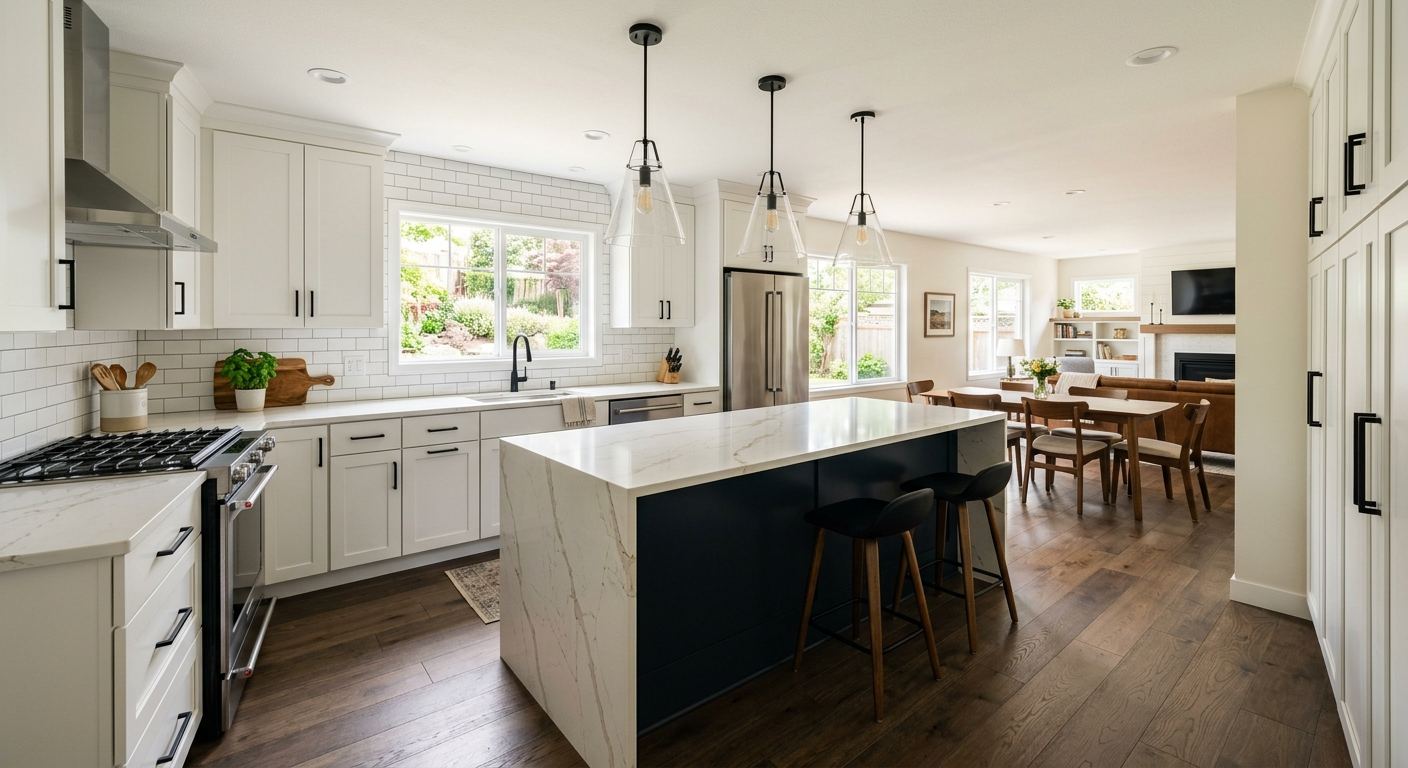
Kitchen renovation options and costs in Woodwards
Woodwards is a small community with big cooking expectations, and that’s exactly what drives the range of kitchen renovation options you’ll see. With a population of 8,055 (Statistics Canada, 2021 Census), you’re typically working with fewer local contractors than in the core Vancouver markets—so availability can affect scheduling, but pricing is still mostly shaped by the wider Lower Mainland–Southwest market. In higher-value pockets across the region, homeowners often plan for resale value, which is why finishes trend upscale: semi-custom cabinetry and quartz or stone counters are common defaults rather than “nice-to-haves.” Your quote can look different simply because the expected buyer profile in the Lower Mainland–Southwest rewards a clean, design-led kitchen.
Climate also plays a supporting role. In Woodwards and the surrounding Lower Mainland, damp marine air means good ventilation and proper cabinet installation matter—especially around sinks, dishwashers, and exterior-facing walls. Contractors also plan for rapid material procurement when supply chains tighten, which can change lead times for cabinets and stone slabs. Even so, for most homeowners, the biggest cost drivers are cabinetry tier, countertop material, and whether you’re changing layout, not weather severity.
If you’re near the busier services area around Ladner/Delta (an adjacent demand hotspot where many of the same cabinetry, countertop, and trades resources get pulled from), you’ll often see quicker turnaround for mid-range refresh scopes and appliance upgrades. Next, here’s how the main renovation tiers typically compare side-by-side in Woodwards.
| Renovation Tier |
What's Included |
Typical Duration |
Price Range |
| Cosmetic refresh (paint, hardware, new appliances only) |
Paint (walls/ceiling), new cabinet hardware, new appliances (cooktop/range, fridge, dishwasher), minor touch-ups |
3–7 business days |
$8,000–$25,000 |
| Mid-range full renovation (new cabinets, counters, sink, tile) |
New semi-custom or quality stock cabinets, new counters, sink & faucet, backsplash tile, disposal, basic electrical refresh as needed |
3–6 weeks |
$40,000–$85,000 |
| High-end full renovation (custom cabinets, stone counters, island) |
Custom cabinets/millwork, stone counters (quartz or natural stone), larger-format backsplash or slab feature, island with upgraded plumbing/electrical, higher-end hardware and finishes |
6–12 weeks |
$85,000–$120,000 |
| Cabinet refacing only (new doors + drawer fronts, same boxes) |
Door/drawer-front replacement, new edging, hardware upgrades, re-lacquer/refinish as applicable; counters may or may not be included |
1–3 weeks |
$8,000–$35,000 |
| Countertop swap only (laminate to quartz or stone) |
Remove existing top, supply/install new countertop, cut-outs for sink/cooktop, seam layout, basic resealing |
2–5 business days |
$3,000–$12,000 |
| Backsplash tile installation only |
Tile supply allowance, tear-out where needed, waterproofing prep, tile install, grout/seal, edge finishing |
2–7 business days |
$1,500–$6,000 |
Prices are estimates only and vary by project scope, site access and material selection.
What affects the price of kitchen renovation in Woodwards
The same kitchen renovation can land 30–50% apart across the Lower Mainland–Southwest compared with other parts of British Columbia because the real budgeting variables aren’t climate—they’re home values, expected buyer finish levels, and how complex the trades work becomes once walls and services change. In higher-value areas of Metro Vancouver, owners tend to choose semi-custom or custom cabinetry and quartz/stone counters because the upgrade cost is more likely to be recovered on resale. In lower-cost markets, laminate and stock cabinets usually dominate because they deliver a noticeable refresh without triggering a “design-led” budget escalation.
In Woodwards and the broader Lower Mainland–Southwest, layout choices create the most unpredictable cost swings. Moving a sink by a few feet, relocating a gas line for a cooktop, or adding an island can turn a straightforward upgrade into a multi-trade redesign, which is why the labour portion can jump even if the finish tier stays mid-range. For example, a mid-range full renovation may sit around $40,000–$85,000, but once plumbing/gas moves and new electrical circuits are required, the same kitchen can trend toward the upper band of a full renovation.
Two concrete Woodwards examples we see often: (1) older homes with dated rough-ins can require extra subfloor and wall prep near exterior-facing walls to address moisture-prone areas; that adds carpentry time even when cabinets stay in the same footprint. (2) if you’re replacing laminate tops with quartz, the stone install is fast, but you may need to adjust cabinet leveling/shimming and revise cut-outs for sink and cooktop—cost is still usually within the $3,000–$12,000 countertop swap band when the layout isn’t changing. The takeaway: finish selection influences pricing, but trades scope and service moves decide whether you stay in a practical range.
| Price Factor |
Why It Matters |
Cost Impact |
| Cabinet tier — stock vs. semi-custom vs. fully custom millwork |
Custom boxes, drawers, and fitting accuracy drive more labour, more fabrication time, and higher material allowances |
Often the single biggest swing; can move a job by 15–40% |
| Countertop material — laminate vs. quartz vs. granite vs. stone |
Material cost and fabrication/seaming complexity differ; heavier stone can require more handling and precise leveling |
Laminate lowest; stone upgrades commonly add several thousand dollars |
| Layout change — wall removal, island add, plumbing/gas move |
Triggers structural review, new rough-ins, and additional inspections; labour increases regardless of finish |
Can add the largest “surprise” costs; often 10–25%+ when services move |
| Appliance package tier — builder vs. mid-range vs. pro-grade |
Higher tiers add specialty venting, fit/finish standards, and sometimes electrical changes |
Typical variance of a few thousand to many thousands |
| Flooring — refinish existing vs. full replacement |
Protecting existing floors during demo can reduce scope; replacing often includes underlayment and trim refinishing |
Replacements can add 2–10% depending on extent |
| Backsplash — ceramic tile vs. marble vs. full-height slab |
Large-format and premium stone raise material price and increase cutting, layout time and labour |
Tile is generally predictable; slab increases both material and labour |
| Electrical — new circuits for island, under-cabinet lighting |
More circuits and lighting points require licensed work, labeling, and inspection readiness |
Often adds $1,000–$5,000+ depending on scope |
| Permit fees and licensed trade requirements |
Structural changes, gas work, plumbing moves, and new electrical circuits can require permits and inspections |
Not usually the biggest line item, but it affects schedule and total labour |
Permits & regulations in British Columbia
In British Columbia, many kitchen updates are straightforward from a permitting standpoint, but the moment you relocate services or alter structure, you need to plan for permits and licensed trades. A cabinet swap or countertop replacement typically does not require a permit, assuming you’re keeping plumbing/gas and electrical locations the same. The same is usually true for an appliance-only refresh, or installing a backsplash and refacing cabinets without touching gas lines or moving supply/drain connections.
However, these scenarios do commonly require permits and licensed work: moving plumbing supply or drain lines, relocating gas for a stove or range setup, removing a load-bearing wall (or any structural change), adding new electrical circuits (for an island power drop, under-cabinet lighting changes, or additional outlets), and any work that changes the way systems are routed and connected. Gas work must be performed by a licensed gasfitter, and electrical work must be done by a licensed electrician—both require proper inspection steps before you can close up walls and proceed with finish.
How to verify before you sign in Woodwards: (1) ask for the contractor’s BC licence details and confirm trades are licensed for gas/electrical where applicable; (2) request certificates of insurance (general liability) showing current coverage for renovation work; and (3) confirm worker coverage through WCB clearance/coverage documentation where required by the arrangement. Make sure the contractor also clearly states in writing who pulls permits (it should not be a “we’ll handle it” assumption).
Cabinets, countertops and layout decisions in Woodwards
For most Woodwards homeowners, three decisions set the cost trajectory and the buyer-ready look: (1) cabinet tier (stock, semi-custom, or custom), (2) countertop material (laminate, quartz, granite, butcher block, or marble), and (3) layout changes (open-concept wall removal, island addition, or plumbing/gas relocation). In the Lower Mainland–Southwest resale market, buyers often expect a bright, durable kitchen surface and clean cabinetry lines—especially at the mid-range to high-end price points. That’s why semi-custom cabinets are the most common “sweet spot”: they’re faster than full custom, but they allow better sizing and functional drawer layouts than basic stock.
Durability is also tied to our wet-season reality. Proper ventilation and good sealing around sinks and exterior-facing areas reduce moisture stress on cabinets and backing materials over time. Countertop choice matters because the kitchen sees daily thermal changes and moisture; quartz generally holds up better to staining and requires less sealing than natural stone like marble.
Here’s a practical dollar example: if you choose a quartz engineered countertop in a mid-range renovation budget (often targeting the $40,000–$85,000 band), you might add roughly $2,000–$5,000 versus laminate for the same approximate counter area. But if you keep the layout unchanged (no plumbing/gas move), that upgrade usually stays justified for resale and day-to-day care. The same $2,000–$5,000 doesn’t go nearly as far if you also add an island and move plumbing or add electrical circuits—those service and trade costs can quickly push the overall project toward the $85,000–$120,000 tier.
In short: match cabinet and countertop quality to your planned layout. If you’re changing plumbing/gas, prioritize durable surfaces (often quartz/stone) and efficient storage first, because the layout work is what you can’t easily “budget out.”
| Option |
Durability |
Maintenance |
Best For |
Price Range |
| Stock cabinets (big-box) |
Good for standard layouts; fit may be less exact on older homes |
Low; wipe-down and quick repairs for chips/edge wear |
Cost control and fast timelines |
$15,000–$30,000 |
| Semi-custom cabinets (local dealer) |
Very solid build; better sizing and drawer customization |
Low; keep hardware tightened and seal around sink penetrations |
Most Woodwards renovations where resale appeal matters |
$25,000–$55,000 |
| Custom cabinets (local millwork shop) |
Highest fit and finish; best for unusual wall angles and storage goals |
Low to moderate; hinges/hardware maintenance as needed |
Design-forward kitchens and complex layouts |
$45,000–$75,000 |
| Laminate countertop |
Decent; susceptible to heat/surface wear if not protected |
Low; avoid prolonged heat and be careful with impact at seams |
Budget refreshes without major plumbing changes |
$3,000–$6,500 |
| Quartz engineered countertop |
High durability and consistent performance; strong against staining |
Low; routine cleaning only, no sealing |
Busy households wanting a “set it and forget it” surface |
$6,500–$11,000 |
| Granite / natural stone countertop |
Very durable; character varies slab-to-slab |
Moderate; sealing often recommended and stone-specific care |
Homeowners wanting natural variation and premium look |
$8,000–$12,000 |
| Butcher block countertop |
Durable but not identical to stone; sensitive to standing water |
Higher; regular oiling and prompt drying |
Warm, modern-rustic kitchens with attentive care |
$5,000–$10,000 |
| Marble countertop |
Beautiful but more prone to etching/staining |
Moderate; sealing and careful cleaning required |
Low-abuse kitchens and premium design buyers |
$10,000–$16,000 |
How to choose a kitchen renovation contractor in Woodwards
Choosing a contractor in Woodwards is mostly about reducing risk: verifying licensing/coverage, getting detailed quotes, and locking in scope so the job doesn’t drift. In British Columbia, make sure any electrical and gas-related work is performed by the appropriate licensed trades. For contractor legitimacy, ask for: (1) proof of general liability insurance (certificate of insurance showing current policy dates and renovation coverage); (2) evidence of worker coverage/clearance documentation through the correct provincial system (your contractor should be able to provide the relevant clearance letter or proof of coverage for their workers); and (3) the contractor’s own registration/licence information if applicable to their business structure. If they can’t provide documents promptly, treat that as a red flag.
Next, request 2–3 itemised written quotes that break out labour and materials (cabinet supply, install labour, countertop fabrication/installation, tile, disposal, electrical allowance, plumbing allowance, and any permit line). Avoid lump-sum-only quotes; you want clarity on what’s excluded (for example, wall patching beyond a defined allowance, debris removal, and whether appliance hookups are included).
Warranty and payment matter: ask for the workmanship warranty length and confirm the manufacturer warranty terms for cabinets/counters. Determine whether warranties are transferable if you sell the home. For payments, keep deposits modest—never more than 10–15% upfront—and use a holdback until the job is complete and any punch-list items are addressed. Finally, secure a start date and a completion estimate in writing; in the Lower Mainland–Southwest, cabinet and stone lead times can be the schedule bottleneck.
- Confirm licensed trades are assigned for gas and electrical where your scope includes those moves.
- Request certificates of insurance before work starts and check dates/coverage details.
- Ask for WCB clearance/coverage documentation for workers used on your site.
- Get itemised quotes (labour + each major material category), not just totals.
- Verify permit responsibility: who pulls permits, who pays fees, and when inspections occur.
- Confirm what disposal and site protection include (dump fees, protection boards, sweep-up).
- Check if measurements and template/verification are included for cabinets and counters.
- Read the exclusions section carefully (what happens if you find hidden damage during demo?).
- Clarify finish assumptions: wall condition, paint colour responsibility, and drywall patching limits.
- Confirm countertop seam plan, sink cut-out assumptions, and faucet/drain compatibility.
- Review warranty documents for workmanship and manufacturer coverage; get it in writing.
- Use a written schedule with lead times and change-order process for scope adjustments.
In Woodwards, common contractor red flags include: refusing to provide insurance/coverage proof, quoting only “allowances” without defining amounts, excluding permit responsibility until late in the project, starting demo before cabinet measurements/templates are confirmed, and demanding large upfront payments beyond 10–15% without a clear schedule.
Frequently asked questions — kitchen renovation in Woodwards
What's the most cost-effective kitchen upgrade?
If your goal is the biggest visual improvement per dollar in Woodwards (and across British Columbia’s Lower Mainland–Southwest buyer mindset), the most cost-effective upgrade is usually a cosmetic refresh paired with targeted hardware and appliances. Replacing dated cabinet hardware, refreshing paint, and upgrading appliances can dramatically modernize the kitchen without triggering plumbing/electrical permitting work. That kind of scope commonly fits the lower end of the bands—often around $8,000–$25,000 for “paint, hardware, and new appliances only” when nothing is moving behind the walls.
If you want a step up, the next best value is often countertops plus a backsplash update. Swapping a laminate countertop for quartz can bring the kitchen’s main surface into a resale-ready tier, typically falling in the $6,500–$11,000 countertop range, while a tile backsplash can be done quickly. Just avoid major layout moves if budget is tight—moving plumbing/gas is what usually expands costs.
Custom vs stock cabinets — is custom worth it?
Custom can be worth it in Woodwards when your kitchen layout is genuinely complex or when you’re solving awkward storage problems (odd wall lines, deep utility needs, specific drawer layouts, or tight spacing around openings). Custom cabinets typically provide the best fit and the most design flexibility, but they also come with longer lead times and higher build costs—often pushing the cabinet tier toward the higher range of a full renovation.
In many Lower Mainland–Southwest homes, semi-custom is the practical middle ground: it delivers most of the functional upgrades and better sizing while keeping timelines more reliable. If you’re renovating for resale and the kitchen is “normal” in shape, stock cabinets can also work well—especially paired with quality countertops—because buyers respond to surfaces and layout first. The key question isn’t “custom vs stock” alone; it’s whether you need custom for fit, or just want an upgraded look. If a custom shop quote would add enough to push you out of your target renovation band (for example, into a $85,000–$120,000 full rebuild tier), semi-custom usually wins on value.
How do I choose a kitchen contractor in Woodwards?
Start by verifying that the contractor and their trades are properly set up to work in British Columbia. Ask for proof of general liability insurance and documentation showing worker coverage/clearance for the labour they’ll bring to your home. For any gas and electrical work, confirm the licensed gasfitter and licensed electrician are assigned and that inspections are part of the plan. Don’t rely on verbal assurances—request documents and keep copies.
Next, get 2–3 itemised written quotes with a labour-and-materials breakdown. You’re looking for clarity: permit pulls (who is responsible), disposal, site protection, and what’s excluded if hidden damage appears after demo. Make sure the quote includes realistic lead times for cabinets and countertop templates. Finally, keep payment schedule sensible: never pay more than 10–15% upfront, and hold back until the final punch list is completed.
What order do kitchen renovation steps happen in?
A typical Woodwards renovation follows a predictable sequence. First, design confirmation and measurements happen—especially important for cabinets and countertops. Then the contractor coordinates removals (demo), protects floors, and handles debris/disposal. Once rough openings are ready, licensed trades complete any required electrical, plumbing, or gas work (only if your scope includes service relocation).
After rough-ins are signed off, walls/floors get prepped—drywall patching, leveling, and surface prep—so the finish work can land cleanly. Next comes cabinetry installation, followed by countertop template/fabrication scheduling (some installers template after cabinets are set). Once the counters are installed, the sink/faucet and backsplash go in, then final hardware, trim, caulking, and appliance hookup (as included in your scope). Finishing steps and final cleanup come last, followed by walkthrough and punch-list corrections.
Can I live at home during a kitchen renovation in Woodwards?
Often, yes—especially for refresh scopes or phased work—but it depends on dust control, how much demolition you’re doing, and whether services are moving. In Woodwards and across the Lower Mainland–Southwest, many homeowners stay in place for cabinet-only installs, countertop swaps, or backsplash-only projects. Those tend to be faster and cause less disruption.
For a mid-range full renovation (commonly around $40,000–$85,000), it’s more realistic to plan for a “kitchen-in-a-box” setup: a temporary sink if plumbing isn’t disturbed, a microwave/toaster setup, and careful segregation of the work zone using plastic barriers. If you’re removing a wall, moving plumbing/gas, or doing electrical updates across multiple days, living in the home is possible but more disruptive due to debris, inspection scheduling, and dry-in times.
Ask your contractor to propose a daily plan: dust containment, where you’ll store valuables, and how they’ll protect your flooring and entry areas during work.
Should I renovate my kitchen before selling in Woodwards?
Generally, you should renovate before selling only if the scope is “buyer-readable” and you’re targeting the improvements that matter most on listing photos: clean cabinetry lines, modern surfaces, and durable countertops. In Woodwards within the Lower Mainland–Southwest, buyers tend to respond well to quartz/stone-style surfaces and updated hardware because kitchens are a priority decision area in showings. That said, you don’t always need a full rebuild to move the needle.
A smarter approach is often to do a focused upgrade that doesn’t trigger heavy layout changes. For example, a countertop swap (often in the $3,000–$12,000 band depending on material and size) plus a backsplash update can make the kitchen feel “new” without the uncertainty of structural/plumbing rework. If you’re considering a full renovation, many homeowners align it with the expected finish tier of the homes being marketed nearby—meaning you might plan within the $40,000–$120,000 full renovation bands depending on how premium you want the finish and layout to be.
Before spending, ask your contractor for a resale-focused recommendation (and, ideally, consult a local realtor about what’s selling fastest in your buyer segment).