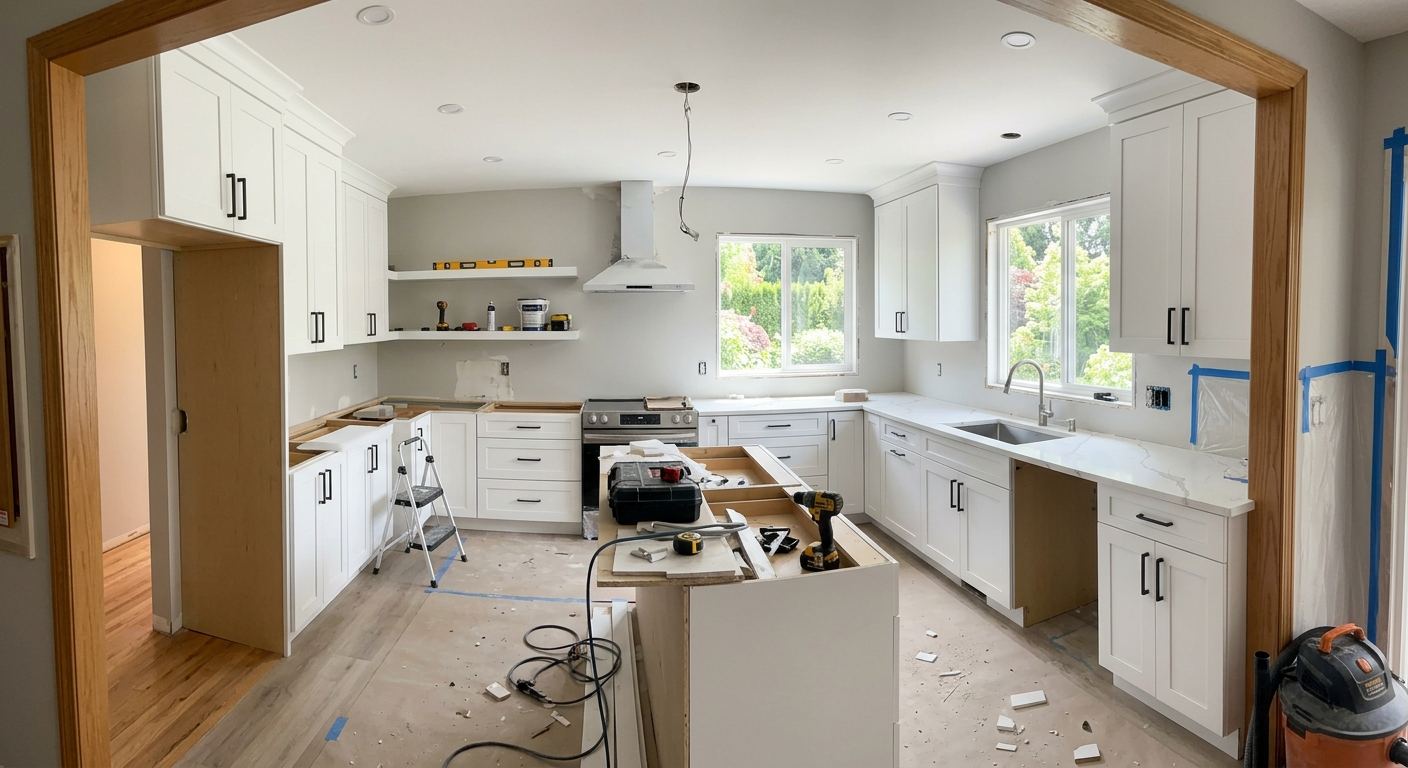
Kitchen renovation options and costs in Batchelor Hills
Kitchen renovation in Batchelor Hills has a clear range of options, from quick, budget-friendly updates to full rebuilds. With a population of 3,685 in the area (Statistics Canada, 2021 Census), most projects are owner-driven and scoped around how long the homeowner plans to stay. In the Lower Mainland–Southwest, the “finish expectations” trend tends to track what families can realistically recover on resale—especially in higher-value pockets where quartz, upgraded hardware, and semi-custom cabinetry are common. Even so, Batchelor Hills homeowners still get value by choosing practical upgrades that improve day-to-day function rather than chasing the most expensive materials.
Pricing in this region is less about climate and more about market demand, home value, and contractor workload—typical of the Lower Mainland–Southwest. That means availability and labour demand can move schedules quickly, while material pricing is driven by the mix of semi-custom packages, stone options, and appliance tiers booked throughout the year. Humidity swings and winter rain in the Greater Vancouver area don’t usually change what you can install, but they do affect how long it takes for finishing trades (paint, sealers, adhesives) to cure reliably—so contractors build in lead time and drying conditions, which can add a little to timelines on cosmetic refreshes.
In practice, many homeowners start by upgrading hardware and appliances, then move to cabinets and counters once they see what’s possible. Trade demand is especially strong around established family neighbourhoods and busy retail-served corridors where kitchen work overlaps with flooring, window, and electrical upgrades. If you’re comparing options, the table below summarizes typical tiers and timelines so you can align scope with budget.
| Renovation Tier |
What's Included |
Typical Duration |
Price Range |
| Cosmetic refresh (paint, hardware, new appliances only) |
Cabinet paint or recoat, new pulls/hinges, new sink tap (if desired), appliance swap (no changes to plumbing/gas/electrical), touch-up trim where needed |
3–7 business days (plus product lead time) |
$8,000–$22,000 |
| Mid-range full renovation (new cabinets, counters, sink, tile) |
New semi-custom or upgraded stock cabinets, countertop (often quartz), sink and faucet, backsplash tile, flooring patching/repair, basic electrical updates for task lighting |
3–5 weeks |
$45,000–$85,000 |
| High-end full renovation (custom cabinets, stone counters, island) |
Custom cabinetry, stone countertops (often granite or premium stone), island build, upgraded hardware package, extended backsplash to ceiling where requested, coordinated electrical and lighting upgrades |
6–12 weeks |
$85,000–$140,000 |
| Cabinet refacing only (new doors + drawer fronts, same boxes) |
Replace doors/drawer fronts, update trim/canopies, reface cabinet sides as needed, new hardware, optional under-cabinet lighting (electrical permitting may apply) |
1–3 weeks |
$18,000–$45,000 |
| Countertop swap only (laminate to quartz or stone) |
Remove existing top, install new quartz/stone, seam work, sink cut-out, caulking, backsplash re-skim only if required (full tile usually separate) |
3–7 business days (often longer if sink and templates need coordination) |
$10,000–$18,000 |
| Backsplash tile installation only |
Tile supply and install, waterproofing prep where required, grout/seal, clean finish around outlets and vent hood trim |
3–6 business days |
$1,500–$6,000 |
Prices are estimates only and vary by project scope, site access and material selection.
What affects the price of kitchen renovation in Batchelor Hills
In the Lower Mainland–Southwest and across British Columbia, the same kitchen job can land 30–50% apart because quotes respond to the market “target finish,” not just the square footage. Contractors price based on expected product tier (stock vs. semi-custom vs. custom), the likelihood of layout and mechanical changes, and how labour-intensive the finish becomes (stone seams, specialty cabinets, island builds). In higher-value BC markets, homeowners commonly choose quartz or stone counters and semi-custom cabinetry because the investment is easier to recover at resale. In more modest markets, laminate and stock cabinets dominate because they reduce risk and keep ROI strong.
Local conditions that most often move cost in Batchelor Hills include: (1) older home plumbing runs, where shutoffs may be dated and supply/drain upgrades can add labour and materials; (2) kitchen layouts that were designed for wall ovens and older clearances—if you’re changing to a modern range hood and wider hood ducting, you can trigger additional electrical and vent work; and (3) product lead times during peak season, which can extend the “in-progress” period and raise coordination costs for trades. Even where climate isn’t a direct cost driver, the region’s frequent rain affects curing and protective coatings, and that can push schedule-dependent trades to staggered dates.
To anchor expectations: if you keep it close to a refresh, you might sit around the lower band of a cosmetic update, often in the $8,000–$22,000 neighbourhood. If you move into a mid-range full renovation—new cabinets and counters with sink and tile—you’ll typically see totals in the $45,000–$85,000 range once layout and trade sequencing are accounted for. The cost spikes most often when you add an island or move plumbing/gas, because those changes introduce new rough-ins, inspections, and longer coordination time regardless of finish level.
| Price Factor |
Why It Matters |
Cost Impact |
| Cabinet tier — stock vs. semi-custom vs. fully custom millwork |
Controls build time, fit/finish detail, storage features, and how many custom pieces (corners, pantries, end panels) are required |
Often the largest swing—can move a project by tens of thousands depending on how many custom elements you want |
| Countertop material — laminate vs. quartz vs. granite vs. stone |
Material price, seam complexity, and fabrication method affect labour and the final look |
Laminate tends to be lowest; premium stone commonly adds several thousand dollars |
| Layout change — wall removal, island add, plumbing/gas move |
Rough-in work (drain, supply, venting, gas line, electrical circuits) plus structural coordination |
Unpredictable and can be a major budget overrun if existing services are hard to access |
| Appliance package tier — builder vs. mid-range vs. pro-grade |
Wiring/venting needs, cut-out tolerances, and feature demands like induction, convection, or built-in ventilation |
Can add notable cost due to both appliance price and needed electrical/vent adjustments |
| Flooring — refinish existing vs. full replacement |
Whether you can protect and rework existing surfaces around demolition impacts demo, install time, and matching |
Full replacement typically adds days and material allowance; refinish keeps disruption lower |
| Backsplash — ceramic tile vs. marble vs. full-height slab |
Tile format (small mosaics vs. slabs) changes labour hours; slabs require higher accuracy |
Can range from a few thousand for standard tile to higher totals for premium stone finishes |
| Electrical — new circuits for island, under-cabinet lighting |
Electrical scope triggers permitted work and licensed electrician time |
Often adds a few thousand depending on circuits, lighting layout, and box/rough-in complexity |
| Permit fees and licensed trade requirements |
When permits are required, timelines, inspection scheduling, and documentation costs increase |
Not the biggest line item, but it can change totals and scheduling certainty |
Permits & regulations in British Columbia
In British Columbia, many “like-for-like” finish swaps do not need permits, but any work that changes building systems usually does. Cabinet and countertop swaps are typically permit-free when you are keeping the same layout and not altering plumbing, gas, structural elements, or electrical load requirements. That generally includes replacing cabinet boxes/doors, installing new counters on the same supports, and swapping a backsplash if outlets and wiring don’t require modification.
Permits and licensed trades are typically required when you: move plumbing supply or drain lines; relocate a gas stove or modify a range hood ducting tied to gas appliances; remove a load-bearing wall or otherwise affect structural support; add electrical circuits for island receptacles or new under-cabinet lighting runs that require new wiring; or extend wiring that changes the circuit load. In practice, gas work must be done by a licensed gas fitter, and electrical work by a licensed electrician, with inspections completed after rough-in and at/near completion.
For a homeowner in Batchelor Hills, the verification process is straightforward: (1) ask for the contractor’s licence number and the scope of subcontractor work; (2) request certificates of insurance and confirm coverage aligns with kitchen renovation risks (general liability, and any trades’ coverage where applicable); and (3) verify workers’ compensation coverage documentation for the trades that are performing work on site. Where to look: you can confirm licensing through the provincial licence registry (for the trade involved), and you should have the certificate of insurance in the contractor’s package before signing. Most reputable contractors also provide a written summary of who pulls permits (and who is responsible) as part of the contract—confirm that responsibility in writing.
Cabinets, countertops and layout decisions in Batchelor Hills
The three biggest decisions in a Batchelor Hills kitchen renovation are usually: (1) cabinet tier, (2) countertop material, and (3) whether you change the layout. Cabinets set your budget and define storage, drawer function, and how well the kitchen “fits” your specific space. Stock cabinets are typically the fastest and cheapest because they’re standardized; semi-custom is the most popular mid-range choice because it balances lead time and customization; custom cabinets cost more but give the tightest fit, better corner solutions, and the most tailored storage.
Countertops are where homeowners see the most durable-vs-cost trade. Laminate is budget-friendly and easy to replace later, but it’s more vulnerable to edge damage and can show wear faster in busy family kitchens. Quartz engineered counters are a common sweet spot in the Lower Mainland–Southwest: they resist staining and handle day-to-day use well with minimal maintenance. Granite/natural stone offers premium look and heat resistance, while requiring more care for sealing and long-term upkeep. Butcher block can be great for a warm, functional style, but it needs sealing and ongoing maintenance; in the Lower Mainland–Southwest, that maintenance matters because moisture and humidity variations can accelerate wear if not cared for.
Layout changes are the most cost-sensitive choice. Removing a wall or adding an island may justify the spend if it creates real usable workspace and improves traffic flow—but moving plumbing or gas lines is where costs get unpredictable. As a concrete example: keeping to a mid-range full renovation scope (around the $45,000–$85,000 band) often makes sense if you’re updating cabinets and quartz counters without moving major services. If you want an island with plumbing relocation and new circuiting, the same cabinet and countertop selections can push the job toward a higher total because rough-in work and coordination add labour and inspection time.
| Option |
Durability |
Maintenance |
Best For |
Price Range |
| Stock cabinets (big-box) |
Good durability with standardized construction; less flexibility for unusual dimensions |
Low; hinges and hardware need normal periodic checks |
Fast timelines and tighter budgets where layout is mostly staying the same |
$8,000–$25,000 |
| Semi-custom cabinets (local dealer) |
Very strong; better fit options and improved storage features |
Low to moderate; hinges/hardware are typically higher quality than stock |
Most Batchelor Hills remodels aiming for a balanced mid-range finish |
$20,000–$55,000 |
| Custom cabinets (local millwork shop) |
Highest durability when built to the room; excellent edge detail and end paneling |
Low; quality hardware and solid construction reduce wear over time |
When you need perfect fit, premium storage, and a design-led layout |
$40,000–$90,000 |
| Laminate countertop |
Moderate; edge exposure can be a weak point |
Low day-to-day; handle hot items with care and protect seams/edges |
Budget-first updates and homes where you want value now |
$3,000–$7,000 |
| Quartz engineered countertop |
High durability; very resistant to staining and normal household wear |
Low; clean with mild soap, avoid abrasive pads |
Busy kitchens in Batchelor Hills that need a strong “set it and forget it” surface |
$6,000–$12,000 |
| Granite / natural stone countertop |
High; heat resistant and durable with correct sealing |
Moderate; periodic resealing and careful maintenance of seams |
Homeowners who want natural variation and premium appearance |
$7,000–$14,000 |
| Butcher block countertop |
Moderate to high; can dent but can be sanded/refinished |
Moderate to high; oiling and sealing are part of ongoing care |
Active cooking households and warmer design aesthetics |
$4,000–$10,000 |
| Marble countertop |
Moderate; beautiful but more susceptible to etching from acidic foods |
High; frequent sealing and careful cleaning |
Low-to-moderate use kitchens where appearance is prioritized |
$9,000–$18,000 |
How to choose a kitchen renovation contractor in Batchelor Hills
Choosing the right kitchen contractor in Batchelor Hills comes down to verifying credentials, tightening the scope, and protecting yourself with a written plan. In British Columbia, confirm licences that match the trade being performed: electrical by a licensed electrician and gas work by a licensed gas fitter. For the general contractor or renovation company, ask for their business registration details and documentation that they are permitted to operate on your project type. Then verify liability insurance: request the certificate of insurance before any work begins, and make sure the coverage amounts make sense for renovation work around occupied homes. For workers’ compensation (WCB), ask for documentation that the trades performing work on your site are covered through their employer program—this helps avoid you taking on risk if an incident occurs.
Get 2–3 itemised written quotes, not lump sums. You want a labour + materials breakdown that clearly shows cabinet supply, install, countertop fabrication, plumbing/electrical rough-in (if included), backsplash tile supply, disposal, and any protection measures. Read exclusions carefully: are permits pulled by the contractor, or is that separate? Is jobsite cleanup included daily, and is demolition disposal included in price or quoted separately? Ask about appliance hookup and whether old appliances are removed and hauled away.
Warranty should be written and specific: workmanship warranty length (often coverage for install defects), product/manufacturer warranty for cabinets and countertops, and whether warranties are transferable to future owners if you sell. Keep payment schedules controlled: never pay more than 10–15% upfront; use holds (for example, a final holdback until final walkthrough and punch list completion). Finally, insist on a start date and completion estimate in writing so you can plan around lead times and trade scheduling.
- Ask for licence numbers and match them to the trade work on your scope (electrical, gas, and structural/inspections as applicable).
- Request certificates of liability insurance and confirm expiry dates before work starts.
- Verify workers’ compensation coverage documentation for the crews that will be on site.
- Confirm who pulls permits, and that responsibility is listed in the contract.
- Get an itemised quote showing cabinet tier, countertop type, backsplash detail, and demolition/disposal.
- Check what’s excluded: moving appliances, patching drywall, floor matching, or plumbing shutoff replacement.
- Clarify lead times for cabinet and stone fabrication and whether the contractor manages coordination.
- Require a written warranty: workmanship coverage plus manufacturer warranty and transferability terms.
- Use a staged payment schedule with holdback tied to milestones and a final punch list.
- Confirm site protection and daily cleanup expectations, especially for occupied homes.
- Ask for proof of past similar kitchen renovations in the Lower Mainland–Southwest (photos and references).
- Get a written schedule with inspection/rough-in dates if any permitted work is required.
Red flags we often see in Batchelor Hills include: quotes that won’t itemise labour vs. materials, unclear responsibility for permits, missing or expired insurance documentation, unusually short timelines that ignore fabrication lead times, and payment requests that ask for most funds upfront without milestone holds.
Frequently asked questions — kitchen renovation in Batchelor Hills
How do I know if I need to update my kitchen plumbing in Batchelor Hills?
Start by checking symptoms, not just age. If you have slow drains, recurring under-sink leaks, discoloured water, or shutoffs that don’t fully close, plumbing refresh is often worth budgeting for—especially in older Batchelor Hills homes where supply/drain access can be limited. Also consider whether you’re changing anything that affects flow: moving the sink location, swapping to a different dishwasher location or configuration, or upgrading to a different faucet type that needs improved shutoff/lines. If your plan is a refresh-only project, plumbing updates are usually limited to replacing visible supply hoses and confirming shutoffs. If you’re in a mid-range full renovation (often in the $45,000–$85,000 band), the plumbing upgrade is more commonly rolled in so you avoid re-opening walls later.
What is the difference between a galley and open-concept kitchen?
A galley kitchen is a narrow layout with counters on two facing walls, usually with minimal space for circulation. It tends to be efficient for cooking but can feel enclosed, and it sometimes limits where you can place an island. An open-concept kitchen connects the cooking area to living space, often by removing a wall or reworking the room boundaries, which changes the traffic flow and can justify adding an island or peninsula. In Batchelor Hills, many homeowners choose open-concept after reviewing what buyers in the Lower Mainland–Southwest tend to expect for resale—typically more visibility, better sightlines, and a modern layout. That layout work can increase costs if you’re removing a load-bearing wall or moving plumbing/electrical, so it’s important to separate “cosmetic-only” from “layout change” in your quote.
How do I get accurate kitchen renovation quotes in Batchelor Hills?
For accurate quotes in British Columbia, you need a defined scope and comparable selections. Bring measurements and a clear list of what’s staying (cabinet footprint, sink location, appliance locations) and what’s changing (cabinets tier, countertop material, backsplash height, lighting placement). Ask for 2–3 itemised quotes with labour and materials broken out—otherwise you won’t be able to see what’s driving differences that can be 30–50% in the Lower Mainland–Southwest. Confirm whether the price includes permit pulling (when needed), disposal, and any floor patching/repair. To reduce surprises, include a written note about whether plumbing/electrical relocations are assumed or explicitly excluded. If you’re targeting a refresh tier, ensure appliances are true swaps; if you’re moving toward a full renovation, align the cabinet and countertop choices with the project band you’re budgeting for (for example, full renovation estimates often start at the $40,000–$120,000 range).
What's the best countertop material for a busy Batchelor Hills kitchen?
For most busy Batchelor Hills households, quartz is the practical “best overall” because it’s durable, low maintenance, and resists staining and everyday wear with less upkeep than natural stone. That’s especially helpful when you’re cooking frequently and want a surface that holds up to normal household use without constant sealing. Laminate can work for budget-first remodels, but it’s more sensitive at seams and edges and may show wear sooner in high-traffic homes. Granite/natural stone is also a strong option for durability and heat resistance, but it requires periodic care such as resealing. Butcher block can be great for cooking, but it needs regular oiling and maintenance; with Lower Mainland humidity swings, consistent maintenance is non-negotiable. If your renovation is in the mid-range tier (often $45,000–$85,000), quartz commonly fits well inside that scope and aligns with what resale buyers expect in the Lower Mainland–Southwest.
How do I add an island to my Batchelor Hills kitchen?
Adding an island is easiest when you can place it without major plumbing or gas relocation. The first step is layout: confirm circulation space, doorway clearances, and how the island will connect to existing cabinets. If you want a sink or dishwasher in the island, you’ll likely be moving plumbing supply/drain lines, which typically triggers permitted work and licensed trade involvement in British Columbia. If you want an island range hood (especially where gas is involved), plan for venting considerations and licensed gas/electrical trades. You’ll also likely need additional electrical circuits for receptacles and task lighting. In cost terms, an island without service relocation can fit within a mid-range renovation scope, but adding plumbing/gas and new circuits is what usually pushes totals up. Use your quote to clearly state whether services are relocating, and verify permit responsibility in writing.
How much does a kitchen renovation cost in Batchelor Hills?
In Batchelor Hills, kitchen renovation pricing depends primarily on finish tier and whether the layout changes, not the weather. A cosmetic refresh (paint, hardware, new appliances only) often starts around the $8,000–$22,000 range, assuming you’re not moving plumbing, gas, or electrical. A mid-range full renovation typically lands around $45,000–$85,000 when you’re installing new cabinets, counters, sink, and backsplash tile. For high-end full renovations—custom cabinetry, premium stone counters, and an island—totals commonly rise into the $85,000–$140,000 range. Across British Columbia, quotes can vary substantially because homeowners in higher-value Lower Mainland–Southwest areas often choose quartz or stone counters and semi-custom cabinetry that drive budgets upward. If you want a tighter estimate, choose your cabinet tier and countertop type first, then confirm whether any plumbing/gas/electrical relocation is included.