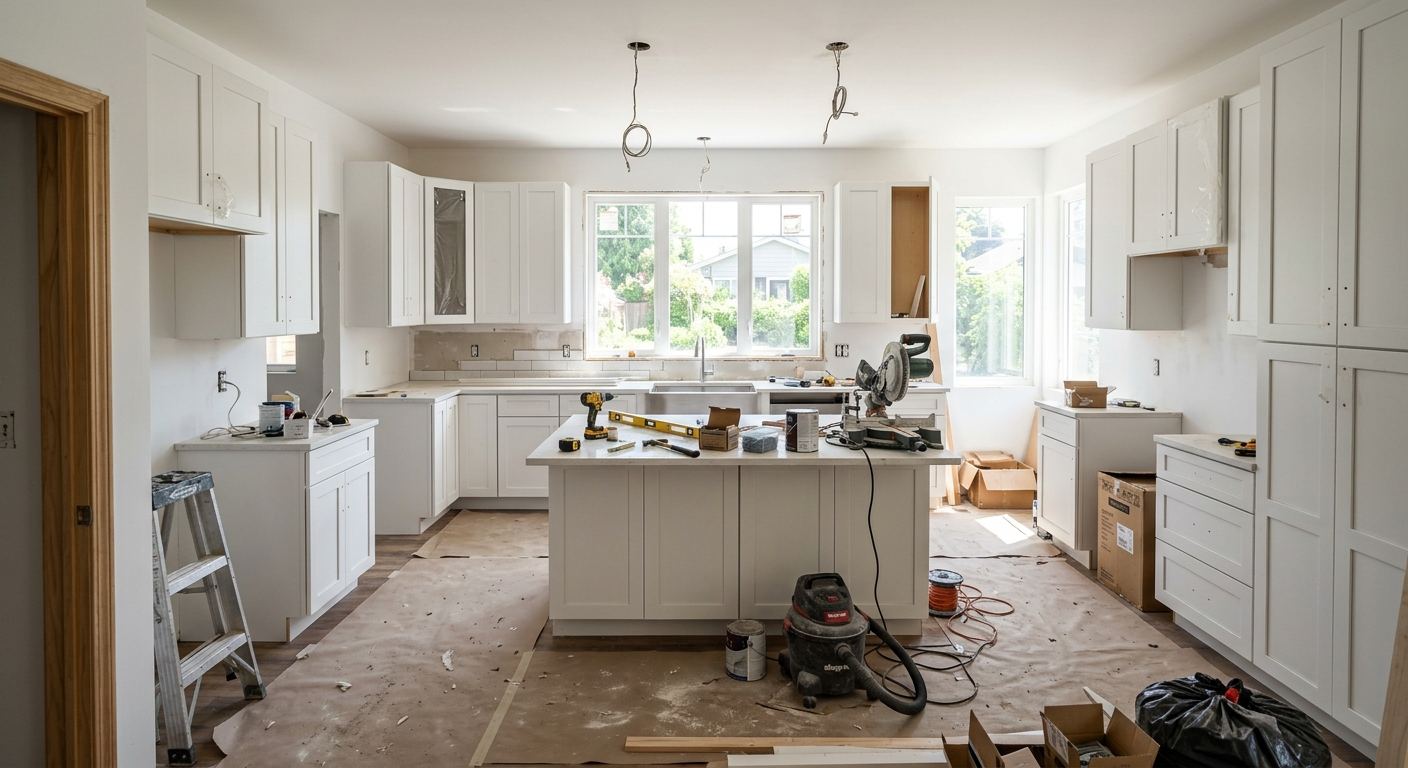
Kitchen renovation options and costs in Whatcom
Kitchen renovation in Whatcom is one of those projects where the “same” kitchen can land in very different price lanes depending on finish expectations and how the work is staged. With Whatcom’s population at 10,270 (Statistics Canada, 2021 Census), many homeowners still favour practical upgrades that fit local trades availability—especially in the Lower Mainland–Southwest, where contractors are busy and scheduling matters. At the same time, the Lower Mainland–Southwest market is shaped more by home values and resale expectations than by weather. In higher-value neighbourhood pockets across the region, owners commonly lean toward semi-custom or custom cabinetry and quartz or stone counters because those finishes are easier to market at resale.
British Columbia’s coastal climate also influences renovation choices: kitchens see frequent humidity swings and seasonal temperature changes, so cabinet materials, adhesive-backed surfacing, and proper ventilation around ranges and hoods have a bigger impact on long-term performance than in drier provinces. Labour and material demand, not the climate itself, is what most strongly drives cost. For many Whatcom residents, kitchen work is in especially high demand around the downtown and shoreline-adjacent housing areas, where older homes often need updates to layout, storage, and electrical capacity for modern appliances.
To help you compare options quickly, use the table below as a practical starting point for your contractor discussions—then we’ll break down what moves the price the most and how to protect yourself when you shop quotes.
| Renovation Tier |
What's Included |
Typical Duration |
Price Range |
| Cosmetic refresh (paint, hardware, new appliances only) |
Cabinet paint or refinishing (no box changes), new pulls/knobs, appliance swap, minor caulking, basic clean-up; countertops not replaced |
1–3 weeks |
$8,000–$25,000 |
| Mid-range full renovation (new cabinets, counters, sink, tile) |
New semi-custom or mid-range stock cabinets, countertop replacement, new sink and faucet, backsplash tile, under-cabinet light prep, disposal connection, plumbing/electrical adjustments as needed |
4–8 weeks |
$40,000–$85,000 |
| High-end full renovation (custom cabinets, stone counters, island) |
Fully custom cabinetry, stone counters (e.g., quartz/stone selections), island (or expanded peninsula), upgraded hardware, feature backsplash (e.g., full-height), floor replacement, coordinated electrical/lighting, design support |
8–14 weeks |
$85,000–$120,000 |
| Cabinet refacing only (new doors + drawer fronts, same boxes) |
New doors/drawer fronts, trim, hardware, repaint or re-surface exposed areas; countertops typically not included |
2–5 weeks |
$8,000–$35,000 |
| Countertop swap only (laminate to quartz or stone) |
Remove and replace existing surfaces, new quartz/stone fabrication and install, sealing where required, sink cut-out work; backsplash updates only if included |
1–2 weeks |
$6,000–$12,000 |
| Backsplash tile installation only |
Tile removal as needed, cement board where required, tile setting, grout/caulking, finishing edges |
3–7 days |
$1,500–$6,000 |
Prices are estimates only and vary by project scope, site access and material selection.
What affects the price of kitchen renovation in Whatcom
In the Lower Mainland–Southwest, two homeowners can receive quotes that differ by 30–50% for what looks like the same kitchen on paper. The biggest drivers are local home value and the level of finish people expect—because in higher-value areas across the region, renovations are often chosen with resale in mind, so owners default to quartz or stone counters and semi-custom cabinetry. In more modest markets, laminate surfaces and more standard cabinet lines tend to dominate, which usually keeps the project closer to the lower end of the price bands. Climate plays a smaller role in total cost than market positioning, but it does affect how homeowners prioritize ventilation, moisture resistance, and material stability.
Layout changes are the most unpredictable cost regardless of finish tier. Removing a wall, adding an island, or moving plumbing (sink drain/supply) and gas (if applicable) can add trades, coordination time, and permit steps—pushing totals well beyond a simple “refresh.” As a rule, a mid-range refresh that stays within the existing plumbing footprint can commonly sit in the $40,000–$85,000 band, while a layout-heavy rebuild with an island and premium materials more often trends toward the $85,000–$120,000 range.
Concrete examples that frequently change cost in Whatcom: (1) older homes can hide knob-and-tube or undersized kitchen circuits, which adds electrical work and inspection time; (2) floors that are out of level by the time cabinets are removed can require subfloor repair before install; and (3) coastal humidity can reveal weak underlayment or poor prior moisture detailing behind sinks—turning “minor tile” into a wider scope. If your kitchen is in an older, lower-to-the-ground crawl or has dated venting, plan for extra assessment, not just surface replacement.
| Price Factor |
Why It Matters |
Cost Impact |
| Cabinet tier — stock vs. semi-custom vs. fully custom millwork |
Higher tiers offer better fit, options for internal organizers, and more precise dimensions around corners and ceilings |
Can move a full renovation by tens of thousands; often the #1 cost swing |
| Countertop material — laminate vs. quartz vs. granite vs. stone |
Material price and fabrication complexity vary widely; natural stone can require extra sealing and skilled templating |
Commonly adds $3,000–$12,000+ depending on choice and cut complexity |
| Layout change — wall removal, island add, plumbing/gas move |
Triggers additional trades, coordination, and frequently permits/inspections |
Often the largest “surprise” item; can add weeks and thousands quickly |
| Appliance package tier — builder vs. mid-range vs. pro-grade |
Professional installs may require better ventilation specs and electrical configuration |
Can shift total project cost noticeably even if cabinetry is unchanged |
| Flooring — refinish existing vs. full replacement |
If floors are damaged during demo, you may need matching underlayments and full replacement |
Partial repairs can be cheaper; full replace typically adds cost and time |
| Backsplash — ceramic tile vs. marble vs. full-height slab |
Stone or full-height installations require more templating and finishing detail |
Can range from $1,500–$6,000+ for tile-focused work |
| Electrical — new circuits for island, under-cabinet lighting |
Modern kitchens often need more outlets, dedicated circuits, and code-compliant lighting |
Can add multiple line items; depends on what’s already present |
| Permit fees and licensed trade requirements |
Permits and inspections add administrative steps; licensed trades ensure compliance |
Fees are usually smaller than trade labour, but can still impact total by thousands |
Permits & regulations in British Columbia
In British Columbia, not every kitchen upgrade needs a permit, but the moment you change key building systems, you almost always move into permit territory. Typically, cabinet and countertop swaps generally do not require a permit when you’re keeping the plumbing, gas, and electrical locations the same—so replacing cabinet fronts/boxes and swapping a surface for quartz or granite is usually straightforward. However, you will generally need permits and licensed trades for work such as moving plumbing supply/drain lines, relocating a gas stove or range hood that uses gas, removing a load-bearing wall, or adding new electrical circuits (for example, adding outlets for an island or installing code-compliant under-cabinet lighting tied into wiring changes).
Gas work must be done by a licensed gas fitter, and electrical work must be done by a licensed electrician; both require inspections where applicable. The safest approach for a Whatcom homeowner is to confirm who is pulling permits and paying fees before you sign—this should be clearly stated in the written contract.
To verify a contractor in practice: (1) ask for their licence number and check it through the appropriate BC online registry for the trade discipline; (2) request a current certificate of insurance that names you/your property as applicable and confirms liability coverage; and (3) ask for their workers’ coverage documentation (WSIB/WCB) and keep a copy. A “we handle everything” answer is good—until you can’t produce documents. Always insist on certificates before work starts.
Cabinets, countertops and layout decisions in Whatcom
When you’re deciding how to spend in a Whatcom kitchen renovation, three choices usually determine 80% of your outcome: (1) cabinet tier, (2) countertop material, and (3) whether you change the layout. In the Lower Mainland–Southwest resale market, buyers expect durable, cleanable surfaces and a kitchen that “flows.” That expectation shifts by price point. If you keep the plan practical and stay within the existing footprint, you can often keep the project in the mid-range by choosing semi-custom cabinetry and quartz within a budget-friendly band. If you add an island, relocate plumbing/gas, or go fully custom, your cost climbs quickly because you’re paying for both materials and coordination.
Cabinet tier is the first lever: stock cabinets are the fastest and cheapest, semi-custom is the most popular middle ground, and custom millwork gives the tightest fit—especially around uneven ceilings and older corners. For countertops, laminate is the entry option (good-looking and budget-friendly), quartz is a common “best balance” because it resists staining and holds up well in a humid coastal climate when sealed and installed correctly. Granite/stone can be stunning but is more expensive to fabricate and may require additional sealing and careful maintenance. Layout changes justify their cost when they create usable clearance, better storage, and real seating/working space; moving plumbing or gas is where justification must be deliberate, because those changes trigger the highest uncertainty.
Dollar example: upgrading from laminate to quartz on a mid-range renovation might add several thousand dollars, but it often pays off visually and functionally without redoing the whole kitchen. On the other hand, moving a sink location to support an island can push you out of a “$40,000–$85,000” scope and toward the “$85,000–$120,000” lane once demolition, trades, and coordination are added.
| Option |
Durability |
Maintenance |
Best For |
Price Range |
| Stock cabinets (big-box) |
Durable for daily use; may need careful fitting around older walls |
Low; wipe-clean surfaces and standard hardware care |
Quick updates, tighter budgets, straightforward footprints |
$8,000–$20,000 |
| Semi-custom cabinets (local dealer) |
Strong construction with better options for sizes and internal organizers |
Low; more choices for finishes and moisture-resistant components |
Most popular mid-range renovations in Whatcom area homes |
$20,000–$50,000 |
| Custom cabinets (local millwork shop) |
Best fit and finish; ideal for complex angles and storage goals |
Low; depends on finish system selected |
High-end projects, unique layouts, statement kitchens |
$50,000–$75,000 |
| Laminate countertop |
Good day-to-day durability; can be vulnerable to heat and seam wear |
Easy clean; avoid hot pans directly and be careful at seams |
Budget refreshes where you’re keeping the layout |
$3,000–$6,000 |
| Quartz engineered countertop |
Very resistant to stains and everyday wear; consistent finish |
Low; wipe-clean with non-abrasive products |
Busy households wanting a premium look with practical maintenance |
$6,000–$12,000 |
| Granite / natural stone countertop |
Extremely durable surface; natural variation adds character |
Moderate; may require sealing depending on stone type |
Premium look when you’re committed to proper care |
$8,000–$14,000 |
| Butcher block countertop |
Durable but can scratch; moisture management matters near sinks |
Higher maintenance; periodic oiling and careful drying |
Warm, traditional styles and those who enjoy upkeep |
$5,000–$11,000 |
| Marble countertop |
Beautiful but softer; can etch/stain if not protected |
Higher care; requires gentle cleaners and thoughtful sealing schedule |
Statement kitchens and lower “heavy wear” households |
$10,000–$18,000 |
How to choose a kitchen renovation contractor in Whatcom
Choosing a contractor in Whatcom for a kitchen renovation should start with proof, not promises. In British Columbia, confirm that the contractor and the trades they sub out are properly licensed for the work they’re performing. For electrical and gas-related scopes, insist on a licensed electrician and licensed gas fitter. To check: look up the trade licence through the BC online registry (request the licence number and trade class), ask for a current certificate of liability insurance, and verify they carry WSIB/WCB coverage for their workforce. A reputable contractor can provide documents before you sign, and they should be comfortable explaining who is responsible for permits.
Next, get 2–3 itemised written quotes (not a lump sum) so you can compare labour and materials line by line: cabinetry, countertop fabrication and install, tile, demolition, electrical allowances, plumbing adjustments, disposal, and any permit/inspection fees. Read the scope carefully—what’s excluded? Is drywall repair included? Is the permit pull included or billed separately? Is waste disposal and site clean-up part of the price? For warranty, ask for the workmanship warranty length in writing, the manufacturer’s product warranty details, and whether coverage transfers if you sell the home. Finally, timeline and payment structure matter: never agree to more than about 10–15% upfront, and plan a holdback tied to completion and punch-list items. Get a start date and an estimated completion window in writing so there’s accountability if materials or inspections delay you.
- Ask for BC trade licence numbers (and verify them via the online registry) before signing.
- Request certificate of liability insurance and confirm coverage applies to your project.
- Verify WSIB/WCB coverage for the contractor’s crews (get documents, not verbal assurances).
- Require quotes broken into labour and materials categories—not one combined number.
- Confirm who pulls permits, who pays fees, and what inspections are expected.
- Check demolition and disposal inclusions (haul-away, dump fees, and site clean-up).
- Ensure electrical scope is explicit (circuits, outlets, lighting) rather than “allowance-only.”
- Confirm plumbing changes are listed (supply/drain moves, shutoffs, new shutoff valves).
- Ask who supplies and installs underlayment, backer board, or waterproofing for tile areas.
- Clarify countertop templating responsibilities and when you’ll approve shop drawings.
- Review payment schedule in writing with a completion-based holdback.
- Get a written start date, key milestones, and a realistic completion estimate.
In Whatcom kitchens, red flags include: a quote that doesn’t itemise labour/materials, refusal to provide proof of liability insurance or WSIB/WCB, vague wording around permits and licensed trades, payment requests of more than 10–15% upfront, and timelines that omit inspection and cabinet/counter fabrication lead times.
Frequently asked questions — kitchen renovation in Whatcom
How do I add an island to my Whatcom kitchen?
Adding an island in Whatcom usually starts with a plan for clearance and traffic flow, then a reality check on services. If the island is purely cabinet-and-counter with no new sink or cooktop, you can often keep the project closer to a mid-range plan. If you want a sink or a gas/electrical cooktop, moving plumbing supply/drain lines and/or adding electrical circuits becomes part of the work and may require permits and licensed trades in British Columbia.
Expect the cost to swing based on whether you’re extending new lines versus tying into existing service runs. A practical budget target for a mid-range full renovation often sits in the $40,000–$85,000 band when you’re largely within the existing footprint. If you’re relocating plumbing/gas and upgrading finish tiers, totals more commonly trend toward $85,000–$120,000. Your contractor should confirm service routing early—before cabinetry and countertops are ordered.
How much does a kitchen renovation cost in Whatcom?
For kitchen renovation in Whatcom, most homeowners land within the region’s typical full renovation bands: about $40,000–$120,000 depending on what you change and the finish level. A cosmetic refresh (paint, hardware, and new appliances only) can be far lower, while a full remodel with new cabinetry, counters, and tile is where costs start to climb. Mid-range full renovations typically sit around $40,000–$85,000, and high-end projects with custom millwork, stone counters, and an island more often land in the $85,000–$120,000 range.
In the Lower Mainland–Southwest, contractors often price based on expected resale finish level rather than purely on climate. If your home is older, you may also need extra allowance for electrical upgrades, subfloor corrections, or hidden damage once demo starts. Build your budget around an itemised quote and include contingencies for real-world conditions.
How long does a kitchen renovation take in Whatcom?
Timelines in Whatcom depend on the renovation tier and, importantly, on lead times for cabinets and countertops. A cosmetic refresh can often be completed in about 1–3 weeks since most work is surface-level: paint, hardware, and appliance swaps. A mid-range full renovation is commonly in the 4–8 week range when trades coordinate smoothly and there are no major surprises behind the walls.
High-end projects typically take longer—often 8–14 weeks—because custom cabinetry requires more fabrication time, stone countertops need templating and scheduling, and island or layout changes add inspection steps. British Columbia’s permit/inspection process can also add time when plumbing, gas, or electrical circuits are altered.
To avoid delays, ask your contractor for a written schedule with start date, cabinet/counter ordering milestones, inspection checkpoints (if permits apply), and an end-date target. That’s the best way to keep uncertainty from becoming budget creep.
Quartz vs granite countertops — which is better?
“Better” depends on your routine, budget, and how much upkeep you’re willing to do. Quartz engineered countertops are popular in British Columbia because they’re very resistant to everyday stains and wear, and they’re usually lower maintenance. They also provide consistent patterning, which many buyers like in the Lower Mainland–Southwest resale market. In Whatcom renovations, quartz commonly lands in the mid-to-upper portion of countertop budgets—often around $6,000–$12,000 depending on size and edge details.
Granite (natural stone) is extremely durable and can look exceptional with one-of-a-kind veining. The trade-off is that natural stone may require periodic sealing depending on the stone selection and how it’s cared for. Granite can also be more sensitive to fabrication complexity and needs careful templating.
If you want a practical, low-fuss choice for a busy household, quartz is usually the safest bet. If you want maximum natural variation and don’t mind maintenance, granite can be worth it.
Should I reface or replace my cabinets?
Refacing versus replacing comes down to the condition of your existing cabinet boxes and how much you want to change the layout and storage. Cabinet refacing (new doors and drawer fronts, keeping the same boxes) is usually a strong option when your boxes are solid, the frames are square, and the damage is mostly cosmetic. It can also be a faster path to a refreshed look—often in the $8,000–$35,000 range depending on how much you’re changing and how complex the finish details are.
Replacing makes more sense if the boxes are warped from moisture, the cabinet configuration is outdated, or you’re planning to make significant layout moves that need new cabinet sizes and installation. Semi-custom or stock replacement cabinets combined with new counters and tile are typically part of a full renovation budget.
In Whatcom’s coastal climate, moisture detailing around sinks and under windows matters. If you see prior water exposure or soft areas, replacing may be the more cost-effective long-term fix than refacing over problem boxes.
Do I need a permit for a kitchen renovation in British Columbia?
In British Columbia, many kitchen updates can proceed without a permit when you’re not changing building systems. Cabinet swaps and countertop replacements typically don’t require permits if plumbing, gas, and electrical locations remain unchanged. However, you generally do need permits (and licensed trades) if your renovation involves moving plumbing supply or drain lines, relocating gas appliances or gas-related venting, removing a load-bearing wall, or adding new electrical circuits (for example, outlets and lighting tied into new wiring for an island).
Homeowners in Whatcom should confirm who is responsible for permits in the written contract before work begins. Ask your contractor how they determine whether a permit is required for your exact scope, then verify the licences for the trades involved via the BC online registry. Also request certificates of insurance and WSIB/WCB coverage so you’re protected if anything goes wrong.