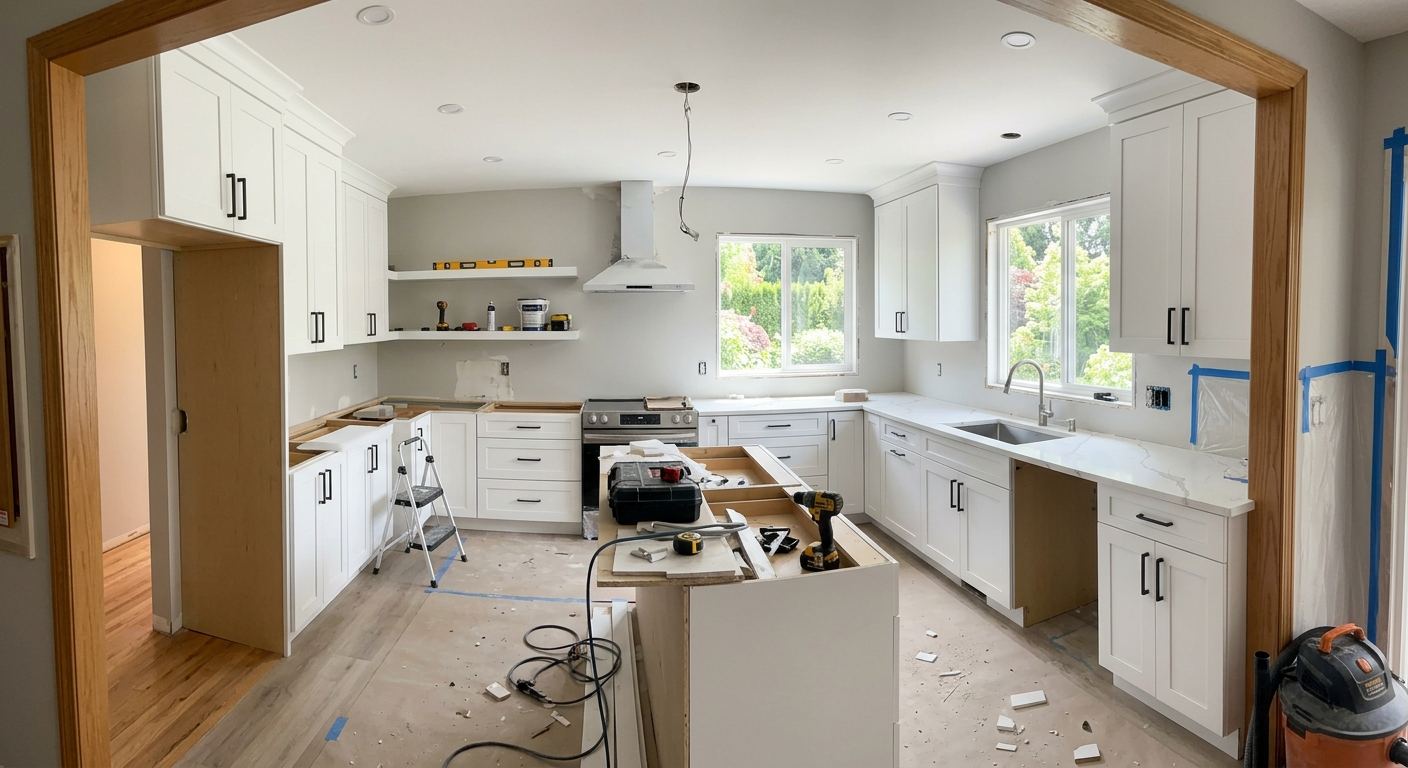
Kitchen renovation options and costs in Greektown
Greektown, British Columbia has a distinct mix of older housing stock and newer infill, so kitchen plans often swing between “refresh” and “rebuild” depending on how far the owner wants to go. With a 2021 population of 4,836 (Statistics Canada, 2021 Census), Greektown’s projects tend to be smaller and more design-led than sprawling new developments, but the overall Lower Mainland–Southwest market still pulls pricing upward when homeowners choose higher-end finishes. In the broader region, higher-value homes (and the incomes that support them) typically correlate with stronger expectations for cabinetry fit, quartz/stone counters, and upgraded hardware—finishes that are easier to justify when a renovation protects resale value. (Statistics Canada, 2021 Census).
In the Lower Mainland–Southwest, costs are driven more by market demand and the chosen finish level than by weather. Humidity swings and wet winters do matter for building durability, but the biggest cost variable is how complex the kitchen package is: new cabinetry, stone counters, layout changes, and additional trades. Contractor availability is also practical—weekends and short-notice work are limited in metro Vancouver, so scheduling can add contingency if you need fast turnarounds near peak season. That’s especially true in high-trade-demand pockets like the Hastings Street corridor, where turn-key kitchens are a common ask.
If you’re comparing scopes, use the table below to align your expectations—then you can talk to contractors about which tier matches your end goal and your budget before detailed measuring starts.
| Renovation Tier |
What's Included |
Typical Duration |
Price Range |
| Cosmetic refresh (paint, hardware, new appliances only) |
Cabinet paint or stain touch-up, new pulls/handles, caulking/trim refresh, replace appliances (no plumbing/gas moves), existing surfaces stay |
3–7 business days |
$8,000–$20,000 |
| Mid-range full renovation (new cabinets, counters, sink, tile) |
New semi-custom or quality stock cabinetry, quartz/stone or upgraded counter, sink + faucet swap, backsplash tile, under-cabinet lighting (if included), flooring refresh/replacement as needed |
3–5 weeks |
$40,000–$85,000 |
| High-end full renovation (custom cabinets, stone counters, island) |
Fully custom millwork, premium stone (often slab), island build with cabinetry integration, more extensive electrical (island circuits/lighting), larger tile scope or full-height backsplash options |
5–9 weeks |
$90,000–$120,000 |
| Cabinet refacing only (new doors + drawer fronts, same boxes) |
Remove and replace doors/drawer fronts, hardware upgrade, re-face visible cabinet surfaces, often paired with repainting, countertops not replaced unless bundled |
1–3 weeks |
$12,000–$35,000 |
| Countertop swap only (laminate to quartz or stone) |
Template and install new counters, sink cut-out adjustment, basic sealing at edges, disposal of old material (scope-dependent) |
3–10 business days |
$6,500–$18,000 |
| Backsplash tile installation only |
Tile removal/installation where needed, waterproofing/backer prep, grout/sealant, trim and edge finishes, match to existing counter height |
3–7 business days |
$1,500–$6,000 |
Prices are estimates only and vary by project scope, site access and material selection.
What affects the price of kitchen renovation in Greektown
In Greektown and across the Lower Mainland–Southwest, it’s common to see quotes for the “same” kitchen land 30–50% apart—especially once the conversation moves from looks to structure. Two homeowners may both want a mid-range update, but one chooses quartz and semi-custom cabinetry while the other stays with laminate and stock units. That’s why regional pricing is more tightly tied to home value, household income and the expected finish tier than to climate alone.
In higher-value Lower Mainland–Southwest neighbourhoods, homeowners often default to quartz or stone counters and semi-custom cabinetry because the renovation cost is easier to recoup on resale; buyers notice the details—edge profiles, hardware, and how the doors align. In more modest markets, laminate counters and stock cabinets usually dominate because they deliver a cleaner look at a safer budget, which keeps ROI healthier. Even then, layout changes are where uncertainty spikes: removing a wall, adding an island, or moving a gas line or vent can add hidden demo, patching, and trade coordination costs regardless of finish level.
Two concrete Greektown examples I see often: (1) older homes can have outdated supply/drain runs behind original cabinets, so a “simple sink swap” can turn into plumbing rework that affects labour and schedule; (2) if your existing backsplash height or outlet locations don’t align with modern cabinet thickness and under-cabinet lighting, you’ll pay more for electrical rough-in and drywall finishing. In price terms, a full mid-range kitchen can start in the $40,000–$85,000 band, while the moment you push to island work and stone-ready millwork, projects commonly drift toward the $90,000–$120,000 range. That’s the market reality here—not just material choice.
| Price Factor |
Why It Matters |
Cost Impact |
| Cabinet tier — stock vs. semi-custom vs. fully custom millwork |
Custom boxes, made-to-fit widths, mouldings, and specialty storage add shop time and precision installation |
$8,000–$45,000+ swing depending on scope |
| Countertop material — laminate vs. quartz vs. granite vs. stone |
Material price, fabrication complexity, edge profiles, and seam planning change labour and waste |
Laminate often $3,000–$7,000; quartz/stone can push $6,000–$12,000+ for install-only budgets |
| Layout change — wall removal, island add, plumbing/gas move |
Triggers structural review, drywall/patching, venting and rough-in coordination; highest unpredictability |
Often adds $10,000–$35,000 where major moves are required |
| Appliance package tier — builder vs. mid-range vs. pro-grade |
Electrical requirements, ventilation needs, and trim fit can add installation time |
Typically $2,000–$15,000+ difference within similar-sized appliances |
| Flooring — refinish existing vs. full replacement |
Kitchen demolition dust control and floor matching to adjacent rooms affects labour and material quantity |
Re-use can save $3,000–$10,000 versus full replacement |
| Backsplash — ceramic tile vs. marble vs. full-height slab |
Pattern matching, backer prep, heavier materials and cutting accuracy increase install time |
Tile installs often $1,500–$6,000; premium full-height scopes can exceed that range |
| Electrical — new circuits for island, under-cabinet lighting |
New loads require additional rough-in time, testing, and approved work by licensed trades |
Commonly adds $1,000–$8,000 depending on circuit count |
| Permit fees and licensed trade requirements |
When plumbing, gas relocation, major electrical, or structural changes are involved, permits and inspections add process cost |
Often $500–$3,500+ plus coordination time where required |
Permits & regulations in British Columbia
For kitchen renovations in British Columbia, cabinet and countertop swaps generally do not require permits, because you’re not changing building systems. That includes replacing cabinet faces/doors (refacing) where the existing cabinet footprint and services remain in place, and installing new counters over the same layout. However, once you move plumbing supply or drain lines, relocate a gas appliance connection (including a gas stove or certain range hood setups), remove a load-bearing wall, or add new electrical circuits, permits and licensed trades become the standard path.
Here’s what typically does require a permit/inspection: relocating sink supply/drain, moving a dishwasher connection, rerouting gas lines or altering gas appliance connections, adding an island that requires new plumbing venting or additional electrical circuits, and any new or upgraded electrical circuits for tasks like under-cabinet lighting transformers with separate feeds or island receptacles. What typically does not require permits: painting cabinets, swapping hardware, replacing like-for-like appliances where connections are unchanged, and installing a new backsplash tile on existing walls (assuming no concealed changes to electrical/plumbing).
To verify a contractor for your Greektown project, ask them to provide: (1) their licence/registration details relevant to the trades they perform (and for specialized work, separate licensed trade confirmations), (2) a current certificate of liability insurance showing adequate coverage, and (3) proof of worker coverage through WSIB/WCB (as applicable to their workforce). Then check the certificate itself for expiry dates and match the insured name to the contractor you sign with. Confirm in writing who is responsible for permits and inspections before any deposit is taken.
Cabinets, countertops and layout decisions in Greektown
In a Greektown kitchen renovation, the three biggest decisions are (1) cabinet tier, (2) countertop material, and (3) whether you change the layout. These choices drive your day-to-day satisfaction and your resale appeal in the Lower Mainland–Southwest market. Start with cabinetry: stock is typically the fastest and cheapest because it’s built in standard sizes; semi-custom is the most popular mid-range option for achieving better fit around quirks in older layouts; custom millwork is the highest cost but pays off when your kitchen has awkward angles, non-standard openings, or you want storage built to your workflow.
Next, countertops. Laminate is a budget-friendly upgrade surface, but in busy kitchens it can be less impact-resistant at seams and edges. Quartz engineered counters are a strong “middle-to-premium” choice in British Columbia because they’re non-porous and handle humidity and temperature swings well when installed correctly. Granite/natural stone is premium and durable, but it needs realistic maintenance planning (sealing and care). Layout decisions are where budgets get won or lost: opening up a wall, adding an island, or relocating plumbing/gas is often justified only when it improves traffic flow or creates a layout buyers recognise instantly.
Here’s a practical dollar example: if you’re already targeting a mid-range $40,000–$85,000 renovation, upgrading from laminate to quartz might be the kind of change that’s “worth it” because it improves perceived value without requiring major demolition. But if you move sink plumbing to support an island, you can push beyond that band quickly—labour coordination, rough-in, patching and inspection steps can take the project into the $90,000–$120,000 high-end territory even if your cabinet choice stays semi-custom.
| Option |
Durability |
Maintenance |
Best For |
Price Range |
| Stock cabinets (big-box) |
Solid for standard layouts; seams and fit may show in older homes |
Low—mostly hardware tightening and occasional refinishing if painted |
Quick timelines and a controlled budget |
$8,000–$25,000 |
| Semi-custom cabinets (local dealer) |
Good strength with better sizing options and upgraded internals |
Low—cleaning and hardware upkeep; better longevity if installed true |
Most Greektown mid-range projects |
$20,000–$50,000 |
| Custom cabinets (local millwork shop) |
Best fit and storage optimization for unusual dimensions |
Low—higher-end finishes still need normal care |
Design-led rebuilds and long-term “stay in the home” plans |
$45,000–$85,000+ |
| Laminate countertop |
Affordable surface; more vulnerable at seams/edges to impact over time |
Low—avoid excessive heat and protect edges |
Budget refreshes and resale-safe updates |
$3,000–$7,000 |
| Quartz engineered countertop |
High durability, good stain resistance and consistent look |
Very low—no sealing; wipe-clean care |
Busy kitchens needing a premium look without heavy maintenance |
$6,000–$12,000 |
| Granite / natural stone countertop |
Very durable surface; performance varies by stone type |
Moderate—typically periodic sealing and careful cleaning |
Owners who want a unique natural pattern |
$8,000–$14,000 |
| Butcher block countertop |
Durable but can scratch or dent; sensitive to standing water |
Higher—oil/conditioning and careful drying required |
Casual warm look and if you’re willing to maintain it |
$5,000–$11,000 |
| Marble countertop |
Beautiful but more prone to etching/staining than quartz |
Higher—requires disciplined care and sealing plan |
Low-spill lifestyles or statement kitchens |
$10,000–$20,000+ |
How to choose a kitchen renovation contractor in Greektown
Choosing the right contractor in Greektown (British Columbia) comes down to proof and process, not just a friendly quote. First, verify licensing and coverage for the trades involved: confirm the contractor’s credentials for the work they claim to do, and request certificates showing current liability insurance. For worker coverage, ask for documentation of WSIB/WCB coverage so you’re not left holding the risk if something happens on site.
Next, get 2–3 itemised written quotes. You want a breakdown that separates labour vs. materials (cabinets, counters, tile, drywall/paint, electrical/plumbing labour) rather than a single lump-sum number. Scope details matter: ask whether permit pulls are included, who schedules inspections, and whether disposal and dust control are covered. Also confirm what’s excluded—common exclusions include patching beyond cabinet footprint, subfloor repairs, or electrical upgrades needed for modern under-cabinet lighting.
Warranty is another make-or-break item. Ask for workmanship warranty length and what it covers (installation issues vs. product defects), plus the manufacturer warranty for cabinets and countertops. Inquire whether warranties are transferable if you sell the home.
For payment, don’t front-load the job. A safe approach is never paying more than 10–15% upfront; use progress payments and a holdback until punch list completion. Finally, insist on a start date and a completion estimate in writing, including lead times for cabinetry and stone fabrication—especially important in the Lower Mainland–Southwest market.
- Ask for a written, itemised quote with labour and material lines.
- Confirm who is responsible for permits and inspections (in writing).
- Request certificate of liability insurance and check expiry dates.
- Verify WSIB/WCB coverage paperwork for their workers.
- Confirm disposal included (dumping fees, recycling, and demo haul-away).
- Review the scope for drywall patching, painting, and caulking responsibilities.
- Ask who does electrical/plumbing—then verify licensed trade confirmations.
- Get cabinet delivery lead times and countertop fabrication schedules in writing.
- Clarify change-order pricing method (rates, allowances, approvals required).
- Confirm dust control plan during demo and cabinetry install.
- Ensure warranty details are specific and in the contract (length + coverage).
- Use a payment schedule with a holdback at substantial completion.
Red flags in Greektown: (1) quotes that are only a lump sum with no line items, (2) refusal to provide insurance/coverage documents, (3) vague scope language like “basic repairs” without stating who pays, (4) no timeline/lead-time assumptions for cabinets and stone, and (5) pushing for large deposits (beyond 10–15%) or demanding final payment before punch list completion.
Frequently asked questions — kitchen renovation in Greektown
Should I renovate my kitchen before selling in Greektown?
If you’re selling soon in Greektown, renovate only if it moves the kitchen closer to what today’s buyers expect in the Lower Mainland–Southwest. In many cases, a cosmetic refresh (paint, hardware, and appliance swaps) can be a smart way to make the home feel clean without over-investing. But if your cabinets are dated or your layout is cramped, a mid-range full renovation—often in the $40,000–$85,000 range—tends to deliver a more noticeable lift for buyers who can see the details. Avoid paying for complex layout changes unless the space gain is clear, because plumbing/gas moves are where costs grow fastest in British Columbia. Also consider your home’s age: older houses may have hidden plumbing upgrades needed, so budget contingency for that.
What's the most popular kitchen style in Greektown right now?
Right now in Greektown and surrounding Lower Mainland–Southwest markets, the most requested look is a bright, modern “transitional” kitchen: flat or simple-profile cabinet fronts (often in soft whites, warm greys or natural wood tones), quartz counters, and clean-lined backsplashes. Buyers also like practical storage upgrades—pantries, drawer organisers, and better lighting—because daily usability shows in photos and during showings. Homeowners often choose semi-custom cabinetry for the best balance of fit and schedule, and pair it with quartz for low maintenance. If you’re targeting resale, keep hardware and colours cohesive with nearby finishes (floors and trims), and don’t underestimate outlet/counter alignment when you change cabinet thickness.
How do I know if I need to update my kitchen plumbing in Greektown?
In Greektown, the best signal is what you see during demo or what the current system behaves like. If you’ve had slow drains, frequent clogs, discoloured water near the sink, or leaks under the cabinet, assume you may need more than a surface-level change. Older plumbing runs behind original cabinets can require re-routing when new sink configurations or dishwashers are installed, and that’s when cost changes the most—especially if supply/drain lines must be moved. A contractor should confirm whether you’re doing like-for-like connections (typically simpler) versus moving plumbing (which in British Columbia commonly involves permitting and licensed work). Ask for a plumbing assessment before finalizing your budget.
What is the difference between a galley and open-concept kitchen?
A galley kitchen is a narrow, corridor-style layout with counters on two sides, typically separated by a single walkway. It’s efficient for workflow but can feel closed off, especially in homes with limited sightlines. An open-concept kitchen removes or reframes the wall connections to blend with living space, which is more appealing to many buyers in the Lower Mainland–Southwest. The trade-off is that open-concept projects often involve structural considerations, electrical redesign, and sometimes more complex ventilation or plumbing coordination. If you’re considering a wall removal or island add, plan for permit requirements in British Columbia and increased labour time—those layout shifts are usually where the largest budget swing happens.
How do I get accurate kitchen renovation quotes in Greektown?
To get accurate quotes in Greektown, provide comparable scope details to each contractor and request itemised pricing. Start with measurements, a basic layout plan, and your finish selections (cabinet tier and countertop material). Ask each company to separate labour and materials, and clarify whether disposal, patching, painting, electrical/plumbing work, and permit pulls are included. If you want quartz, for example, tell them whether you’re doing a straightforward countertop swap or if you’ll need cut-outs and edge changes—those affect install time. As a pricing anchor, many mid-range full renovations fall around the $40,000–$85,000 band; if one quote is dramatically lower or higher without explanation, ask what’s omitted. Finally, confirm lead times for cabinets and stone—timing gaps can change scheduling and labour rates.
What's the best countertop material for a busy Greektown kitchen?
For most busy households in Greektown and across British Columbia, quartz is the safest “set it and forget it” choice: it’s durable, non-porous, and holds up well to daily cleaning without the sealing routines natural stones often require. That’s why quartz commonly pairs with semi-custom cabinetry in mid-range remodels. If you want to balance budget and performance, laminate can still be a practical option for a refresh, but it’s less forgiving at seams and edges over time. Natural stone like granite can be excellent, but maintenance habits matter. If you cook often with hot pans, use proper trivets for any countertop. For pricing expectations, quartz countertop install budgets commonly land in the $6,000–$12,000 range within the broader renovation totals.