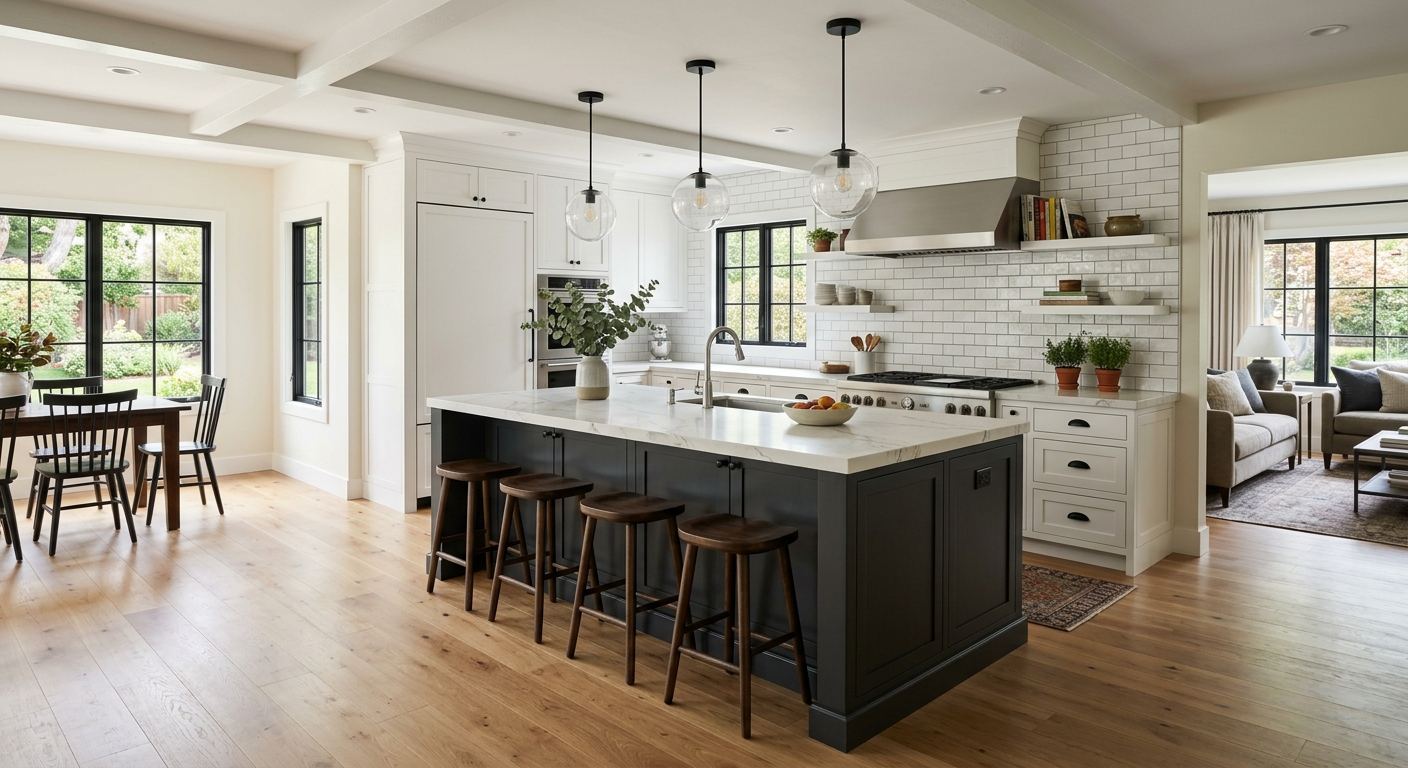
Kitchen renovation options and costs in Dallas
Dallas, British Columbia is a smaller community (Population 2021: 4,479) where kitchen renovations tend to follow the same Lower Mainland–Southwest pattern as nearby Surrey, Abbotsford and Burnaby: pricing is driven more by expected finish level and home value recovery on resale than by weather. In higher-value pockets of the Lower Mainland–Southwest, homeowners often choose semi-custom or custom cabinetry and quartz/stone counters because those upgrades look “right” to buyers. Even though Dallas itself is modest in size, contractors serving the region still bring a range of cabinet and countertop supply options, so you’ll see multiple price points for the same kitchen size.
Climate also plays a practical role in day-to-day costs. British Columbia’s damp coastal winters mean materials must be installed with correct ventilation, moisture management and sealants—especially around sinks, plumbing penetrations and exterior-facing exterior walls. While the climate isn’t typically the biggest driver of total project cost, it can affect detailing and the time needed to prep older finishes.
Cabinet trade demand is especially steady for homes along the municipal core where typical renovations include moving from older builder-grade layouts to more functional storage and cleaner sightlines. That’s why you’ll want to compare options side-by-side before calling for a quote—starting with the table below for common Dallas renovation tiers.
| Renovation Tier |
What's Included |
Typical Duration |
Price Range |
| Cosmetic refresh (paint, hardware, new appliances only) |
Cabinet paint or repaint, new pulls/knobs, appliance swap, minor caulking/grout touch-ups, simple countertop cleaning/repair, basic lighting refresh |
3–7 days |
$8,000–$22,000 |
| Mid-range full renovation (new cabinets, counters, sink, tile) |
New cabinets (stock or semi-custom), countertop replacement, new sink + faucet, backsplash tile, demo/haul-away, under-cabinet lighting upgrades (where feasible), new flooring transitions as needed |
3–5 weeks |
$40,000–$80,000 |
| High-end full renovation (custom cabinets, stone counters, island) |
Custom cabinetry/made-to-fit millwork, stone counters (quartz/stone), island build, upgraded hardware and interior organizers, full backsplash (including elevated details), electrical upgrades for island (if needed), premium trim/finishing |
6–10 weeks |
$90,000–$120,000 |
| Cabinet refacing only (new doors + drawer fronts, same boxes) |
Reface doors/drawer fronts, new hardware, paint/stain refinishing where needed, limited demo, careful alignment and sealing around existing boxes, optional new backsplash to match |
1–3 weeks |
$12,000–$35,000 |
| Countertop swap only (laminate to quartz or stone) |
Remove existing laminate, template, install new quartz/stone, sink/faucet reseat (if retaining), basic backsplash matching or partial backsplash coverage where required |
1–2 weeks |
$15,000–$45,000 |
| Backsplash tile installation only |
Tile supply selection, prep and leveling, install ceramic/porcelain tile, grout/seal (as required), caulking at countertop/wall transitions |
2–6 days |
$1,500–$6,000 |
Prices are estimates only and vary by project scope, site access and material selection.
What affects the price of kitchen renovation in Dallas
In Dallas and across the Lower Mainland–Southwest, two quotes for the “same” kitchen can easily differ by 30–50%—even before you change sizes—because labour availability, finish tier and how much work is hidden behind the walls vary a lot. In higher-value Metro Vancouver neighbourhoods, owners commonly move to quartz or stone counters and semi-custom cabinetry, and those choices tend to stick because buyers expect that look at resale. In more modest markets, laminate surfaces and stock cabinets remain common, which keeps the project closer to the backbone full-renovation band of $40,000–$120,000.
Local home values and household income influence the finish tier far more than climate. In higher-value areas of the Lower Mainland–Southwest, homeowners feel more comfortable paying for durability and a “design-led” layout because those costs are more recoverable. In Dallas, the kitchen stock is often older and the plumbing/electrical routing may be dated, so even if you choose mid-range finishes, the renovation can jump if the contractor needs to open walls to make safe connections.
Concrete examples: (1) If your kitchen has an older drain line that doesn’t align with modern cabinet depths, the contractor may need more carpentry and plumbing time—pushing the project toward the higher end of the mid-range $40,000–$80,000 range. (2) If you add an island and need to move a gas line or relocate plumbing, the unpredictability is usually greater than upgrading from laminate to quartz. (3) If your existing floors are wavy from moisture exposure, refinishing may not be possible and full replacement can become the better, safer call—especially for tile transitions.
Finally, housing age matters. Older homes often have smaller electrical capacity at the panel and limited dedicated circuits, so island under-cabinet lighting and new receptacles can add time and licensed electrical work regardless of whether you choose stock or custom millwork.
| Price Factor |
Why It Matters |
Cost Impact |
| Cabinet tier — stock vs. semi-custom vs. fully custom millwork |
Higher tiers improve fit, storage, and finish quality; they also change lead times and install complexity |
$8,000–$50,000 for installation/refacing portions depending on scope |
| Countertop material — laminate vs. quartz vs. granite vs. stone |
Material cost and fabrication/handling drive labour, templating and replacement complexity |
$3,000–$12,000 for countertop installation band; higher when stone + complex edges |
| Layout change — wall removal, island add, plumbing/gas move |
Opening walls exposes surprises (stud condition, old venting, misaligned rough-ins) |
Often the largest swing; can shift a $40,000–$80,000 job toward the upper end of $90,000–$120,000 |
| Appliance package tier — builder vs. mid-range vs. pro-grade |
Pro-grade models may require different electrical and venting; finishes also cost more |
$2,000–$15,000+ depending on package and hookups |
| Flooring — refinish existing vs. full replacement |
Coastal moisture issues can cause subfloor prep needs; tile demands specific underlayment |
$1,500–$8,000 for typical flooring portion variation |
| Backsplash — ceramic tile vs. marble vs. full-height slab |
Slab-style backsplashes require extra labour for alignment, sealing and careful cutting |
$1,500–$6,000 for tile install; higher for premium stone finishes |
| Electrical — new circuits for island, under-cabinet lighting |
New circuits require licensed work, materials, and inspection scheduling |
$1,000–$7,000+ depending on scope |
| Permit fees and licensed trade requirements |
Any permitted work adds administrative time and may affect sequencing of trades |
Can add $500–$3,000 in admin/trade coordination, plus labour for licensed work |
Permits & regulations in British Columbia
In British Columbia, cabinet and countertop swaps on their own typically do not require permits. That means replacing existing cabinets, changing laminate to quartz, or swapping a backsplash tile system is usually handled as a straightforward renovation scope (assuming no hidden structural, plumbing, or electrical changes). However, permits and licensed trades become necessary when the project moves beyond finishes.
Work that commonly does require a permit includes: relocating plumbing supply or drain lines (moving your sink), changing the location of a gas stove or modifying the gas line, removing a load-bearing wall, and adding new electrical circuits (for example, powering an island receptacle set or upgrading lighting with added circuits). Gas work must be done by a licensed gas fitter, and electrical work must be done by a licensed electrician—both of which require inspections as applicable.
Step-by-step verification for Dallas homeowners: (1) Ask your contractor for the licence numbers or business registration details for gas fitting/electrical trades (if those trades are subcontracted). (2) Request certificate of insurance for general liability and confirm coverage limits. (3) For workplace coverage, ask how the trades will be covered under WCB/WCB-equivalent arrangements in their province of registration and obtain documentation as required. (4) For permits, ask who is responsible for pulling permits and have that responsibility clearly stated in your written contract.
Before you sign, confirm that the permit responsibility (contractor vs. owner) and the inspection process are clearly documented—this is where many disputes are prevented.
Cabinets, countertops and layout decisions in Dallas
When planning a kitchen renovation in Dallas, three decisions determine most of your cost, schedule and long-term satisfaction: (1) cabinet tier, (2) countertop material, and (3) layout changes. First, choose your cabinet tier. Stock cabinets are the fastest route (good for a refresh with predictable lead times), semi-custom is the most popular mid-range option in the Lower Mainland–Southwest, and fully custom is the best fit when you need irregular dimensions, deeper storage, or a specific designer look.
Second, countertop material is where buyers in the Lower Mainland–Southwest often “judge” the kitchen instantly. Laminate is budget-friendly but needs careful heat and moisture management. Quartz is popular because it’s durable and relatively low-maintenance, while granite/other natural stones offer a premium look with different sealing/maintenance expectations. Butcher block can be beautiful, but it needs oiling and is sensitive to standing water; marble looks high-end but can be more maintenance-intensive.
Third, layout changes drive the most unpredictable cost regardless of finish tier. Moving plumbing for a sink, relocating a gas range, adding an island, or opening up walls changes the rough-in work and often increases the number of trades involved. Those changes are justified when the space gain actually improves daily flow—like creating a clear work triangle or adding seating/storage where the current plan feels tight.
Here’s a realistic dollar example: if you keep your footprint and upgrade from laminate to quartz only, you’re often staying in the countertop swap band around $15,000–$45,000 depending on backsplash and sink reseating. If you add an island and re-route electrical plus plumbing/gas rough-ins, the project can escalate toward the upper full-renovation band of $90,000–$120,000, even if your cabinets are semi-custom rather than fully custom.
| Option |
Durability |
Maintenance |
Best For |
Price Range |
| Stock cabinets (big-box) |
Good everyday durability; consistent finish quality but limited sizing flexibility |
Low; wipe clean, address impacts promptly |
Budget-conscious renovations and faster timelines |
$8,000–$22,000 |
| Semi-custom cabinets (local dealer) |
Very good durability with better storage options and improved fit to common Canadian kitchen dimensions |
Low; regular cleaning and gentle care of finishes |
The most common mid-range choice in the Lower Mainland–Southwest resale market |
$22,000–$45,000 |
| Custom cabinets (local millwork shop) |
Excellent durability and tailored fit; best for unusual spaces and premium hardware integration |
Low; typically hinges/rollers need occasional adjustment |
Design-led layouts, tight constraints, and premium finishes |
$45,000–$70,000+ |
| Laminate countertop |
Good for light/moderate use; can chip at edges and is less forgiving with heat |
Wipe clean; protect from hot pans and standing water |
Cost-effective refreshes |
$3,000–$7,000 |
| Quartz engineered countertop |
Very durable, resistant to stains and day-to-day impacts |
Low; wipe clean and avoid harsh abrasives |
Most homeowners who want a premium look without natural-stone maintenance |
$6,000–$12,000 |
| Granite / natural stone countertop |
Durable and premium; performance depends on the stone and finish |
Moderate; periodic sealing and careful cleaning |
Premium aesthetic and long-term investment buyers |
$8,000–$14,000 |
| Butcher block countertop |
Durable but vulnerable to water and impact; best with proper sealing |
Higher; regular oiling and protection from moisture |
Warm, traditional kitchens where upkeep is acceptable |
$5,000–$10,000 |
| Marble countertop |
Premium look; can scratch/etch more easily than quartz |
Higher; needs sealing and careful cleaning |
Low-traffic “showpiece” kitchens or buyers prioritizing appearance |
$10,000–$18,000+ |
How to choose a kitchen renovation contractor in Dallas
Choosing a contractor for your kitchen renovation in Dallas, British Columbia should start with verification: licensing, insurance and coverage for trade workers. First, ask for the specific licence numbers relevant to your scope—especially if plumbing/gas moves or electrical work will happen. Next, request certificates of liability insurance (and confirm expiry dates and project-specific coverage). For workplace coverage, ask how the contractor and their trades handle WCB/WCB-equivalent arrangements and request documentation where applicable.
Then get 2–3 itemised written quotes. You want a breakdown that separates labour and materials, not a single lump-sum number. Make sure the quote states what’s included for demolition, disposal, cabinet installation, countertop templating and whether backsplash and trim work are included or “allowance-based.” Confirm whether permits are pulled by the contractor and whether the cost of inspections is covered.
Warranty matters: look for a workmanship warranty length for installation (cabinet setting, countertop install, tile/grout workmanship) and ask what the manufacturer warranty covers for products. Also confirm whether warranties are transferable to the next owner—this is a common request in the Lower Mainland–Southwest resale market.
For payments, never agree to more than 10–15% upfront. Hold back a portion until the job is complete and the final walkthrough is signed off. Finally, demand a start date and a completion estimate in writing, including lead-time assumptions for cabinets and countertops.
- Verify the exact trades they will use for gas and electrical when your scope includes moving lines.
- Request certificates of insurance and confirm coverage dates match the project period.
- Use itemised quotes with separate line items for demo, disposal, cabinetry, counters, backsplash, and electrical upgrades.
- Ask what’s excluded (e.g., subfloor repairs, drywall patching, mould remediation, floor replacement beyond allowances).
- Confirm whether permits are included, who pulls them, and who pays permit/inspection fees.
- Ensure countertop templating and fabrication lead times are accounted for in the schedule.
- Confirm disposal/haul-away is included and where waste is taken.
- Ask for a written warranty for workmanship and how long it lasts after completion.
- Ask how the contractor handles backorders or material substitutions mid-project.
- Make sure a final clean-up and punch-list process is included.
- Request references from recent Dallas-area or Lower Mainland–Southwest kitchen installs.
- Clarify payment milestones and keephold terms tied to measurable progress.
Red flags to watch for: vague scopes with no allowances, quotes that don’t list labour vs materials, refusing to provide insurance/licence proof, asking for a large upfront deposit, or giving only verbal timelines without acknowledging cabinet/counter lead times common to the Lower Mainland–Southwest.
Frequently asked questions — kitchen renovation in Dallas
Can I move my kitchen sink or stove?
Yes, you can move your sink and/or stove in Dallas, British Columbia, but the feasibility and permit requirements depend on what’s behind the walls. Moving a sink typically involves relocating plumbing supply and drain lines, which is the work that usually triggers permits and licensed plumbing coordination. Moving a stove can involve gas line work; if it’s gas (common in many older Lower Mainland–Southwest homes), relocation requires a licensed gas fitter and inspections. If you’re staying within the existing cabinet footprint and only changing the position slightly using the same rough-in routes, costs are usually lower and timelines tighten. If the move requires opening walls and rerouting services, expect higher labour and scheduling complexity. Always confirm permit responsibility and inspection steps in writing before you sign your contract.
What's the most cost-effective kitchen upgrade?
For most Dallas homeowners, the best “bang for buck” is often a cabinet-and-hardware refresh paired with a focused upgrade to visible surfaces—either new hardware and paint or a backsplash change. If your cabinets are structurally sound, cabinet refacing can deliver a big visual improvement without the full demo costs; those projects often land in the mid range of $12,000–$35,000. If your cabinets are dated but you don’t want full demolition yet, upgrading countertops is another strong option: a countertop swap only can be budgeted around the countertop installation band of $3,000–$12,000 for install, though the full project with templating and sink adjustments can run higher depending on quartz/stone selection. If you’re choosing just one upgrade for resale appeal in the Lower Mainland–Southwest, countertops or cabinetry usually outperform appliance-only swaps.
Custom vs stock cabinets — is custom worth it?
Custom cabinets can be worth it in Dallas when you have unusual wall lengths, tall/short ceilings, or a layout that needs tailored storage (like pantry integration or difficult corners). If your space matches common dimensions and you’re aiming for practicality, stock or semi-custom usually provides the best cost-to-value balance. Custom is also the most expensive path and typically increases lead times. In the broader Lower Mainland–Southwest market, buyers often respond to clean lines and well-finished storage, but they don’t always require made-to-fit millwork unless the layout is truly bespoke. As a planning benchmark, cabinet installation/refacing scopes commonly fall into $8,000–$50,000, and cabinetry differences are often the reason quotes for similar kitchens can swing substantially. If you’re planning a full reno budget around $90,000–$120,000, custom may make sense; if you’re targeting $40,000–$80,000, semi-custom is usually the sweet spot.
How do I choose a kitchen contractor in Dallas?
Start by confirming British Columbia licensing for the trades involved in your scope—especially gas fitting and electrical if you’re changing stove/range placement, adding island circuits, or upgrading lighting. Ask for proof of liability insurance and for documentation showing workplace coverage where applicable. Then request 2–3 itemised written quotes with labour and materials separated, including demo/disposal, countertop templating, backsplash scope, and any allowance items. Make sure the written contract specifies who pulls permits and who is responsible for inspections if you’re moving plumbing or adding electrical circuits. In Dallas, kitchens often include older plumbing/electrical routing behind walls, so a good contractor should discuss possible surprises before the quote is final. Finally, compare payment terms—avoid large upfront deposits (often keep it to around 10–15%) and require a holdback until the punch list is complete.
What order do kitchen renovation steps happen in?
A typical kitchen workflow in Dallas, British Columbia starts with design confirmation and a final site measure, then demolition. Cabinet installation follows once rough-ins are confirmed: if you’re moving plumbing or gas, those trades complete the rough connections first, followed by required inspections where applicable. Electrical work for new circuits or island receptacles usually happens around the same phase as rough-ins so drywall and finishes aren’t reworked later. Once walls/floor surfaces are ready, installers set cabinets, then countertops are templated and fabricated, and then counters go in. After that, backsplash tile, trim, hardware, and final caulking/grout are completed, followed by appliance installation and cleanup. Lead times can affect the order (especially for counters and custom cabinets), so your contractor should provide a written schedule that includes expected fabrication dates.
Can I live at home during a kitchen renovation in Dallas?
Often yes, but it depends on how extensive your scope is in Dallas. For cosmetic refreshes and backsplash-only work, many homeowners stay in the home because the disruption is limited and trade access is contained. For mid-range full renovations, you may be able to remain in place if you can set up a temporary cooking area and bathroom access is not blocked, but expect dust control and periodic noise for demo, cabinet installs and tile work. If your project involves moving plumbing/gas lines, expect a higher disruption level and longer “out of service” phases because walls and surfaces may be opened for inspections and rebuild. The cost band doesn’t directly determine your ability to stay—layout and service moves do. If you’re planning something closer to a full reno budget such as $40,000–$80,000, discuss your living arrangement in advance so the contractor can sequence trades and protect your home’s unaffected areas.