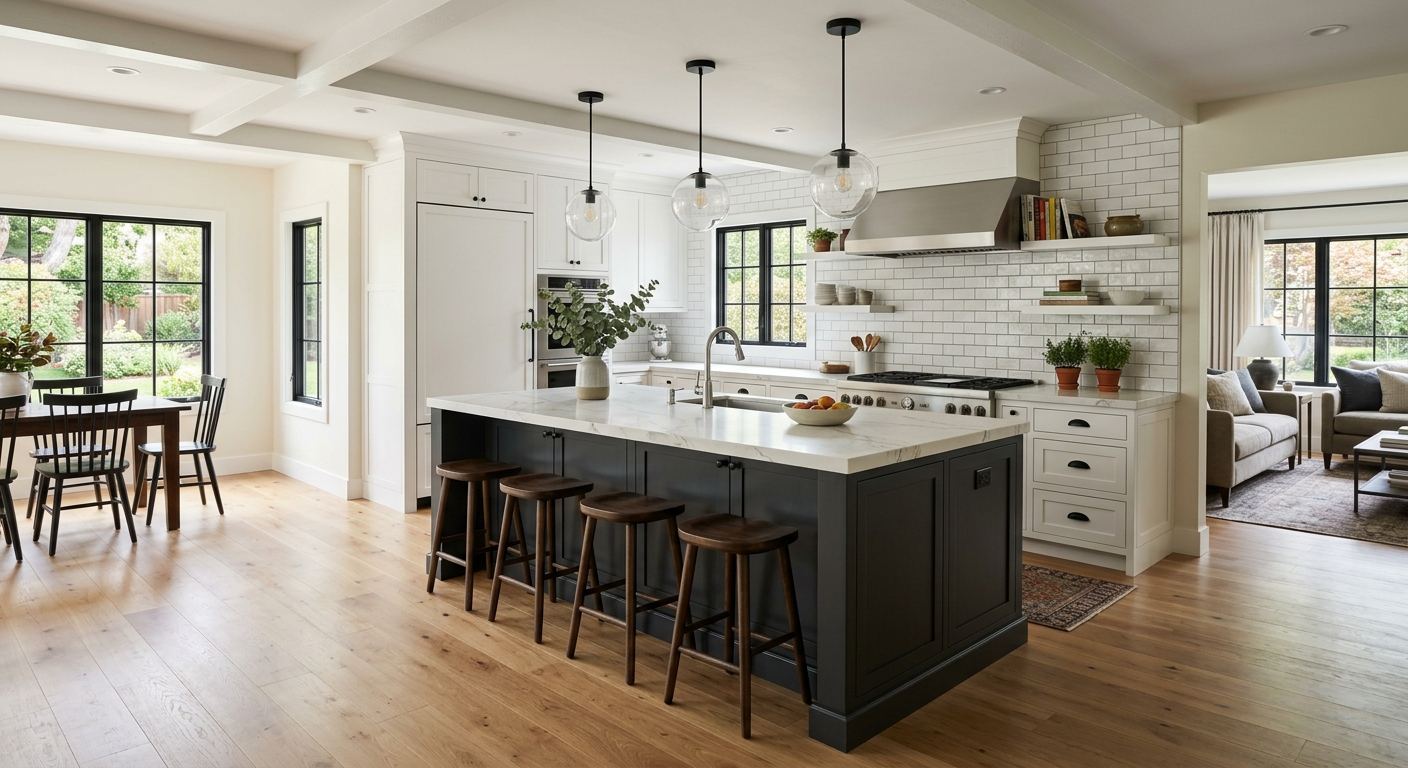
Kitchen renovation options and costs in Fernwood
In Fernwood, your kitchen renovation choice usually starts with the finish level you want, not just the room size. With a local population of 10,200 (Statistics Canada, 2021 Census), demand is steady, and many homeowners are renovating older housing stock where kitchens were last updated decades ago. In the Lower Mainland–Southwest, kitchen pricing is strongly shaped by what buyers in nearby higher-value pockets expect to see—so even a “minor” upgrade can drift upward when cabinets, counters, and hardware are selected at a more premium tier.
As a contractor, I see the biggest quote gaps in the same neighbourhood block when one homeowner plans a practical refresh and another plans a design-led rebuild with an island, upgraded lighting, and stone counters. Climate plays a role, but here it’s mostly about scheduling and drying times rather than preventing major costs. British Columbia’s wet season and seasonal labour demand can push trades together, so demolition-to-install sequencing matters—especially if you’re changing flooring, fixing subfloor issues, or addressing ventilation around cooking appliances.
In Fernwood, trade work is especially in demand around the Camosun Street and Quadra Street corridor area, where kitchens tend to be compact and layouts are challenged by older plumbing runs. That’s where a scope review pays off—because moving plumbing or adding electrical is often the most unpredictable part of the budget. Below is a practical comparison to help you map what you get at each renovation tier before you ask for a detailed itemised quote.
| Renovation Tier |
What's Included |
Typical Duration |
Price Range |
| Cosmetic refresh (paint, hardware, new appliances only) |
Cabinet paint or restain (existing), new pulls/handles, appliance swaps, minor caulking/silicone, basic housekeeping and touch-ups |
1–3 weeks |
$8,000–$25,000 |
| Mid-range full renovation (new cabinets, counters, sink, tile) |
New semi-custom or solid-stock cabinets, new countertop, sink and tap, backsplash tile, faucet/trim upgrades, installation by licensed trades where needed |
4–8 weeks |
$40,000–$85,000 |
| High-end full renovation (custom cabinets, stone counters, island) |
Fully custom millwork, quartz/stone counters, island build with upgraded hardware, stone or premium backsplash, upgraded under-cabinet lighting, more complex layout work |
8–14 weeks |
$85,000–$120,000 |
| Cabinet refacing only (new doors + drawer fronts, same boxes) |
Remove and replace doors/drawer fronts, new hardware, repaint or finish touch-ups for existing boxes, optional internal upgrades like soft-close |
2–5 weeks |
$8,000–$35,000 |
| Countertop swap only (laminate to quartz or stone) |
Remove old surface, install quartz/stone, new cut-outs for sink and cooktop (as applicable), edge profile selection, basic sealants |
1–3 weeks |
$3,000–$12,000 |
| Backsplash tile installation only |
Tile supply and install, waterproofing/underlayment where required, preparation, grouting and sealing, finish around outlets |
5–10 days |
$1,500–$6,000 |
Prices are estimates only and vary by project scope, site access and material selection.
What affects the price of kitchen renovation in Fernwood
In the Lower Mainland–Southwest, it’s common for two quotes for the “same kitchen” to differ by 30–50% in total cost. The reason isn’t usually the local weather—it’s the market expectations attached to home values and resale buyers. In higher-value parts of Metro Vancouver, homeowners more often choose quartz or stone counters, semi-custom cabinetry, upgraded hardware, and layout refinements that read as “new kitchen” at first glance. In lower-cost segments, laminate and stock cabinet systems tend to deliver better ROI because the finish jump is smaller and the finish bill is easier to control.
For Fernwood, layout and services are where costs move the most. Even if you keep the same cabinet footprint, replacing old supply/drain runs, adding a new vent path, or rerouting a gas line can add significant labour and permit work. A wall removal or an island addition can also change the entire electrical and ventilation plan—so the budget becomes unpredictable regardless of whether you’re staying mid-range or going high-end.
Two concrete Fernwood examples we see: (1) older kitchens often have undersized or aging shutoffs and brittle shutoff-to-supply connectors, so a “simple sink swap” can include extra plumbing labour; (2) if your fridge opening and adjacent cabinet reveals are tight, minor cabinet re-siting can trigger custom filler pieces and longer lead times. That’s why a mid-range full renovation starting around $40,000–$85,000 can climb quickly if you add layout work, while a countertop-only upgrade often remains within $3,000–$12,000 when the plumbing cut-outs match the existing opening.
| Price Factor |
Why It Matters |
Cost Impact |
| Cabinet tier — stock vs. semi-custom vs. fully custom millwork |
Tier affects cabinet materials, door styles, internal components, lead times, and how well pieces fit older walls. |
Often the largest driver; can shift totals by tens of thousands depending on fit and style complexity. |
| Countertop material — laminate vs. quartz vs. granite vs. stone |
Material choice changes fabrication cost, edge profiles, and installation time; heavier stone may require more careful handling. |
Typical countertop installs can land in the region of $3,000–$12,000, with higher-end choices pushing the top end. |
| Layout change — wall removal, island add, plumbing/gas move |
Changes trigger structural checks, ventilation rework, electrical redesign, and licensed trade involvement. |
Unpredictable; can add major cost even when “finishes stay the same.” |
| Appliance package tier — builder vs. mid-range vs. pro-grade |
Higher tiers bring better fit/finish, ventilation requirements, and sometimes specialized hookups. |
Can move overall budget notably, especially when ventilation and electrical circuits change. |
| Flooring — refinish existing vs. full replacement |
Kitchen renovations often disturb adjacent flooring transitions; subfloor condition may need repair after removal. |
Refinishing typically saves cost; full replacement adds material, labour, and time. |
| Backsplash — ceramic tile vs. marble vs. full-height slab |
Material thickness and complexity affect waterproofing, cutting accuracy, and cleaning/finishing effort. |
Can add up quickly; tile-only installs typically sit around $1,500–$6,000. |
| Electrical — new circuits for island, under-cabinet lighting |
More lighting and outlets require planning; island layouts often change load and circuit layout. |
Increases licensed electrician time and inspection steps. |
| Permit fees and licensed trade requirements |
When plumbing, gas, electrical, or structural elements are altered, permits and licensed trades are expected. |
Usually a smaller line item than cabinets, but it can significantly affect schedule and sequencing. |
Permits & regulations in British Columbia
In British Columbia, the permit requirement is mostly tied to what you move, not the look you’re replacing. A cabinet door swap, cabinet refacing, and countertop surface replacement typically do not require permits because you’re not altering plumbing, gas lines, structural elements, or electrical circuits. However, if you’re moving plumbing supply/drain lines, relocating a gas stove or making changes related to a gas range/hood, removing a load-bearing wall, or adding electrical circuits (for an island receptacle bank or under-cabinet lighting runs), permits are commonly required and licensed trades must do the work.
Step-by-step, here’s how a Fernwood homeowner should verify your contractor before signing: first, ask for the contractor’s proof of business identity and their applicable licence information (and any trade partners they’ll use). Next, request a current certificate of insurance (liability) and ensure coverage is adequate for a renovation. For workers who need to be covered, ask how they handle provincial workplace coverage and request proof you can review. Then, confirm that the electrical work will be completed by a licensed electrician and that any gas-related work will be performed by a licensed gas fitter. Finally, ask who will pull permits (and confirm it in writing) and whether you’ll receive inspection documentation after the work is complete.
Cabinets, countertops and layout decisions in Fernwood
When you renovate in Fernwood, three decisions typically determine 80% of your cost outcome: (1) cabinet tier, (2) countertop material, and (3) layout changes. For cabinets, stock units are the fastest and usually cheapest, while semi-custom is the most popular mid-range choice because it balances options with realistic lead times. Custom cabinets cost the most, but they shine when your kitchen has older, out-of-square walls, unusual alcoves, or you want a tight, built-in feel around soffits and angled corners. For countertops, laminate is budget-friendly and can be replaced cleanly later; quartz offers a strong blend of durability and low maintenance; granite and other natural stones add visual depth but require more careful selection and maintenance planning; butcher block brings warmth and repairability; marble is beautiful but needs more diligence.
Layout is where you must be honest about value. An open-concept wall removal or adding an island can be justified if it improves traffic flow and adds usable seating—but it also tends to require updated electrical and ventilation planning, plus more trades coordination. In Lower Mainland–Southwest resale expectations, buyers commonly look for clean lines, quartz/stone looks, and efficient storage, especially in kitchens that connect to living space.
Here’s a realistic dollar example: if you upgrade from laminate to quartz while keeping the same cabinet footprint, you may stay within the countertop swap band of $3,000–$12,000. But if you pair that with a plumbing move to reposition the sink, the labour and permit steps can push your “like-for-like” plan toward a full renovation budget (often in the $40,000–$85,000 mid-range scope). In a wet British Columbia season, sequencing also matters—waiting on inspections or drying times can extend the schedule, so plan for longer total duration when you change services.
| Option |
Durability |
Maintenance |
Best For |
Price Range |
| Stock cabinets (big-box) |
Good for everyday use; fit may be less forgiving on older walls |
Low to moderate; hinges and soft-close options vary |
Quick timelines and cost control |
$15,000–$40,000 |
| Semi-custom cabinets (local dealer) |
Very strong; better sizing flexibility and internal options |
Low; hardware upgrades can reduce daily wear |
Fernwood homeowners wanting a modern look without full custom pricing |
$25,000–$60,000 |
| Custom cabinets (local millwork shop) |
Top-tier; tailored construction and best fit |
Low to moderate; finishing quality matters |
Challenging layouts, tight dimensions, and high finish expectations |
$45,000–$90,000 |
| Laminate countertop |
Moderate; can scratch or chip depending on edge and use |
Easy daily cleaning; avoid heat directly on surface |
Budget refreshes and short-horizon ROI projects |
$3,000–$6,500 |
| Quartz engineered countertop |
High; resistant to staining and daily impacts |
Very low; typically no sealing required |
Most popular mid-to-high tier due to durability and look consistency |
$6,000–$12,000 |
| Granite / natural stone countertop |
High; natural variation and heat resistance are strong benefits |
Moderate; sealing and stain management are part of ownership |
Homeowners who want unique patterning and natural character |
$7,000–$14,000 |
| Butcher block countertop |
Good to high when maintained; can be repaired |
Moderate; requires oiling and protection from moisture |
Family-focused kitchens and a warm, traditional aesthetic |
$4,500–$9,500 |
| Marble countertop |
Moderate; elegant but more vulnerable to etching/staining |
High; needs careful cleaning and prompt protection |
Lower-traffic showpiece kitchens and homeowners willing to maintain |
$8,000–$18,000 |
How to choose a kitchen renovation contractor in Fernwood
Choosing the right contractor in Fernwood starts with verifying credentials that directly protect you during demolition, plumbing/electrical tie-ins, and finish installation. For British Columbia, confirm the contractor’s business licence information (if applicable), request proof of liability insurance, and ask for workplace coverage documentation so you’re not exposed if a worker gets injured on site. If the scope includes gas or electrical alterations, insist that the work is performed by the licensed trades involved (ask for the electrician’s and gas fitter’s confirmation of licensing where relevant).
Next, insist on 2–3 itemised written quotes rather than a lump sum. Good quotes break labour and materials into line items (cabinets, install labour, countertop fabrication and install, tile labour, and disposal). Read the exclusions carefully: disposal included or not, demo included, permit pull responsibility, shop drawings included, and whether product lead times extend your start date. Warranty should be written down: workmanship warranty length, product/manufacturer warranty terms, and whether the warranty is transferable if you sell the home.
For payment, a safe schedule keeps you protected: never more than 10–15% upfront, and hold back a meaningful portion until the final punch list is complete. Finally, demand a timeline in writing with a start date, estimated completion, and what happens if materials arrive late or if inspections push work sequencing.
- Ask for licence/registration details and confirm they align with the trades they’ll use.
- Request proof of liability insurance and confirm the policy is current.
- Confirm workplace coverage documentation for the crew doing the work.
- Get 2–3 itemised quotes with labour and materials separated (no vague allowances).
- Check who pulls permits and whether permit fees are included.
- Confirm disposal: demo debris and packaging haul-away included or not.
- Verify countertop templating timing and what happens if measurements need correction.
- Confirm tile waterproofing expectations and how corners/penetrations are handled.
- Ask for electrical scope in writing (island receptacles, under-cabinet lighting, switches).
- Review warranty terms for both workmanship and manufacturer products.
- Use a payment schedule that keeps holdback until final sign-off/punch list.
- Get start and finish dates (or ranges) in writing, plus weather/lead-time assumptions.
Red flags I see in Fernwood include: quotes that don’t itemise materials (no way to compare apples-to-apples), promises of “we’ll handle permits” without stating who is responsible in the contract, vague timelines with no allowance for countertop templating/lead times, warranties limited to “verbal” statements, and payment requests that exceed 10–15% upfront or won’t allow a holdback until completion.
Frequently asked questions — kitchen renovation in Fernwood
Quartz vs granite countertops — which is better?
In Fernwood and across British Columbia, quartz is usually the easier recommendation for day-to-day ownership. It’s engineered to resist staining, it generally requires less day-to-day care than many natural stones, and it delivers a consistent look that fits modern buyers’ expectations in the Lower Mainland–Southwest. Granite is also durable and often handles heat well, but it can require sealing and the pattern varies significantly from slab to slab—great if you want uniqueness, but it means choices should be made thoughtfully. If you’re comparing budgets, quartz countertop installs commonly land within the $6,000–$12,000 band for most full kitchen swaps, while granite can trend higher depending on edge profiles and cut complexity.
Should I reface or replace my cabinets?
Refacing is usually worth considering when the existing cabinet boxes are solid (straight, not sagging, and not water-damaged) and your goal is a quick visual upgrade. It’s often faster and can keep costs down compared with replacement. However, in older Fernwood kitchens, it’s common to find box issues behind the scenes—soft floors, warped toe-kicks, or plumbing leaks that have damaged base cabinets. If your boxes are compromised or you want a totally new layout (more drawers, different heights, larger storage footprint), replacement or at least partial replacement typically makes more sense. As a budget anchor, cabinet refacing projects often sit around $8,000–$35,000, while mid-range full renovations that include new cabinets and counters usually start closer to $40,000–$85,000.
Do I need a permit for a kitchen renovation in British Columbia?
Often, you don’t need a permit for surface-level updates in British Columbia: cabinet refacing and countertop swaps typically fall into the “no major system changes” category. You commonly do need permits (and licensed trades) when you move plumbing supply/drain lines, relocate gas components for a stove/range/hood, remove a load-bearing wall, or add new electrical circuits (such as for island outlets or new lighting). The practical way to handle this in Fernwood is to confirm responsibilities in the written contract: who pulls permits, which trades are licensed, and whether inspections are included in the scope. If you’re unsure whether your plan triggers permits—especially with older kitchens and dated venting—ask your contractor to outline the permit-triggering tasks in advance.
What's the ROI on a kitchen renovation?
Kitchen renovations usually have strong resale impact, but the exact ROI depends on how aligned your finish level is with local buyer expectations in the Lower Mainland–Southwest. In higher-value neighbourhoods, quartz/stone counters and semi-custom or custom cabinetry tend to be easier to justify because buyers recognize the upgrade and the cost is easier to recover on resale. In more modest tiers, laminate and stock cabinets can still add value if the layout is practical and the kitchen looks clean and functional. A key driver is whether you change the layout: opening walls or adding an island can increase perceived value, but it also adds cost through plumbing/gas and electrical redesign. As a practical budget note, homeowners who keep finishes within a cosmetic refresh range like $8,000–$25,000 often see quicker ROI consistency, while full renovations in $40,000–$120,000 deliver more upside when the design truly matches the home’s resale target.
How do I budget for a kitchen renovation?
Budgeting in Fernwood starts with choosing a tier that matches both your needs and your resale intent, then adding a contingency for service surprises. Older kitchens can reveal hidden issues after demo—subfloor soft spots near plumbing, outdated wiring, or cabinet walls that aren’t square—so I recommend planning a contingency even for mid-range jobs. Start by defining which elements you’ll change: cabinets, counters, backsplash tile, appliances, flooring, and whether you’ll move plumbing/gas. Typical bands in the Lower Mainland–Southwest help you stay grounded: full renovations often land in $40,000–$120,000, while cabinet refacing and countertop swaps can be more controlled at $8,000–$50,000 and $3,000–$12,000 respectively. Then get itemised quotes with clear inclusions for disposal, permits, and electrical/plumbing tie-ins.
Can I move my kitchen sink or stove?
You can, but whether it’s wise depends on the plumbing/gas distance and what your Fernwood home will physically allow. Moving a sink usually means relocating supply and drain lines, adding complexity for waterproofing and venting design, and involving licensed plumbing work plus likely permits. Moving a stove is even more sensitive: if you’re relocating gas, the work must be done by a licensed gas fitter and typically triggers permits and inspection requirements. If you’re moving appliances purely for cosmetics, a better ROI approach is often to keep the fixture locations and adjust cabinet storage, countertop cut-outs, and backsplash detailing around the existing systems. Your contractor should map the new positions early and price the trade work; otherwise, you risk blowing past a planned countertop-only band like $3,000–$12,000 once demolition and re-plumbing are included.