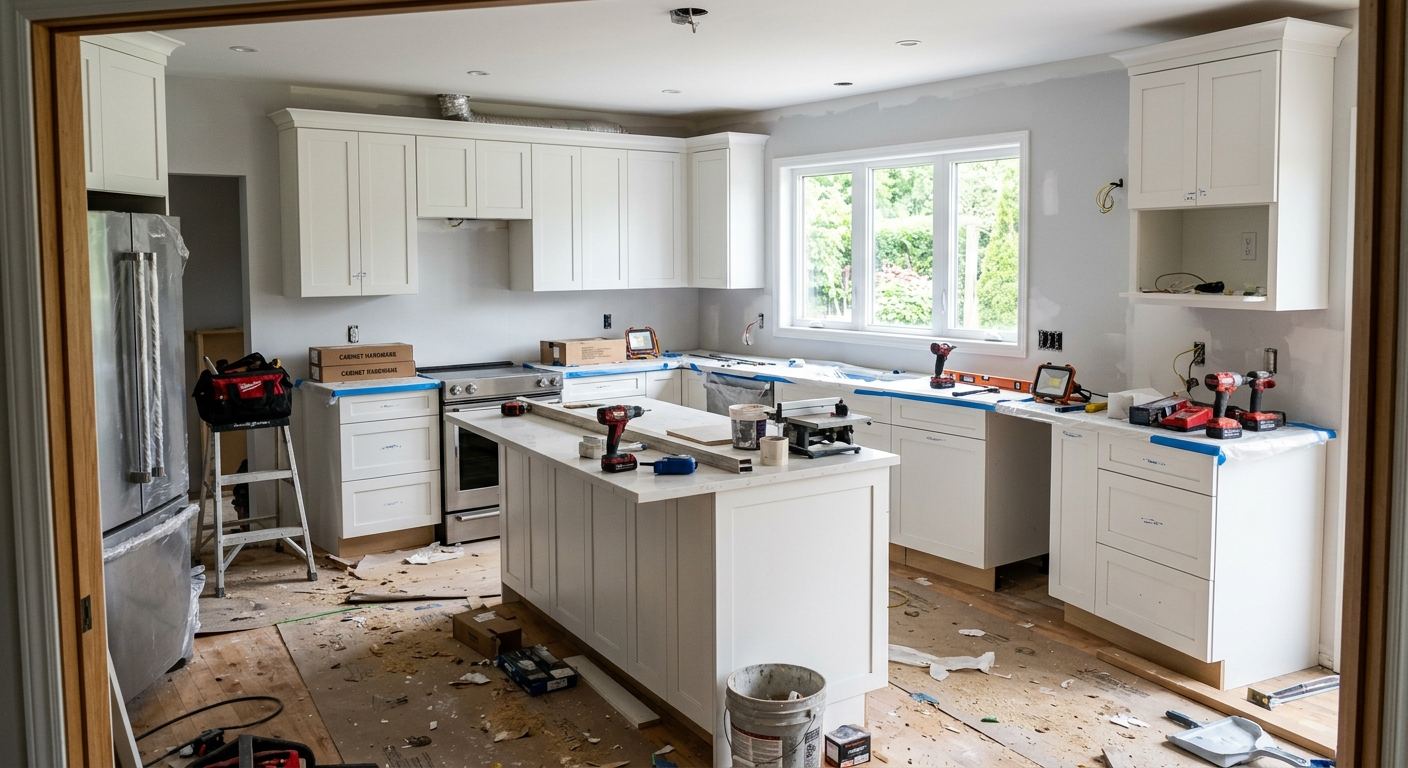
Kitchen renovation options and costs in Six Mile
Kitchen renovation in Six Mile is usually less about the weather itself and more about the homeowner’s finish expectations and the resale value of the home. With a population of 1,031 (Statistics Canada, 2021 Census), the local market is small, so you tend to see a tighter pool of cabinetry and countertop installers than in bigger hubs—meaning availability can affect scheduling and sometimes labour staging. In the Lower Mainland–Southwest, homeowners also often plan renovations with buyer-ready finishes in mind, and that’s why a similar kitchen can price very differently depending on whether it’s a practical refresh or a full rebuild. In high-value parts of Metro Vancouver within the same regional market band, quartz/stone counters and semi-custom cabinetry are more common because the added cost is easier to justify on resale; in lower-cost scopes, laminate and stock cabinets are still popular for a faster, lower-disruption upgrade.
Across British Columbia, climate impacts are real but they’re usually indirect: dampness and temperature swings can stress caulking, grout, and some finishes over time, and older homes can have uneven ventilation that makes tile work and cabinet sealing more important. At the same time, contractor availability and material lead times in the Lower Mainland–Southwest often drive the biggest swings between quotes—especially when you’re choosing stone counters, complex cabinetry, or doing layout changes that require electrical/plumbing trades. In Six Mile, renovations are especially in demand in the surrounding neighbourhoods along the corridor toward Abbotsford, where families often update functional kitchens before selling or upsizing.
Below are realistic options homeowners commonly choose, and how they translate into project totals—use this table as a starting point before you request itemised quotes.
| Renovation Tier |
What's Included |
Typical Duration |
Price Range |
| Cosmetic refresh (paint, hardware, new appliances only) |
Cabinet paint or repaint, new hardware/pulls, appliance swap, minor caulking and touch-ups, basic cleaning |
2–7 days |
$8,000–$18,000 |
| Mid-range full renovation (new cabinets, counters, sink, tile) |
New semi-custom or stock cabinets, countertop replacement, sink + faucet, backsplash tile, flooring refresh where needed, plumbing/electrical tie-ins as required |
2–4 weeks |
$40,000–$85,000 |
| High-end full renovation (custom cabinets, stone counters, island) |
Fully custom millwork, stone/quartz counters, island build, upgraded hardware and lighting, full backsplash feature, extended electrical/plumbing for island |
4–8 weeks |
$85,000–$120,000 |
| Cabinet refacing only (new doors + drawer fronts, same boxes) |
New door/drawer fronts, veneer/face replacement, updated hardware, re-seal edges, optional pantry/trim updates |
1–3 weeks |
$8,000–$30,000 |
| Countertop swap only (laminate to quartz or stone) |
Remove old surface, install new countertop, cutouts for sink/cooktop, seam/finish work where applicable |
3–10 days |
$7,000–$16,000 |
| Backsplash tile installation only |
Tile supply/installation, prep of existing wall surface, edging/trim, grout/seal, cleanup |
3–7 days |
$1,500–$6,000 |
Prices are estimates only and vary by project scope, site access and material selection.
What affects the price of kitchen renovation in Six Mile
In the Lower Mainland–Southwest, it’s common to see the same kitchen renovation scope land 30–50% apart across British Columbia when you compare quotes. The driver isn’t usually the climate; it’s the finish tier homeowners choose and what the local housing market rewards on resale. In higher-value Lower Mainland neighbourhoods, homeowners frequently default to quartz or stone counters and semi-custom cabinetry because the renovation cost is easier to recover when you sell. In more modest markets, laminate surfaces and stock cabinet lines dominate because they deliver a good functional return per dollar. Even within Six Mile, your cabinet and countertop choices typically push the tier up or down faster than insulation or ventilation changes do.
Layout changes are the wildcard. Removing a wall to open sightlines, adding an island, or moving plumbing/gas lines can add substantial labour and material costs regardless of whether your finishes are laminate or stone. For example, a basic countertop swap might sit around the $3,000–$12,000 band, but once you add new plumbing for a new sink location or reroute a gas cooktop/range hood vent, the quote can jump quickly into a full mid-range scope.
Concrete Six Mile examples: (1) older homes often need extra subfloor or wall prep for tile—sometimes even patching behind cabinets before new backsplash tile will hold; (2) if your current cabinet boxes aren’t square, installers may spend more time shimming and re-aligning, which increases labour; and (3) homes with dated electrical panels or limited circuit capacity can require new circuits for under-cabinet lighting and island outlets, adding both trades and scheduling time. Those factors are why a job can start as a refresh and end up closer to $40,000–$85,000 once the concealed conditions are assessed.
| Price Factor |
Why It Matters |
Cost Impact |
| Cabinet tier — stock vs. semi-custom vs. fully custom millwork |
Custom sizing, mouldings, soft-close options, and build quality affect material and labour time |
From roughly $8,000–$30,000 for refacing-style updates to full renovation ranges that can reach $85,000–$120,000 with custom cabinetry |
| Countertop material — laminate vs. quartz vs. granite vs. stone |
Material cost, installation complexity, and seam/edge finishing vary significantly |
Countertops alone often span $3,000–$12,000, with higher-end stone landing toward the upper end and more for islands |
| Layout change — wall removal, island add, plumbing/gas move |
Changes trigger structural, electrical, plumbing, and often permit work; trades must coordinate |
Can shift a refresh into a full renovation tier; typically the biggest swing in total project cost |
| Appliance package tier — builder vs. mid-range vs. pro-grade |
Pro-grade appliances increase material costs and may require different cutouts/venting |
Can add several thousand dollars and influence electrical/plumbing/venting scope |
| Flooring — refinish existing vs. full replacement |
Some contractors can reuse or spot-repair; others prefer full replacement for a clean transition |
Spot repairs keep costs lower; full replacement adds both labour and material planning time |
| Backsplash — ceramic tile vs. marble vs. full-height slab |
Higher-end materials need careful prep, sealing, and alignment |
Backsplash tile installations typically fall around $1,500–$6,000 depending on finish and coverage |
| Electrical — new circuits for island, under-cabinet lighting |
More outlets, new lighting runs, and appliance-ready circuits require licensed work and inspection |
Often adds cost and scheduling; can be a major driver during island additions |
| Permit fees and licensed trade requirements |
Permits and inspections add administrative steps and require qualified trades |
Small compared to cabinets/stone, but the trade work can increase labour days and overall coordination |
Permits & regulations in British Columbia
In British Columbia, a cabinet and countertop swap usually does not require a building permit. If you’re simply replacing existing cabinets, installing new countertop tops, and updating the backsplash without changing plumbing locations, gas lines, structural elements, or electrical circuits, most homeowners can treat the job as a straightforward renovation scope. However, permits and licensed trades are typically required when you’re moving or altering building systems. That includes relocating plumbing supply/drain lines, changing the location of a sink, moving or upgrading a gas cooktop/range setup, removing a load-bearing wall, or adding new electrical circuits (for example, dedicated circuits for island outlets or under-cabinet lighting).
For Six Mile homeowners, the verification process should be methodical. First, ask your contractor for their trades’ licence details (where applicable) and confirm they are properly licensed for the work they’re performing in BC. Next, request liability insurance and make sure it includes the renovation scope (not just general contracting). Also confirm workers’ compensation coverage—coverage expectations are commonly addressed through WSBC/WCB compliance documentation for the trades involved. Where possible, get a clearance letter or proof of coverage from the contractor or their subcontractor team.
Finally, don’t rely on verbal assurances. Before you sign, confirm in writing who is pulling permits, who schedules inspections, and what’s included for compliance. In most kitchen renovations, the permit responsibility should be clearly assigned in the contract so you’re not left holding surprises mid-project.
Cabinets, countertops and layout decisions in Six Mile
For a Six Mile kitchen renovation, three decisions usually determine 80% of your result: cabinet tier, countertop material, and layout changes. Cabinet tier sets the tone for fit and speed. Stock cabinets are the fastest route and the lowest upfront cost, but you may compromise on wall-to-wall fit, specialty storage, or door style. Semi-custom cabinets are the most popular mid-range choice in the Lower Mainland–Southwest because they strike a balance: better storage options and more realistic sizing without the full custom price. Custom cabinets deliver the best fit and design flexibility, especially when you’re planning an island or unusual pantry layouts, but they push budgets toward the high end of the renovation band.
Countertops follow the same pattern. Laminate is cost-effective and serviceable, but it needs careful care around seams and heat. Quartz is popular in British Columbia because it’s consistent, resistant to staining, and typically less demanding than natural stone in daily life—often a clear step up from laminate for busy families. If you’re aiming for a premium, natural stone like granite or marble adds character, but marble in particular demands more sealing and careful maintenance.
Layout changes are where you justify spend with space gain. For example, adding an island can improve circulation and prep space, but it triggers electrical and sometimes plumbing/gas considerations. That’s why many homeowners keep changes to “move plumbing minimally and add a modest island” rather than relocating everything. A realistic rule of thumb: if you’re choosing between a countertop swap and a layout shift, a countertop-only upgrade often sits near the $3,000–$12,000 band, while plumbing or gas relocation can push you into the broader full renovation range ($40,000–$85,000 or higher) even when the finishes stay mid-range.
| Option |
Durability |
Maintenance |
Best For |
Price Range |
| Stock cabinets (big-box) |
Solid for everyday use; strength depends on frame quality and installation |
Low—focus on proper sealing at edges and stable wall alignment |
Quick timelines and budget-conscious refreshes |
$8,000–$25,000 |
| Semi-custom cabinets (local dealer) |
Better sizing options and build consistency; good hardware and soft-close availability |
Low to moderate—keep hinges and tracks adjusted as needed |
Most Six Mile renovations where buyers expect “finished” look without full custom |
$20,000–$50,000 |
| Custom cabinets (local millwork shop) |
Highest fit and finish; best for irregular spaces and specialty storage |
Low—durable finishes; ensure correct humidity control during installation |
Premium upgrades and complex layouts |
$45,000–$85,000 |
| Laminate countertop |
Good for normal use but can be more vulnerable at seams and to heat damage |
Easy daily care; avoid prolonged heat exposure and moisture at edges |
Value-focused renovations and rental-style refreshes |
$3,000–$7,000 |
| Quartz engineered countertop |
Very durable and stain-resistant; handles day-to-day cooking well |
Low—typically wipe-and-clean; avoid cutting directly on it to reduce wear |
Busy households wanting a premium look without natural stone sensitivity |
$6,000–$12,000 |
| Granite / natural stone countertop |
Highly durable with natural heat resistance; variation is normal |
Moderate—requires periodic sealing depending on stone type |
Premium aesthetics and homeowners who want natural character |
$8,000–$14,000 |
| Butcher block countertop |
Durable but susceptible to moisture and dents if not maintained |
Higher—regular oiling and careful drying help prevent swelling |
Warm, rustic kitchens and homeowners who maintain surfaces |
$5,000–$10,000 |
| Marble countertop |
Stunning look; can etch or stain and needs careful handling |
Higher—seal and use gentle cleaners; protect from acidic spills |
Design-forward kitchens where homeowners accept maintenance |
$10,000–$18,000 |
How to choose a kitchen renovation contractor in Six Mile
Choosing a contractor in Six Mile means verifying three things: licensing/coverage, quality of documentation, and clarity in the scope. Start with British Columbia licensing for the trades involved—ask specifically which parts of the work require licensed professionals (plumbing/gas and electrical) and request licence numbers for those trades. Confirm liability insurance by requesting a current certificate of insurance that covers renovation work (not just basic liability). For coverage, verify workers’ compensation compliance (WSBC/WCB coverage) for the contractor and any subcontractors—ask for proof such as a clearance letter where available.
Then request 2–3 itemised written quotes, not a single lump-sum. A good quote separates labour and materials (cabinets, countertops, tile, electrical/plumbing line items, disposal, and any temporary protection). Read the scope carefully: what’s excluded (drywall patching, subfloor repairs, appliance installation, caulking details), what permits are included, who pulls them, and whether waste disposal and site cleanup are part of the plan. Ask about change orders and how they are priced.
Warranty matters too. Confirm workmanship warranty length and what it covers (for example, cabinet install alignment and tile grout/seal failures) and whether product/manufacturer warranties apply to the items used. Also clarify if warranties are transferable to future homeowners. Payment schedules should be conservative—never pay more than about 10–15% upfront, and hold back the remainder until key milestones are complete. Finally, insist on a start date and completion estimate in writing, including allowances for material lead times.
- Confirm which trades are licensed for plumbing/gas and electrical and ask for licence/proof documents.
- Request current liability insurance certificate naming the right parties and job location.
- Verify WSBC/WCB coverage and obtain clearance letter documentation where applicable.
- Get 2–3 itemised quotes with labour and material line items, not lump sums.
- Check inclusions: demolition haul-away, disposal fees, and site protection.
- Ask whether permits are included and who is responsible for pulling them.
- Confirm the scope for electrical work (new circuits, under-cabinet lighting, island outlets).
- Clarify plumbing scope (sink hookups, shutoffs, supply/drain replacement).
- Review countertop measures and template process (when measurements happen and who verifies).
- Confirm cabinet installation details: shimming, fastening to framing, and leveling plan.
- Understand warranty: workmanship length, product warranty terms, and transferability.
- Use a payment schedule with a holdback until completion and final walkthrough.
In Six Mile kitchen projects, common red flags include: quotes that aren’t itemised (you can’t compare apples to apples), promises to “handle permits” without stating who submits paperwork, no written start/completion timeline, vague warranty language (no specific coverage for install defects), and requiring high upfront payments beyond 10–15% without milestone-based releases.
Frequently asked questions — kitchen renovation in Six Mile
How do I know if I need to update my kitchen plumbing in Six Mile?
In Six Mile and across British Columbia, you don’t always need to replace every pipe—but you do need to update plumbing when you’re changing fixtures or when the existing lines are failing. A good contractor will inspect shutoffs, check for corrosion at supply lines, and look for signs like slow drains, recurring leaks under the sink, moisture staining on the cabinet bottoms, or inconsistent water temperature. If you’re keeping the sink in the same location and not moving supply/drain lines, plumbing updates may be limited to replacing shutoffs, traps, or parts of the flex lines. If you’re adding an island with a new sink or moving the cooktop that ties into ventilation/gas considerations, plumbing scope often expands. Budget accordingly: even a mid-range kitchen refresh can shift upward quickly once plumbing modifications push you toward full renovation tier pricing (for many projects, that’s in the $40,000–$85,000 band).
What is the difference between a galley and open-concept kitchen?
A galley kitchen is typically two parallel counters with a narrow walkway between them; it’s efficient for workflow but can feel closed off. An open-concept kitchen removes barriers so the kitchen connects visually and functionally to living/dining space, often requiring layout planning around circulation, lighting, and—if applicable—venting for cooking. In the Lower Mainland–Southwest, homeowners choose open-concept layouts when they want a more resale-friendly, design-led feel, but it’s also where costs can jump because openings, structural considerations, and new electrical circuits are more common. If you’re only doing a cosmetic refresh, you can often keep a galley layout and focus on paint, hardware, and appliance swaps. Once you move toward island additions or wall removal, you’re more likely to be in the full renovation range (commonly $40,000–$120,000 depending on cabinet and countertop choices).
How do I get accurate kitchen renovation quotes in Six Mile?
Accurate quotes in Six Mile come from scope clarity and site measurement. Start by asking for a site visit so the contractor can confirm wall conditions, cabinet wall straightness, and where plumbing/electrical currently run. Then insist on itemised written quotes that separate labour and materials (cabinets, countertops, tile, electrical/plumbing tie-ins, disposal, and any allowances for subfloor repairs). Avoid “all-in” numbers that don’t list what’s included—those are where surprises happen. Provide your intended finish tier and whether you’re changing layout, moving a sink, or adding a peninsula/island. If you’re unsure, ask for two option tiers: a refresh path (often $8,000–$18,000) and a mid-range remodel path (commonly $40,000–$85,000). This makes comparisons fair and helps you understand how cabinet tier and countertop material drive the biggest cost differences.
What's the best countertop material for a busy Six Mile kitchen?
For most busy Six Mile households, quartz is usually the best “daily-use” balance: it’s durable, consistent in appearance, and resistant to staining compared with many softer surfaces. It also tends to be lower maintenance than natural stone like marble, which can etch and stain if acidic spills aren’t cleaned quickly. Laminate can work well for value-focused renos, but it’s more sensitive at seams and edges—so it’s best when you want a restrained budget and you’re comfortable with careful daily care. Granite is durable and often heat resistant, but it requires periodic sealing depending on the specific stone. Cost-wise, countertops alone often fall around the $3,000–$12,000 band, with quartz typically landing in the mid-to-upper portion for many standard kitchen layouts.
How do I add an island to my Six Mile kitchen?
Adding an island starts with measuring circulation space and confirming how you’ll handle services. If your island is purely prep/storage (no sink or cooktop), the electrical and plumbing impact can be modest. If you want a sink or cooktop on the island, you’ll likely need electrical circuits plus plumbing relocation for the sink and possibly gas/venting considerations depending on your cooking setup—this is where permits and licensed trades become more likely in British Columbia. Practically, you’ll also want to plan cabinet base structure for overhangs, toe-kick space, and countertop support. In Six Mile homes, older framing can be out of square, so allow time for leveling and shimming so the island sits properly. Pricing varies widely: an island in a mid-range remodel commonly aligns with the $40,000–$85,000 tier, while custom cabinetry and stone counters with expanded services can push toward $85,000–$120,000.
How much does a kitchen renovation cost in Six Mile?
Kitchen renovation cost in Six Mile typically follows the same broad bands used across the Lower Mainland–Southwest, with the biggest swing coming from cabinetry tier, countertop material, and whether you change layout or move plumbing/gas lines. A cosmetic refresh (paint, hardware, new appliances only) often stays in the $8,000–$18,000 range. A mid-range full renovation—new cabinets, counters, sink, and backsplash tile—frequently lands around $40,000–$85,000. High-end full renovations with custom cabinetry, stone counters, and an island often move into the $85,000–$120,000 band. Even within that, your exact scope matters: a countertop swap only might be closer to the $3,000–$12,000 band, while anything that adds plumbing or electrical circuits can increase total project cost significantly. If you’re planning changes, request itemised quotes so you can see where the money is going.