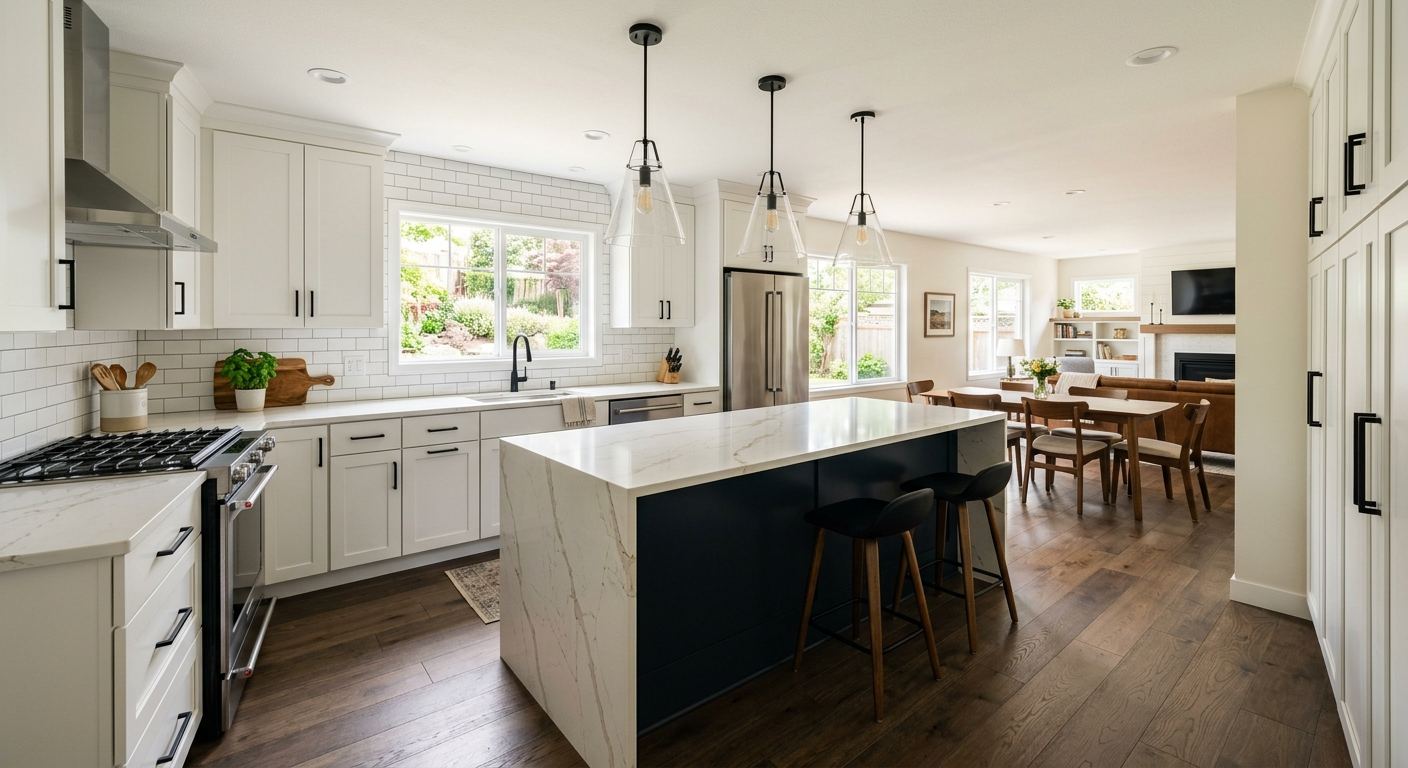
Kitchen renovation options and costs in Second Street
In Second Street, British Columbia, kitchen renovation options generally line up with three spending levels: cosmetic refreshes, practical mid-range remodels, and higher-end rebuilds. The reason is that, across the Lower Mainland–Southwest, the market often expects a finish level that matches the home’s value and the household’s purchasing power. Even with similar square footage, the project can come in very differently—especially when homeowners aim for semi-custom cabinetry and quartz/stone counters rather than stock cabinets and laminate. In a population of 5,666 (Statistics Canada, 2021 Census), the local housing mix is tight-knit, so design-led upgrades show up quickly in neighbourhood showpieces and then influence what’s “normal” at resale.
Lower Mainland–Southwest pricing is driven more by home value, income, and desired finish than by day-to-day weather. That means the climate mainly affects logistics (schedule and indoor protection) rather than the core trade rates. Still, you’ll see kitchen timelines stretch slightly more in winter because crews plan around freeze-thaw and snow days, and because flooring and tile settings need consistent indoor conditions. Availability can also vary when multiple renovation trades are working in the same corridor—typical demand is especially high around the older housing stock near the Second Street commercial strip, where many homes are ripe for layout updates.
If you want a clean way to compare apples-to-apples, start with the renovation tier—then confirm your kitchen size, access, and whether you’re moving plumbing or gas. From there, you can use the ranges below to benchmark your quotes before you compare scope and materials.
| Renovation Tier |
What's Included |
Typical Duration |
Price Range |
| Cosmetic refresh (paint, hardware, new appliances only) |
Cabinet paint or touch-ups, new pulls/handles, new appliances (no cabinet modifications), basic countertop cleaning/polish, minor seal/caulk touch-ups |
1–2 weeks |
$12,000–$25,000 |
| Mid-range full renovation (new cabinets, counters, sink, tile) |
Semi-custom or quality stock cabinets, countertop swap, new sink/faucet, backsplash tile, install of appliance hookups (as needed), under-cabinet lighting where applicable, flooring plan as specified |
4–8 weeks |
$55,000–$85,000 |
| High-end full renovation (custom cabinets, stone counters, island) |
Custom millwork, quartz/stone countertops with upgraded edges, island build, more complex backsplash detailing, higher-end hardware, expanded electrical scope for lighting/outlets, sink and faucet upgrades, often partial layout change |
8–14 weeks |
$95,000–$125,000 |
| Cabinet refacing only (new doors + drawer fronts, same boxes) |
New door and drawer fronts, trim and hardware, limited adjustments where feasible, countertop remains unless separately quoted, existing-box preparation and refinishing |
2–5 weeks |
$18,000–$40,000 |
| Countertop swap only (laminate to quartz or stone) |
Remove existing counters (and disconnect where needed), install new quartz/stone, new sink cutout support if required, caulking and finishing at seams |
3–7 days |
$3,500–$12,000 |
| Backsplash tile installation only |
Tile supply (as quoted), layout and installation, waterproofing/underlayment as required, trim and sealing, cleanup |
3–10 days |
$1,800–$6,000 |
Prices are estimates only and vary by project scope, site access and material selection.
What affects the price of kitchen renovation in Second Street
In Second Street and across the Lower Mainland–Southwest, it’s common to see quotes for the same kitchen scope land 30–50% apart once cabinetry tier, countertop choice, and layout moves are accounted for. It’s not usually the weather that drives this gap; it’s the market expectation and the cost of premium finishes in higher-value Metro Vancouver-adjacent neighbourhoods. Home value and median household income tend to correlate with what homeowners choose at resale: in higher-value pockets, people more often default to quartz or stone counters and semi-custom cabinetry because those upgrades are easier to justify when the home is sold later. In more modest-market renovations, laminate and stock cabinets keep ROI stronger and reduce the risk of over-improving.
Even within British Columbia, the same contractor’s labour can vary based on demand windows, crew availability, and how complex the build is. Layout changes add the most unpredictable costs regardless of finish level. Removing a wall, adding an island, or moving a gas line/plumbing connection can require new rough-ins, inspections, and longer schedules. For example, a simple cabinet replacement with a countertop swap might sit in the $55,000–$85,000 mid-range band, but the moment you shift plumbing and add an island, the project often pushes toward the $95,000–$125,000 high-end range even if you choose mid-tier materials.
Two common Second Street pricing drivers are older service locations and tight kitchen clearances. In homes with dated plumbing runs, extending supply/drain lines can add labour and drywall patching costs. In compact layouts near older streetscapes, an island addition can also trigger more extensive electrical work for outlets and lighting. On the other hand, if your home already has an efficient cabinet “box” layout, cabinet refacing or a countertop swap can keep costs closer to the $18,000–$40,000 refacing band or the $3,500–$12,000 countertop band, respectively.
| Price Factor |
Why It Matters |
Cost Impact |
| Cabinet tier — stock vs. semi-custom vs. fully custom millwork |
Cabinet construction, fit tolerances, and interior options (pull-outs, organizers, dovetail drawers) change both material cost and install time |
Often the single biggest driver; can swing a full remodel by tens of thousands |
| Countertop material — laminate vs. quartz vs. granite vs. stone |
Material and fabrication complexity; stone requires more precise templating and heavier handling |
Typical countertop-only ranges run $3,000–$12,000; full projects rise quickly with stone + island |
| Layout change — wall removal, island add, plumbing/gas move |
Rough-in changes, inspections, structural considerations, and more demolition/drywall work |
Frequently adds the largest unpredictability; often the reason mid-range becomes high-end |
| Appliance package tier — builder vs. mid-range vs. pro-grade |
Electrical requirements, ventilation details, and premium integration (panels, higher-end ventilation) |
Can add several thousand dollars and sometimes affects cabinet/modification scope |
| Flooring — refinish existing vs. full replacement |
Matching transitions and subfloor prep after demolition can be costly if floors are older or uneven |
Small kitchens can still see meaningful swing if full replacement is needed |
| Backsplash — ceramic tile vs. marble vs. full-height slab |
Premium stone/slab increases material weight, fabrication, and labour time for straight, clean lines |
Backsplash-only installs often range $1,500–$6,000 |
| Electrical — new circuits for island, under-cabinet lighting |
Adding lighting/outlets triggers licensed work, box installs, and sometimes panel adjustments |
Can add labour and permit-related costs depending on how far circuits must run |
| Permit fees and licensed trade requirements |
Permits don’t just add fees; they also add lead time for inspections and scheduling |
Most noticeable when plumbing/gas/electrical scope expands |
Permits & regulations in British Columbia
In British Columbia, not every kitchen renovation needs a permit, but the scope decides. Cabinet and countertop swaps typically do not require permits because you’re not changing building services or structural elements. However, if you plan to move plumbing supply or drain lines, relocate gas (stove location, gas range or changing hood ducting), remove a load-bearing wall, or add new electrical circuits for an island or new lighting/outlets, you’re generally stepping into work that requires permits and licensed trades. Gas work must be performed by a licensed gas fitter, and electrical work must be completed by a licensed electrician—both require inspection.
For a homeowner in Second Street, the practical step-by-step is this:
1) Ask your contractor to list every permit-triggering activity in writing (e.g., “sink relocation,” “gas line extension,” “new circuit for island,” “wall removal/beam”). 2) Request proof of licences and registrations before work starts: licence details and contractor credentials should align with the trade performing the work. 3) Verify liability insurance: request a current certificate of insurance and confirm the coverage limits are appropriate for a renovation of your size. 4) For trade coverage, ask how they handle workers’ compensation coverage and request the relevant clearance documentation. 5) Confirm permit responsibility in the contract—whether the contractor pulls permits and schedules inspections, or whether you’re being asked to do it.
Always avoid “we’ll sort it out later” language. In British Columbia renovations, the best outcomes come from matching permits, licensed trades, and inspection dates to your schedule up front.
Cabinets, countertops and layout decisions in Second Street
The three decisions that change your kitchen renovation outcome the most in Second Street are: (1) cabinet tier, (2) countertop material, and (3) whether you change the layout. Start with cabinet tier. Stock cabinets are the fastest and cheapest because the sizes are standardized, semi-custom is the most popular mid-range approach for local projects, and custom cabinets deliver the best fit if you have an awkward wall, vaulted ceiling, or want built-ins. Next, pick a countertop that matches how you actually live: laminate is budget-friendly and good for a lighter-use home, while quartz is a strong “day-to-day” choice because it resists staining and is easier to maintain than porous natural stone. Finally, evaluate layout changes—open-concept wall removal, island additions, and plumbing/gas relocation can be justified, but only when the space gain improves function and resale.
In the Lower Mainland–Southwest, buyers frequently expect a clean, bright look that reads “new” at a glance. That’s why mid-range renovations commonly pair semi-custom cabinetry with quartz counters and a tiled backsplash. If you jump to high-end stone and a custom island, the spend typically lands in the $95,000–$125,000 band, and you should do it when you’re also gaining meaningful workflow (extra seating, a better prep triangle, or clearer circulation). If you don’t change the plumbing and your existing layout is already workable, you can often stay closer to the $55,000–$85,000 mid-range band.
Here’s a concrete budgeting example. If your current cabinets are structurally sound and boxes are straight, cabinet refacing plus a countertop swap can be a smarter path than a full replacement. Refacing is often in the $18,000–$40,000 band, and a countertop-only upgrade can land around $3,500–$12,000 depending on material and edges. That may deliver the “looks renovated” result without paying for demolition, re-install cycles, and major layout labour—especially valuable in older homes where trades can run into hidden irregularities.
| Option |
Durability |
Maintenance |
Best For |
Price Range |
| Stock cabinets (big-box) |
Solid for standard-use; durability varies by door material and hinges |
Low; straightforward wipe-down and basic tightening |
Quick turnarounds and tighter budgets |
$8,000–$20,000 |
| Semi-custom cabinets (local dealer) |
Good durability with better drawer systems and options |
Low; organizers help keep wear even |
Most resale-focused upgrades in the Lower Mainland–Southwest |
$18,000–$45,000 |
| Custom cabinets (local millwork shop) |
Highest durability potential with tailored joinery and fit |
Low to moderate; premium finishes may need gentle cleaners |
Irregular spaces, built-ins, and maximum design control |
$35,000–$75,000 |
| Laminate countertop |
Good for daily use; edges are the vulnerability point |
Easy wipe-down; avoid prolonged heat exposure |
Cost-conscious renovations or secondary suites |
$3,000–$6,500 |
| Quartz engineered countertop |
Very durable surface; resistant to staining with proper sealing not typically required |
Low; routine cleaner only, protect against extreme heat |
High-demand “upgrade” look with practical maintenance |
$5,500–$11,000 |
| Granite / natural stone countertop |
Strong wear performance; natural variance in structure |
Moderate; may require periodic sealing depending on stone |
Premium look and you’re willing to maintain the stone |
$7,500–$14,000 |
| Butcher block countertop |
Durable with proper care; can mark or scratch and needs regular oiling |
Moderate; ongoing oiling and gentle cleaning |
Casual warmth and active cooking households |
$4,000–$9,500 |
| Marble countertop |
Elegant but more prone to etching/staining than quartz |
Higher maintenance; requires careful cleaning and sealing |
Design-forward kitchens where you treat the surface gently |
$9,000–$18,000 |
How to choose a kitchen renovation contractor in Second Street
Choosing the right contractor in Second Street starts with proof, not promises. Verify British Columbia licensing for the trades involved (especially gas fitting and electrical), and confirm liability insurance is active for the full duration of work. For workers’ compensation coverage, ask for the appropriate clearance documentation so you’re not exposed if a worker gets injured on site. In practice, you’ll check three things: (1) licence credentials that match the trade scope, (2) certificate of insurance with proper coverage details and dates, and (3) clearance/coverage documentation for workers’ compensation.
Next, get 2–3 itemised written quotes, not lump sums. You want a labour + materials breakdown that clearly separates cabinetry, counters, tile/backsplash, demolition/dust control, disposal, and any licensed trade line items. Read the scope carefully for inclusions and exclusions: disposal included or not, whether floor protection is part of the work, and whether permits/pull fees and inspection scheduling are included. If your project involves new electrical circuits, confirm under-cabinet lighting is included where you expect it.
Warranty also matters. Ask for workmanship warranty length and what it covers (e.g., cabinet alignment, tile cracking due to substrate issues, caulking failures) and whether the manufacturer warranty is transferable when products are installed by the contractor. Payment schedule should stay sensible: never agree to more than 10–15% upfront, and hold back a portion until key milestones are complete and the punch list is finished. Finally, request the start date and completion estimate in writing, including lead times for custom or semi-custom cabinetry.
- Confirm the contractor’s scope matches the quote line-by-line (cabinet model, countertop thickness/edge, tile grade).
- Ask who is pulling permits and who schedules inspections for any plumbing/electrical/gas changes.
- Verify licensed trades: gas fitter for gas relocation, electrician for new circuits and island power.
- Request certificate of insurance and confirm it’s valid for renovation work in British Columbia.
- Ask for workers’ compensation clearance documentation before demolition begins.
- Get an itemised labour breakdown (demolition, rough-in coordination, finish carpentry, installation).
- Confirm disposal is included and specify how old cabinets/counters are removed.
- Check whether tile backer/underlayment and waterproofing are included, not “allowanced.”
- Ensure countertop templating is scheduled after final cabinet installation for correct fit.
- Review warranty terms in writing, including what triggers service calls and response times.
- Negotiate payment milestones tied to completed stages, not just calendar dates.
- Get a written schedule with dependencies (cabinet lead times, countertop fabrication, inspections).
In Second Street, watch for red flags: (1) quotes that use vague allowances like “premium stone” without specifying the slab or thickness, (2) a refusal to provide an itemised breakdown, (3) missing permit responsibility language in the contract, (4) asking for large upfront payments beyond 10–15%, and (5) no written warranty terms for workmanship and installation.
Frequently asked questions — kitchen renovation in Second Street
How long does a kitchen renovation take in Second Street?
Timelines in Second Street usually hinge on cabinetry lead times and whether you’re changing plumbing or electrical. A cosmetic refresh (paint/hardware plus appliances only) can often be completed in about 1–2 weeks. A mid-range full renovation with new cabinets, counters, sink, and tile typically runs 4–8 weeks once demolition, ordering, and installs line up. If you’re doing a high-end rebuild with custom cabinetry or an island plus stone counters, expect roughly 8–14 weeks. The Lower Mainland–Southwest market also means scheduling multiple trades can affect completion—especially in older homes where access is tight and inspections take time.
Quartz vs granite countertops — which is better?
“Better” depends on how you want the kitchen to perform day-to-day. Quartz is engineered for consistent appearance and is generally easier to maintain; it resists staining well and usually doesn’t require sealing. Granite is a natural material with unique variation and can look stunning, but it may need periodic sealing and more careful cleaning to protect the surface. In British Columbia, both choices fit the resale look buyers expect, but quartz is often the practical pick if you want fewer maintenance steps. Budget-wise, countertop swaps for quartz often fall around the $5,500–$11,000 range, while granite typically costs more (often $7,500–$14,000) once fabrication and installation are included.
Should I reface or replace my cabinets?
Refacing is usually the right move when your cabinet boxes are structurally solid, doors/drawers are the main issue, and the layout doesn’t need changing. It delivers a “new kitchen” look without the full demolition and re-install, which can help keep costs controlled—often landing in the $18,000–$40,000 range. Replacement makes more sense if your boxes are out of square, you need a different configuration, or you’re planning to move major plumbing/electrical routes. If you’re also upgrading to quartz or stone counters, you can sometimes pair refacing with a countertop-only scope to stay nearer the lower end of the renovation bands. Your contractor should assess box condition before you decide.
Do I need a permit for a kitchen renovation in British Columbia?
In British Columbia, a cabinet and countertop swap typically does not require a permit. However, permits are commonly required when you move plumbing supply or drain lines, relocate gas (including stove changes), remove a load-bearing wall, or add electrical circuits (for island power, under-cabinet lighting, or new outlets). Gas work must be performed by a licensed gas fitter, and electrical work by a licensed electrician, and both require inspections. For a Second Street homeowner, confirm permit responsibility in writing before signing. Ask your contractor to clearly list which tasks trigger permits, and request proof of licensing and insurance for the trades doing the regulated work.
What's the ROI on a kitchen renovation?
ROI in Second Street is best thought of as “market fit” rather than a single guaranteed percentage. In the Lower Mainland–Southwest, kitchen renovations often hold value when they align with buyer expectations: functional layout, clean finishes (like quartz counters), good cabinet hardware, and sensible lighting. That’s why upgrades can be more cost-effective than you’d expect when they match your home’s price tier—especially if you can avoid full layout changes. Many homeowners choose a mid-range full renovation approach (often $55,000–$85,000) to balance quality and cost. If you go high-end (often $95,000–$125,000), ROI tends to be strongest when the layout changes are truly valuable and the finishes look cohesive, not just “expensive.”
How do I budget for a kitchen renovation?
Budgeting starts with choosing a realistic tier and then pricing the “unknowns” up front. Use the band that matches your plan: cosmetic refresh (about $12,000–$25,000), mid-range full renovation ($55,000–$85,000), or high-end ($95,000–$125,000). Then add specific line items for scope drivers: cabinet tier, countertop material, tile/backsplash, appliance tier, and—most importantly—layout moves. If you’re moving plumbing or gas, plan for permits, inspections, and licensed trade scheduling. In British Columbia, it’s also smart to include a contingency for hidden conditions in older kitchens (subfloor flatness, older wiring routes, or plumbing locations). Ask for itemised quotes and ensure disposal, protection, and lead-time allowances are explicitly included.