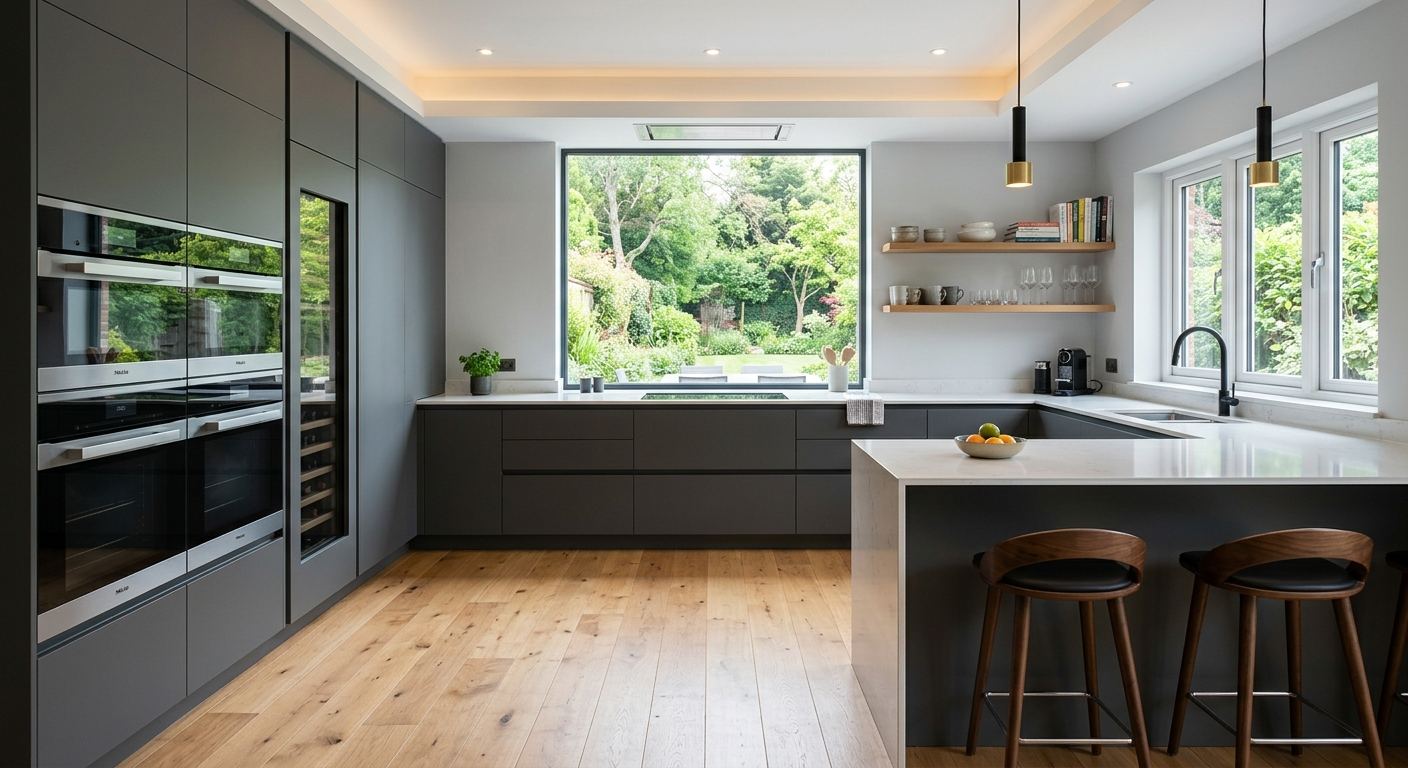
Kitchen renovation options and costs in West Cambie
Kitchen renovation in West Cambie, British Columbia, is usually priced less by weather and more by what buyers in the Lower Mainland–Southwest expect to see when they walk in. With a population of 12,255 (Statistics Canada, 2021 Census), this area reflects a broader Metro Vancouver pattern: many homeowners prioritize resale-ready finishes, and that pushes projects toward upgraded cabinetry and countertops. In higher-value pockets across the region, homeowners commonly choose semi-custom or custom cabinetry paired with quartz or stone, because those upgrades tend to “match” the rest of the home’s finish level. That’s why two kitchens of the same size can land far apart in cost depending on whether you’re doing a refresh or a full rebuild.
Climate still matters, but in practical ways—humidity swings and wet-coast conditions can accelerate wear on unsealed wood edges, grout failures, and certain laminate seams if they’re not installed and maintained well. The bigger driver of cost is labour availability and the complexity of finishes in a high-demand market. Trade scheduling can tighten around busier months, and availability of installers for tile, cabinet installation, and stone templating influences timeline and sometimes price.
In West Cambie, renovations are especially in demand around the West Cambie neighbourhood corridor near Richmond Road (and the surrounding residential streets), where many homeowners are planning updates alongside broader home improvements. To help you compare scopes and expected budgets, use the table below as a realistic starting point for quotes.
| Renovation Tier |
What's Included |
Typical Duration |
Price Range |
| Cosmetic refresh (paint, hardware, new appliances only) |
Cabinet paint or refinishing (if chosen), new pulls/hinges, appliance swap, minor caulking/touch-ups, basic countertop clean/protect (no material swap) |
1–2 weeks |
$8,000–$20,000 |
| Mid-range full renovation (new cabinets, counters, sink, tile) |
New semi-custom/stock cabinets, countertop installation, undermount sink, faucet, backsplash tile, select flooring patch/replacement, disposal hookup/finishing |
3–6 weeks |
$40,000–$75,000 |
| High-end full renovation (custom cabinets, stone counters, island) |
Custom millwork, quartz/stone countertops, island with overhang, upgraded hardware/undermount accessories, full backsplash, upgraded lighting, higher-end finish details |
6–10 weeks |
$75,000–$120,000 |
| Cabinet refacing only (new doors + drawer fronts, same boxes) |
New doors/drawer fronts, hardware, interior re-laminate or prep as needed, basic trim/caulk work; counters/appliances unchanged |
1–3 weeks |
$8,000–$35,000 |
| Countertop swap only (laminate to quartz or stone) |
Remove and reinstall countertops, seam/edge work, sink/faucet removal and reset (as applicable), caulking and finishing; backsplash not included unless requested |
3–10 days |
$3,000–$12,000 |
| Backsplash tile installation only |
Tile supply and labour, surface prep, grout/caulk, finishing around outlets; may include minor electrical plate adjustments |
5–10 days |
$1,500–$6,000 |
Prices are estimates only and vary by project scope, site access and material selection.
What affects the price of kitchen renovation in West Cambie
In the Lower Mainland–Southwest, quotes for the same kitchen can swing by 30–50% because the market treats “finish level” and resale optics as part of the scope—not just the physical work. Even in British Columbia outside West Cambie, the biggest difference is often what’s chosen after demolition: semi-custom versus fully custom cabinetry, quartz or stone versus laminate, and whether the design includes upgrades like islands and upgraded hardware. Climate plays a supporting role, but the economics dominate: higher-value home areas typically push homeowners toward premium materials and more complex millwork, because those costs are easier to justify on resale.
In a high-value Metro Vancouver–style market, many owners default to quartz or stone countertops and semi-custom cabinetry because the upgrade aligns with buyer expectations. In more modest scopes, laminate and stock cabinets offer better ROI while still refreshing the look. Regardless of finish tier, layout changes are the most unpredictable cost—removing a wall, adding an island, or moving a gas line or plumbing stack changes not only labour, but also the need for electrical work, permits, and sometimes structural assessment.
Two common West Cambie cost examples: (1) kitchens with older plumbing runs often require longer supply/drain adjustments, which can add hours for licensed plumbing and wall patching; (2) if you choose full-height tile or thicker stone backsplashes, installation time rises because templating, fitting around outlets, and specialty cut-outs take more labour. For budgeting, it helps to anchor early: a typical mid-range full renovation can start around $40,000, while a high-end full build with custom millwork and stone can climb past $75,000 depending on the island and electrical/lighting scope.
| Price Factor |
Why It Matters |
Cost Impact |
| Cabinet tier — stock vs. semi-custom vs. fully custom millwork |
Higher tiers require made-to-fit construction, more design time, and often better hardware integration |
Largest portion of variance; can shift a project by roughly tens of thousands |
| Countertop material — laminate vs. quartz vs. granite vs. stone |
Materials change not only material price but templating complexity and edge finishing |
Laminate keeps totals restrained; stone/quartz increases both product and installation |
| Layout change — wall removal, island add, plumbing/gas move |
Alters trades coordination, demolition, patching, and sometimes structural/permit scope |
Most unpredictable; often the main driver of 30–50% swings |
| Appliance package tier — builder vs. mid-range vs. pro-grade |
Premium appliances can require different cut-outs, ventilation, and electrical provisions |
Smaller than cabinetry, but can still add several thousand |
| Flooring — refinish existing vs. full replacement |
Kitchen work often damages adjacent flooring; matching can be difficult |
Refinishing is cheaper; full replacement adds material and labour |
| Backsplash — ceramic tile vs. marble vs. full-height slab |
Higher-end surfaces require more careful layout, cutting, and sealing/finishing |
Can move backsplash-only scope from mid-range to premium |
| Electrical — new circuits for island, under-cabinet lighting |
Extra outlets, pendants, and LED runs require licensed electrical and inspection |
Often adds meaningful labour + permit-linked time |
| Permit fees and licensed trade requirements |
Permits extend scheduling and require licensed trades for compliance |
Costs vary by scope, but can add both fees and timeline |
Permits & regulations in British Columbia
In British Columbia, many kitchen updates don’t require permits—but some common “make it better” upgrades absolutely do. Cabinet and countertop swaps typically do not require permits when you’re keeping existing plumbing and gas locations and you’re not altering electrical circuits. That means replacing cabinets, installing new quartz countertops, or swapping a backsplash surface are usually permit-free work.
However, permits and licensed trades are typically required when you change the services or the structure. Examples that generally do require a permit include: moving a sink supply or drain line; relocating a gas stove or range/hood connection (gas work must be performed by a licensed gas fitter); removing a load-bearing wall or making structural alterations; and adding new electrical circuits (for example, new outlets and under-cabinet lighting at an island). Electrical work must be done by a licensed electrician and inspected.
For a homeowner in West Cambie, the verification steps matter. First, ask the contractor for their business licence details (and trade numbers where applicable), plus liability insurance. For workers’ compensation coverage, confirm WSIB/WCB status through the contractor’s documentation—your contractor should provide proof before work starts. When electrical or gas is involved, request the licensed trade’s certificate of insurance and documentation, and ensure the permit application responsibility is written clearly in your contract. You should also confirm who pulls the permits, who pays permit fees, and which inspections are scheduled.
Cabinets, countertops and layout decisions in West Cambie
In a West Cambie kitchen renovation, three decisions drive most of the outcome: (1) cabinet tier (stock, semi-custom, or custom), (2) countertop material (laminate, quartz, granite, butcher block, or marble), and (3) whether you change the layout (open-concept wall removal, island addition, or plumbing/gas relocation). In the Lower Mainland–Southwest resale market, buyers often expect a clean, modern look with durable surfaces, so the “best value” choices are usually the ones that balance longevity with appearance.
Cabinet tier: stock cabinets are the fastest and often the cheapest, especially when your existing wall-to-wall measurements line up well. Semi-custom is usually the most popular mid-range because it offers better height/width options without custom lead times. Custom cabinets deliver the tightest fit and best storage planning, but they cost more because design and fabrication are bespoke.
Countertops: laminate is budget-friendly and easy to refresh visually, but it’s less tolerant of edge damage. Quartz is a common sweet spot—very durable and lower maintenance than natural stone. Granite and other natural stones look premium and can be long-lasting, but they may require sealing schedules depending on the stone. Butcher block adds warmth and repairability, though it needs consistent maintenance to handle moisture variation common on the wet coast.
Layout changes: opening up a wall or adding an island can be justified if it improves flow and creates seating or work zones. But plumbing/gas relocation is where costs rise quickly, often becoming a bigger line item than the material upgrades themselves. For example, if you’re comparing a “mid-range” plan around $40,000 versus a higher-end plan above $75,000, the extra cost is often tied to island wiring/lighting, upgraded millwork, and stone countertop seams/edge work—not just the countertop price alone.
| Option |
Durability |
Maintenance |
Best For |
Price Range |
| Stock cabinets (big-box) |
Solid when installed correctly; limited flexibility for awkward spaces |
Low; wipe clean and inspect hinges/hardware |
Quick refreshes with straightforward measurements |
$8,000–$25,000 |
| Semi-custom cabinets (local dealer) |
Good build quality with better fit for common West Cambie layouts |
Low to moderate; maintain hardware and seal any exposed edges |
Most mid-range renovations aiming for resale-ready results |
$20,000–$45,000 |
| Custom cabinets (local millwork shop) |
Best fit and strongest option for complex storage needs |
Low if surfaces are protected from moisture at seams |
Design-led kitchens, islands, and unusual dimensions |
$35,000–$70,000 |
| Laminate countertop |
Decent for daily use; vulnerable to edge chips and moisture if damaged |
Low; avoid heat and protect seams/edges |
Budget-sensitive renovations that still need a clean look |
$3,000–$6,500 |
| Quartz engineered countertop |
High durability; resistant to staining and everyday wear |
Low; routine cleaner and gentle maintenance |
Busy households wanting “set it and forget it” performance |
$6,000–$10,000 |
| Granite / natural stone countertop |
Very durable; performance varies by stone type and finish |
Moderate; often requires periodic sealing |
Premium look with long lifespan if maintained properly |
$7,000–$12,000 |
| Butcher block countertop |
Good durability; can scratch but is repairable |
Moderate to high; regular oiling and protection from moisture |
Warm, lived-in style and cooking-focused layouts |
$4,500–$9,000 |
| Marble countertop |
Premium and elegant; softer and more prone to etching/staining |
Higher maintenance; sealing and careful cleaning needed |
Low-abuse showpiece kitchens and buyers prioritizing aesthetics |
$9,000–$12,000 |
How to choose a kitchen renovation contractor in West Cambie
When you’re hiring for a kitchen in West Cambie, start with proof—licensing, insurance, and coverage—because the Lower Mainland–Southwest trades market is busy and you want accountability. For British Columbia, ask for documentation showing the contractor’s business details and liability insurance. For the trades involved, confirm they’re properly licensed for their scope: electrical work must be performed by a licensed electrician, and gas work by a licensed gas fitter. Also request proof of workers’ compensation coverage (WSIB/WCB equivalent documentation) before work starts.
Next, get 2–3 itemised written quotes instead of a single lump sum. You want a breakdown that separates labour and materials—cabinet supply, countertop templating/installation, demolition, tile labour, plumbing/electrical allowances, and disposal. Read the scope carefully: is permit pulling included? Who handles any required inspections? Is waste disposal and haul-away included, and where does the contractor dump/deliver materials?
Warranty matters in kitchens because workmanship and product issues can show up months later. Ask for the workmanship warranty length, whether the manufacturer warranty is included for cabinets/stone/appliances, and whether those warranties are transferable to the homeowner. Use a sensible payment schedule: never pay more than about 10–15% upfront, and hold back a portion until key completion items are finished. Finally, insist on a written timeline with a start date and completion estimate.
- Request written proof of liability insurance and confirm the certificate is current.
- Confirm workers’ compensation (WSIB/WCB equivalent) documentation before demolition begins.
- Get the electrical and gas contractor licence details in writing if your scope touches those systems.
- Ask for itemised labour/materials quotes (not just one total).
- Confirm who pulls permits and who pays permit fees.
- Verify disposal/haul-away is included (and what’s excluded).
- Check for an allowance list: appliances, tile, lighting, and any “TBD” items.
- Demand a written start date and target completion date.
- Confirm payment milestones and keep holdback until completion/sign-off.
- Ask how the contractor protects floors, stairways, and doorways during the dust phase.
- Review warranty terms for both workmanship and manufacturer defects.
- Ensure the contract clearly states responsibility for site conditions discovered after demo.
Red flags in West Cambie to watch for: (1) “We’ll handle permits” but no permit language in the contract; (2) only accepting a large upfront payment; (3) quotes that don’t list allowances or exclude tile/plumbing/electrical; (4) no proof of insurance or coverage; (5) vague timelines with no demolition-to-finish sequencing plan.
Frequently asked questions — kitchen renovation in West Cambie
Do I need a permit for a kitchen renovation in British Columbia?
In West Cambie and across British Columbia, cabinet and countertop swaps typically do not require a permit when plumbing, gas connections, structural elements, and electrical circuits are not changed. For example, replacing cabinets, installing new quartz counters, and updating a backsplash are usually permit-free if you’re not altering services. Where permits often come into play is when you move plumbing supply/drain lines, relocate a gas stove or gas-connected range/hood connection, remove a load-bearing wall, or add new electrical circuits (like additional outlets or island lighting). Because scopes vary by exact work, confirm permit responsibility in writing with your contractor before you sign—who pulls the permit, who pays fees, and who schedules inspections.
What's the ROI on a kitchen renovation?
ROI in British Columbia is influenced by what buyers expect to see and how competitive your home’s finish level is. In the Lower Mainland–Southwest, a kitchen refresh that looks modern and clean can support resale value, especially if you keep layout functional and choose durable, commonly desired materials. A practical reference point: a mid-range full renovation is often in the $40,000–$75,000 range, while higher-end builds can move from about $75,000 up toward $120,000 depending on custom millwork and stone. The “highest ROI” isn’t always the most expensive—it’s the portion buyers can clearly see (cabinet quality, countertop look, and coherent design). If your layout requires major plumbing/gas moves, ensure the new design actually improves usability; otherwise, ROI can be weaker than the cost.
How do I budget for a kitchen renovation?
Budgeting works best when you separate your project into tiers and decide which “must-haves” you won’t compromise. Start with a realistic backbone: a cosmetic refresh (paint/hardware/appliances only) often stays around $8,000–$20,000, while a mid-range full renovation usually lands near $40,000–$75,000 for cabinets, counters, sink, and tile. If you’re adding an island and moving into custom cabinetry and stone, plan for the high-end band of about $75,000–$120,000. Don’t forget hidden-cost items that show up after demo—unexpected water damage, older plumbing alignment issues, and rework for electrical outlets or lighting. In the Lower Mainland–Southwest, timeline pressure and stone templating lead times can also affect labour costs, so get itemised quotes and allowances early.
Can I move my kitchen sink or stove?
Yes, you can move a sink or stove in West Cambie, but the feasibility and cost depend on whether you’re changing plumbing and gas lines. A sink move typically requires adjustments to supply and drain lines, which usually brings permit and licensed plumbing involvement. A stove move can be even more complex: if you’re relocating a gas stove, gas work must be done by a licensed gas fitter and will require permits and inspections. Cost increases are often driven less by “moving a fixture” and more by the wall/ceiling access needed, structural considerations, and how trades coordinate. If you want to control budget, many homeowners keep the rough-in locations as-is and optimize layout with cabinetry arrangement and island placement instead.
What's the most cost-effective kitchen upgrade?
The most cost-effective upgrade is usually the one that delivers the biggest visible change without major service relocation. In British Columbia pricing, cabinet and countertop swaps are often the biggest visible “wow,” but the budget-friendly version depends on what you already have. If your boxes are in good shape, cabinet refacing only (new doors and drawer fronts) can be a strong value in the $8,000–$35,000 range. If your cabinets are fine but your counters look dated, a countertop swap only—laminate to quartz or stone—often sits around $3,000–$12,000. For a purely aesthetic boost with minimal disruption, backsplash tile installation only can be a relatively contained upgrade at about $1,500–$6,000. In most West Cambie homes, the best value comes from upgrades that avoid moving plumbing or gas while modernizing surfaces.
Custom vs stock cabinets — is custom worth it?
Custom can be worth it in West Cambie when your kitchen has challenging dimensions, you need specific storage solutions, or you want a perfectly integrated design (like an island with tailored panels and specialty pull-outs). Stock cabinets are typically fastest and cheapest, and they can be a great choice if your measurements match well and you don’t need unusual configurations. Semi-custom is often the practical middle. If you’re comparing price tiers, custom millwork generally costs more—commonly adding material and labour that pushes projects toward the higher-end renovation bands (and in some cases toward $75,000–$120,000 when combined with stone and layout changes). If your goal is resale-ready appearance, semi-custom or refacing can deliver a similar “look” with fewer surprises and usually better budget predictability, especially in the Lower Mainland–Southwest where scheduling and stone templating can affect lead times.