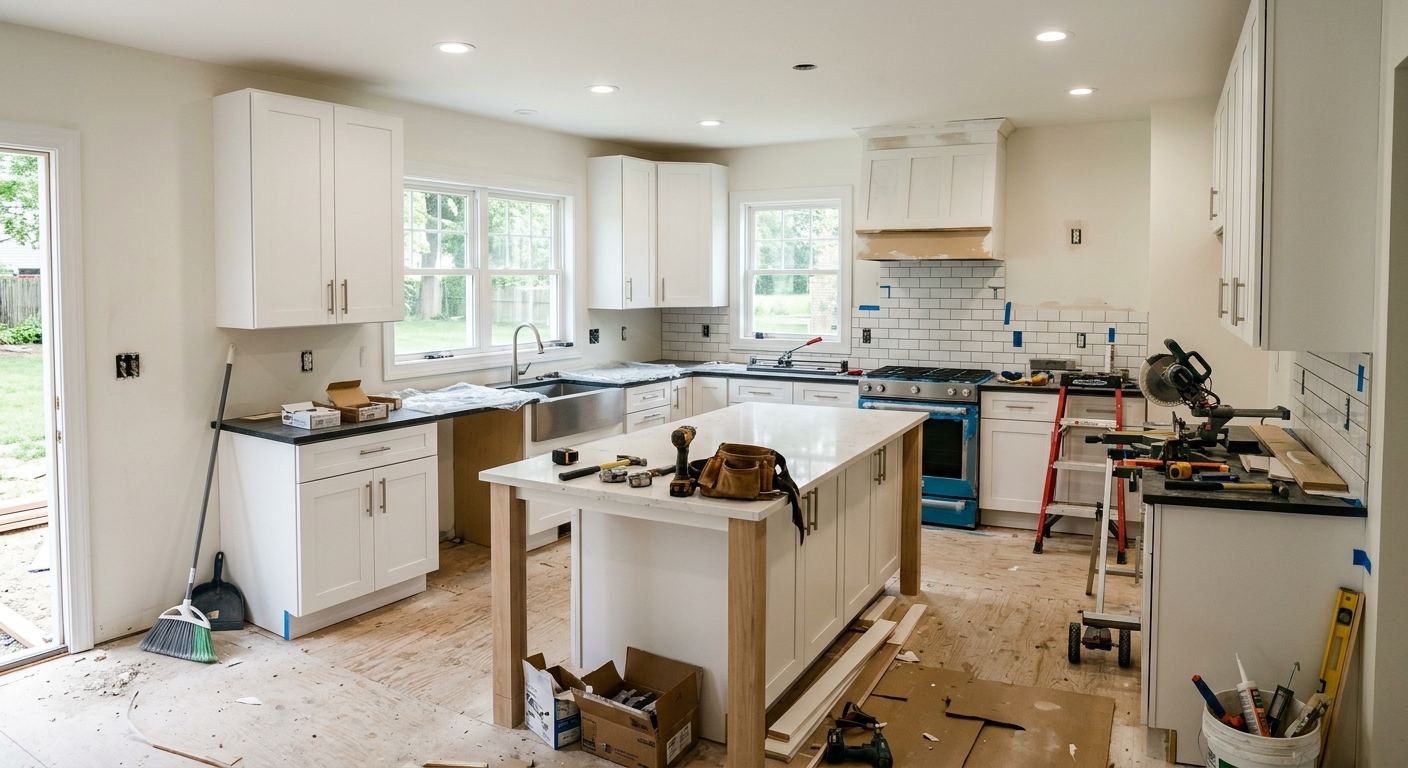
Kitchen renovation options and costs in Keating
Kitchen renovation options in Keating typically start with what you want to change and how “showroom-ready” the finished kitchen needs to look. With a small local population of 1,403 (Statistics Canada, 2021 Census), trades can book up quickly when multiple nearby Lower Mainland–Southwest projects land at the same time, especially around popular renovation windows. In the wider economic region, owners often weigh renovation spend against home value expectations—finish selections in this part of the Lower Mainland–Southwest tend to track premium buyers’ expectations more than weather does.
In the Lower Mainland–Southwest, pricing is driven more by home value, income, and expected finish level than by climate. You’ll see that most when comparing a practical refresh (new appliances, paint, hardware) to a full rebuild with custom cabinetry and stone counters. Although British Columbia’s coastal climate brings dampness risk, modern cabinet and countertop installs mainly handle it through good ventilation, quality underlayment, and proper sealing at seams—so the biggest cost swings still come from cabinetry complexity, countertop selection, and whether the layout changes. Contractor availability also affects turnaround times: when high-end stone and custom millwork are ordered, schedules can stretch because lead times are longer and crews coordinate more trades. Demand is especially high in the Surrey/Abbotsford corridor—many Keating-area homeowners time installs around those supply and scheduling cycles.
Use the table below to compare typical scopes before you ask for quotes, then choose the tier that best matches your resale goals and lifestyle.
| Renovation Tier |
What's Included |
Typical Duration |
Price Range |
| Cosmetic refresh (paint, hardware, new appliances only) |
Cabinet repaint or paint touch-ups, new cabinet hardware, appliance swap (like-for-like), basic cleaning/degreasing; no cabinetry or plumbing/drain moves |
1–3 weeks |
$8,000–$22,000 |
| Mid-range full renovation (new cabinets, counters, sink, tile) |
Stock or semi-custom cabinets, countertop replacement, sink swap, backsplash tile, flooring refresh (either refinish or replacement), and minor plumbing updates |
3–7 weeks |
$40,000–$85,000 |
| High-end full renovation (custom cabinets, stone counters, island) |
Fully custom cabinetry, quartz or natural stone counters, island build with detailed millwork, upgraded hardware, full-height backsplash or feature wall, electrical for task lighting |
6–12 weeks |
$85,000–$120,000 |
| Cabinet refacing only (new doors + drawer fronts, same boxes) |
New doors and drawer fronts, new hardware, optional partial interior upgrades; countertops may be left in place if structurally sound |
2–5 weeks |
$15,000–$40,000 |
| Countertop swap only (laminate to quartz or stone) |
Remove and dispose of existing countertop, install new quartz/stone, seal and finish edges, coordinate sink cut-outs; cabinetry remains |
3–10 days (plus scheduling) |
$15,000–$35,000 |
| Backsplash tile installation only |
Tile supply/installation for standard backsplash area, surface prep, waterproofing as needed, grouting and caulking; no cabinetry or countertops |
5–10 days |
$1,500–$6,000 |
Prices are estimates only and vary by project scope, site access and material selection.
What affects the price of kitchen renovation in Keating
When homeowners in Keating get multiple quotes for what sounds like the same kitchen, it’s common to see bids diverge by 30–50% across the Lower Mainland–Southwest and broader British Columbia. The reason is simple: local buyers often choose different finish tiers based on expected resale value, and contractors price for the level of cabinet craftsmanship, countertop type, and detail work that matches that target. In higher-value parts of the Lower Mainland–Southwest, owners frequently default to quartz or stone counters and semi-custom cabinetry because the spend is easier to recover on resale. In more modest areas, laminate and stock cabinets dominate because they deliver a cleaner look with better ROI, especially when the layout stays mostly intact.
Layout changes add the most unpredictable cost regardless of finish tier. Removing a wall, adding an island, or moving a gas line/plumbing supply tends to trigger extra framing, electrical, venting considerations, and inspections—so the “base scope” can jump even when your cabinet and countertop choices are the same. In Keating specifically, a key cost driver is older housing stock: if you uncover dated subflooring or aging supply/drain rough-ins behind the existing cabinets, costs rise quickly once you’re into demolition. Coastal humidity also matters—not because kitchens “rot” instantly, but because poor ventilation and unsealed backsplash edges can lead to finish failures that require rework.
To keep your budgeting realistic, anchor your plan to common band ranges. For example, a practical mid-range full renovation often lands in the $40,000–$85,000 range, while moving to high-end custom millwork and stone can push a full renovation toward the $85,000–$120,000 band. Those jumps aren’t just “luxury”—they reflect more complex cabinet builds, heavier stone handling, and additional trades coordination during install.
| Price Factor |
Why It Matters |
Cost Impact |
| Cabinet tier — stock vs. semi-custom vs. fully custom millwork |
Custom boxes, fitted reveals, and better hardware/door systems change material and install labour |
Typically adds $8,000–$35,000 to a full renovation depending on kitchen size and complexity |
| Countertop material — laminate vs. quartz vs. granite vs. stone |
Material cost, thickness/edge detailing, and template/installation difficulty drive the total |
Often shifts countertop budgets by $3,000–$12,000 for installation plus stone selection impact |
| Layout change — wall removal, island add, plumbing/gas move |
Triggering framing, electrical/plumbing changes, and more inspections increases unpredictability |
Frequently changes totals by $5,000–$25,000 in the Lower Mainland–Southwest once trades and rough-in work are included |
| Appliance package tier — builder vs. mid-range vs. pro-grade |
Pro-grade units add ventilation, electrical considerations, and sometimes custom panel/cut requirements |
Can move appliance-related spend by $2,000–$15,000 even when the cabinet plan is unchanged |
| Flooring — refinish existing vs. full replacement |
Demolition access and matching materials affect labour and waste |
Replacement-ready scopes commonly add $1,500–$8,000 depending on kitchen footprint and finish type |
| Backsplash — ceramic tile vs. marble vs. full-height slab |
Full-height coverage and premium stone increase cutting complexity and installation time |
Typically adds $1,500–$6,000 for tile installation-only scopes |
| Electrical — new circuits for island, under-cabinet lighting |
New circuits require licensed electrician work and can affect timelines |
Often adds $1,000–$6,000 depending on number of circuits and lighting package |
| Permit fees and licensed trade requirements |
Permits, inspections, and licensed trades add both costs and scheduling dependencies |
Commonly adds $500–$4,000 when required, plus coordination time |
Permits & regulations in British Columbia
In British Columbia, many straightforward kitchen finish swaps are low-friction, but “swap” can quickly become “alter” once you move services. In general, cabinet and countertop swaps do not require permits—so replacing laminate or installing quartz on the existing layout is typically a straightforward scheduling and workmanship process. However, permits and licensed trades are generally required when you move plumbing supply or drain lines, relocate gas (for stoves/ranges and certain hood setups), remove a load-bearing wall, or add new electrical circuits (for example, an island with outlets or new under-cabinet lighting circuits).
Step-by-step, here’s how you can verify your contractor in Keating before signing. First, confirm the scope in writing: ask specifically whether the work involves plumbing line moves, gas connection changes, electrical circuit additions, or any structural wall removal. Next, ask for proof of licensing for the trades they will use (gas work by a licensed gas fitter; electrical by a licensed electrician). Then request certificate of insurance for liability coverage and clearance/coverage confirmation for the relevant worker coverage (commonly handled through WSIB/WCB arrangements). Where to look: use the online provincial registries for licence status, and review the insurance certificate directly for policy details and effective dates. Make sure the contractor clearly states who is pulling permits (if any)—it should be documented in your contract, not assumed.
Cabinets, countertops and layout decisions in Keating
Your three most consequential decisions in a Keating kitchen renovation are cabinet tier, countertop material, and whether to change the layout. Start with cabinet tier. Stock cabinets are typically the fastest and cheapest option, because boxes and sizing are standard. Semi-custom cabinets are the popular mid-range choice here: you often get better sizing for awkward corners and more design flexibility without custom lead times that push schedules. Custom cabinets deliver the best fit and highest “built-in” look, but they cost more because every elevation and rail detail is made to order.
Second, choose countertop material with real daily-life expectations. Laminate is budget-friendly, but it’s more sensitive to heat and seam integrity over time. Quartz is a strong, low-maintenance middle ground for busy households in the Lower Mainland–Southwest; it handles everyday use well and resists staining better than most laminate surfaces. Granite/natural stone looks premium and can be very durable, but it may need periodic sealing depending on the exact stone and finish. Marble is beautiful but generally more maintenance-sensitive.
Third, layout changes justify cost only when they create meaningful space gains—like improving circulation, adding an island that truly supports how you cook, or opening the kitchen to living space. If you’re moving a sink or stove, you’re not just paying for new cabinets—you’re paying for plumbing/gas rough-ins and the trades coordination that comes with permits where required. As a practical dollar example: upgrading from laminate to quartz on a mid-range renovation often fits within a countertop-focused budget line, while a layout change that adds an island plus new electrical outlets can push your project toward the high-end full renovation band. That’s why a cosmetic refresh can stay restrained, while a fully reconfigured, stone-counter, custom-cabinet kitchen can quickly move into the $85,000–$120,000 range.
| Option |
Durability |
Maintenance |
Best For |
Price Range |
| Stock cabinets (big-box) |
Good for standard-use homes; durability depends on door/core quality |
Low-to-moderate—protect hinges and clean spills promptly |
Fast refreshes with a practical layout and tight timelines |
$8,000–$25,000 |
| Semi-custom cabinets (local dealer) |
Very solid for everyday cooking; improved fit reduces wear at joints |
Low—normal wipe-down and hardware tightening over time |
Most Keating homeowners balancing cost and design flexibility |
$20,000–$55,000 |
| Custom cabinets (local millwork shop) |
Excellent—precise reveals and tailored internal organization |
Low—built for long-term use, but hinges/adjustments still matter |
Premium kitchens, irregular spaces, and high “built-in” expectations |
$45,000–$85,000 |
| Laminate countertop |
Moderate; can be impacted by heat and seam issues if poorly installed |
Low—avoid prolonged heat exposure and don’t soak seams |
Budget-conscious upgrades and short-term residence plans |
$3,000–$8,000 |
| Quartz engineered countertop |
High—very durable against staining and everyday abrasion |
Low—typical wipe-down; avoid cutting on finished surfaces |
Busy family kitchens that want a premium look with easy care |
$7,000–$12,000 |
| Granite / natural stone countertop |
High—strong, scratch-resistant with varied patterning |
Moderate—often requires sealing to maintain stain resistance |
Homeowners who want natural variation and classic premium appeal |
$8,000–$14,000 |
| Butcher block countertop |
Moderate to high when cared for; sensitive to standing water |
Moderate—oil/condition regularly and dry thoroughly |
Warm, casual kitchens and those willing to maintain the surface |
$6,000–$11,000 |
| Marble countertop |
Moderate—beautiful but can etch with acids and heat |
Higher—seal and use protective cleaning habits |
Low-traffic kitchens where aesthetics matter most |
$10,000–$18,000 |
How to choose a kitchen renovation contractor in Keating
Choosing the right contractor in Keating comes down to verifying credentials, comparing itemised quotes, and aligning on the full scope (including what’s excluded). In British Columbia, kitchens often involve multiple licensed trades if you’re changing plumbing, gas connections, or adding electrical circuits. Before you sign, verify licensing through the relevant provincial licence registries for the trades involved. Ask for certificate of insurance (liability coverage) and confirm worker coverage arrangements (WSIB/WCB) so you’re not left holding risk if something goes wrong on site. Make these checks part of your contractor selection—don’t wait until after the job starts.
Next, request 2–3 itemised written quotes. You want labour and materials broken out, not a single lump sum. Review whether permits are included, whether disposal/dump fees are covered, and what’s excluded (for instance: drywall patching after cabinet removal, subfloor repairs, mould remediation if discovered, or electrical rough-in changes). A proper contract also lists warranty terms. Ask for workmanship warranty length and whether product warranties transfer to you at completion.
Payment schedules should be conservative. A common rule of thumb is never paying more than about 10–15% upfront; hold back until key milestones are complete and the contractor has delivered the finishes and close-out work. Finally, insist on a written timeline: a start date and a realistic completion estimate that accounts for countertop templating and cabinet lead times common in the Lower Mainland–Southwest.
- Confirm the licence status of each applicable trade (gas, electrical, plumbing) before work begins.
- Request proof of liability insurance and check the policy is active for the job dates.
- Verify worker coverage/clearance documentation (WSIB/WCB arrangements) and keep it on file.
- Get 2–3 itemised quotes with labour + materials, not just total cost.
- Ask whether permits are required for your exact scope and who pulls them.
- Check exclusions: disposal, drywall patching, appliance haul-away, and any floor/subfloor repairs.
- Confirm who buys countertops/cabinets and who handles delivery coordination and damage claims.
- Require a written start date and completion target, including allowance for templating.
- Ensure the quote states brand/model options for appliances, fixtures, and hardware.
- Review warranty details: workmanship duration, manufacturer warranty, and transferability.
- Keep payment milestones tied to completed scope; avoid large upfront deposits.
- Ask for examples/photos of similar Keating-area kitchens with your chosen cabinet tier.
Red flags I see in Keating and across the Lower Mainland–Southwest: they won’t provide insurance or licence numbers on request, they quote only in lump sums without line items, they can’t clearly explain who pulls permits and when, they ask for unusually high deposits upfront, or they provide a vague timeline that ignores cabinet/counter lead times.
Frequently asked questions — kitchen renovation in Keating
Quartz vs granite countertops — which is better?
In Keating, “better” depends on how you use the kitchen. Quartz is typically the easiest day-to-day choice: it’s very stain-resistant, doesn’t need the same sealing routine as many natural stones, and it holds up well to everyday cooking. Granite is also durable and many homeowners love the natural veining, but it’s more variable by slab and may require periodic sealing to stay protected. If you want a low-maintenance premium surface that fits busy households, quartz is often the practical winner. If you’re chasing an organic look and you’re comfortable with light maintenance, granite can be an excellent choice. In pricing, a countertop swap is commonly part of the broader countertop installation band, with countertop scopes often landing around the $3,000–$12,000 installation range depending on edges, thickness, and complexity—then the stone selection changes the total.
Should I reface or replace my cabinets?
Refacing is often the smartest option when your cabinet boxes are solid, square, and well-attached—especially if you like the current layout and only want a refreshed face style. It can be a good path for a refresh approach within the cabinet-focused ranges (cabinet installation/refacing budgets often start in the $8,000–$50,000 band depending on door/drawer quality and kitchen size). Replacing cabinets makes more sense when boxes are damaged by moisture, the interior layout is inefficient, or your renovation requires significant layout changes or improved storage systems. A key Keating consideration is older installations: if you find swelling at toe-kicks, failing hardware, or poor ventilation impacts behind the cabinets, refacing may not solve the root problem. For best guidance, ask your contractor to assess box condition after removal and price both options so you can compare the true risk and cost difference.
Do I need a permit for a kitchen renovation in British Columbia?
Many kitchen finish swaps in British Columbia do not require permits—cabinet and countertop replacement alone is typically permit-free. Where it changes is when your scope alters services or structure. Generally, permits and licensed trades are required when moving plumbing supply or drain lines, relocating gas connections for a stove/range setup, removing a load-bearing wall, or adding new electrical circuits (like outlets for an island or significant lighting upgrades). In Keating, you can expect more questions around any gas connection work and any “new location” for sink/stove. The homeowner check is to confirm the contractor’s responsibility in the written contract and ask what permits (if any) will be pulled. For your peace of mind, insist on proof of licensed trades and inspections where applicable before work proceeds.
What's the ROI on a kitchen renovation?
ROI (return on investment) varies by finish tier and by the buyer expectations in your part of the Lower Mainland–Southwest. Generally, cosmetic refreshes can improve appeal without major structural cost, while mid-range and high-end renovations can recoup more when finishes align with the neighbourhood’s resale profile. The most value typically comes from making the kitchen functional—better storage, sensible lighting, and durable surfaces—rather than purely “upgrading everything.” In practical terms, homeowners who stay in a mid-range full renovation band (often $40,000–$85,000 depending on scope) frequently find it easier to justify on resale compared to over-investing in ultra-premium materials without a corresponding market fit. If you move plumbing/gas or make major layout changes, ROI depends on whether the new layout feels clearly better to typical buyers. A good contractor will help you target what’s likely to sell versus what’s just personal taste.
How do I budget for a kitchen renovation?
Budgeting well starts by choosing your renovation tier and then adding realistic allowances for changes. In Keating, the biggest cost swings come from cabinet tier, countertop material, and whether you’re changing the layout. A common backbone range for a full kitchen renovation is $40,000–$120,000, but you can also structure the plan by line items: cabinet refacing or cabinet installs often sit in the $8,000–$50,000 range, countertop installation commonly aligns with $3,000–$12,000, and backsplash tile installation-only often falls around $1,500–$6,000. Include an allowance for demolition surprises (subfloor repairs, electrical touch-ups, or minor plumbing updates) because older cabinets and rough-ins sometimes aren’t as clean as expected. I also recommend holding back a small contingency. Finally, insist on itemised quotes so you can compare apples-to-apples: labour, materials, disposal, and whether permits are included.
Can I move my kitchen sink or stove?
Yes, but it’s one of those changes that can multiply complexity quickly in British Columbia. Moving a sink typically means new plumbing supply/drain rough-ins, and moving a stove/range may involve gas line relocation or changes tied to venting/hood requirements. In most cases, moving these fixtures is where permits and licensed trades are more likely required, especially when plumbing or gas lines are altered. In Keating, I tell homeowners to treat sink/stove moves as a “full coordination” project, not just a cabinet change—because timelines are affected by rough-in work, inspections, and countertop/sink cut-outs. From a budgeting perspective, if you’re already in the $40,000–$85,000 mid-range renovation band, fixture moves can push you toward the higher end depending on how far lines must travel and how complicated the rough-ins become. Your best step is to get a plan review from your contractor before ordering cabinets and counters, so the layout and services are confirmed.