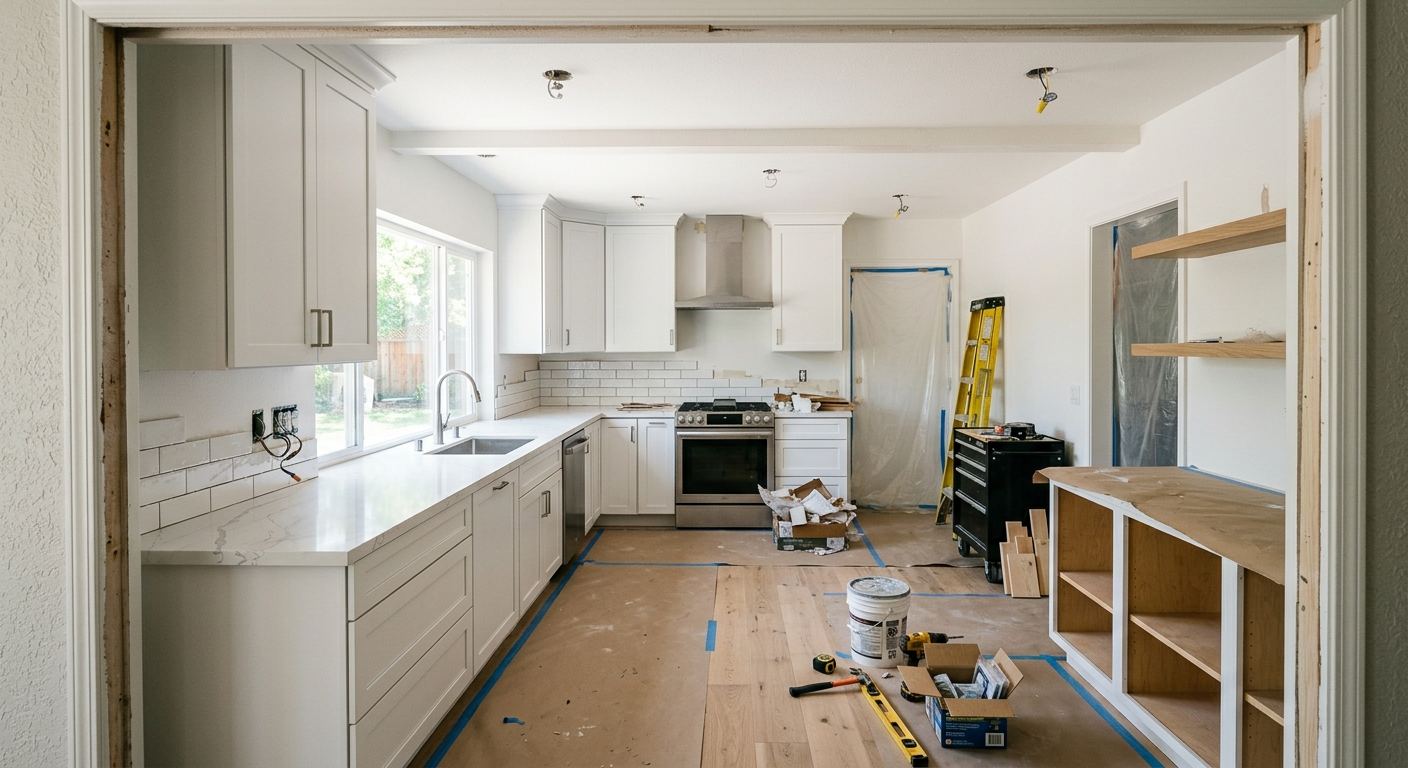
Kitchen renovation options and costs in Christina Lake
Kitchen renovations in Christina Lake typically start with one question: how far do you want to go, and what finish level are you aiming for? With a population of 1,329 (Statistics Canada, 2021 Census), trades availability is tighter than in larger hubs, so planning and scheduling matter as much as design. At the same time, homeowners in British Columbia tend to anchor decisions to resale expectations, and in higher-value parts of the Lower Mainland–Southwest the market often rewards updated cabinetry, quartz/stone counters, and a more intentional layout. In those areas, the renovation budget can rise quickly once semi-custom or custom millwork is on the table—because buyers see it as “built-in” value rather than just cosmetics.
That market effect matters locally too. Christina Lake projects often use Lower Mainland–Southwest pricing as a baseline, then adjust for site access, distance, and lead times. Coastal temperature swings and seasonal humidity can also influence material choices: durable cabinet finishes and well-sealed counters and backsplashes perform better when the house is transitioning between wet/cool seasons and drier periods. In practical terms, the same kitchen size can feel much more expensive when you add layout changes (especially plumbing or gas routing) than when you keep the footprint.
In Christina Lake, contractors are especially in demand around the village core and the more established waterfront-adjacent homes where access is tight and renovations need to be staged carefully. Use the options below as a starting point, then compare the “tier” that matches your goals in the table.
| Renovation Tier |
What's Included |
Typical Duration |
Price Range |
| Cosmetic refresh (paint, hardware, new appliances only) |
Cabinet paint or repaint, new hardware, appliance swap, minor wall patching/trim, basic countertop protection where applicable |
1–3 weeks |
$8,000–$20,000 |
| Mid-range full renovation (new cabinets, counters, sink, tile) |
Semi-custom or quality stock cabinets, new countertops, sink and faucet, backsplash tile, flooring repair/patching, basic plumbing hookup, electrical allowances for lighting |
4–8 weeks |
$40,000–$75,000 |
| High-end full renovation (custom cabinets, stone counters, island) |
Fully custom cabinetry, stone counters, island build, upgraded hardware and lighting, comprehensive backsplash, enhanced plumbing/electrical provisions, designer-level layout refinements |
8–16 weeks |
$85,000–$120,000 |
| Cabinet refacing only (new doors + drawer fronts, same boxes) |
Door/drawer replacement, new trim, veneer/finish over existing boxes (where structurally sound), hardware change, careful prep and sealing |
3–6 weeks |
$8,000–$28,000 |
| Countertop swap only (laminate to quartz or stone) |
Remove and dispose of old surface, install quartz/stone (or similar), reseal/finish edges, new sink set only if plumbing remains in same location |
1–3 weeks |
$10,000–$35,000 |
| Backsplash tile installation only |
Surface prep, tile supply allowance, layout and install, grout and sealing, waterproofing where required behind wet areas |
1–2 weeks |
$1,500–$6,000 |
Prices are estimates only and vary by project scope, site access and material selection.
What affects the price of kitchen renovation in Christina Lake
Across the Lower Mainland–Southwest and the wider British Columbia market, it’s common to see the same kitchen scope quoted 30–50% apart. The biggest drivers usually aren’t climate—they’re home value, household income, and the finish expectations that come with that resale profile. In higher-value Lower Mainland–Southwest pockets, homeowners often default to quartz or stone counters and semi-custom cabinetry because the cost is easier to recover on resale. In more modest scopes, laminate and stock cabinets can deliver a similar “new kitchen” look at a far lower replacement cost.
Where Christina Lake stands out is that renovation pricing often reflects distance, scheduling, and how trades stage work through seasonal conditions (wet/cool periods can slow site drying and tile/set times). If you’re staying within the cabinet-and-counter “mid-range full renovation” band (for example, around $40,000–$75,000), costs stay more predictable. As soon as you add layout changes—removing a wall, adding an island, or moving a gas line—labour and permitting complexity rise, and the same renovation can quickly drift toward the high-end “stone and custom millwork” totals (up to $85,000–$120,000).
Two local examples: waterfront-adjacent homes often have tighter access for material drops, which can raise staging and labour time; older cabinetry footprints sometimes require more carpentry corrections once you remove the old counters and backers. Also, if your existing kitchen is from an older construction cycle, you may find outdated electrical or undersized junctions—upgrades for under-cabinet lighting or an island circuit can add cost even when the visible finishes are unchanged.
| Price Factor |
Why It Matters |
Cost Impact |
| Cabinet tier — stock vs. semi-custom vs. fully custom millwork |
Higher tiers offer better fit, storage planning, and finish quality; custom also drives longer lead times and shop fabrication |
Can shift a full renovation by roughly $15,000–$45,000 depending on tier and layout |
| Countertop material — laminate vs. quartz vs. granite vs. stone |
Material price, edge profiles, fabrication complexity, and sink cut accuracy vary widely |
Typically adds $3,000–$12,000+ over a basic surface swap |
| Layout change — wall removal, island add, plumbing/gas move |
Structural work, trade coordination, and re-routing services create the most unpredictable labour costs |
Often the largest swings: commonly $8,000–$30,000+ beyond “like-for-like” work |
| Appliance package tier — builder vs. mid-range vs. pro-grade |
Higher-end appliances increase purchase cost and can require clearer clearances/venting |
Typically $1,500–$10,000+ difference depending on brands and venting needs |
| Flooring — refinish existing vs. full replacement |
Staged demolition can damage adjacent flooring; replacement may be cheaper than patching mismatched areas |
May add $2,000–$12,000 depending on product and demolition scope |
| Backsplash — ceramic tile vs. marble vs. full-height slab |
Stone and full-height applications require extra templating, sealing, and careful waterproofing |
Usually $1,500–$6,000+ for tile; higher for premium stone treatments |
| Electrical — new circuits for island, under-cabinet lighting |
New circuits and fixtures require licensed work and inspection, plus planning for wiring runs |
Often adds $1,000–$6,000+ depending on number of runs and fixtures |
| Permit fees and licensed trade requirements |
Complex work triggers permitting/inspections; licensed trades schedule differently and add administrative cost |
Can add $500–$3,000+ and delays if not planned early |
Permits & regulations in British Columbia
In British Columbia, many straightforward kitchen upgrades don’t require permits. Cabinet and countertop swaps—such as replacing cabinet doors, installing new counters, or doing a backsplash—are typically handled as finish work and usually do not trigger building permits. However, once you change the “services” around the kitchen, permits and licensed trades become the rule, not the exception.
Work that typically does require permits includes: moving plumbing supply or drain lines (sink relocation), relocating a gas appliance or changing the gas line route, removing or altering a load-bearing wall, adding or modifying electrical circuits (for example, new outlets for an island, rewiring major sections, or adding dedicated circuits for higher-load appliances), and any structural changes that affect beams or supports. Gas work must be performed by a licensed gas fitter, and electrical work by a licensed electrician—both require proper inspections where applicable.
For a Christina Lake homeowner, a practical verification process is simple. First, ask your contractor to provide the licence numbers and proof of liability insurance (ask for a certificate of insurance). For workers’ compensation, request confirmation of WSIB/WCB coverage—either a clearance letter or proof that the company is in good standing for the work. Then, verify licences through the applicable online registries, using the licence number on their paperwork. Finally, confirm in writing who is responsible for permits and inspections—before you sign—so the permit pulls don’t become an unexpected line item later.
Cabinets, countertops and layout decisions in Christina Lake
Your biggest payoff decisions in a Christina Lake kitchen renovation are usually: (1) cabinet tier, (2) countertop material, and (3) whether you change the layout (open-concept wall removal, island addition, or plumbing/gas relocation). In the Lower Mainland–Southwest resale market, buyers tend to expect clean, durable surfaces and cabinetry that looks “built for the space,” especially at mid-range and above. That doesn’t mean you need premium for everything—it means you should spend where it’s most visible and most durable.
Cabinet choice: stock cabinets are the fastest and cheapest, but they may fight your wall lines and uneven flooring in older homes. Semi-custom cabinets are the most popular in Christina Lake projects because they balance lead times and fit. Custom cabinets cost more, yet they can eliminate awkward gaps and maximize storage—valuable if you’re adding an island or extending storage to the ceiling.
Countertops: laminate is the budget workhorse, but it’s more prone to edge wear and staining if maintenance slips. Quartz is often the sweet spot for British Columbia: it handles everyday impacts well and wipes clean easily, which matters during seasonal humidity swings. Granite/natural stone are beautiful and durable but require more attentive sealing and are generally priced higher once fabrication and sink cut complexity are included.
Layout changes are the cost justification hinge. If you add an island, you’re paying for more than cabinetry—you’re paying for electrical and possibly plumbing/gas coordination. For example, upgrading from laminate to quartz might add a few thousand dollars within a countertop swap, but moving a sink can add significant labour and permit work. If your goal is “more usable space,” a modest layout change can be worth it; if the goal is only appearance, keep the footprint and redirect budget to cabinetry and surfaces.
| Option |
Durability |
Maintenance |
Best For |
Price Range |
| Stock cabinets (big-box) |
Good for standard wear; fit/finish depends on wall condition and installation quality |
Low; keep hinges and seals maintained |
Fast refreshes with minimal rework |
$8,000–$25,000 |
| Semi-custom cabinets (local dealer) |
Very good; better storage options and more flexibility in sizing |
Low to moderate; refinish/repair only if chips occur |
Most Christina Lake mid-range renovations |
$20,000–$55,000 |
| Custom cabinets (local millwork shop) |
Excellent; tailored fit and higher build quality potential |
Low; long-term care like wiping and hardware tightening |
Spaces with unusual dimensions or island/ceiling-to-floor storage |
$40,000–$85,000 |
| Laminate countertop |
Fair to good; edges and seams are the most vulnerable spots |
Low; avoid prolonged standing water at seams |
Budget-focused refreshes keeping plumbing and sink positions |
$3,000–$7,000 |
| Quartz engineered countertop |
Very good; resists staining and everyday impacts well |
Low; wipe clean and avoid abrasive pads |
Most “best value” renovations in British Columbia |
$6,000–$12,000 |
| Granite / natural stone countertop |
Excellent; naturally hard surface but fabrication must be done carefully |
Moderate; periodic sealing and attention to grout/edge sealing |
Owners wanting premium look with long service life |
$8,000–$16,000 |
| Butcher block countertop |
Good; handles cutting but can mark and swell if neglected |
Higher; oiling and immediate wipe-down for moisture control |
Casual or farmhouse style kitchens |
$5,000–$12,000 |
| Marble countertop |
Beautiful but softer; can etch with acidic cleaners |
Higher; sealing and careful cleaning habits |
Statement kitchens where maintenance habits match expectations |
$10,000–$20,000 |
How to choose a kitchen renovation contractor in Christina Lake
Choosing the right contractor in Christina Lake comes down to proof, clarity, and control over the work. In British Columbia, confirm the contractor has the right licences for what they’re doing (electrical must be by a licensed electrician; gas work by a licensed gas fitter). Ask for a certificate of insurance showing liability coverage and, importantly, confirmation of WSIB/WCB coverage. You’re not trying to police them—you’re protecting yourself: request a clearance letter or proof the company is in good standing for the work they’ll perform.
Next, get 2–3 itemised written quotes, not just one lump sum. An itemised quote should separate labour and materials (cabinet supply, countertop fabrication, tile supply, disposal, electrical allowances, plumbing allowances). Read the scope for exclusions: Is permit pulling included, who pulls it, and what’s the timeline? Is disposal included or is it “truck and tip” billed separately? Does the quote include patching/drywall refinishing, or is drywall repair an extra cost after cabinet install?
Warranty matters in two parts: workmanship warranty and product/manufacturer warranty. Ask how long the workmanship warranty lasts, whether it’s tied to the person/house, and if it transfers to a new homeowner if you sell. For payments, avoid large deposits; a common safe approach is 10–15% upfront, then hold back until the job is complete and punchlist items are addressed. Finally, require a written start date and a completion estimate.
- Request licence numbers and proof of liability insurance before any work starts.
- Confirm WSIB/WCB coverage with a clearance letter or equivalent proof.
- Insist on 2–3 itemised quotes (labour + materials) with line-by-line scope.
- Check whether permits are included, and specify who is responsible for pulling them.
- Confirm disposal and cleaning are included (construction debris and jobsite sweep).
- Ask who supplies and installs the backsplash waterproofing (if needed) and grout/seal products.
- Verify appliance cut-outs, venting provisions, and clearance requirements are in the scope.
- Review plumbing and electrical allowances: what is included vs “as quoted” changes.
- Ask about lead times for cabinets and countertops and whether delays affect the schedule.
- Confirm the warranty length for workmanship and whether it’s in writing.
- Agree on a payment schedule with a holdback until punchlist completion.
- Get a written start date and a completion estimate with key milestones (demo, install, final trim).
In Christina Lake, red flags usually include: vague scopes that don’t list disposal/patching, quoting “everything” but omitting permits and licensed trade responsibilities, asking for more than 15% upfront without clear milestones, refusing to put warranty terms in writing, or giving a too-short timeline that ignores cabinet/counter lead times.
Frequently asked questions — kitchen renovation in Christina Lake
Quartz vs granite countertops — which is better?
In British Columbia, quartz is often the practical “best fit” for busy households because it’s low-maintenance and resists staining well without the same day-to-day sealing routines that natural stone typically needs. Granite is also durable and can look stunning, but you should plan for periodic sealing and careful cleaning to protect the surface. If you’re aiming for a mid-range renovation in Christina Lake (often around $40,000–$75,000 for a full package), quartz usually delivers a more consistent finish and predictable fabrication. If you want a more premium, unique look and you’re willing to manage maintenance, granite can be worth it—especially when the rest of the kitchen is already upgraded to match.
Should I reface or replace my cabinets?
Refacing can be a smart choice when your existing cabinet boxes are solid, level, and not water-damaged—especially in older kitchens where the layout is staying the same. Replacement makes sense when boxes are sagging, doors don’t align anymore, you need major storage reconfiguration, or the footprint needs reworking. In Christina Lake, refacing is also appealing if you want speed and less disruption, but you should only do it after the contractor confirms the carcasses are worth keeping. If you’re trying to stay closer to a cabinet-focused budget, refacing often falls in the $8,000–$28,000 range, while a full cabinet package (mid-range) typically sits much higher. Your installer’s measurement and finishing quality are critical for both options.
Do I need a permit for a kitchen renovation in British Columbia?
Many finish-only updates in British Columbia don’t require permits—like replacing cabinets, swapping countertops, repainting, or installing a backsplash. However, permits and licensed trades become necessary when you move plumbing supply or drain lines (such as moving a sink), relocate a gas appliance or change gas routing, remove or alter a load-bearing wall, or add/modify electrical circuits (such as new island power or under-cabinet lighting requiring new wiring runs). For homeowners in Christina Lake, the safest approach is to ask your contractor to list exactly what requires permits in writing and who will pull them. If gas or electrical is involved, confirm the work is performed by the correct licensed professionals and that inspections are completed where required.
What's the ROI on a kitchen renovation?
ROI is highly dependent on what you change and what buyers in your market expect. In the Lower Mainland–Southwest, renovations that look “complete” (cabinet upgrades, durable counters, and a cohesive layout) tend to recoup more than cosmetic-only upgrades when the rest of the home is in good condition. That said, overbuilding for the neighbourhood can reduce returns. Practically, a cosmetic refresh can improve day-to-day enjoyment, but it usually won’t match the resale impact of a full mid-range renovation with new cabinetry and counters. If you’re targeting a full renovation budget around $40,000–$75,000, focus on visible quality and functional upgrades that buyers notice immediately. For higher-end totals like $85,000–$120,000, ROI is strongest when the home can support the finish level and the layout truly improves usability.
How do I budget for a kitchen renovation?
Start by picking a renovation tier that matches your goals, then add allowances for the “unknowns” that commonly affect Christina Lake projects—site access, lead times, and service rework when walls or floors are opened. For example, if you’re planning a full mid-range renovation, many projects land within $40,000–$75,000 depending on cabinetry choice and whether you keep the plumbing and gas in place. If you’re doing a refresh (appliances, paint, and hardware), you may be closer to the lower bands, but cabinet and countertop choices still drive totals quickly. Ask for itemised quotes so you can see what’s included: permits, disposal, patching/drywall finishing, electrical allowances, and warranty terms. Finally, keep a contingency for changes once the demo is complete—kitchen renovations often reveal surprises behind old backsplashes and under existing counters.
Can I move my kitchen sink or stove?
Yes, you can move a kitchen sink or stove in British Columbia, but it’s not just carpentry—it’s plumbing/gas and usually more permitting complexity. Moving a sink generally means changing plumbing supply and drain lines, which typically triggers permit requirements and requires licensed trades for the work. Moving a gas stove involves gas line relocation and must be done by a licensed gas fitter; electrical vent fans or upgraded hoods also require proper electrical work by a licensed electrician. In Christina Lake, the added labour and scheduling time is often the difference between a predictable countertop swap and a full renovation budget jump. If you want to control cost, the best strategy is usually to keep plumbing/gas in the same approximate locations and redesign around that footprint.