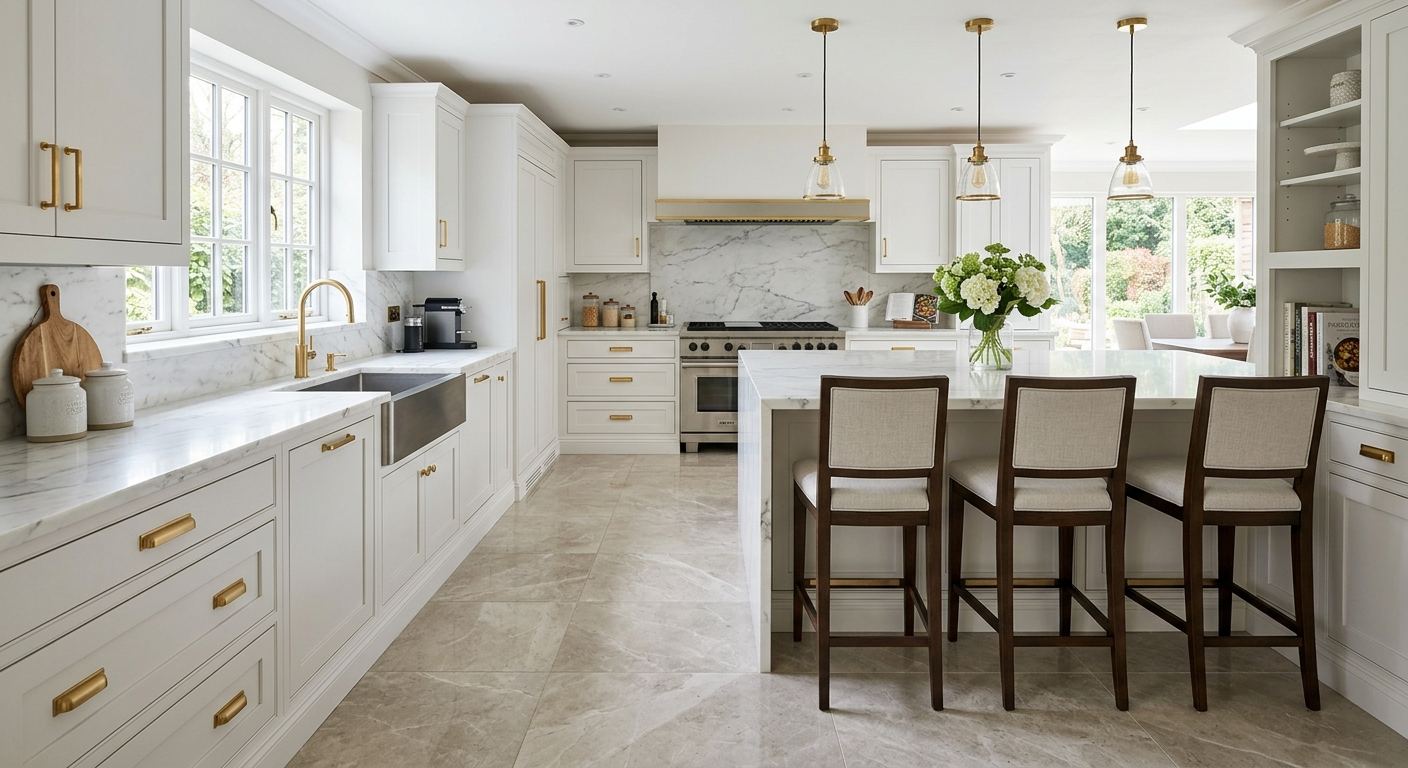
Kitchen renovation options and costs in Mackenzie
Mackenzie homeowners usually start their kitchen plans by comparing options that feel similar on paper, but cost differently once you price cabinets, counters, and the labour to fit everything into older homes. With a median household income of about $88,000 (Statistics Canada, 2021 Census) and an ownership rate of 80.8% of households, many projects aim for a durable, sale-friendly upgrade rather than a full custom rebuild. Most dwellings were built before 1981 (77.3% of homes), so you often see older electrical runs, uneven subfloors, and plumbing that needs attention—each one can add labour even when the finish selection stays “mid-range.”
In the Cariboo economic region, kitchen renovation costs are shaped more by local home values and household income than by climate. That said, Mackenzie’s cold winters matter for how contractors prep for long lead times: cabinets and flooring are sensitive to indoor humidity during curing, and you want the ventilation and heat turned on early to avoid delays. Contractor availability can also tighten during busier seasons, and that affects the schedule portion of your quote.
Because workmanship and materials drive most price bands, the best way to compare bids is by renovation tier. Demand is especially strong around the downtown Mackenzie area, where homeowners tend to update kitchens for resale and practical day-to-day use. Next, review the typical tiers below so your table-to-table comparisons are apples-to-apples before you talk numbers with contractors.
| Renovation Tier |
What's Included |
Typical Duration |
Price Range |
| Cosmetic refresh (paint, hardware, new appliances only) |
Cabinet paint or refinishing (no cabinet box changes), new pulls/knobs, appliance swap, backsplash in limited areas (optional) |
1–2 weeks |
$2,500–$9,500 |
| Mid-range full renovation (new cabinets, counters, sink, tile) |
New semi-custom or stock cabinets, countertop (quartz or laminate), sink and faucet, backsplash tile, plumbing fixture refresh, basic electrical updates |
3–6 weeks |
$28,000–$65,000 |
| High-end full renovation (custom cabinets, stone counters, island) |
Fully custom cabinetry, natural stone or premium engineered counters, island with added electrical/plumbing as needed, full-height backsplash/tile, upgraded finishes throughout |
6–12 weeks |
$65,000–$95,000 |
| Cabinet refacing only (new doors + drawer fronts, same boxes) |
Refacing veneer, new doors/drawers, new hardware, minor trim work, repainting touch-ups, countertop remains (unless bundled) |
1–3 weeks |
$5,000–$18,000 |
| Countertop swap only (laminate to quartz or stone) |
Remove and dispose of old top, install new countertop, sink cut-out transfer (if compatible), caulking, seam finishing |
3–7 days |
$3,000–$14,000 |
| Backsplash tile installation only |
Surface prep, tile installation, grout/seal where required, caulking transitions at counters and corners |
3–10 days |
$1,500–$9,000 |
Prices are estimates only and vary by project scope, site access and material selection.
What affects the price of kitchen renovation in Mackenzie
In Mackenzie and across the Cariboo region, quotes for the same kitchen renovation can vary by roughly 30–50% because contractors price risk differently—especially when older homes meet modern cabinet systems. Climate is not the main driver in B.C.; local home values and household income tend to determine whether homeowners choose laminate and stock cabinets or quartz/stone counters and semi-custom or custom cabinetry. In higher-value pockets across the region, people often pick quartz or natural stone because buyers see it as an easy quality signal and it’s easier to recover on resale. In more modest value markets, laminate and stock cabinetry dominate because they deliver a strong visual upgrade within the practical band (for example, full renovations commonly land in the $28,000–$95,000 range).
Even so, layout changes are the biggest cost swing regardless of finish. Removing a wall to open the kitchen, adding an island, or moving a gas line and associated venting can add substantial labour and trades time. Likewise, moving plumbing supply or drain lines turns a “counter swap” project into a multi-day rough-in and inspection exercise.
Here are a few concrete examples that commonly raise or lower cost in Mackenzie:
- Older than-1981 framing: when cabinet walls are not square, the install requires extra labour and sometimes filler panels, which raises the cabinet installation time.
- Cold-season work sequencing: installers typically schedule around when heat and humidity control are stable so adhesives cure properly; poor conditions can mean rework.
- Appliance choices: switching from a standard range to a pro-grade model or changing hood style can require extra electrical work and ventilation planning.
Finally, remember that the cabinet package is usually the cost swing. That’s why a mid-range full kitchen can sit closer to $28,000–$65,000, while an island and stone upgrades push projects toward the upper end.
| Price Factor |
Why It Matters |
Cost Impact |
| Cabinet tier — stock vs. semi-custom vs. fully custom millwork |
Cabinet quality affects materials, fit/finish, door style options, and installation complexity |
Often the largest swing; can add several tens of thousands on full renovations |
| Countertop material — laminate vs. quartz vs. granite vs. stone |
Material cost, edge profiles, and cutting complexity change the installed price |
Can move an installed top from “budget” to premium quickly; typically several thousand dollars difference |
| Layout change — wall removal, island add, plumbing/gas move |
Creates rough-in, inspections, extra framing, and longer schedules |
One of the most unpredictable factors; commonly the difference between mid-range and high-end totals |
| Appliance package tier — builder vs. mid-range vs. pro-grade |
Higher tiers cost more and may require electrical/venting adjustments |
Moderate to high impact depending on whether hookups change |
| Flooring — refinish existing vs. full replacement |
Old subfloors and uneven surfaces may require prep, underlayment, or replacement |
Typically adds a few thousand dollars if replacement is required; can add more if subfloor is damaged |
| Backsplash — ceramic tile vs. marble vs. full-height slab |
Tile installs need careful layout; stone slabs add cost, weight, and specialty handling |
Low to high impact depending on tile type and coverage height |
| Electrical — new circuits for island, under-cabinet lighting |
New circuits require licensed work and inspection scheduling |
Can add several hundred to several thousand dollars depending on scope |
| Permit fees and licensed trade requirements |
Certain work triggers permits and trades; paperwork and inspection time affect total cost |
Usually modest fees, but compliance requirements can add labour and coordination cost |
Permits & regulations in British Columbia
In British Columbia, many “swap” upgrades are straightforward. Cabinet and countertop swaps typically do not require permits because you’re replacing finishes within the existing footprint. However, when you change the kitchen’s systems—plumbing, gas, load-bearing structure, or electrical—permits usually come into play, and licensed trades are required.
Work that typically does require a permit includes: moving plumbing supply or drain lines; relocating or adding gas connections for a stove or other gas appliance; removing a load-bearing wall (or doing structural changes); adding new electrical circuits (for example, for an island receptacle load or significant under-cabinet lighting plans); and any work that triggers an inspection. Gas work must be performed by a licensed gas fitter, and electrical work must be done by a licensed electrician—both then require inspections as part of code compliance.
Work that typically does not require a permit includes: replacing existing cabinets with new cabinets of similar size; installing new countertops on the existing base; and applying a backsplash with tile (as a surface finish) without changing plumbing/electrical routes.
How to verify a contractor in Mackenzie before you sign:
- Licence status: check the appropriate provincial online registry for the electrician/gas fitter when those trades are involved.
- Liability insurance: request a certificate of insurance showing coverage amounts and effective dates.
- Workers’ compensation coverage: confirm WSIB/WCB coverage documentation is current (ask for clearance letters or proof of registration).
- Written responsibility: make sure the contract states who pulls permits (and pays permit fees) if any are needed.
Cabinets, countertops and layout decisions in Mackenzie
Your cabinet tier, your countertop material, and your layout plan are the three decisions that most influence both cost and buyer appeal in Mackenzie’s Cariboo market. First, choose cabinet tier: stock cabinets are fastest and cheapest but have fewer custom sizes; semi-custom is the most popular mid-range option because it balances fit and price; custom cabinetry provides the best layout fit but raises the budget quickly. Second, countertop material should match your lifestyle. Laminate is budget-friendly and easy to maintain day-to-day, while quartz tends to resist staining and is more consistent across seams. Natural stone (granite or other stone) offers a premium look, and butcher block adds warmth but requires more care.
Third, layout changes—open-concept wall removal, island addition, and plumbing/gas relocation—should be justified by space gain and functionality. In older homes (77.3% built before 1981), floors may be uneven and walls may not be perfectly square; this makes “minor tweaks” sometimes become longer install days. If you’re considering an island, plan electrical and any needed plumbing upfront because moving those lines later usually costs more than adjusting the design early.
Resale-wise, buyers at mid-range renovation budgets expect a clean, modern look with durable surfaces. That’s where quartz or laminate and semi-custom cabinets often land. If you want a clearer price example: a countertop swap only can be around $3,000–$14,000, while a full mid-range kitchen renovation with new cabinets, counters, sink, and tile commonly targets $28,000–$65,000. Upgrading countertops within a cosmetic plan is often the best value; upgrading cabinet tier plus layout changes is what drives the high-end totals.
| Option |
Durability |
Maintenance |
Best For |
Price Range |
| Stock cabinets (big-box) |
Good durability with standard hardware; best when your layout matches common sizes |
Low; keep hinges aligned and avoid excessive moisture exposure around sink areas |
Budget-focused renovations with minimal layout changes |
$10,000–$22,000 |
| Semi-custom cabinets (local dealer) |
Very strong performance; improved fit helps reduce gaps and keeps doors operating smoothly |
Low to moderate; periodic hardware tightening and gentle cleaning |
Most Mackenzie homeowners—best balance of cost and finish |
$18,000–$35,000 |
| Custom cabinets (local millwork shop) |
Highest durability and precise fit; can incorporate unique storage solutions |
Low; benefits from proper installation and ventilation near cooking areas |
High-end kitchens, tricky layouts, and buyers targeting premium resale appeal |
$30,000–$60,000 |
| Laminate countertop |
Moderate durability; seams and edges need attention to prevent moisture intrusion |
Low; wipe and avoid prolonged water pooling near sink edges |
Value renovations and rental-like practicality |
$3,000–$7,000 |
| Quartz engineered countertop |
High durability; resistant to stains and everyday wear with minimal sealing needs |
Low; regular cleaning and gentle pads for cookware |
Most mid-range full renovations aiming for modern look and long service life |
$7,000–$12,000 |
| Granite / natural stone countertop |
High durability; excellent heat resistance but can be porous depending on the stone |
Moderate; may require periodic sealing and careful protection at seams |
Premium aesthetics for resale-focused owners |
$10,000–$14,000 |
| Butcher block countertop |
Good for everyday use; surface can scratch and is sensitive to standing water |
Moderate; oiling and drying discipline are important |
Warm, traditional styles where the family actively cooks |
$6,000–$11,000 |
| Marble countertop |
Beautiful but more susceptible to etching and staining than quartz |
Higher; requires careful cleaning and protection from acidic spills |
High-end decorative kitchens with lighter daily mess |
$12,000–$18,000 |
How to choose a kitchen renovation contractor in Mackenzie
Choosing the right contractor in Mackenzie is mostly about proof: licensing where required, insurance, clear scope, and a schedule you can actually plan around. For British Columbia, make sure you verify (1) liability insurance via a current certificate, (2) WSIB/WCB coverage via proof/clearance documentation, and (3) that licensed trades are being used for gas and electrical work. If a contractor is hiring electricians or gas fitters, confirm those individuals are licensed through the appropriate provincial online registries and that their insurance is in place.
Next, get 2–3 itemised written quotes. You want a breakdown that separates labour from materials, and line items for cabinets, countertops, plumbing/electrical allowances, demolition, disposal, and flooring/backsplash work. Avoid lump-sum quotes where you can’t see what’s included. Read the scope carefully for exclusions: will they remove and dispose of old cabinets and countertops? Is permit pull included (if needed)? Is dust control part of the work, especially in older, tighter homes?
Warranty matters too. Ask for the workmanship warranty length in writing, and confirm what manufacturer warranties cover for cabinets, countertops, and appliances. Also ask whether warranties are transferable if you sell your home. On payment schedule, never pay more than 10–15% upfront; hold back a portion until key milestones are complete, such as final cabinet fit, countertop install, and backsplash/grout curing.
Finally, require timeline clarity: start date, milestone dates, and a realistic completion estimate. Kitchen projects can extend due to cabinet and countertop lead times, and a good contractor will build that into your plan.
- Verify BC licences for involved trades (electrician/gas fitter) using provincial registry checks.
- Request a current certificate of liability insurance (and ensure it matches the job address).
- Confirm WSIB/WCB coverage and ask for clearance proof or equivalent documentation.
- Get 2–3 itemised quotes (labour + materials) instead of one lump-sum estimate.
- Ensure the scope states who handles permits and which parts are “included.”
- Confirm disposal and demolition are included (old cabinets, packaging, and tile waste).
- Ask how they handle out-of-square walls common in pre-1981 homes.
- Require a written demolition-to-install sequence and protection plan for flooring.
- Clarify cabinet installation tolerances and filler usage if dimensions don’t match.
- Check countertop templating timing and whether sink cut-outs are included.
- Review warranty terms: workmanship length, product warranty, and transferability.
- Confirm payment milestones: maximum 10–15% upfront, with a holdback until completion.
Red flags to watch for in Mackenzie: (1) no written itemisation—only vague “kitchen renovation” numbers; (2) refusal to provide insurance/licence proof for key trades; (3) promising start dates without accounting for cabinet/counter lead times; (4) “permit not needed” answers when scope includes plumbing, gas, or electrical changes; and (5) asking for large upfront payments beyond 10–15%.
Frequently asked questions — kitchen renovation in Mackenzie
What order do kitchen renovation steps happen in?
In Mackenzie, the typical order keeps rough-in work and protection steps from getting in the way of finish installs. We start with a site assessment and measurements, then schedule demolition and any cabinet/counter templates. If you’re moving plumbing or adding electrical, that rough-in comes early—before cabinetry—so the trades can install lines and boxes where needed. After that, cabinets go in first, then countertops are templated and installed. Backsplash and trim follow countertop installation, and flooring finishing is sequenced based on how the cabinets are being installed (sometimes flooring goes under toe-kicks; sometimes it’s finished last). Appliances are installed near the end so you don’t damage them during construction. This sequencing also helps protect older pre-1981 framing from repeated traffic and makes it easier to manage dust control during colder B.C. months.
Can I live at home during a kitchen renovation in Mackenzie?
Often, yes—especially for cosmetic refreshes or cabinet refacing plus a countertop swap. For a full renovation, homeowners frequently do partial living by setting up a temporary “safe zone” with a microwave, fridge, kettle, and access to a working sink in another part of the home. In Mackenzie’s winter conditions, we also plan around heating and humidity control because sealants and adhesives need stable indoor conditions to cure properly. If your project includes opening walls, moving plumbing, or new electrical circuits, you may want to keep daily routines minimal while rough-in is underway. A mid-range full renovation commonly targets the $28,000–$65,000 band and usually takes weeks, which is why many families plan for at least an equipment staging period. Your contractor should outline dust control, access routes, and when services like water or power may be interrupted.
Should I renovate my kitchen before selling in Mackenzie?
It depends on the condition of your kitchen and the resale expectations in Mackenzie. With 80.8% of households owning and many homes built before 1981 (77.3%), buyers often respond to upgrades that remove dated visuals and improve day-to-day function—especially flooring readiness, cabinet door style, and countertop durability. If your current cabinets are structurally sound, cabinet refacing or a countertop upgrade can offer better ROI than a full teardown. If your goal is resale-focused improvement, a mid-range full renovation is frequently the sweet spot because it updates major surfaces without going fully custom—often landing within the $28,000–$95,000 full renovation band. However, if you’re planning major layout changes, confirm the cost against your expected buyer pool; buyers can love islands but only if the space and circulation work well. The best approach is to match finishes to what today’s buyers typically expect at different budget levels in the Cariboo market.
What's the most popular kitchen style in Mackenzie right now?
Right now, many Mackenzie homeowners are choosing a clean, modern look with warm neutrals—think shaker-style cabinet doors in light to mid tones, quartz or practical laminate surfaces, and straightforward backsplash patterns. This style reads well in smaller or older layouts and doesn’t require extreme layout changes, which helps keep projects within the realistic bands used for Cariboo pricing. Semi-custom cabinetry is popular because it provides better fit and storage options than stock while staying far below fully custom millwork. Quartz engineered countertops also tend to be a frequent choice because they offer a premium feel with lower maintenance than more porous natural stone. If you’re aiming for a higher-end finish with an island and stone counters, you’ll see more of those choices cluster around neighbourhoods where resale value and larger footprints justify the cost—though the final selection should still match your budget and how you actually use the kitchen day-to-day.
How do I know if I need to update my kitchen plumbing in Mackenzie?
You may need plumbing updates if you see slow drains, recurring leaks under the sink, corrosion at supply lines, or if your plan changes where the sink/dishwasher sit. In older Mackenzie homes built before 1981, it’s common to find outdated shutoff valves, undersized lines, or plumbing that was installed with limited access. During renovation, your contractor should inspect what’s behind toe-kicks and within the cabinet bays, because once walls or cabinetry go in, access can be limited. If you’re only swapping countertops and fixtures with minimal changes, you can often keep existing plumbing—assuming it passes inspection and connections remain solid. But if you’re moving plumbing supply/drain lines or relocating the sink, plan on rough-in work early and permits as required. A good contractor will clarify whether plumbing updates are “recommended” versus “required,” and itemise those costs so you’re not surprised mid-project.
What is the difference between a galley and open-concept kitchen?
A galley kitchen is a narrow layout with counters and storage along two parallel walls, which is efficient for cooking and works well in smaller footprints. An open-concept kitchen connects the kitchen with adjacent living spaces so you can see across and move between areas more easily—often achieved by removing or modifying a wall, which can involve structural and permit considerations. In Mackenzie, many renovations start as galley updates (cabinet refreshes, counters, and improved lighting) because they’re less invasive and keep costs more predictable within bands like $28,000–$65,000 for a mid-range full renovation. Open-concept remodels can be worth it when you want better sightlines, family interaction, or when the space is large enough to support an island. But layout changes are where costs become less predictable, especially if plumbing/gas lines or electrical circuits need to be moved. Your contractor should explain the traffic flow and whether the space can handle an island without bottlenecking.