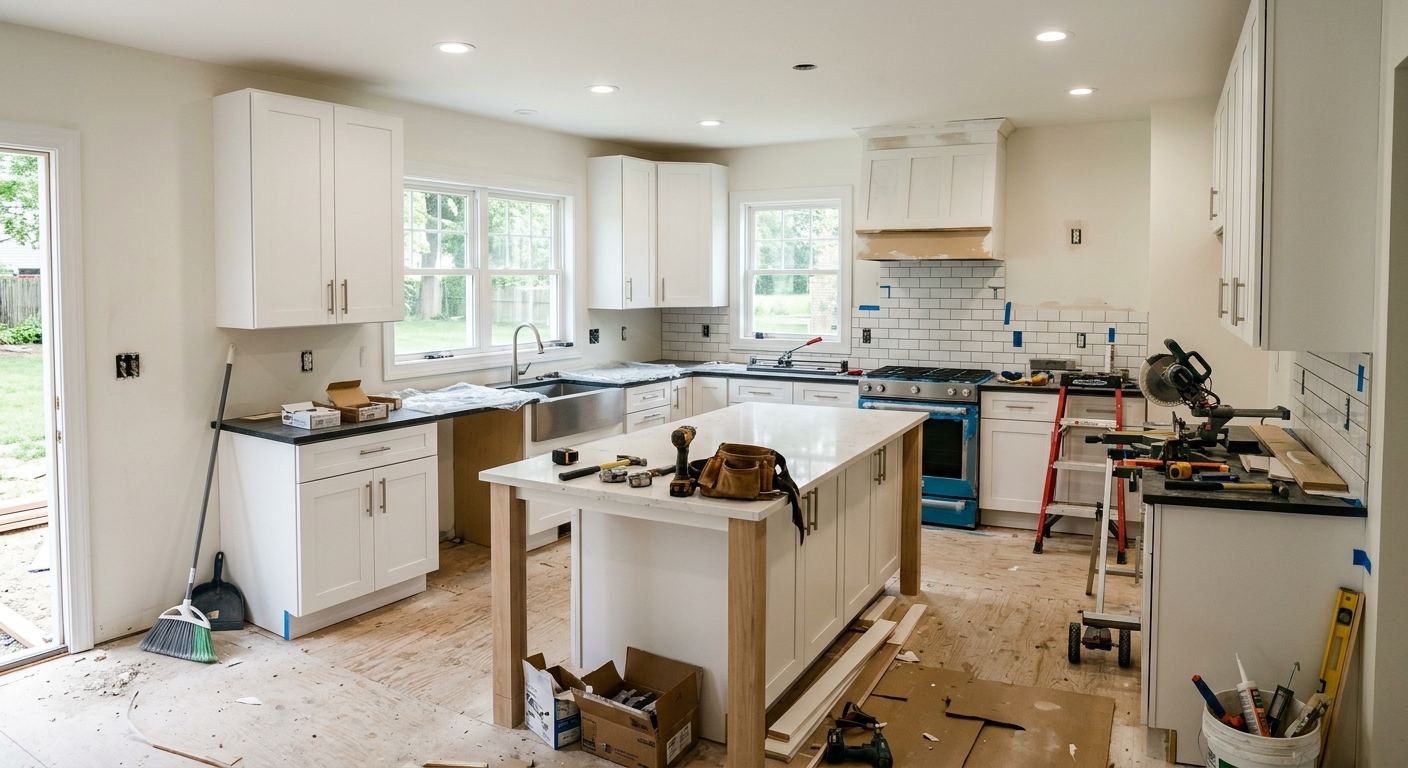
Kitchen renovation options and costs in Kaleden
Kaleden kitchen renovations are often decided less by the season and more by the buyer expectations that come with the Lower Mainland–Southwest market. Even in a small town setting—where only about 1,186 people live locally (Statistics Canada, 2021 Census)—many homeowners plan for resale, so the “right” finish level matters. In this broader region, higher-value homes tend to support upgraded cabinetry and harder-wearing surfaces; that’s why you’ll see premium packages cluster around the most active renovation pockets of the area and why contractors stay busiest when homeowners want design-led upgrades, not just cosmetic changes. The trade demand is especially high around Okanagan-adjacent communities and commuter corridors where contractors can keep crews working consistently and schedule deliveries efficiently.
Cost is also heavily shaped by what you’re replacing. In the Lower Mainland–Southwest, pricing is driven more by home value, income, and expected finish level than by climate. Coastal and valley weather can be humid and salt-free, but kitchen failure points are more about daily use: water exposure at sinks/dishwashers, grease on backsplashes, and temperature swings near ranges. These realities influence how quickly laminate chips, how well caulking holds, and whether you need full replacement versus a simple refinish. Contractors in the region can often quote faster for refresh scopes, but full remodels swing wider—because layout changes, plumbing/gas work, and upgraded cabinet systems create labour-heavy, inspection-dependent steps. When you’re comparing options, start by choosing the renovation tier, then match that to your countertop and layout decisions.
Use the table below as a budgeting baseline for Kaleden, then tailor it to your room size and whether you’re keeping the existing plumbing lines and electrical locations.
| Renovation Tier |
What's Included |
Typical Duration |
Price Range |
| Cosmetic refresh (paint, hardware, new appliances only) |
Cabinet repaint or touch-ups, new pulls/hinges, new dishwasher or range/hood (no plumbing or gas relocation), minor caulking and trim |
1–3 weeks |
$8,000–$25,000 |
| Mid-range full renovation (new cabinets, counters, sink, tile) |
Semi-custom or stock cabinets, countertop install, sink and faucet swap, backsplash tile, flooring patch/replace as needed, standard lighting updates |
3–8 weeks |
$40,000–$80,000 |
| High-end full renovation (custom cabinets, stone counters, island) |
Fully custom millwork, quartz/stone countertops, island with electrical, extended backsplash, upgraded hardware, upgraded appliances package, more complex layout |
7–14 weeks |
$90,000–$120,000 |
| Cabinet refacing only (new doors + drawer fronts, same boxes) |
Door/drawer front replacement, new hardware, updated edge banding and finish on existing cabinet boxes (where structurally sound) |
1–4 weeks |
$12,000–$35,000 |
| Countertop swap only (laminate to quartz or stone) |
Remove and dispose old tops, install new quartz/stone, reseal/silicone at sink and backsplash transitions, may include sink cut-outs and minor cabinet leveling |
3–7 days (plus fabrication time) |
$6,000–$14,000 |
| Backsplash tile installation only |
Tile layout and installation, waterproofing details where required, grout/seal, cut-outs for outlets and plumbing penetrations |
3–10 days |
$1,500–$6,000 |
Prices are estimates only and vary by project scope, site access and material selection.
What affects the price of kitchen renovation in Kaleden
In Kaleden and across the Lower Mainland–Southwest, the same kitchen can land 30–50% apart depending on how owners choose their finish tier and how much “work under the skin” is required. Climate is rarely the main driver; instead, local home values, typical household income expectations, and the finish level that buyers look for on resale steer most budgeting decisions. In higher-value Lower Mainland–Southwest pockets, homeowners often default to quartz or stone counters and semi-custom cabinetry because the renovation cost is easier to recover when a kitchen shows well in photos and during showings. In more modest scopes, laminate and stock cabinet systems dominate because they keep upfront costs predictable and still deliver a clean, refreshed look.
Where prices unpredictably swing is layout and infrastructure. Removing a wall, adding an island, or moving a gas line or plumbing connection tends to create the biggest jump regardless of whether you’re installing laminate or stone—because the labour includes framing, permits/inspections, and trade coordination. For example, if your existing sink is staying put, a countertop swap may sit in the “countertop swap only” band, but if you relocate the sink for better sightlines or an island, you should expect the project to move toward a mid-range full renovation cost band due to plumbing rework and additional cabinets/backsplash work. Another common Kaleden cost lever is older cabinetry and subfloor condition: if 1990s-era base cabinets are above a tired subfloor, you can lose time on leveling and patching—often pushing a refresh closer to a renovation once you open walls. In kitchens exposed to seasonal humidity swings, we also see caulking and adhesive failures more often around sinks and the edges of countertops, which can turn a simple “swap” into a targeted rebuild of seams and water-damaged framing.
| Price Factor |
Why It Matters |
Cost Impact |
| Cabinet tier — stock vs. semi-custom vs. fully custom millwork |
Material quality, fit/finish, internal storage, and lead times differ widely |
Can change total cabinet portion by tens of thousands of dollars |
| Countertop material — laminate vs. quartz vs. granite vs. stone |
Price per square foot, fabrication complexity, and edge/detail choices |
Often shifts countertop scope by several thousand dollars |
| Layout change — wall removal, island add, plumbing/gas move |
Creates trade coordination, framing, inspections, and rework risk |
Typically the largest swing in overall project cost |
| Appliance package tier — builder vs. mid-range vs. pro-grade |
Electrical/gas requirements and premium finishes plus accessories |
May add or reduce several thousand dollars depending on specs |
| Flooring — refinish existing vs. full replacement |
Undercut/transitioning cabinetry and matching older materials |
Full replacement can add a noticeable labour + material line item |
| Backsplash — ceramic tile vs. marble vs. full-height slab |
Pattern matching, installation time, and substrate prep needs |
Tile is usually moderate; slab/waterfall details raise costs |
| Electrical — new circuits for island, under-cabinet lighting |
Requires licensed work, new receptacles, and lighting runs |
Can materially increase labour and inspection time |
| Permit fees and licensed trade requirements |
Certain work must be permitted and inspected; scheduling adds overhead |
Small fee vs potentially larger scheduling and coordination costs |
Permits & regulations in British Columbia
In British Columbia, simple swaps usually don’t trigger permits, but any work that changes building systems or safety-critical elements often does. Cabinet and countertop swaps generally do not require a building permit. That said, moving plumbing supply or drain lines, relocating gas for a stove/range, removing a load-bearing wall, or adding new electrical circuits (for example, an island with receptacles and dedicated lighting circuits) typically require permits and licensed trades. Gas work must be completed by a licensed gas fitter, and electrical work must be performed by a licensed electrician—both generally involve inspection steps tied to the permit.
For a homeowner in Kaleden, the practical way to verify this is before you sign. First, ask the contractor what scope they consider permit-requiring and whether they will pull the permit(s) (and for what trades). Then verify the contractor’s licensing and coverage: request their licence number(s) and check the appropriate online registry for active status (for trade trades, look up the specific licence tied to the company/person performing the work). Next, obtain a certificate of insurance showing liability coverage and request confirmation that any subcontractors are insured as well. For worker protection coverage in the province, ask whether the company carries coverage through the required worker protection system; if they cannot provide it, don’t proceed.
Always confirm permit responsibility in writing—who submits, who schedules inspections, and what trade pulls which permit—so you’re not surprised at the end of the job.
Cabinets, countertops and layout decisions in Kaleden
When you’re planning a kitchen renovation in Kaleden, three decisions do the most to determine both the feel of the finished room and the total cost: (1) cabinet tier, (2) countertop material, and (3) layout changes. Cabinet tier sets your baseline speed and fit. Stock cabinets are the fastest and usually the cheapest, but they may not maximize storage or match a unique wall angle. Semi-custom cabinets are the popular mid-range approach in the Lower Mainland–Southwest because you get better storage options and improved door styles without the long lead times of fully custom millwork. Custom cabinets cost more, yet they can be worth it if you have an awkward footprint and need made-to-fit solutions for pantry space, tall units, or an island configuration.
Countertops should match how you cook and how maintenance works in your household. Laminate can be budget-friendly but is more vulnerable to edge wear and heat damage; quartz provides better stain resistance and durability for everyday use and is a common resale-friendly choice. If you’re thinking granite or other natural stone, factor in visual variation and sealing expectations—beautiful, but requires a more deliberate maintenance routine.
Layout changes are where “pretty” becomes “expensive.” Open-concept wall removal, island addition, and plumbing/gas relocation can be justified when they create real usable space and improve traffic flow. For example, if you keep your sink in place and just upgrade from laminate to quartz, you might stay near a countertop-only budget band. But if you relocate the sink to the island, you’re not just paying for countertop fabrication—you’re funding plumbing work, potential electrical adjustments, and additional cabinet framing to make the new layout functional.
| Option |
Durability |
Maintenance |
Best For |
Price Range |
| Stock cabinets (big-box) |
Good for typical use; depends on box quality and installation |
Low; wipe and keep hardware tightened |
Fast projects, budget control, straightforward footprints |
$8,000–$20,000 |
| Semi-custom cabinets (local dealer) |
High; better storage layouts and finish options |
Low to moderate; routine hardware care |
Most homeowners aiming for a durable “mid-range” kitchen look |
$20,000–$45,000 |
| Custom cabinets (local millwork shop) |
Very high; can be built to site conditions and storage needs |
Low with proper sealing/handling |
Unique layouts, space optimization, and premium resale presentation |
$45,000–$75,000 |
| Laminate countertop |
Moderate; edges and heat can be weak points |
Low day-to-day; protect seams and avoid prolonged heat |
Refresh budgets and renters/shorter ownership horizons |
$3,000–$6,000 |
| Quartz engineered countertop |
High; resistant to stains and everyday impacts |
Low; wipe clean, manage caulking at sink edges |
Family kitchens that want a resale-friendly, low-maintenance surface |
$6,000–$11,000 |
| Granite / natural stone countertop |
High; durable but depends on stone type and finish |
Moderate; sealing and careful cleaning |
Owners wanting natural variation and premium styling |
$8,000–$14,000 |
| Butcher block countertop |
Moderate to high; best with regular sealing |
Moderate; periodic oiling and water management |
Casual, warm aesthetics; homeowners who cook often and maintain finishes |
$4,000–$10,000 |
| Marble countertop |
Moderate; beautiful but can etch/stain with acidic use |
Higher maintenance; careful cleaning and protection |
Design-forward kitchens with lighter-duty use |
$10,000–$18,000 |
How to choose a kitchen renovation contractor in Kaleden
Choosing a kitchen renovation contractor in Kaleden starts with proof, not promises. In British Columbia, you should verify: (1) the right trade licensing for the people doing the work, (2) liability insurance, and (3) worker protection coverage. To check licensing, ask for the contractor’s licence details and then confirm they’re active using the applicable online registry. For insurance, request a current certificate of insurance showing liability coverage and ensure the coverage is valid for the renovation period. For worker protection, ask whether the company carries required worker protection coverage; if you can’t get documentation, treat it as a major risk.
For quotes, get 2–3 itemised proposals rather than a single lump sum. You want labour and materials separated so you can see what’s included for cabinetry install, countertop fabrication/installation, tile prep, disposal, and any site protection. Read the scope line by line: are permits included, who pulls them, and what is excluded (like subfloor repairs, drywall patching, or making good after plumbing reroutes)? Disposal should be clearly stated—both for demolition and packaging. Warranty matters too: confirm the workmanship warranty length and whether product warranties are direct from the manufacturer. Ask if warranties are transferable to future owners, which helps if you’re planning to sell soon.
For payments, never rush to large deposits. A common safe approach is to keep upfront payments to about 10–15%, then hold a portion until punch list completion. Finally, demand a written start date and a completion estimate, not “best-case” timing.
- Request licence numbers and confirm they’re active in the appropriate online registry.
- Ask for a certificate of liability insurance and verify the dates cover your project.
- Confirm worker protection coverage for the contractor and subcontractors.
- Get 2–3 itemised quotes with labour/material breakdowns (not lump sums).
- Verify who pulls permits and includes inspection scheduling in the scope.
- Confirm demolition/disposal is included (dump fees and jobsite cleanup).
- Check what’s excluded: drywall patching, subfloor leveling, additional plumbing/electrical.
- Insist on a clear material list: cabinet brand/line, countertop thickness/finish, tile type.
- Ask for cabinet and countertop lead times so your timeline isn’t guessing.
- Review the warranty: workmanship duration, product/manufacturer warranty terms, and transferability.
- Set a payment schedule with a holdback until completion and signed punch list.
- Get a written timeline including start date, milestones, and an allowance for inspections/fabrication.
Red flags in Kaleden include: vague “turnkey” pricing with no itemisation, no proof of insurance/licensing when you ask, lead times given without written order dates, skipping permit responsibility discussion, and requesting large upfront payments beyond 10–15% without a clear reason.
Frequently asked questions — kitchen renovation in Kaleden
Can I move my kitchen sink or stove?
Yes, you can move a kitchen sink or stove in British Columbia, including around Kaleden, but the work falls into permit/inspection territory when plumbing or gas services are relocated. Moving a sink usually means reworking drain and supply lines, plus shut-off valves and proper venting where applicable—your contractor should list what’s included and who is doing the plumbing. Relocating a stove or range is even more sensitive because gas work must be performed by a licensed gas fitter, and it’s typically tied to permits and inspections. If you’re trying to keep costs closer to a “countertop swap only” budget, the best way is to keep the sink in the current plumbing zone. If you want a new island layout, be prepared for the project to trend toward the mid-range full renovation band (often in the $40,000–$80,000 range depending on cabinet and finish choices).
What's the most cost-effective kitchen upgrade?
The most cost-effective upgrade is usually the one that delivers a “new kitchen” look without triggering the biggest infrastructure changes. In Kaleden kitchens, that typically means either (1) a cosmetic refresh with new hardware and appliances only, or (2) cabinet refacing plus a targeted backsplash update. If your cabinet boxes are still sound, refacing can dramatically improve the front look while controlling labour and material waste. A backsplash tile installation is also a relatively contained scope when the walls are already in good shape, and it gives a high visual payoff. If you want to upgrade performance, a countertop swap to quartz can be a smart middle option compared with laminate, while avoiding the bigger cost of moving plumbing. As a rule of thumb, cosmetic refresh scopes often land in the $8,000–$25,000 range, whereas a cabinet refacing + backsplash combination can move you into higher but still controlled budgets.
Custom vs stock cabinets — is custom worth it?
Custom cabinets are worth it when your footprint is irregular, you need built-ins to solve a real storage problem, or you’re aiming for a design-led finish that a buyer will notice immediately. Stock cabinets are typically the fastest and cheapest route—great when the kitchen layout is straightforward. Semi-custom is often the best “value sweet spot” in the Lower Mainland–Southwest because it balances lead time, fit, and variety without the highest millwork costs. In Kaleden, many homeowners consider custom when they’re also doing a full kitchen renovation, where the incremental cabinet spend is easier to justify because countertops, flooring, and layout work are already underway. If you’re trying to stay near the mid-range full renovation band (roughly $40,000–$80,000), custom may be possible but you’ll likely need to be selective on countertop thickness, island size, and the extent of layout changes. For tighter budgets, stock or semi-custom usually makes more financial sense.
How do I choose a kitchen contractor in Kaleden?
Start with verification and transparency. Ask for proof of British Columbia trade licensing as applicable, and request a current certificate of liability insurance with dates that cover your renovation window. Confirm worker protection coverage too—don’t assume. Then get 2–3 itemised quotes so you can compare labour line items (cabinet install, countertop install, tile prep) and material selections (specific cabinet lines, countertop type, tile grade). Read the scope carefully: is permit pulling included, is disposal included, and what happens if the subfloor or framing needs correction once cabinets are removed? A good contractor will identify unknowns during site review and include allowances or clear exclusions in writing. Finally, align the payment schedule with quality: keep upfront payments to about 10–15% and hold back until the job is complete and any punch list items are addressed. If someone rushes you toward big deposits or avoids written details, that’s a major warning sign.
What order do kitchen renovation steps happen in?
In Kaleden kitchens, a typical sequence looks like this: First, confirm your layout and finish selections, then schedule fabrication (especially for custom cabinets and stone/quartz tops). Next comes demolition and rough-in prep (electrical, plumbing, and any gas routing if changing locations). After rough-in, framing and drywall patching happen where needed, followed by cabinet installation once the base is level and protected. Countertops go in after cabinets are secured and sealed at the appropriate transitions. Then you install backsplash tile, under-cabinet lighting (if included), and any final trim. Flooring repair or replacement is usually coordinated so edges are properly finished—sometimes it’s done before cabinets, sometimes after, depending on your existing floor and transitions. Finally, install appliances, complete caulking and sealing, and do a punch list walk-through. This order helps prevent damage to finished surfaces during trades work.
Can I live at home during a kitchen renovation in Kaleden?
Often yes, but it depends on the scope and how much dust and utility disruption your contractor has to manage in British Columbia. During cosmetic refreshes, like paint/hardware and appliance-only swaps, many homeowners stay in place comfortably, with daily work confined to cabinets and surfaces. For mid-range and high-end full renovations, living at home is more feasible if the contractor can set up a temporary kitchen zone, protect floors and doorways, and schedule the riskiest phases (demolition and plumbing/electrical rough-ins) with minimal crossover. If you’re keeping existing sink locations and avoiding gas/plumbing relocation, you can usually maintain daily routines better than with a full layout change. Budget scopes still matter for planning: for example, a full renovation commonly ranges from $40,000–$120,000, and larger jobs increase the time you’ll be without a fully functional kitchen. Ask your contractor for a daily containment plan, water access plan, and a realistic completion timeline in writing before you decide.