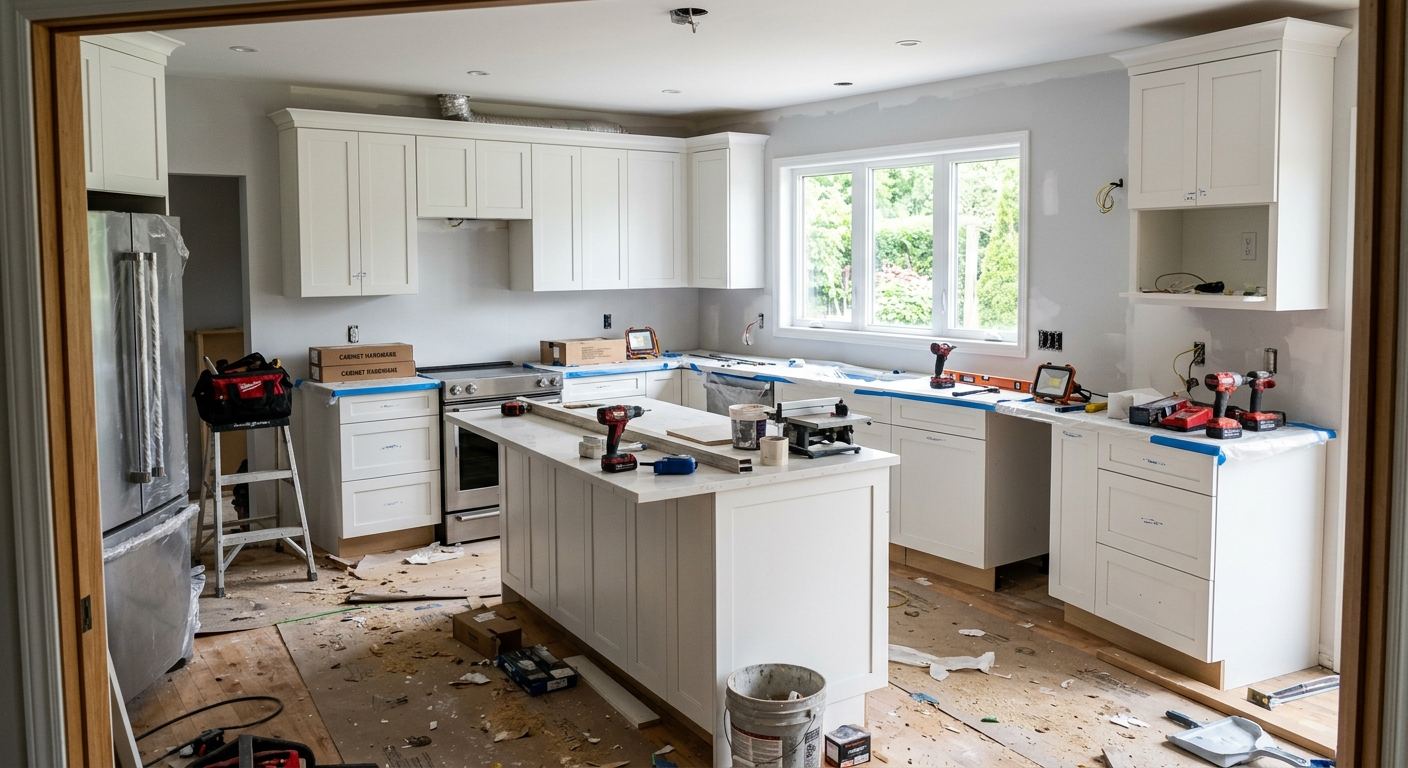
Kitchen renovation options and costs in Lions Gate
Lions Gate, British Columbia is a small but high-expectation community, and that shows up in how homeowners budget for kitchen renovations. With a population of about 2,660 (Statistics Canada, 2021 Census), the local trade scene is tight, so scheduling can be slightly slower than in bigger neighbouring centres. At the same time, the Lower Mainland–Southwest is driven more by home value and expected finish level than by climate—meaning many owners in the area lean toward semi-custom cabinetry and upgraded surfaces when they want the kitchen to feel “ready for resale.” In higher-value parts of Metro Vancouver, that finish expectation pushes project totals higher, often compared with a more restrained refresh using laminate and stock materials.
The Lower Mainland–Southwest also has a different cost rhythm than, say, the Prairies or Northern BC. You still pay for weather protection and good building-envelope practices, but the big variable for kitchen budgets is typically material and labour demand. In Lions Gate and nearby areas, trades can be booked out around peak season, and that affects total labour pricing more than the weather itself. If your kitchen is in an older home stock (common in parts of Lions Gate), the scope often expands quickly once contractors assess subfloor condition, venting, and how the plumbing routes run behind walls.
Trade demand is especially strong for cabinet and countertop installs where homes are updated for function—often in the waterfront-adjacent pockets of Lions Gate, where layout upgrades like islands and better storage are popular. With that in mind, here’s a practical breakdown of renovation tiers before you compare contractor quotes.
| Renovation Tier |
What's Included |
Typical Duration |
Price Range |
| Cosmetic refresh (paint, hardware, new appliances only) |
Cabinet paint/stain (or repaint), new hardware, appliance swap (no plumbing/gas moves), minor caulking/trim touch-ups |
1–2 weeks |
$10,000–$25,000 |
| Mid-range full renovation (new cabinets, counters, sink, tile) |
Semi-custom or stock cabinets, quartz or upgraded counters, new sink/faucet (no major layout move), backsplash tile, updated flooring/tile work |
3–6 weeks |
$40,000–$75,000 |
| High-end full renovation (custom cabinets, stone counters, island) |
Fully custom cabinetry, stone counters, island build-out (often with electrical upgrades), custom backsplash, upgraded lighting and hardware, higher-end finishes throughout |
6–12 weeks |
$85,000–$120,000 |
| Cabinet refacing only (new doors + drawer fronts, same boxes) |
New doors/drawer fronts, veneer or panel replacement where needed, new hardware, optional repaint of existing boxes |
2–4 weeks |
$15,000–$35,000 |
| Countertop swap only (laminate to quartz or stone) |
Removal and install of new countertop, sink cut-out if matching or swapping sink, basic sealing/finishing, optional backsplash tie-in |
5–10 business days |
$6,000–$12,000 |
| Backsplash tile installation only |
Tile layout and installation, waterproofing/underlayment as needed, grouting and sealing, trim at edges and outlets |
3–7 business days |
$1,500–$6,000 |
Prices are estimates only and vary by project scope, site access and material selection.
What affects the price of kitchen renovation in Lions Gate
In the Lower Mainland–Southwest, it’s common to see quotes for the “same” kitchen land 30–50% apart once you factor in finish tier, labour scheduling, and how much the contractor expects to uncover behind walls. Across British Columbia, the biggest driver is usually not climate—it’s local housing value, buyer expectations, and the finish level that helps homeowners protect resale value. In higher-value markets around Metro Vancouver, many owners move toward quartz or stone counters and semi-custom cabinetry because the cost can be more easily recovered on resale. In more modest scopes, laminate and stock cabinets remain popular because they deliver a visible refresh without the same material premium.
Layout decisions are where costs become most unpredictable, regardless of whether you choose a mid-range full renovation (often starting around $40,000–$75,000) or push toward a high-end rebuild (commonly $85,000–$120,000). A wall removal, an island addition, or relocating a gas line can trigger new venting needs, electrical changes, and permit requirements—all of which add labour and coordination time.
In Lions Gate specifically, older home construction can raise costs when the kitchen’s rough-in plumbing is routed through older chases or when subfloor flatness requires additional prep. Conversely, costs can be lower if your existing cabinet boxes are in solid condition for a refacing approach (often $15,000–$35,000) or if your new countertop matches existing cut-outs closely. Also, because the Lower Mainland–Southwest trades market is competitive, a faster timeline you request can increase labour rates or overtime costs, especially for installs that depend on cabinet delivery windows.
| Price Factor |
Why It Matters |
Cost Impact |
| Cabinet tier — stock vs. semi-custom vs. fully custom millwork |
Materials, tolerances, and how well cabinets fit uneven walls and older layouts |
Typically +$10,000 to +$40,000 moving up tiers in a full renovation |
| Countertop material — laminate vs. quartz vs. granite vs. stone |
Material cost, fabrication complexity, and sink/edge options |
Laminate can save roughly $3,000–$6,000 versus premium stone; higher-end stone can add $4,000–$12,000 |
| Layout change — wall removal, island add, plumbing/gas move |
More trades coordination, demolition, and re-routing utilities |
Often the single biggest swing: add $8,000–$30,000 depending on scope |
| Appliance package tier — builder vs. mid-range vs. pro-grade |
Electrical/gas requirements, venting complexity, and trim kit compatibility |
Can add $1,500–$10,000+ depending on brand tier and venting |
| Flooring — refinish existing vs. full replacement |
Subfloor prep and whether existing flooring can be protected and reused |
Refinish/patch: often +$2,000–$6,000; full replacement: +$4,000–$15,000 |
| Backsplash — ceramic tile vs. marble vs. full-height slab |
Installation time and material fragility; grout and waterproofing requirements |
Full-height premium installs can add $2,000–$8,000 over basic tile |
| Electrical — new circuits for island, under-cabinet lighting |
Licensed work, load calculations, and new wiring paths |
Commonly +$1,500–$8,000 depending on number of circuits and fixtures |
| Permit fees and licensed trade requirements |
Work that touches plumbing/gas/electrical/structural typically requires permits and inspections |
Often +$500–$3,500 in direct fees, plus coordination labour |
Permits & regulations in British Columbia
In British Columbia, cabinet and countertop swaps generally do not require permits, as long as you’re not changing rough-ins. That means replacing counters (including quartz or stone) on the existing layout, and swapping cabinet faces or entire cabinetry without moving plumbing or electrical lines is typically treated as renovation work that doesn’t trigger a permit requirement.
Permits and licensed trades are required when you change the systems behind the kitchen. For example: moving plumbing supply/drain lines, relocating a gas range or changing gas connections, adding or relocating vents/hood ducting tied to gas cooking, removing a load-bearing wall, or adding new electrical circuits (like dedicated power to an island, under-cabinet lighting with new wiring paths, or upgrading outlets beyond simple replacements). Gas work must be done by a licensed gas fitter, and electrical work must be done by a licensed electrician, with inspections completed after the work is installed.
To verify a contractor in Lions Gate before you sign: (1) confirm their licence status for relevant trades in the appropriate online registry, (2) request a certificate of insurance (liability) with the project address listed, and (3) ask for evidence of worker coverage (WSIB/WCB) if applicable to their workers. Then, insist on a written contract stating who pulls permits, who schedules inspections, and what’s included for disposal and protection. A reputable contractor will provide clear documentation without pressure.
Cabinets, countertops and layout decisions in Lions Gate
Your Lions Gate kitchen renovation will usually be decided by three big choices: (1) cabinet tier, (2) countertop material, and (3) layout changes. Cabinet tier affects both how fast the project moves and how well the kitchen fits older framing. Stock cabinets are the quickest and least expensive, but they can be more noticeable in homes with out-of-square walls. Semi-custom is the most popular mid-range option because it balances fitting accuracy and lead times—especially useful in renovations where you want clean lines without waiting for full custom millwork.
Countertop material is the durability-and-feel decision. Quartz is a strong “busy kitchen” choice because it resists staining better than many natural stones and doesn’t require the same sealing routine. Natural stone like granite offers a premium look and strong heat tolerance, but maintenance expectations are higher. If you’re choosing between laminate and quartz, the price delta can justify itself quickly when you consider day-to-day use: swapping to quartz often moves you toward a mid-range full renovation total starting around $40,000–$75,000 rather than a narrower countertop-only plan.
Layout changes (wall removal, adding an island, plumbing/gas relocation) are where ROI becomes space-based rather than finish-based. If you gain practical storage and circulation—like an island that actually allows prep and seating—those costs can be justified. In Lions Gate, many older homes benefit from better storage and improved workflow, but the cost is still unpredictable if ducts, venting, or rough-ins are routed through concealed chases.
Concrete example: if you keep plumbing where it is and only upgrade counters and cabinets, you might stay around $40,000–$75,000 for a mid-range renovation. If you add an island and relocate plumbing to support a new sink, the job often rises toward the high-end rebuild band ($85,000–$120,000) because the scope expands across trades, permits, and schedule coordination.
| Option |
Durability |
Maintenance |
Best For |
Price Range |
| Stock cabinets (big-box) |
Good for standard dimensions; durability depends on box construction and finish |
Low; wipe-down care and gentle cleaning of surfaces |
Budget refreshes and faster timelines |
$8,000–$20,000 |
| Semi-custom cabinets (local dealer) |
High; better fitting options and improved hardware choices |
Low to moderate; hinges/soft-close care as needed |
Most Lions Gate mid-range renovations |
$20,000–$45,000 |
| Custom cabinets (local millwork shop) |
Excellent; tailored to out-of-square walls and unique layouts |
Low; depends on finish type and hardware quality |
Design-led layouts and challenging spaces |
$45,000–$80,000 |
| Laminate countertop |
Moderate; edges and seams are the main wear points |
Low; avoid prolonged moisture at seams |
Cost-conscious refreshes |
$3,000–$6,000 |
| Quartz engineered countertop |
High; very resistant to staining and everyday wear |
Low; basic cleaning with non-abrasive products |
Busy kitchens and resale-friendly upgrades |
$6,000–$10,000 |
| Granite / natural stone countertop |
High; strong heat tolerance |
Moderate; may need periodic sealing depending on stone |
Premium look with natural variation |
$8,000–$12,000 |
| Butcher block countertop |
Moderate to high; resilient but can scratch and needs care |
Moderate; oiling and moisture management |
Families who want warmth and easy spot-repair |
$7,000–$11,000 |
| Marble countertop |
Moderate; softer surface and can etch |
Higher; regular sealing and careful cleaning |
Low-traffic kitchens or homeowners who want the look |
$10,000–$14,000 |
How to choose a kitchen renovation contractor in Lions Gate
Choosing the right contractor in Lions Gate comes down to proof, not promises. First, verify British Columbia licensing and the right coverage. Request the contractor’s relevant licence details (and licence numbers if they perform regulated scopes), then ask for their liability insurance certificate showing the project address. For coverage evidence, ask how they handle worker coverage (WSIB/WCB) for their crew and any subcontractors; you should be provided with clear documentation rather than verbal assurances.
Next, get 2–3 itemised written quotes. “Itemised” matters: you want labour and materials broken out—cabinet supply, fabrication, installation labour, countertop fabrication and templates, electrical allowances, demolition, disposal, and any plumbing/gas coordination. Avoid lump sums that don’t identify what you’re actually paying for. Read the scope carefully for exclusions: is permit pulling included, are protective floor coverings included, and does disposal/haul-away fall under their price?
For warranties, ask for two parts: workmanship warranty (how long they stand behind installation) and product/manufacturer warranty (for cabinets, countertops, and appliances). Clarify whether warranties are transferable if you sell the home. On payments, never pay more than 10–15% upfront; use progress milestones and hold back a meaningful amount until the job is substantially complete and defects are corrected. Finally, insist on timeline details: start date, lead-time assumptions, and a completion estimate stated in writing.
- Confirm licensing for any regulated trades involved and ensure subcontractors are covered.
- Ask for a certificate of insurance (liability) and verify the project address.
- Request evidence of worker coverage (WSIB/WCB) for their staff and subcontractors.
- Get 2–3 itemised quotes (labour + materials) rather than one lump sum.
- Verify countertop measurements and template process is included to reduce remake risk.
- Confirm who pulls permits and who pays permit fees if any are required.
- Check disposal/haul-away and dump fees are included in the written scope.
- Confirm floor protection and jobsite cleanup responsibilities.
- Ask for a written warranty statement for workmanship and products.
- Use a payment schedule with no more than 10–15% upfront; hold back until punch list is done.
- Request a start date and completion target, plus how delays due to cabinet delivery are handled.
- Ensure the quote lists cabinet finish type, countertop material/edge profile, and backsplash coverage.
Red flags I see too often in Lions Gate: contractors who won’t provide itemised quotes, “permit included” claims without stating who is pulling permits, vague warranty terms (“we’ll fix it”) without duration, demanding large upfront deposits, and timelines that ignore cabinet and countertop lead times.
Frequently asked questions — kitchen renovation in Lions Gate
What's the most popular kitchen style in Lions Gate right now?
In Lions Gate, the most commonly requested look is a bright, functional modern transitional kitchen: shaker-style or simple slab-front cabinetry, neutral tones (warm whites, greys, and light woods), and quartz countertops with a straightforward edge profile. Homeowners often pair that with a practical backsplash (ceramic tile or a clean-format stone-look) and upgraded hardware for a “finished” feel. Because many homes are older and the resale audience in the Lower Mainland–Southwest expects move-in-ready updates, the popular finish tier tends to align with mid-range renovations, which commonly fall around $40,000–$75,000 when you’re keeping plumbing in place.
How do I know if I need to update my kitchen plumbing in Lions Gate?
You typically don’t need to replace everything, but you do need to inspect before you renovate. Signs include low water pressure, inconsistent hot/cold temperature, frequent leaks under the sink or dishwasher, corroded shutoff valves, or older braided lines that feel brittle. If you plan a sink move, new faucet style, or an island sink, you’ll almost certainly need plumbing changes and likely permit involvement. In older Lions Gate homes, I often see hidden issues behind toe-kicks or where supply lines were routed through older chases—small problems become major when cabinets are removed. A good contractor verifies shutoffs, checks for water damage, and confirms whether any rough-in rework is required before locking the cabinet layout.
What is the difference between a galley and open-concept kitchen?
A galley kitchen is typically a narrow, corridor-like layout with counters and storage on two facing walls, often with a separate dining area beyond. An open-concept kitchen removes barriers or rethinks the wall structure so the kitchen flows into the living/dining space. In British Columbia, an open-concept goal can be simple if you’re not touching structural elements, but wall removal that’s load-bearing or requires venting changes can trigger permits and inspections. Cost-wise, moving from galley to open-concept can increase labour substantially because demolition, framing, flooring transitions, and electrical updates add coordination time. If you’re just updating finishes, you may stay in more predictable bands like the mid-range scope (around $40,000–$75,000), but layout transformation often pushes you higher.
How do I get accurate kitchen renovation quotes in Lions Gate?
Accurate quotes come from clear scope and measurements, not from a first phone call estimate. Ask for 2–3 itemised written quotes that separate labour and materials: cabinet supply/installation, countertop fabrication/template, plumbing/electrical allowances, tile and backsplash installation, demolition, and disposal. Confirm whether permits are included and who is responsible for pulling them if any plumbing/gas/electrical changes are required. A contractor should also document what’s excluded (for example, appliance cost, floor replacement extent, or drywall repair beyond a stated allowance). If you want a countertop upgrade only, quotes should reflect the countertop install band (often $6,000–$12,000) rather than mixing it into full renovation totals.
What's the best countertop material for a busy Lions Gate kitchen?
For a busy Lions Gate kitchen, quartz is usually the most practical “best overall” choice: it’s durable, resistant to staining from everyday spills, and low-maintenance compared with many natural stones. Granite is also excellent for heat tolerance and offers premium natural variation, but it can require periodic sealing depending on the specific stone. Marble looks stunning but is more prone to etching from acidic foods and typically has a higher maintenance routine. If you cook often and want fewer day-to-day worries—especially with a family and frequent cleaning—quartz is commonly the smart middle-to-premium selection. In cost planning, quartz countertops frequently align with the countertop swap band (around $6,000–$10,000 for many projects), which helps keep the overall renovation predictable.
How do I add an island to my Lions Gate kitchen?
Adding an island is usually doable, but it’s one of the most scope-sensitive updates because it can require new electrical circuits and, if you want a sink or range in the island, plumbing and sometimes gas rework. Start by deciding whether the island is purely storage/prep with no utilities, or whether it includes a sink (needs drain and supply) and/or cooktop (may require venting and gas considerations). In British Columbia, electrical work for island lighting and new outlets must be done by a licensed electrician, and plumbing/gas changes require the appropriate licensed trades and inspections. Budget-wise, an island addition can push you from a straightforward refresh into full renovation territory quickly—particularly if you’re moving utilities—so it’s worth getting a quote that clearly lists demolition, framing/repair, cabinet base adjustments, and utility tie-ins.