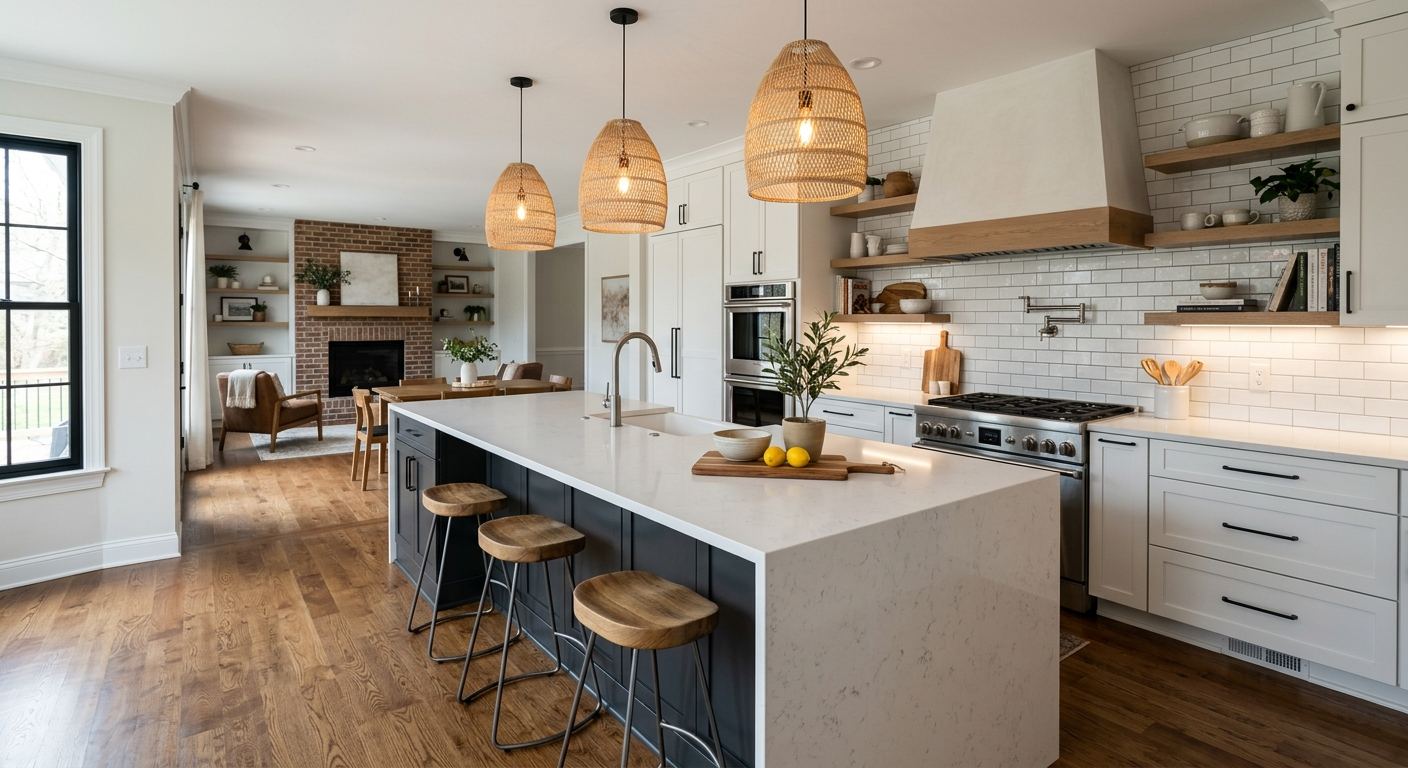
Kitchen renovation options and costs in Dufferin
Dufferin, British Columbia is a small community (population 2,783 per Statistics Canada, 2021 Census), but kitchen demand is shaped by the wider Lower Mainland–Southwest market. In this region, homeowners often weigh the renovation against resale value and day-to-day usability. That matters because finish expectations tend to track local purchasing power and housing values more than the local climate alone. Where household incomes and home values support higher-end upgrades, buyers more readily accept semi-custom or custom cabinetry and stone surfaces—finishes that also hold up well to the damp, temperature-swing conditions common along the Lower Mainland. (Statistics Canada, 2021 Census)
Pricing in the Lower Mainland–Southwest is also driven by contractor availability and scheduling. When trades are booked out, labour can rise even if materials don’t. At the same time, the region’s typical housing stock—many older homes and renovations done in waves—means existing cabinets and framing are sometimes out of square, which can add labour for re-fitting and patching. If you’re in the area where homeowners frequently update their kitchens for family use and resale appeal (often along the more established residential pockets near the broader Dufferin-area corridor), you’ll notice quicker turnaround when the scope stays within a refresh rather than a full structural change.
If you’re trying to budget from the start, the table below compares common scopes and durations so you can map your plan to a realistic range.
| Renovation Tier |
What's Included |
Typical Duration |
Price Range |
| Cosmetic refresh (paint, hardware, new appliances only) |
Cabinet paint or refinish, new hardware, appliance swap, minor touch-ups |
1–2 weeks |
$12,000–$28,000 |
| Mid-range full renovation (new cabinets, counters, sink, tile) |
New semi-custom or stock cabinets, countertop replacement, sink + faucet, backsplash tile, updated lighting basics |
3–6 weeks |
$40,000–$85,000 |
| High-end full renovation (custom cabinets, stone counters, island) |
Custom cabinets/millwork, quartz/stone counters, island, premium hardware, upgraded backsplash (including larger-format tile or slab options) |
6–12 weeks |
$85,000–$120,000 |
| Cabinet refacing only (new doors + drawer fronts, same boxes) |
Door/drawer replacement, new veneers, updated hardware, optional paint transition, basic backsplash allowance |
1–3 weeks |
$8,000–$28,000 |
| Countertop swap only (laminate to quartz or stone) |
Removal and installation of new countertop material, cut-outs, edge profile, sink cut-in (if staying in place) |
3–7 days |
$3,000–$12,000 |
| Backsplash tile installation only |
Tile supply allowance, prep/patching, layout, grout/seal (where needed), clean-up |
3–10 days |
$1,500–$6,000 |
Prices are estimates only and vary by project scope, site access and material selection.
What affects the price of kitchen renovation in Dufferin
In Dufferin and across the Lower Mainland–Southwest, you can often see the same “kitchen renovation” land 30–50% apart depending on finish tier, cabinetry complexity, and whether the scope includes layout and trade work. That spread isn’t usually because of weather—it’s because higher-value pockets of the Metro Vancouver region influence what homeowners choose: quartz or stone counters, semi-custom cabinetry, upgraded hardware, and more design-led layouts. On the other hand, in more modest scopes, homeowners keep ROI in mind and lean toward laminate or stock cabinets, where labour and install time stay predictable. Lower Mainland pricing can also be influenced by how quickly you need the job completed, because scheduling trades around permit-inspections and material lead times can cost money when you shorten timelines.
In Dufferin specifically, a couple of conditions routinely push costs up or down. First, older homes can have dated plumbing locations, which makes “keeping plumbing in place” a big lever—moving supply or drain lines is often the difference between staying near a countertop installation budget and drifting into a mid-range full renovation. Second, if your framing is out of square, new cabinet runs may require more shimming, longer install time, and more drywall patching, especially when going from stock to semi-custom. Third, if you’re adding an island, you’ll almost always trigger added electrical and potentially a gas or venting coordination step, even if you’re not changing the kitchen footprint.
It’s also worth noting that the Lower Mainland–Southwest market tends to treat cabinetry and counters as the “value anchors.” A job that stays closer to a refresh can remain relatively restrained, while once cabinetry and stone counters are included, a full kitchen renovation often moves into the broader $40,000–$120,000 band.
| Price Factor |
Why It Matters |
Cost Impact |
| Cabinet tier — stock vs. semi-custom vs. fully custom millwork |
Pricing changes with fit accuracy, options, door styles, and build time |
Can swing the budget by tens of thousands; semi-custom often lands mid-band |
| Countertop material — laminate vs. quartz vs. granite vs. stone |
Material cost, fabrication complexity, and edge profiles affect both labour and supply |
Typical countertop installation ranges from about $3,000–$12,000 |
| Layout change — wall removal, island add, plumbing/gas move |
Structural and service reroutes add trades, permits, and demolition/restoration |
Often the biggest unpredictable variable regardless of finish level |
| Appliance package tier — builder vs. mid-range vs. pro-grade |
Pro-grade items can require different venting/clearances and upgrade electrical |
Can add several thousand and increase install coordination time |
| Flooring — refinish existing vs. full replacement |
Subfloor conditions after demo can force repairs or full replacement |
Refinishing stays cheaper; replacement adds material + labour days |
| Backsplash — ceramic tile vs. marble vs. full-height slab |
Cutting, pattern matching, and surface prep differ sharply by material |
Backsplash tile installation typically falls in $1,500–$6,000 |
| Electrical — new circuits for island, under-cabinet lighting |
Electrical work triggers licensed trades, inspection, and material upgrades |
Usually adds cost and schedule time, especially with new circuits |
| Permit fees and licensed trade requirements |
Some work needs permits and inspected sign-offs, even for small changes |
Adds administrative time and can increase labour by trade scheduling |
Permits & regulations in British Columbia
In British Columbia, many kitchen upgrades are straightforward, but the permit line matters. A cabinet and countertop swap typically does not require a permit if you’re keeping plumbing, gas, and electrical in the same locations and not changing the structure. Likewise, replacing like-for-like surfaces—such as exchanging a laminate top for quartz in the same footprint—usually stays permit-free.
By contrast, permits (and licensed trades) are commonly required when you move plumbing supply or drain lines, relocate a gas range or modify gas-related venting components, remove a load-bearing wall, or add new electrical circuits (for example, dedicated power for an island) and certain lighting upgrades that require additional wiring. Gas work must be completed by a licensed gas fitter, and electrical work must be completed by a licensed electrician—both followed by appropriate inspections.
To protect yourself, verify contractor credentials before you sign: (1) ask for a current certificate of insurance and confirm liability limits; (2) request proof of WSIB/WCB coverage where applicable for their workers; (3) confirm licensing by checking the applicable online licence registry for the trades involved (gas fitter and electrician should each be licensed for their scope). Finally, clarify in writing who pulls permits and who schedules inspections—permit responsibility belongs in the contract, not in email promises.
Cabinets, countertops and layout decisions in Dufferin
The three biggest decisions in a Dufferin kitchen renovation are cabinet tier, countertop material, and whether you change the layout. If you’re aiming for speed and budget control, start with cabinets: stock cabinets are usually the quickest and cheapest, semi-custom is the most popular mid-range choice because it balances options with reasonable lead times, and fully custom millwork is the highest cost but gives the tightest fit around uneven walls and unique storage needs.
Next is countertop material, where Lower Mainland conditions matter in practice. Quartz offers a strong blend of durability and low maintenance for daily use; laminate is the budget-friendly option but needs careful installation to avoid premature seam wear; granite/natural stone can look premium but may require sealing and more attention to chips and staining; butcher block adds warmth but demands oiling and careful moisture management; marble looks high-end yet is more sensitive to etching.
Finally, layout changes are where costs often jump out of proportion. Removing a wall or adding an island improves flow and resale appeal, but plumbing or gas relocation—and new electrical—can turn a straightforward scope into a multi-trade project. A good rule of thumb: if you can keep plumbing and gas where they are, you can keep many jobs closer to a typical mid-range renovation budget ($40,000–$85,000). If you move services, the same kitchen can drift upward even when the finishes look similar.
For example, upgrading from laminate to quartz while keeping the sink and cooktop in the same location can land near the countertop installation band (often around $3,000–$12,000). But if you relocate the sink or adjust venting, the labour and trade coordination typically erase that “small upgrade” advantage. In Dufferin’s resale-focused market, that trade-off can be justified—just make sure the space gain is real, measurable, and reflected in the way you use the kitchen day to day.
| Option |
Durability |
Maintenance |
Best For |
Price Range |
| Stock cabinets (big-box) |
Good structural durability when walls are standard and measurements are accurate |
Low ongoing care; hinges/adjustments may be limited by model |
Fast renovations and tighter budgets |
$8,000–$20,000 |
| Semi-custom cabinets (local dealer) |
High day-to-day durability with better sizing options and hardware choices |
Low; more flexibility for upgrades like soft-close and better drawer builds |
Most Dufferin homeowners aiming for a balanced mid-range finish |
$20,000–$45,000 |
| Custom cabinets (local millwork shop) |
Excellent fit and longevity; best for irregular spaces |
Low; high-quality hardware and joinery |
Complex layouts, premium storage, and maximum resale polish |
$45,000–$80,000 |
| Laminate countertop |
Solid for light-to-moderate wear; seam quality matters |
Wipe clean; avoid standing water at seams/edges |
Budget refreshes where cabinetry is the priority |
$3,000–$6,000 |
| Quartz engineered countertop |
Very durable and resistant to staining and daily impact |
Low; routine cleaning only |
Busy households and resale-ready finishes |
$6,000–$11,000 |
| Granite / natural stone countertop |
High durability with natural pattern variation |
May require periodic sealing; chip management is important |
Premium look with natural character |
$8,000–$12,000 |
| Butcher block countertop |
Durable if maintained; can dent without care |
Regular oiling and careful moisture control |
Home chefs who want warmth and can commit to care |
$4,500–$9,000 |
| Marble countertop |
Beautiful but softer; can etch and stain more easily |
Higher care; prompt cleaning and protection recommended |
Low-abuse kitchens and strong design-led upgrades |
$9,000–$14,000 |
How to choose a kitchen renovation contractor in Dufferin
Choosing the right contractor matters just as much as materials, because kitchen renovations are multi-trade projects and small omissions in the scope can create big cost overruns. In British Columbia, verify the licences that apply to the work being done: gas work should only be done by a licensed gas fitter, and any electrical additions or new circuits require a licensed electrician. For coverage, request proof of liability insurance (so you’re protected if there’s property damage) and confirmation of WSIB/WCB coverage where applicable for their workers. Don’t accept “we’re covered” without documentation—ask for certificates and expiry dates.
Get 2–3 itemised written quotes, not lump sums. A proper quote separates labour and material allowances (cabinets, counters, tile, removal/disposal, electrical/plumbing allowances, and any permit-related items). Read what’s excluded: disposal, drywall patching beyond the cabinet footprint, subfloor repairs, patching/painting, and whether a backsplash includes prep work all affect your final total. Also ask about permit pull—if permits are required for plumbing/gas/electrical changes, the contractor should confirm who files and who schedules inspections.
Warranty should be clear. Look for a workmanship warranty length, confirm the manufacturer warranty for products, and ask whether the warranty is transferable if you sell your home. For payments, avoid large upfront deposits: keep initial payments to about 10–15% and use a holdback until key completion items are done. Finally, insist on a start date and completion estimate in writing so you can plan around real life.
- Confirm licences for gas and electrical scopes in writing (copies of licence/registration details).
- Ask for liability insurance certificate and ensure the address/project is covered.
- Request proof of WSIB/WCB coverage for their workers.
- Get itemised labour/material breakdowns and line-by-line allowances.
- Confirm who is responsible for permits, inspections, and any additional code upgrades.
- Check disposal and dump fees: is demolition waste removed and hauled away?
- Verify what’s included in cabinet installation (shimming, re-lining, toe-kick finishing).
- Ask whether electrical rough-in, under-cabinet lighting, and new circuits are included or allowance-based.
- Confirm countertop template and fabrication lead times (and who pays for re-fabs due to field measurement issues).
- Review the workmanship warranty and how claims are handled if something fails early.
- Use a payment schedule with a holdback until punch-list completion.
- Demand a written schedule with milestones: demo, rough-in, cabinet install, countertops, tile, paint.
Red flags I see in Dufferin and the wider Lower Mainland–Southwest include: (1) a contractor who won’t provide proof of insurance and licences, (2) quotes with “allowances” that aren’t itemised (no clear material specs), (3) missing disposal/disconnect details in the scope, (4) a vague warranty with no length or process, and (5) pushing for a large deposit well above 10–15%.
Frequently asked questions — kitchen renovation in Dufferin
What's the most cost-effective kitchen upgrade?
If you want the biggest visual impact for the least money in Dufferin, the usual best-value move is either a cosmetic refresh (paint + hardware + appliance swap only) or a targeted cabinet facelift (refacing) combined with a new backsplash. A cosmetic refresh can often land in the $12,000–$28,000 range, and it’s typically the fastest path to a cleaner, updated look without triggering plumbing or electrical permits. If you’re willing to spend a bit more for a more “new kitchen” feel, refacing can modernise doors and drawer fronts while keeping the existing cabinet boxes—often closer to $8,000–$28,000. In many Lower Mainland–Southwest homes, the trick is to avoid layout changes unless the space truly needs it, because moving services is where budgets jump.
Custom vs stock cabinets — is custom worth it?
Custom cabinets are worth it when you have a problem to solve, not just a preference. In Dufferin, older homes and uneven walls can make stock cabinets harder to fit cleanly, and that can cost you in extra labour and patching. Semi-custom is often the sweet spot if you want better options than stock but don’t need the highest-cost millwork. Fully custom can also be justified if you want a tailored layout (specific drawer sizes, integrated pull-outs, or non-standard openings). On resale, premium cabinetry and stone surfaces tend to read well in higher-finish markets across the Lower Mainland–Southwest, but stock cabinets can still look excellent with good installation and quality hardware. In real budgeting terms, the cabinet portion can vary widely: stock commonly falls around $8,000–$20,000, while custom can climb well beyond that.
How do I choose a kitchen contractor in Dufferin?
Start with credentials and documentation. In British Columbia, confirm that the contractor and the specific trades they use are licensed for the work: electrical changes need a licensed electrician, and gas-related work needs a licensed gas fitter. Ask for liability insurance and proof of WSIB/WCB coverage for their workers. Next, require 2–3 itemised written quotes with labour and material line items—no “lump sum” without assumptions. Ensure the scope is explicit about permits (who pulls them), disposal (dump fees and hauling), and exclusions like patching/painting beyond the cabinet footprint. Finally, look at warranty: workmanship warranty length, product warranty, and whether warranties are transferable. A well-run kitchen project in Dufferin is usually predictable because the scope is tight and the schedule accounts for countertop templating and cabinet delivery lead times.
What order do kitchen renovation steps happen in?
A typical order in Dufferin is: (1) site visit and measurements, then final selections; (2) demolition and removal/disposal; (3) rough-in work (plumbing/drain supply changes, gas coordination, electrical rough-in and inspection); (4) drywall repairs and surface prep; (5) cabinet installation (including levelling/shimming); (6) countertop templating and fabrication; (7) install counters, sink, and any integrated accessories; (8) backsplash tile installation; (9) painting, trim, and final caulking; (10) final electrical/plumbing connections, appliance hook-ups, and punch-list. The reason countertops come after cabinets is measurement accuracy—once cabinets are set and leveled, the templates reflect the real field conditions. If you’re staying in the same layout with no service moves, you can compress the timeline, often keeping the project closer to refresh windows.
Can I live at home during a kitchen renovation in Dufferin?
Often, yes—especially for cosmetic refreshes or cabinet refacing where plumbing/gas work is minimal. In Dufferin, many homeowners remain in the home for a “refresh” because the disruption is mainly cosmetic and the dust is easier to contain. For mid-range full renovations, you may be able to live in the home if there’s a functional temporary kitchen setup (microwave/portable cooktop/temporary sink area) and the contractor isolates dust with containment. If the scope includes wall removal, major plumbing/gas relocation, or significant electrical changes, living in the home is still possible but less comfortable due to extended work phases and inspection timelines. Use the contractor’s proposed staging plan in your decision. It also affects cleanup frequency and safety—good contractors control dust, protect floors, and schedule loud work for daytime hours.
Should I renovate my kitchen before selling in Dufferin?
Usually, you should renovate before selling only if it’s aligned with buyer expectations in the Lower Mainland–Southwest. In Dufferin’s local resale context, updates that improve condition and finishes tend to help, while over-improving beyond typical market tastes can be hard to recover. If your cabinets are dated but structurally sound, refacing plus a modern backsplash and hardware is often a pragmatic move that can keep costs controlled (for example, refacing commonly sits around $8,000–$28,000). If you’re considering a full rebuild, budget accordingly—full kitchen renovations commonly land in the $40,000–$120,000 band depending on cabinetry and countertop tier. Also consider timing: stone counters require templating and lead time, and service moves can trigger permits and inspections. The best approach is to match the finish tier to what comparable homes are offering and to avoid structural/layout changes unless the space gain clearly improves usability.