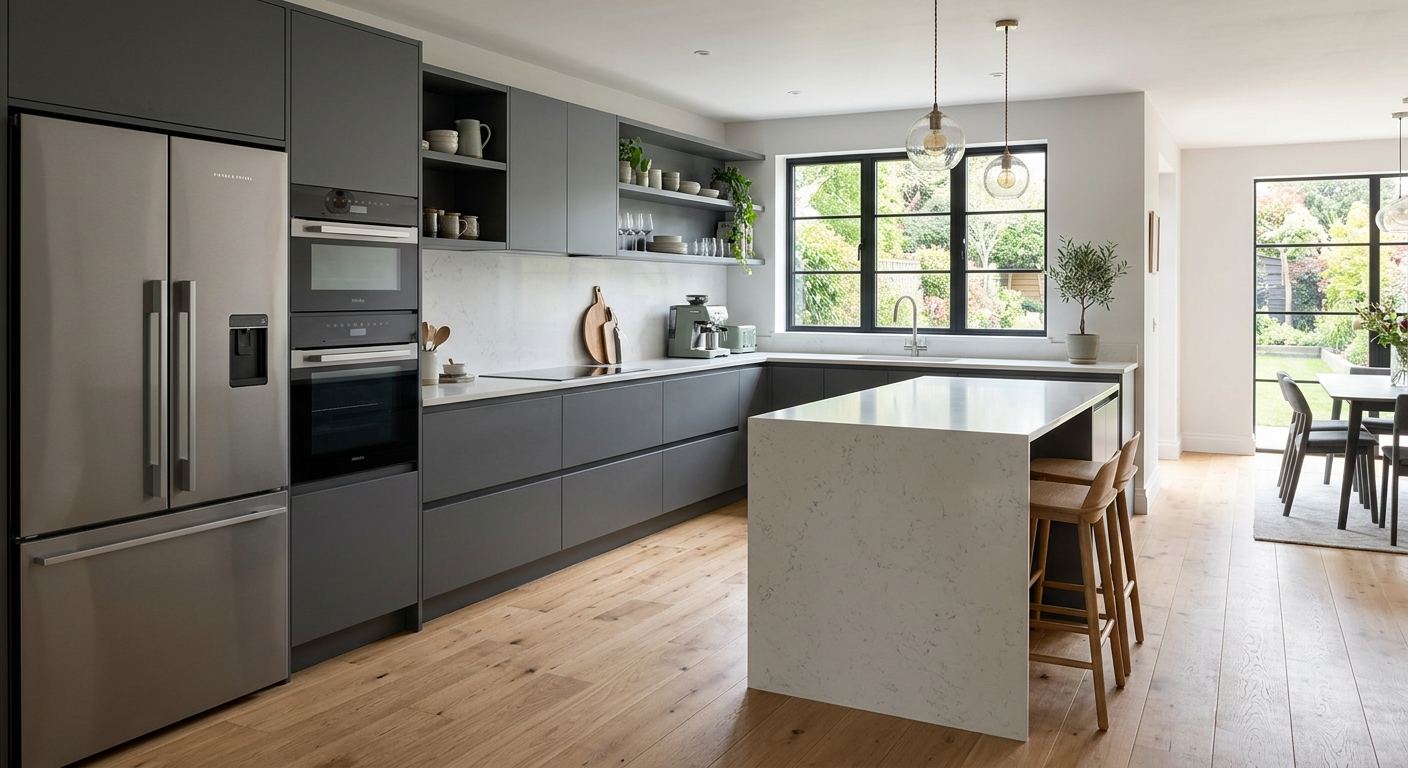
Kitchen renovation options and costs in Winchester
Kitchen renovations in Winchester, Ontario tend to follow the same budgeting reality as the wider Toronto economic region: what you spend is driven more by buyer expectations and home values than by local weather. Winchester’s smaller population (2,394 residents per the Statistics Canada, 2021 Census) means fewer tradespeople relative to the GTA core, so the strongest demand is often for planners who can coordinate cabinet lead times, countertop templating, and trades schedules without pushing your timeline. In higher-value GTA pockets, homeowners commonly invest enough in the kitchen to support resale—often around 8% to 15% of the home’s value—so projects there skew toward quartz or natural stone and semi-custom cabinetry. Winchester doesn’t have the same density, but the Toronto-driven “finish standards” still show up in many client requests.
Across the Toronto economic region, finish tier is the main cost driver. The Toronto area doesn’t typically force contractors to “spend for weather,” but the freeze–thaw cycle and humidity swings can affect how long tile thinsets cure and how subfloors behave after demolition. That means it’s wise to plan for more drying and subfloor verification when you’re replacing flooring or removing cabinets. Availability also matters: in peak seasons, we see longer lead times for cabinetry and stone, which pushes labour scheduling—especially for countertop installs that require exact templating.
In Winchester, we see the most concentrated renovation demand around the older residential pockets near Main Street, where homeowners often want a “Toronto-ready” kitchen without a structural overhaul. With that in mind, here’s how the most common project tiers typically price out, from cosmetic refresh through high-end custom builds.
| Renovation Tier |
What's Included |
Typical Duration |
Price Range |
| Cosmetic refresh (paint, hardware, new appliances only) |
Cabinet painting or touch-ups, new pulls/knobs, new or refreshed range hood, dishwasher and/or range (no cabinet replacement), minor trim, basic plumbing hookups for appliances |
3–6 business days |
$25,000–$35,000 |
| Mid-range full renovation (new cabinets, counters, sink, tile) |
New semi-custom or upgraded stock cabinets, quartz or laminate counters, sink swap, backsplash tile, updated lighting where needed, tile flooring or backsplash, disposal and faucet change |
3–5 weeks |
$40,000–$65,000 |
| High-end full renovation (custom cabinets, stone counters, island) |
Fully custom cabinetry, natural stone counters (granite/stone), large island with seating, more extensive backsplash detailing (often full-height in key areas), premium appliance package, upgraded lighting package, possible flooring replacement |
6–10 weeks |
$70,000–$90,000 |
| Cabinet refacing only (new doors + drawer fronts, same boxes) |
Door and drawer replacement, new veneer surfaces, hardware upgrade, light drywall/trim work, cabinet re-leveling if needed |
1–2.5 weeks |
$10,000–$25,000 |
| Countertop swap only (laminate to quartz or stone) |
Remove and replace existing countertop, new undermount sink if desired, templating, sealing where applicable, basic countertop plumbing reconnection |
3–7 business days (plus templating lead time) |
$12,000–$20,000 |
| Backsplash tile installation only |
Demolition of existing backsplash (if required), tile supply and install, waterproofing prep, grouting, caulking transitions to countertop and cabinetry |
2–5 business days |
$2,500–$10,000 |
Prices are estimates only and vary by project scope, site access and material selection.
What affects the price of kitchen renovation in Winchester
In Winchester, Ontario—and across the broader Toronto economic region—two homeowners can receive quotes that differ by 30% to 50% for the “same” kitchen because the scope details rarely match. One contractor may include electrical upgrades, drywall patching, and disposal/refinish labour; another may quote only cabinets and counters with minimal prep. Even when materials look similar, labour assumptions (site protection, demolition complexity, subfloor repairs, and how many trades touch your layout) can swing the total.
Local market expectations play a bigger role than climate. In higher-value GTA pockets, many owners default to quartz or natural stone counters and semi-custom cabinetry because the upgrade cost is easier to justify on resale. In more price-sensitive areas, laminate and stock cabinets remain common, since they deliver a refreshed look with a stronger budget-to-results ratio. For Winchester buyers, the practical takeaway is that finish tier drives most of the cost: a mid-range renovation often lands in the $40,000–$65,000 band, while a high-end custom build moves toward the $70,000–$90,000 range when you add an island, stone counters, and premium appliances.
Winchester conditions still influence the details. Older housing stock can hide out-of-level floors or dated electrical rough-ins behind toe kicks, which increases labour to re-square base cabinets and straighten tile lines. If your kitchen has a concrete slab or older subfloor, we typically see extra time confirming flatness before stone install. Also, if you’re changing plumbing runs—moving a sink from an exterior wall to a peninsula—or relocating a gas range, that work adds cost unpredictably in any season, because it’s driven by what’s behind the walls, not by weather.
| Price Factor |
Why It Matters |
Cost Impact |
| Cabinet tier — stock vs. semi-custom vs. fully custom millwork |
Material quality, door styles, internal components, and fit/finish standards vary widely |
Can shift the project by tens of thousands; typically the biggest single lever after counters |
| Countertop material — laminate vs. quartz vs. granite vs. stone |
Stone thickness, edge profiles, fabrication complexity, and seaming requirements change the install effort |
Laminate is usually lowest; quartz and natural stone add labour and material costs |
| Layout change — wall removal, island add, plumbing/gas move |
Structural and MEP work drives permits, licensed trades, and demolition/patching risk |
Most unpredictable; often where overruns happen even on “simple” upgrades |
| Appliance package tier — builder vs. mid-range vs. pro-grade |
Electrical requirements, ventilation specs, and fit can require extra carpentry and cabinetry spacing |
Pro-grade appliances commonly cost more and can raise electrical/venting complexity |
| Flooring — refinish existing vs. full replacement |
Matching existing flooring or subfloor condition impacts prep time and tile/leveling needs |
Replacement usually adds underlayment prep and more demo/disposal |
| Backsplash — ceramic tile vs. marble vs. full-height slab |
Porous materials require sealing and careful junctions; full-height adds surface area and waterproofing |
Full-height slab can move backsplash into countertop-like pricing territory |
| Electrical — new circuits for island, under-cabinet lighting |
Lighting, outlets, and ventilation controls may require new breaker capacity and rework behind walls |
Can add meaningful labour and electrician time; often required when adding islands |
| Permit fees and licensed trade requirements |
Permits and inspections are tied to scope (plumbing, gas, structural, electrical) |
Usually a moderate add-on, but the bigger driver is schedule and trade coordination |
Permits & regulations in Ontario
In Ontario, a simple cabinet or countertop swap typically does not require a permit. Replacing doors, drawer fronts, paint, hardware, and installing new laminate or quartz countertops over the existing footprint is usually straightforward—no major building systems are being altered. However, once your renovation touches plumbing, gas, load-bearing structure, or electrical circuits, permits and licensed trades are commonly required.
Work that typically does require permits and licensed professionals includes: relocating or changing water supply and drain lines (sink changes that move piping, adding a dishwasher branch line, relocating a bar sink); relocating a gas stove or making changes related to gas appliances and ventilation (a gas range and any gas line adjustments require a licensed gas fitter); removing a load-bearing wall or doing structural modifications; and adding new electrical circuits for an island, new appliance circuits, or significant rewiring. Electrical work must be performed by a licensed electrician, with inspection tied to the permit process.
For Winchester homeowners verifying contractor readiness, I recommend three checks before signing: (1) confirm the contractor’s Ontario business licence details and request a Certificate of Insurance (general liability) plus WSIB/WCB coverage where applicable; (2) ask for documentation for the specific licensed trades they will subcontract (gas fitter licence and electrician registration); and (3) keep everything in writing—who is pulling permits, who schedules inspections, and what’s included in the contract scope and responsibility. Also confirm you’ll receive clearance/inspection paperwork if permits are issued; it matters for future resale and homeowner due diligence.
Cabinets, countertops and layout decisions in Winchester
The three decisions that most affect both your satisfaction and your resale value in Winchester are: cabinet tier, countertop material, and whether you change the layout. For cabinets, your choices typically run from stock (fastest and most budget-friendly), to semi-custom (the most popular mid-range option), to custom (best fit, highest cost). Countertops then determine how “premium” the kitchen reads—laminate is the value play, quartz and engineered surfaces are the balanced option for daily use, and natural stone (granite/stone/marble) delivers the high-end look but needs more careful sealing and maintenance planning.
Finally, layout changes are where you either unlock real space value or burn money. In the Toronto resale market, buyers often expect clear work zones, good lighting, and intuitive storage—so adding an island or opening a wall can pay off if it makes the kitchen more functional and bright. In Winchester, we also consider how freeze–thaw and humidity swings interact with older floor assemblies: moving cabinets and tile lines may require extra subfloor prep, and seams around countertops must be executed cleanly to reduce moisture vulnerability over time.
Here’s a concrete example: upgrading from laminate to quartz might add roughly several thousand dollars (commonly within the countertop-focused range of $3,000–$15,000 depending on square footage and edges). If you keep the existing layout and only swap counters, that can be a smart, lower-risk improvement. By contrast, if you want to add an island and move plumbing/gas, the cost can jump quickly because it’s not just materials—it’s licensed trades, demolition, and permit-driven scheduling. If your goal is a “Toronto-ready” look, start with cabinets and counters before paying for major MEP moves.
| Option |
Durability |
Maintenance |
Best For |
Price Range |
| Stock cabinets (big-box) |
Good structural basics; durability depends on hinge quality and finish thickness |
Easy cleaning; limited custom adjustments to fit uneven older walls |
Budget-focused refreshes and faster turnarounds |
$10,000–$25,000 |
| Semi-custom cabinets (local dealer) |
More options for internal organization and better fit/finish |
Simple upkeep; accommodates modest site quirks better than stock |
Most mid-range full renovations in Winchester |
$20,000–$40,000 |
| Custom cabinets (local millwork shop) |
Highest build quality and best alignment for unique layouts |
Low daily maintenance; benefits from precise installation and premium hardware |
Complex layouts, islands, and “showpiece” kitchens |
$35,000–$60,000 |
| Laminate countertop |
Resistant to daily wear but can be vulnerable to impact at edges and heat exposure |
Wipe clean; avoid prolonged standing water at seams |
Cost-effective upgrades where ROI and budget control matter |
$3,000–$8,000 |
| Quartz engineered countertop |
Very durable for everyday use; consistent surface and good stain resistance |
Low maintenance; resealing usually not required |
Most “best value” kitchens aiming for a premium look |
$6,000–$15,000 |
| Granite / natural stone countertop |
High durability with unique patterns; edges and seams must be well-finished |
Sealing is typically needed depending on the stone; blot spills promptly |
High-end finishes and buyers who want natural variation |
$8,000–$18,000 |
| Butcher block countertop |
Durable but can dent/scratch; sensitive to moisture at seams |
Regular oiling and prompt drying needed |
Warm, casual kitchens where homeowners maintain the surface |
$4,500–$12,000 |
| Marble countertop |
Beautiful but more delicate—prone to etching and staining without careful use |
Requires sealing and lifestyle-friendly cleaning habits |
Statement kitchens where the look is the priority |
$10,000–$20,000 |
How to choose a kitchen renovation contractor in Winchester
Choosing the right contractor in Winchester means verifying licensing and insurance, not just comparing price. Start by requesting documentation: (1) proof of Ontario liability insurance; (2) WSIB/WCB clearance or proof of coverage for workers (or documentation explaining their coverage structure); and (3) confirmation of which licensed trades they will use for gas fitting and electrical work. You should also be able to obtain evidence of trade qualifications and, where required, permit/inspection handling responsibility.
When you ask for quotes, don’t accept a vague lump sum. Get 2–3 itemised, written quotes with labour and materials breakdowns. I recommend that your quote specify: demo and disposal, cabinet supply, countertop templating and install, backsplash scope, floor prep, electrical or plumbing inclusions, and what’s excluded (often drywall repair, subfloor leveling, or any structural changes). Clarify whether permit pulling is included or billed separately, and whether the cost includes inspections and rework time if inspection corrections are needed.
Warranty matters in kitchens because problems can show up after the fact. Ask for the workmanship warranty length and whether product warranties from manufacturers apply directly to you (and whether they’re transferable). Payment schedule should protect you: never pay more than 10% to 15% upfront for deposits, and use a holdback tied to substantial completion and key milestones.
Finally, timeline should be in writing. Get a start date and a realistic completion estimate that accounts for cabinet and countertop lead times and includes trade coordination windows. A good contract makes the schedule and responsibility boundaries clear.
- Confirm Ontario business details and request proof of general liability insurance.
- Verify WSIB/WCB coverage (or the contractor’s documented coverage arrangement).
- Ask for the electrician and gas fitter contact details and their licence documentation.
- Request 2–3 itemised quotes with labour + materials, not just a total.
- Make sure the scope lists demolition, disposal, and protection of flooring/doorways.
- Check whether permit pulling and inspection fees are included.
- Clarify electrical inclusions: new circuits, under-cabinet lighting, island outlets.
- Clarify plumbing inclusions: sink faucet change, disposal, dishwasher connection.
- Confirm countertop process: templating date, seam plan, and sink/cutout responsibility.
- Confirm backsplash prep responsibilities (wall flatness, waterproofing, grout/caulk finish).
- Ask for warranty details: workmanship length, product warranty, and transferability.
- Use a staged payment plan and negotiate a holdback until complete and punch list is done.
Red flags we see in Winchester include: contractors who won’t put permit responsibility in writing, quotes that omit drywall repair or subfloor leveling but assume “no surprises,” requests for large upfront payments (beyond 10% to 15%), no proof of insurance/coverage when asked, and vague schedules with no allowance for cabinet and stone lead times.
Frequently asked questions — kitchen renovation in Winchester
Do I need a permit for a kitchen renovation in Ontario?
In Ontario, many kitchen refresh tasks don’t require permits—typical examples are cabinet refacing, cabinet/door replacement where boxes stay put, paint, hardware, and countertop swaps that don’t alter plumbing, gas lines, structural elements, or electrical circuits. If you’re moving plumbing supply/drain lines (for a new sink location or adding a dishwasher line), changing gas appliance positions, removing a load-bearing wall, or adding electrical circuits (such as for an island), permits and licensed trades are commonly required. For Winchester homeowners, the key is to confirm in your contract who pulls permits and who coordinates inspections. A licensed electrician and licensed gas fitter should handle their respective work, and you should receive documentation tied to any inspections once completed.
What's the ROI on a kitchen renovation?
ROI varies by scope and by how “buyer-ready” your finish choices are in the Toronto market. High-quality upgrades like quartz counters, updated cabinet fronts (or full semi-custom cabinets), and a functional layout are the improvements most likely to resonate at resale. In higher-value GTA pockets, owners may invest roughly 8% to 15% of their home value into the kitchen, which is why premium materials are more common there; Winchester projects often track those expectations even if budgets can be more controlled. A modest refresh without moving plumbing or structural elements tends to be the best ROI lever. If you’re planning a full renovation, realistic budgets often fall in the mid-$20k to $80k+ range in the region; choosing a mid-range plan closer to the $40,000–$65,000 band typically balances cost and resale impact better than jumping straight into high-end custom builds.
How do I budget for a kitchen renovation?
Budgeting starts by matching your goals to a realistic tier. In Winchester, a cosmetic-only update (paint, hardware, and new appliances) is often the lowest disruption, while a full renovation with new cabinets, counters, a sink swap, and tile typically lands in the mid-range. For example, mid-range full renovations commonly price around the $40,000–$65,000 band, while high-end custom projects with stone counters and islands often move toward $70,000–$90,000. Add a contingency for layout-driven surprises: moving plumbing or gas lines, correcting out-of-level floors, or reworking electrical can add unpredictable costs. Because the Toronto economic region is competitive on finishes, material selection is the biggest driver; your quote should break down cabinetry tier, countertop material, tile scope, and any electrical or permit-related work so you can decide where to spend and where to trim.
Can I move my kitchen sink or stove?
Yes, you can move a sink or stove in an Ontario kitchen, but it’s not always the cheapest or simplest route. Moving a sink usually means extending or relocating water supply lines and modifying the drain—this often triggers permit requirements and requires licensed plumbing work. Moving a gas stove is even more regulated: gas-related changes must be done by a licensed gas fitter and typically require permits and inspections. If you’re in Winchester and your renovation is tied to an “older pocket” home with dated framing, what’s behind the walls can add time for demolition and patching. A practical approach is to keep the sink or stove footprint if possible and prioritize cabinets/counters instead. If you do move them, budget for the full package: licensed trades, drywall restoration, and electrical/venting coordination as needed.
What's the most cost-effective kitchen upgrade?
The most cost-effective upgrades are usually the ones that deliver the biggest visual change without requiring major demolition or permits. For many Winchester homeowners, cabinet refacing or a countertop swap is the best value: it can refresh the look while keeping existing boxes and plumbing locations. Cabinet refacing only commonly prices around the $10,000–$25,000 range, while a countertop swap only (for example, laminate to quartz or stone) often falls around $12,000–$20,000 depending on size and edges. If you want to stretch dollars further, pair refacing with a good-quality quartz counter rather than going straight to full custom millwork. The “best value” also depends on your layout: if your kitchen is currently awkward, spending on layout changes may be justified, but if the space is functional, start with surfaces and storage first.
Custom vs stock cabinets — is custom worth it?
Custom cabinets are “worth it” when you need a truly fitted solution: unusual dimensions, a demanding island design, or a layout where millimetre-accurate fit prevents visual gaps and improves function. In Winchester homes, older framing and out-of-square walls can make perfectly fitted storage harder with basic stock lines—so semi-custom is often the practical middle ground. Stock cabinets (often faster to order and install) can work well for budget refreshes, while semi-custom cabinets are a common sweet spot for durability and storage features. Fully custom millwork pushes costs upward, and many projects that reach the high-end tier typically land toward the $70,000–$90,000 total renovation range once you include premium counters and layout changes. If you’re mainly after a modern look, semi-custom or refacing plus a quartz countertop is frequently the better balance for both cost and resale appeal.