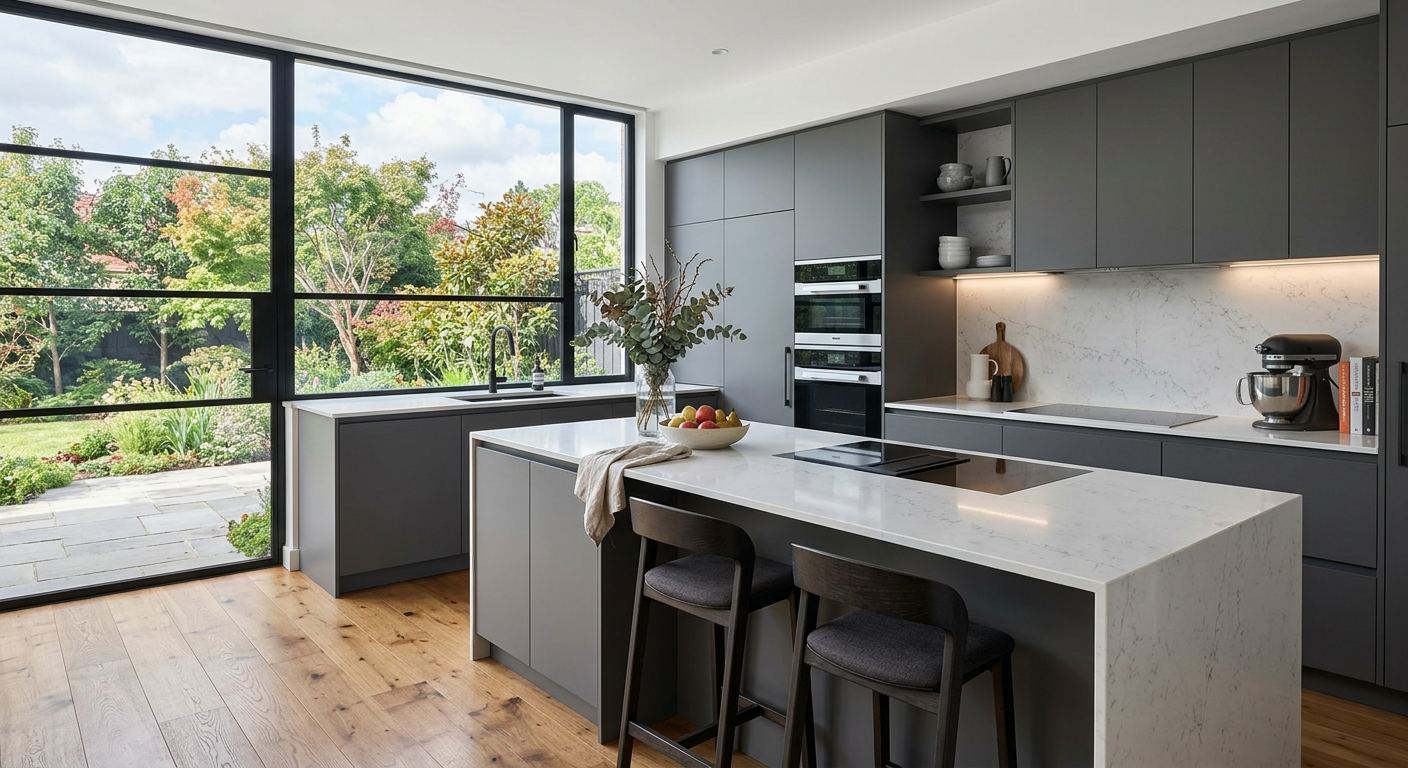
Kitchen renovation options and costs in Georgetown
Georgetown, Ontario is seeing steady demand for kitchen renovations because homes there are often larger than average and get updated for day-to-day comfort and resale. With a local population of 44,058 (Statistics Canada, 2021 Census), you’ll find plenty of trades availability nearby, but pricing still reflects the broader Toronto economic region where finishes and craftsmanship expectations tend to be higher. In higher-value pockets around the GTA, many homeowners choose upgrades that can approach 8–15% of home value, which typically pushes projects toward semi-custom or custom cabinetry and quartz or natural stone countertops. That’s why two similar kitchens in the same neighbourhood can still land in different budget bands.
Ontario kitchen costs are less about climate surprises and more about market pressure and scope: labour and materials track closely across the Toronto region. That said, Georgetown’s freeze–thaw winters and wet ground conditions still matter indirectly—water management at plumbing connections, properly sealed tile edges, and ventilation for cooking appliances help prevent callbacks later. Contractor schedules can also tighten during peak spring and summer reno windows, affecting start dates more than the base unit costs. In Georgetown’s downtown and newer infill areas near established commercial corridors, we often see fast turnarounds on cosmetic refreshes and mid-range full renovations for resale timing.
Use the table below to compare realistic options, typical timelines, and budget ranges—then we’ll break down what drives price up or down in your specific project.
| Renovation Tier |
What's Included |
Typical Duration |
Price Range |
| Cosmetic refresh (paint, hardware, new appliances only) |
Cabinet paint or touch-ups, new hardware, appliance replacement, minor caulking and trim, re-seat/adjust doors, basic cleaning and sealant at sink/backsplash edges |
3–7 days |
$7,500–$18,000 |
| Mid-range full renovation (new cabinets, counters, sink, tile) |
New semi-custom cabinets, quartz or good laminate countertops, new sink and faucet, backsplash tile, floor finishing/patching, plumbing adjustments (non-structural), installation and countertop templates |
3–6 weeks |
$25,000–$55,000 |
| High-end full renovation (custom cabinets, stone counters, island) |
Fully custom millwork, premium quartz or natural stone (granite/stone), island build-out, extended backsplash, upgraded appliance package, enhanced lighting (including under-cabinet), more involved plumbing/gas planning |
6–12 weeks |
$65,000–$90,000 |
| Cabinet refacing only (new doors + drawer fronts, same boxes) |
Refacing materials, new door/drawer fronts, hinges/soft-close upgrades, new hardware, optional cabinet interior upgrades, re-seal around sink and toe-kick areas |
1–3 weeks |
$8,000–$28,000 |
| Countertop swap only (laminate to quartz or stone) |
Remove old tops, template and install new countertops, seal backsplash seam areas, fit sink/cut-outs (if moving not required), basic re-caulk and cleanup |
2–5 days |
$3,500–$15,000 |
| Backsplash tile installation only |
Surface prep, tile supply and install (typical layout), grout/seal where needed, finishing at outlets and corners |
2–7 days |
$2,000–$10,000 |
Prices are estimates only and vary by project scope, site access and material selection.
What affects the price of kitchen renovation in Georgetown
In Georgetown and across the Toronto economic region, two quotes for the same kitchen can differ by 30–50% because contractors are pricing different risk levels and finish tiers, not just labour hours. Home values and household income levels influence what buyers expect to see in a renovated kitchen—so the market often nudges homeowners toward quartz or stone counters and semi-custom cabinetry rather than sticking with laminate and stock cabinets. In more price-sensitive areas of the GTA, many projects remain mid-range (refacing, upgraded laminate, selective layout tweaks) to balance resale value with affordability; in higher-value pockets, the tendency to choose premium materials is what pushes budgets into the $80k+ band on larger builds.
Layout changes are the most unpredictable cost in any price tier. Removing a wall, adding an island, or moving plumbing or a gas line can trigger permit work, trade coordination, and hidden-condition pricing—especially when existing walls and subfloors aren’t what the drawings assumed. Georgetown’s housing stock includes a mix of older builds and later renovations, so we frequently see surprises behind old backsplashes, cabinet walls, or under existing flooring.
Here are a few concrete local examples that change your number quickly: (1) if your sink location needs to move even a short distance, plumbing labour and drywall repairs can raise an otherwise “$25,000–$55,000” mid-range job toward the upper end; (2) upgrading from laminate to quartz adds cost and often affects installation scheduling, but it’s usually one of the best value upgrades in the $3,500–$15,000 countertop band; and (3) if you’re adding electrical for under-cabinet lighting over an island, you may see electrical scope expand even when cabinets and counters stay in the same tier.
| Price Factor |
Why It Matters |
Cost Impact |
| Cabinet tier — stock vs. semi-custom vs. fully custom millwork |
Better fit, more finish options, upgraded hardware, and stronger build quality raise material and shop time |
Small jobs can move from low–mid pricing to the high-end band; cabinetry is often the #1 driver |
| Countertop material — laminate vs. quartz vs. granite vs. stone |
Material price per square foot and installation complexity (seams, edge profiles, tolerances) vary a lot |
Can shift a countertop-only budget by multiple thousands and pull full renovations upward |
| Layout change — wall removal, island add, plumbing/gas move |
Changes trigger coordination and often permits, plus hidden-condition risks |
Most likely source of 30–50% quote variance across similar kitchens |
| Appliance package tier — builder vs. mid-range vs. pro-grade |
Higher tiers increase purchase price and may require different ventilation/clearance planning |
Can add material and electrical/venting scope even if the cabinet footprint doesn’t change |
| Flooring — refinish existing vs. full replacement |
Whether subfloor repairs and new underlayment are needed affects both labour and downtime |
Replacement typically pushes the total budget more than homeowners expect |
| Backsplash — ceramic tile vs. marble vs. full-height slab |
Harder materials and full-height applications demand more precision and fabrication time |
Full-height or stone increases cost beyond typical “tile-only” ranges |
| Electrical — new circuits for island, under-cabinet lighting |
New lighting and circuit work requires licensed trades and affects coordination schedules |
Often modest in cosmetic refreshes; becomes significant with islands and extra outlets |
| Permit fees and licensed trade requirements |
Work that changes plumbing, electrical, structural elements, or gas increases compliance steps |
Not just direct fees—also adds inspection time that impacts your project timeline |
Permits & regulations in Ontario
In Ontario, simple cabinet and countertop swaps typically don’t require a permit. Replacing cabinets in the same locations and installing new countertops on the existing cabinet footprint is usually treated as a finish upgrade, not a structural change. However, once you move beyond surfaces, permits and licensed trades become part of the process. If you’re moving plumbing supply or drain lines, relocating a gas appliance connection, removing a load-bearing wall, or adding electrical circuits (for example, outlets and lighting on an island), you should expect permit requirements and inspections.
Gas work must be completed by a licensed gas fitter, and electrical work must be done by a licensed electrician. The trades then complete required inspection steps before the work can be safely closed in (drywall, backsplash, and soffits). Even if your contractor “handles it,” you should confirm who is responsible for pulling permits and ensuring inspections are passed.
Step-by-step verification for a homeowner in Georgetown:
- Ask for the contractor’s Ontario licence details and the names of their subcontractors for gas and electrical (if applicable).
- Request a certificate of insurance (liability) and verify it’s current and aligned with the work’s scope.
- Confirm WSIB/WCB coverage for each trade involved, not just the general contractor’s paperwork.
- Request proof of clearance letters where applicable for trades with coverage obligations.
- Ask who pulls permits and get it listed in the written contract, including inspection responsibility.
- Verify permit status before demolition—changes during construction can delay your timeline.
- Ensure the electrician and gas fitter provide documentation after work is complete.
Cabinets, countertops and layout decisions in Georgetown
The three most consequential decisions in a Georgetown kitchen renovation are cabinet tier, countertop material, and layout. Cabinet tier drives installation time, finish quality and how well the kitchen looks “tight” once it’s finished. Stock cabinets are the fastest and cheapest route, but semi-custom cabinets are usually the best balance for resale-ready kitchens—more sizes, better internal organization, and a more tailored look without the wait and premium price of fully custom millwork. Custom cabinets excel when you have a complex footprint, unusual ceiling heights, or you want a truly integrated pantry/island design.
Countertop material is where many homeowners feel the price jump immediately. Laminate can be a practical upgrade, while quartz is the common Toronto-area “best value” choice because it’s durable and low-maintenance for busy households. Granite/natural stone looks high-end and resists everyday wear, but it typically comes with different sealing and care expectations. Butcher block can be beautiful and warm, yet it requires more ongoing maintenance to avoid moisture-related issues near sinks and dish areas.
Layout changes are justified when they unlock usable space: open-concept wall removal can improve sightlines, and adding an island can create seating and more working room. But if you’re moving plumbing or gas to support the sink or cooktop, it can quickly push a mid-range build toward the upper budget band.
For example, a typical move from laminate to quartz might add several thousand dollars within the countertop range, and that’s usually justified because the cost is straightforward and the result reads as a full kitchen upgrade. By contrast, adding a wall removal and new island plumbing can multiply complexity beyond the $25,000–$55,000 band and often pushes the project toward $65,000–$90,000 territory.
| Option |
Durability |
Maintenance |
Best For |
Price Range |
| Stock cabinets (big-box) |
Good for daily use, but limited sizes can force compromises at corners and ceilings |
Low—keep hardware adjusted and wipe clean; minor repairs are easier |
Quick turnarounds and budget-focused refreshes in Georgetown |
$8,000–$22,000 |
| Semi-custom cabinets (local dealer) |
Very solid construction with better fit options and more functional storage |
Low—basic care; soft-close hardware reduces wear noise |
Most homeowners targeting a resale-ready mid-range renovation |
$18,000–$45,000 |
| Custom cabinets (local millwork shop) |
Highest fit and finish; best for odd spaces and integrated features |
Low to moderate—depends on finish; handle and recoat schedule may apply |
Premium kitchens with islands, pantries, and specialty storage |
$35,000–$70,000 |
| Laminate countertop |
Resists many day-to-day impacts, but edges and seams are less forgiving |
Low—avoid prolonged moisture at seams and use trivets |
When you want a clean look on a tight budget |
$3,000–$7,000 |
| Quartz engineered countertop |
Excellent everyday durability; generally less staining than many natural surfaces |
Low—routine cleaning only; keep heavy heat off surfaces |
Families wanting low maintenance with a high-end appearance |
$6,000–$12,000 |
| Granite / natural stone countertop |
Very durable and scratch-resistant; performance varies by slab type |
Moderate—sealing and care needed, especially near sinks |
Premium look where homeowners accept ongoing stone care |
$8,000–$15,000 |
| Butcher block countertop |
Strong but susceptible to moisture and cuts; needs proper sealing |
Higher—regular oiling and careful handling around wet zones |
People who cook often and want a warm, repairable surface |
$4,500–$10,000 |
| Marble countertop |
Beautiful but more susceptible to etching and staining than quartz |
Moderate to high—requires careful cleaning and sealing |
Statement kitchens where aesthetics outweigh heavy day-to-day wear |
$9,000–$16,000 |
How to choose a kitchen renovation contractor in Georgetown
Choosing the right kitchen contractor in Georgetown starts with verification and clarity. In Ontario, confirm the contractor’s licensing (where applicable), liability insurance, and WSIB/WCB coverage for the trades they use. How to check: request a current certificate of insurance (liability) and read the effective dates; ask for WSIB clearance where coverage is required; and verify coverage documentation for subcontractors before demolition. If a contractor can’t provide paperwork quickly or speaks vaguely about who’s insured, that’s your first warning.
Next, get 2–3 itemised written quotes—labour and materials broken out, not a single lump-sum number. A solid quote shows what’s included for cabinets, countertop fabrication/installation, backsplash tile, plumbing/electrical allowances, demolition, disposal, and any drywall/patching required to support new finishes. Read the scope carefully: is permit pulling included if needed, who schedules inspections, and does disposal include cabinetry and tile waste? Confirm product warranties (manufacturer) and workmanship warranties (contractor). Ask whether warranties are transferable to the next homeowner—this matters for resale in the Toronto market.
Payment schedule should protect you: never pay more than 10–15% upfront, and use a holdback until the job is complete and corrected. Make timelines explicit: get the start date and a realistic completion estimate in writing, including lead-time assumptions for cabinets and countertops.
- Request current insurance and WSIB/WCB documentation before signing.
- Confirm named subcontractors for gas and electrical when those scopes apply.
- Get 2–3 itemised quotes with line items for labour and materials.
- Verify demolition scope and whether disposal is included.
- Ensure countertop templating dates and fabrication lead times are included.
- Ask who is responsible for permits and inspections, if required.
- Confirm plumbing/gas/electrical rough-in and final hook-up responsibilities.
- Check cabinet installation includes shimming, fastening to structure, and alignment.
- Clarify warranty lengths for workmanship and how claims are handled.
- Confirm finish responsibilities (caulking, sealing, grout, edge treatments).
- Use a payment schedule with milestones and a holdback at completion.
- Insist on a written timeline with start/completion and dependencies.
Red flags we commonly see in Georgetown: quotes that don’t specify what happens with permits; “all-in” pricing with no allowances or exclusions; refusal to provide insurance/WSIB clearance documents; unrealistic timelines that ignore cabinet or countertop lead times; and payment terms that ask for large deposits beyond 10–15% upfront.
Frequently asked questions — kitchen renovation in Georgetown
How much does a kitchen renovation cost in Georgetown?
A kitchen renovation in Georgetown typically falls within the GTA price bands, so homeowners usually budget from about $25,000 up to $90,000 depending on scope and finish tier. A cosmetic refresh (paint, hardware, and new appliances only) can be far lower—often in the low–mid range—while a mid-range full renovation with new cabinets, counters, sink and tile commonly lands in the $25,000–$55,000 area. If you’re doing custom cabinets, stone counters, and an island (especially with more trades coordination), it often moves into the $65,000–$90,000 band. Since Georgetown sits in the Toronto economic region, many projects track home value expectations more than weather, and that’s why premium finishes are common in higher-value pockets. (Statistics Canada, 2021 Census)
How long does a kitchen renovation take in Georgetown?
Timelines depend mostly on how much you change. A cosmetic refresh is often a few days to about a week because cabinets aren’t being removed and plumbing/electrical changes are minimal. Cabinet-and-counter installations for a mid-range full renovation typically take around 3–6 weeks when lead times are reasonable, while higher-end custom builds are commonly 6–12 weeks. The biggest schedule killers are cabinet and countertop fabrication lead times, plus permitting and inspection timing if you’re moving plumbing, relocating gas, removing a load-bearing wall, or adding electrical circuits. Georgetown homeowners should plan for a kitchen downtime window that aligns with rough-in work (plumbing/electrical), then finishing (tile, sealing, trim), and finally hardware and final appliance connections. Confirm your start date and completion estimate in writing before you sign.
Quartz vs granite countertops — which is better?
“Better” depends on how you live with the kitchen. Quartz is engineered for consistent performance and is typically low-maintenance for daily cooking—easy to clean and generally more forgiving for homeowners who want fewer care steps. Granite is a natural product with unique veining and a premium look; it’s very durable but usually requires sealing and more careful maintenance depending on the slab. If you’re aiming for a resale-ready upgrade in Georgetown and want a safe, widely preferred choice, quartz is often the most straightforward path within the $6,000–$12,000 countertop band. Natural stone like granite can land higher (commonly $8,000–$15,000), and the homeowner should be comfortable with the care routine. Either way, installation quality matters: proper sealing at sink edges and good support under seams reduce long-term issues.
Should I reface or replace my cabinets?
Refacing is usually the best move when the cabinet boxes are solid (not sagging, not water-damaged) and you want a fast upgrade. It keeps the existing frame, which can reduce demolition and shorten the timeline compared with a full replacement. Cabinet refacing only is often in the $8,000–$28,000 range in the GTA. Replacing makes sense when boxes are worn, layout needs to change, you want bigger storage changes, or you’re dealing with out-of-square conditions that refacing can’t fully correct. For most Georgetown homeowners targeting a resale-friendly finish, semi-custom replacement is the popular mid-range path (often $25,000–$55,000 for a full renovation), while fully custom replacement can push higher into the $65,000–$90,000 territory. The right choice comes down to cabinet condition and whether you’re changing the footprint or storage design.
Do I need a permit for a kitchen renovation in Ontario?
Often, cabinet and countertop swaps in Ontario don’t require permits—if you’re keeping plumbing and electrical work in the same locations and you’re not changing structural elements. However, permits are typically needed when you move plumbing supply or drain lines, relocate gas (like a stove/connection or gas-related venting), remove a load-bearing wall, or add electrical circuits (for example, new outlets or lighting for an island). Gas work must be done by a licensed gas fitter and electrical by a licensed electrician, with inspections for the relevant trades. For a Georgetown homeowner, the easiest verification is to ask your contractor who pulls the permit and to ensure it’s written in the contract. Confirm subcontractors’ documentation and inspection responsibility before demolition—this prevents delays and surprises.
What's the ROI on a kitchen renovation?
ROI depends on what you change and what buyers in your area expect. In the Toronto economic region, higher-value markets tend to invest a larger share of home value into kitchens—often reflected in upgraded cabinetry and quartz/stone counters—because owners expect they can recover more of that spend on resale. That said, ROI won’t be maximized by overspending on features your layout can’t support (or by adding expensive structural changes without a clear space benefit). A sensible approach is to anchor your spend to realistic bands: for example, a mid-range full renovation in the $25,000–$55,000 range can deliver strong buyer appeal if finishes are durable and the layout is functional. Premium projects in the $65,000–$90,000 band can pay off when materials match and the design reads cohesive. For the best outcome, focus on cabinets, countertops, ventilation, and layout flow rather than chasing the most expensive option in every category.