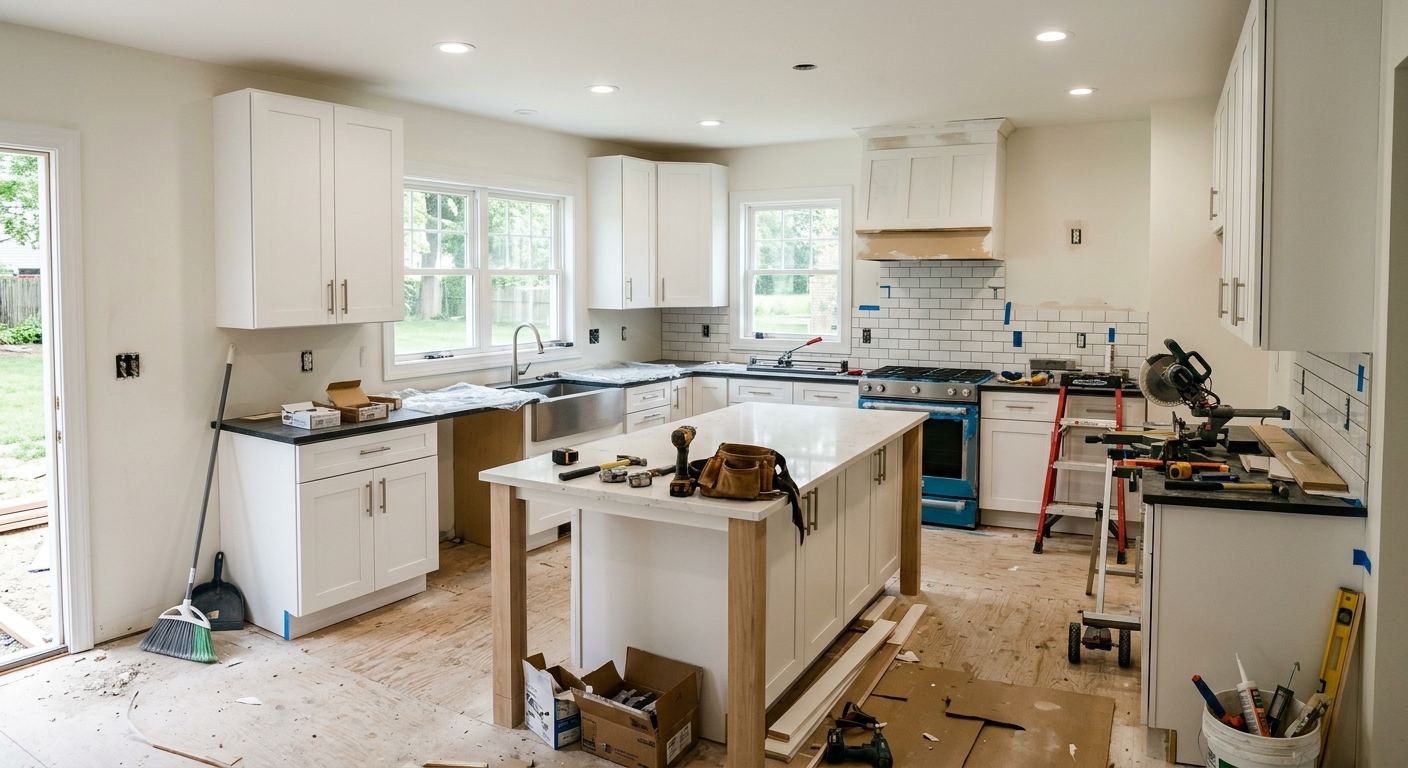
Kitchen renovation options and costs in Picton
Kitchen renovation in Picton can run from a simple refresh to a full redesign, and the best option depends on how much you want to change the layout and finish level. Picton has a relatively small population (4,702 in 2021), so contractor availability can feel tighter than in the GTA core, especially in peak spring and early summer. At the same time, homeowners here often compare budgets to the broader Toronto economic region, where many higher-value areas lean toward upgraded materials—often investing enough to push kitchen projects into the mid-to-high finish tiers. In practice, that means you’ll see more demand for cabinetry that looks “built-in” and countertops that hold up well to daily use and resale expectations.
Ontario’s real cost drivers aren’t really climate-driven for kitchen materials; instead, they’re driven by market choices and what trades must do behind the walls. In the Toronto region, labour and material pricing are fairly consistent, but homeowners in higher-value pockets tend to choose quartz or natural stone and more custom millwork. That habit is what pulls average full renovation budgets upward into the $80k+ range for larger projects and into the mid-$20k zone for modest refreshes.
In Picton, you’ll typically feel the most renovation interest around older housing pockets near the downtown core, where kitchens are often original or have outdated layouts. Once you know which tier fits your goals, it becomes much easier to compare quotes—use the table below as a starting point.
| Renovation Tier |
What's Included |
Typical Duration |
Price Range |
| Cosmetic refresh (paint, hardware, new appliances only) |
Cabinet paint or repaint, new hardware, appliance swap (same rough-in), re-caulking/small trim, basic lighting refresh |
3–7 days |
$8,000–$18,000 |
| Mid-range full renovation (new cabinets, counters, sink, tile) |
Semi-custom or quality stock cabinets, new countertop, new sink + faucet, backsplash tile, flooring refinishing or replacement (typical mid-tier), labour for plumbing/electrical hookups |
2–4 weeks |
$25,000–$55,000 |
| High-end full renovation (custom cabinets, stone counters, island) |
Custom millwork, premium quartz or natural stone, island with upgraded lighting, tile to ceiling option, enhanced appliance package, structural/layout changes as needed |
4–8 weeks |
$70,000–$90,000 |
| Cabinet refacing only (new doors + drawer fronts, same boxes) |
Remove/replace doors and drawers, install new veneer panels, new pulls/knobs, optional cabinet lighting cut-ins (where feasible) |
1–2 weeks |
$8,000–$25,000 |
| Countertop swap only (laminate to quartz or stone) |
Remove laminate, install new countertop, handle sink cut-out (if changing sink type plan for small adjustments), polish/seal as applicable for stone |
3–7 days |
$3,000–$15,000 |
| Backsplash tile installation only |
Tile supply and install, grout/seal, basic prep/caulking, remove/install small trim as required |
3–5 days |
$2,000–$10,000 |
Prices are estimates only and vary by project scope, site access and material selection.
What affects the price of kitchen renovation in Picton
Even when two homeowners ask for “the same kitchen,” Toronto and wider Ontario bids can land 30–50% apart because quotes aren’t apples-to-apples—labour allowances, cabinet tier, and how much work is required behind the scenes differ. In this region, the biggest swing is the finish tier: local home values and the typical buyer’s expectations influence whether homeowners default to quartz/stone and semi-custom cabinetry or stay with laminate and stock options for better value. In higher-value areas of the Toronto economic region, owners often prioritize upgrades because the kitchen cost is easier to recover on resale; in more price-sensitive pockets, kitchens usually land in the low–mid ranges with smart compromises.
Layout changes create the most unpredictable cost regardless of finish level. Moving a wall, adding an island, or relocating a gas line or plumbing rough-in can require demolition, reframing, rerouting services, and extra inspection work. That’s where you can see a modest update jump from the mid-$20k territory toward the $80k+ band.
In Picton specifically, a few local conditions commonly raise or lower price. First, older cabinetry and dated drain layouts sometimes mean extra floor/partition repair during sink moves, pushing countertop and plumbing coordination costs up by several thousand dollars. Second, if you’re replacing a laminate top with quartz, you may need support adjustments for the new countertop weight, which can add shop time and installation labour. Third, depending on your chosen neighbourhood and how tight the work area is near downtown cores, staging and dust control may add labour time. These factors usually matter more than weather—then again, spring humidity in Ontario can slow curing for finishes and certain tile adhesives, so schedule windows should be built into your plan.
| Price Factor |
Why It Matters |
Cost Impact |
| Cabinet tier — stock vs. semi-custom vs. fully custom millwork |
Custom millwork and higher grade materials increase fabrication time and fitting complexity |
Can shift a full renovation from mid-range ($25,000–$55,000) toward high-end ($70,000–$90,000) |
| Countertop material — laminate vs. quartz vs. granite vs. stone |
Material cost and install requirements vary; some stones need sealing and extra handling |
Countertops alone can range from about $3,000 to $15,000+ depending on material and edges |
| Layout change — wall removal, island add, plumbing/gas move |
More demolition + service reroute + potential engineering/permits |
Often adds several thousand to tens of thousands; biggest swing on total project cost |
| Appliance package tier — builder vs. mid-range vs. pro-grade |
Higher tiers cost more and may require better ventilation and electrical readiness |
Can add roughly $2,000–$10,000+ depending on package and brands |
| Flooring — refinish existing vs. full replacement |
Existing subfloor condition and matching finishes change labour and waste |
Refinishing is cheaper; full replacement typically adds $2,000–$8,000+ |
| Backsplash — ceramic tile vs. marble vs. full-height slab |
Premium materials need skilled layout, sealing, and careful cutting around outlets |
Backsplashes often land around $2,000–$10,000+ based on tile type and height |
| Electrical — new circuits for island, under-cabinet lighting |
Electrical work impacts permitting, scheduling, and labour trade requirements |
Frequently adds $800–$5,000+ depending on how extensive it is |
| Permit fees and licensed trade requirements |
Work that affects gas/plumbing/electrical may require permits and inspections |
Adds administrative costs and can add calendar time (often $500–$2,500+) |
Permits & regulations in Ontario
In Ontario, some kitchen updates are straightforward from a permitting standpoint, while others trigger permits and licensed trades. Generally, swapping cabinets and countertops in place does not require a permit—so a “like-for-like” refresh usually stays within scope of standard trade work. However, you should plan for permits when you move plumbing supply/drain lines, relocate a gas stove or gas line, remove a load-bearing wall, or add electrical circuits (for example, for an island with new outlets or additional lighting tied into a new circuit). Gas work must be completed by a licensed gas fitter, and electrical work must be done by a licensed electrician; both should be inspected where required by Ontario practice.
For homeowners in Picton, a practical step-by-step approach is:
- Ask your contractor to list the exact work that is permit-required in the written scope.
- Before you sign, request copies of current licences (or licence numbers) for the trades involved and proof they’ll arrange any required permits.
- Check liability insurance: request a certificate of insurance showing the policy holder and coverage limits.
- Confirm WSIB/WCB coverage (as applicable) for workers involved—ask for confirmation documentation.
- For permit-required work, ensure the contractor clarifies who pulls permits and when inspections will be booked.
- Keep copies of all approvals and inspection sign-offs in your project folder.
The key: confirm permit responsibility with the contractor in the contract—so there are no surprises when something behind the walls changes your budget or timeline.
Cabinets, countertops and layout decisions in Picton
In a Picton kitchen renovation, the three decisions that most affect your day-to-day experience and resale value are cabinet tier, countertop material, and whether you change the layout. For cabinets, stock units are the quickest and lowest-cost path; semi-custom (the most popular mid-range option) balances cost with better storage and fit; custom cabinets deliver the tightest fit and the best opportunities for features like appliance garages, pull-out pantry systems, and integrated lighting. For countertops, laminate is budget-friendly and durable enough for many households, but it can show wear earlier at seams. Quartz engineered countertops offer a practical sweet spot—low maintenance and consistent colour—while granite/natural stone and marble make the biggest visual statement but require more care and can carry higher installation costs.
Layout is where Toronto resale expectations meet real-world function. If you’re staying close to your existing plumbing and gas rough-ins, you protect budget and schedule. If you add an island or open an awkward wall, it can justify moving services because you gain flow and usable workspace—one of the reasons kitchens in the Toronto economic region often trend toward upgrades in the mid-to-high finish tiers. That’s why a renovation that starts as a mid-range plan around $25,000–$55,000 can become high-end quickly once you add an island, reroute plumbing, and upgrade finishes into the $70,000–$90,000 bracket.
Climate matters less for cabinets and stone performance than for installation logistics. Ontario winters and spring humidity can slow curing for adhesives and finishes, so plan for drying time and weather-tight work. For an example of justification: upgrading from laminate to quartz on the whole top is often worth it because it improves daily maintenance and resale appeal, while saving money by doing only a partial countertop swap rarely looks “intentional.”
| Option |
Durability |
Maintenance |
Best For |
Price Range |
| Stock cabinets (big-box) |
Good day-to-day durability; limited custom sizing |
Wipe clean; touch up minor scuffs with matching paint |
Budget-focused refresh with straightforward layout |
$8,000–$20,000 |
| Semi-custom cabinets (local dealer) |
High durability with better interior options and fitting flexibility |
Easy care; hinges/rails vary by grade—expect fewer issues with better hardware |
Most Picton homeowners who want strong value and storage |
$15,000–$35,000 |
| Custom cabinets (local millwork shop) |
Excellent fit and long-term build quality |
Wipe clean; premium finishes often resist staining better |
Integrated features, unique layouts, and higher-end resale expectations |
$30,000–$60,000 |
| Laminate countertop |
Resistant to everyday wear; can be less forgiving at seams |
Simple cleaning; avoid prolonged standing water at edges |
Keeping a kitchen in the low–mid budget while updating the look |
$3,000–$7,000 |
| Quartz engineered countertop |
Very durable for kitchens; consistent surface performance |
Low maintenance; wipe clean, avoid abrasive pads |
Best balance of looks, durability, and easier ownership |
$7,000–$12,000 |
| Granite / natural stone countertop |
Strong natural durability; variety of patterns and hardness |
Typically needs periodic sealing depending on stone |
Premium look when you want natural variation |
$9,000–$15,000 |
| Butcher block countertop |
Durable but can mark; sensitive to standing water |
Oil/maintain the surface; dry promptly |
Warm, traditional kitchens and casual family use |
$4,500–$9,000 |
| Marble countertop |
Beautiful but more porous; can etch with acidic spills |
Needs careful cleaning and sealing schedule |
Statement kitchens where you’re willing to maintain |
$10,000–$18,000 |
How to choose a kitchen renovation contractor in Picton
Choosing the right kitchen renovation contractor in Picton is mostly about verifying credentials and tightening the scope. Start by confirming Ontario licensing for relevant trades: electricians and gas fitters must hold the appropriate provincial licences. For the main contractor, ask for liability insurance and proof of WSIB/WCB coverage where applicable. How to check: request the licence numbers and then verify them using the appropriate provincial online registry; for insurance, obtain a current certificate of insurance showing coverage and policy effective dates; and for WSIB/WCB, ask for clearance confirmation documentation so you know workers are covered.
Next, get 2–3 itemised written quotes, ideally with a breakdown of labour and materials (cabinets, counters, tile, plumbing/electrical line items, disposal, and any permit allowances). Avoid “lump sum only” bids—your budget can drift when hidden assumptions appear later. Read the scope carefully for what’s excluded: waste hauling, dust control, subfloor repairs, matching existing trim, appliance delivery timing, and whether permits are included. Ensure you know whether the contractor will pull permits and schedule inspections for permit-required work.
Warranty should be clear and in writing: confirm workmanship warranty length, product/manufacturer warranties for cabinets/counters/appliances, and whether warranties transfer if you sell your home. For payment, never pay more than 10–15% upfront; use a holdback until completion and final walk-through. Finally, request a start date and a realistic completion estimate in writing, including lead times for cabinets and countertops.
- Confirm licensing for electrical and gas work before design is finalized.
- Request proof of liability insurance (certificate of insurance) and ensure coverage dates align with your timeline.
- Verify WSIB/WCB coverage for workers involved.
- Get itemised quotes with line-by-line labour and material costs, not just totals.
- Ask who pulls permits and whether fees are included in the quote.
- Confirm disposal/removal of old cabinets, flooring, and construction debris.
- Include demolition protection details (floor protection, dust control, masking).
- Ask about cabinet lead times and countertop fabrication timelines in the contract.
- Ensure allowances are clearly stated for tile, fixtures, and electrical components.
- Verify the warranty terms: workmanship length and manufacturer warranty transferability.
- Use a payment schedule with a holdback until final punch-list completion.
- Get a written schedule showing inspections/permit windows where needed.
Concrete red flags to watch for in Picton: (1) offers a low quote without an itemised scope, (2) avoids answering who is pulling permits, (3) asks for large upfront deposits beyond 10–15%, (4) cannot provide insurance/WSIB/WCB documentation, and (5) promises countertop install dates without confirming fabrication lead times.
Frequently asked questions — kitchen renovation in Picton
How do I budget for a kitchen renovation?
For Picton homeowners, I recommend budgeting by tier first, then choosing finishes. A cosmetic refresh (paint, hardware, and appliance-only changes) typically sits around $8,000–$18,000, while a mid-range full renovation with new cabinets, counters, a sink, and backsplash tile is commonly in the $25,000–$55,000 band. If you’re adding an island, upgrading to custom millwork, and moving plumbing or gas, you should plan closer to the high-end $70,000–$90,000 range. Quotes can vary because layout changes and service reroutes are the biggest cost swings. When you request bids, ask for itemised labour and materials so you can compare apples-to-apples. Also add a contingency for surprises behind older walls, especially around drains and supply lines.
Can I move my kitchen sink or stove?
Yes, you can move a sink or stove in Ontario, but whether it triggers permits and licensed work depends on what you change. Moving a sink usually means adjusting plumbing supply and drain locations; that typically requires permit steps and professional plumbing work, especially if you alter drain routing behind walls. Moving a stove can also involve gas line relocation (if it’s gas), which must be handled by a licensed gas fitter and may require inspections. If you’re changing from gas to electric (or vice versa), the electrical or gas service requirements still apply. From a budgeting viewpoint, keeping the sink or stove near existing rough-ins is the best way to stay in the mid-range bands like $25,000–$55,000. If you do need to move services, build timeline flexibility—older Picton housing can hide issues once walls open.
What's the most cost-effective kitchen upgrade?
Most homeowners get the biggest “new kitchen” impact per dollar from either a cabinet facelift (refacing) or a countertop upgrade paired with a backsplash refresh. Cabinet refacing (new doors and drawer fronts while keeping the existing boxes) often lands in the $8,000–$25,000 range and can dramatically change the look without the full demolition cost of a complete swap. Countertop-only installs are commonly around $3,000–$15,000, and adding a backsplash tile package can be $2,000–$10,000 depending on height and material. If you’re trying to keep costs controlled, choose quartz strategically—full coverage is usually worth more than partial replacement because the colour and edge transitions look intentional. For many Picton kitchens, improving lighting at the same time (under-cabinet) also makes the space feel brighter with relatively minor trade work.
Custom vs stock cabinets — is custom worth it?
Custom cabinets are “worth it” when you have a unique layout, want specific storage features, or need perfect spacing around uncommon wall conditions. Stock cabinets are fastest and cheapest, and they work well when your kitchen dimensions match standard cabinet sizing. Semi-custom tends to be the most common compromise in Ontario: you get better interior options and fitting flexibility without the full premium of fully custom millwork. Price-wise, stock and semi-custom typically influence your kitchen project budget in a way that can keep you in the $25,000–$55,000 band for mid-range renovations, while custom cabinets often push more projects toward the $70,000–$90,000 zone, especially when paired with stone countertops and layout changes. In Picton, many older homes have slightly off angles or legacy venting routes—custom or semi-custom can save you from awkward filler and reduce rework.
How do I choose a kitchen contractor in Picton?
Start with verification and then move to scope clarity. Ask contractors to show current proof of liability insurance, and confirm WSIB/WCB coverage for their workers. For the trades, ensure electrical and gas work is done by licensed professionals—your contractor should provide licence details and confirm who is responsible for permits. Next, get 2–3 itemised quotes with labour and materials breakdowns, not only a single total. Read exclusions closely: disposal, cabinet lead times, permit pull responsibility, and what happens if subfloor or wall repairs are needed. Warranty matters too—confirm workmanship warranty length, manufacturer warranty terms for cabinetry/counters, and whether warranties transfer if you sell. Finally, payment should be structured: keep upfront deposits around 10–15% max and hold back until completion. If any contractor avoids providing documentation or changes the scope verbally after the quote, that’s a red flag.
What order do kitchen renovation steps happen in?
A typical kitchen renovation sequence in Ontario runs in phases so you don’t waste money on finishes that will get damaged later. First is demolition and rough-in verification: remove old cabinets/counters and assess subfloor, drain lines, and electrical/gas readiness. Next comes rough plumbing/electrical/gas work (permit-required items) and any required inspections. After that, framing and underlayment/floor prep happen so cabinets install on a stable surface. Cabinets go in next, then countertops are templated (once cabinets are aligned), fabricated, and installed. After counters are set, tile/backsplash work follows, and then fixtures and hardware are installed. Finishing steps—paint, final caulking, trim, and appliance hookups—come last. In Picton, plan lead times carefully: cabinet delivery and countertop fabrication often control your completion date more than labour availability.