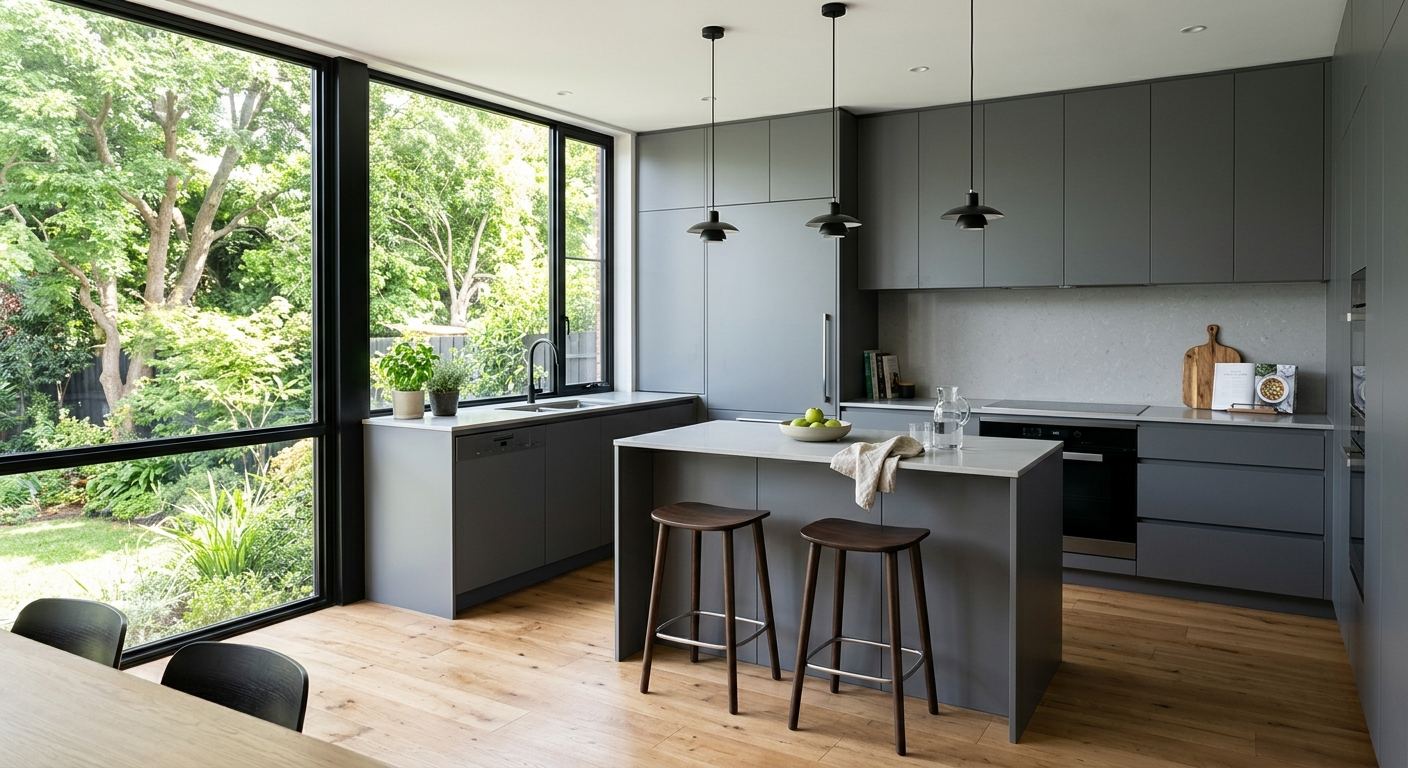
Kitchen renovation options and costs in Baden
Baden, Ontario homeowners usually start their kitchen renovation conversations with the same goal: improve daily function without overpaying. With Baden’s small population of 4,940 residents (Statistics Canada, 2021 Census), trades availability can feel tight compared with larger GTA municipalities, so booking early often matters as much as the finish selection. Pricing also reflects the broader Toronto economic region’s “move-up” market—many owners renovate at a level consistent with local household purchasing power and the resale expectations tied to higher property values, where renovations commonly align to premium cabinetry and stone.
In the Toronto region, kitchen budgets track more closely to home value and household incomes than to weather. That said, Ontario’s freeze–thaw cycles and winter humidity swings can indirectly affect cost: if your current kitchen shows swollen base cabinets, failed caulking at the counter, or water-damaged flooring near exterior doors or poorly ventilated zones, remediation may be added once the contractor sees what’s behind the drywall and subfloor. In Baden, trade demand is especially noticeable around the newer growth pockets along the Grand River area where families are updating kitchens for long-term living and resale.
To compare quotes fairly, it helps to separate the project into renovation tiers. The table below shows typical inclusions, duration expectations, and price bands commonly used for Baden full-kitchen work, from a cosmetic refresh to a custom, island-centred redesign.
| Renovation Tier |
What's Included |
Typical Duration |
Price Range |
| Cosmetic refresh (paint, hardware, new appliances only) |
Paint/trim touch-ups, new cabinet hardware, appliance swap (dishwasher range/microwave/hood if compatible), existing countertop reuse, basic cleaning and caulking where visible |
3–7 days |
$6,000–$15,000 |
| Mid-range full renovation (new cabinets, counters, sink, tile) |
Semi-custom or stock cabinets, new counters, new sink and faucet, backsplash tile, updated lighting fixtures (as allowed), tile flooring/backsplash as specified |
3–5 weeks |
$25,000–$60,000 |
| High-end full renovation (custom cabinets, stone counters, island) |
Custom millwork, premium quartz or natural stone counters, island build/finishing, enhanced backsplash (tile feature or slab-style look), upgraded appliance package, expanded lighting and trim details |
6–10 weeks |
$65,000–$90,000 |
| Cabinet refacing only (new doors + drawer fronts, same boxes) |
Door/drawer replacement, new hardware, veneer/finish update, optional interior upgrades (shelves/organizers), existing countertop reuse unless otherwise specified |
1–3 weeks |
$8,000–$35,000 |
| Countertop swap only (laminate to quartz or stone) |
Removal and disposal, counter fabrication and installation, new sink cut-out as needed, finishing at seams and edges, silicone/trim touch-ups |
2–7 days |
$3,000–$15,000 |
| Backsplash tile installation only |
Surface prep, tile layout and install, grout/seal where required, trim/caulk finishing, removal of old backsplash only if included in scope |
3–7 days |
$2,000–$10,000 |
Prices are estimates only and vary by project scope, site access and material selection.
What affects the price of kitchen renovation in Baden
In Baden and throughout the Toronto economic region, it’s common to see the “same” kitchen renovation quote vary by 30–50% because the driver isn’t just labour—it’s finish tier, how much trades time is required to address what’s hidden, and how extensive the layout and service changes are. Home value and household income influence what people choose: in higher-value pockets, homeowners more often prioritize quartz or natural stone and semi-custom cabinetry because those upgrades feel aligned with resale expectations. In more price-sensitive areas around the region, many projects aim for mid-range budgets using stock or refaced cabinets with good-quality counters to balance affordability and return.
Climate has a smaller direct effect on cost than in coastal markets, but Ontario’s winter freeze–thaw still matters during renovations. For example, if your kitchen sits near a poorly sealed exterior door, winter airflow can dry out caulking and reveal gaps along the backsplash and counter line—after demolition, contractors sometimes need to rework wall prep or adjust drywall. In older housing stock, outdated subflooring can also show up once cabinets are removed; correcting uneven floors can add labour even when the finishes are mid-range (e.g., $25,000–$60,000 projects). Conversely, if you’re staying within a “like-for-like” plan and reusing the existing cabinet boxes, cabinet refacing can keep scope under tighter control (often $8,000–$35,000).
Two local examples I see often in Baden: (1) shifting a sink location near or away from exterior-facing plumbing can trigger additional chase work and more drywall patching; (2) adding under-cabinet LED lighting in a kitchen with older wiring may require new circuits. The biggest unknown cost remains layout change—removing a wall, adding an island, or moving a gas line can raise labour, material, and permit time regardless of finish tier.
| Price Factor |
Why It Matters |
Cost Impact |
| Cabinet tier — stock vs. semi-custom vs. fully custom millwork |
Higher tiers improve fit, storage, and finish consistency but increase millwork time, customization, and material cost |
Small change in cabinet tier can swing a full renovation by several thousand dollars |
| Countertop material — laminate vs. quartz vs. granite vs. stone |
Fabrication complexity and slab/engineered material pricing drive both purchase and installation labour |
Counter materials alone can shift total project cost by a major step up or down |
| Layout change — wall removal, island add, plumbing/gas move |
Service moves require trades coordination, drywall repair, inspection/permits, and rework if hidden framing differs |
Often the largest unpredictable variance in quotes |
| Appliance package tier — builder vs. mid-range vs. pro-grade |
Electrical/gas compatibility and ventilation requirements change installation effort and potential vent/hood modifications |
Can add significant cost even with a fixed cabinet/counter plan |
| Flooring — refinish existing vs. full replacement |
Removing cabinets can force replacement if flooring is damaged or not level; matching existing finishes can be difficult |
Full replacement typically adds labour, underlayment and disposal costs |
| Backsplash — ceramic tile vs. marble vs. full-height slab |
Premium tile/stone increases material yield issues, pattern alignment time, and sealing requirements |
Full-height or feature materials can meaningfully extend the labour window |
| Electrical — new circuits for island, under-cabinet lighting |
New circuits/lighting increase licensed electrician time and may trigger panel/breaker adjustments |
Pricing varies widely depending on what wiring exists today |
| Permit fees and licensed trade requirements |
Work that triggers permits adds administrative time, inspection scheduling and certified trades |
Can add costs and timing even if materials stay the same |
Permits & regulations in Ontario
In Ontario, many cabinet and countertop upgrades are straightforward, but permits come into play when you change the kitchen’s “systems,” not just its finishes. Typically, swapping cabinets and replacing countertops—like laminate to quartz—does not require a permit because you’re not altering plumbing, electrical supply, or structural load paths. However, you should expect permits and inspections when you move plumbing supply or drain lines, relocate a gas stove/range or make changes related to gas ventilation, remove a load-bearing wall, or add new electrical circuits (for example, dedicated island receptacles or under-cabinet lighting tied into an updated circuit).
Gas work must be done by a licensed gas fitter, and electrical work must be done by a licensed electrician; both require inspection. Before signing, confirm in writing who pulls permits and who is responsible for compliance—contractors should list it in the scope and clarify whether they’re bundling permit fees or charging separately.
How Baden homeowners verify a contractor: start with the contractor’s Ontario business registration and then check for proof of trades coverage. Ask for a Certificate of Insurance (liability) and a clearance letter or proof of WSIB/WCB coverage (as applicable) before work begins. For licensing, review the relevant trade registry information linked to the contractor or subcontractors, and ensure any issued permits show your address and contractor details once filed.
Cabinets, countertops and layout decisions in Baden
The most consequential decisions in a Baden kitchen renovation usually fall into three buckets: cabinet tier, countertop material, and layout. In the Toronto resale market, these choices affect how the kitchen looks at a glance and how it performs day-to-day—so your best plan depends on whether you’re aiming for a fast refresh or a resale-focused “showpiece” kitchen.
First, cabinet tier: stock cabinets are typically the fastest and cheapest option, but they’re less flexible for awkward corner runs, pantry layouts, or custom appliance spacing. Semi-custom cabinets are the most popular balance in Baden because they deliver better door styles, internal organization, and fit without the lead-time spikes of full custom millwork. Custom cabinets can provide the best fit and storage, but they push timelines and often land you in the upper renovation band (e.g., $65,000–$90,000) especially when an island is added.
Second, countertops: laminate is cost-effective but more sensitive to heat and impacts. Quartz offers a strong durability-to-maintenance trade-off. Natural stone like granite looks premium and can be very resilient, but it generally requires periodic sealing and careful fabrication details. In Ontario homes, sealing and seam quality matter because winter humidity swings can highlight minor leaks—especially around sinks and dishwasher zones.
Third, layout: open-concept wall removal, island additions, and plumbing/gas relocation often deliver the biggest “space gain,” but they’re also the least predictable costs. A practical way to justify it: if your kitchen is closed off and your dining/living area is underused, an island can improve daily traffic flow and seating more than swapping finishes alone. If you’re staying with your existing plumbing and not moving a gas line, your project can more easily land in the mid-range (e.g., $25,000–$60,000) without the extra permitting and rework.
Dollar example: If you choose quartz over laminate, a typical countertop upgrade can move you closer to the mid-to-upper portion of the countertop-only bands (often $3,000–$15,000 depending on size and edges). If that upgrade is paired with keeping your sink location and cabinet layout unchanged, the extra cost is usually easier to recover on resale than paying for full layout changes.
| Option |
Durability |
Maintenance |
Best For |
Price Range |
| Stock cabinets (big-box) |
Good structural durability; depends on the exact model and hardware quality |
Low day-to-day effort; touch-up may be needed if doors are heavily used |
Fast projects and budget-conscious renovations |
$8,000–$25,000 |
| Semi-custom cabinets (local dealer) |
Very solid; improved fit and storage options reduce wear points |
Low maintenance with proper installation; tune-up is straightforward |
Most Baden homeowners balancing look, storage and timeline |
$15,000–$45,000 |
| Custom cabinets (local millwork shop) |
Highest durability when built for your exact measurements and load needs |
Low maintenance; hinges/organizers can be tailored to your usage |
Complex layouts, built-ins, and maximum storage |
$35,000–$60,000 |
| Laminate countertop |
Resists staining; can be vulnerable to heat and edge damage if not cared for |
Wipe-clean routine; avoid direct heat and prolonged standing water at seams |
Best value when you want a refreshed look quickly |
$3,000–$7,000 |
| Quartz engineered countertop |
Very durable; consistent surface and good resistance to everyday impacts |
Low maintenance; clean with mild soap and avoid abrasive pads |
Resale-friendly upgrades and busy households |
$7,000–$12,000 |
| Granite / natural stone countertop |
Highly heat-tolerant; strength depends on thickness and fabrication quality |
Often requires periodic sealing; wipe spills and protect seams |
Premium aesthetics with traditional, timeless appeal |
$9,000–$15,000 |
| Butcher block countertop |
Great for cutting but can dent/scratch; best with proper finishing |
Requires oiling/maintenance to prevent drying or staining |
Warm, family-friendly kitchens where you’ll maintain it |
$6,000–$11,000 |
| Marble countertop |
Beautiful but softer; more prone to etching and staining without careful use |
Higher maintenance; requires consistent sealing and gentle cleaners |
Design-forward kitchens where appearance is the priority |
$10,000–$15,000 |
How to choose a kitchen renovation contractor in Baden
Choosing the right contractor in Baden is mostly about verifying three things: Ontario licensing/eligibility for the trades involved, coverage, and clarity of scope. Start by confirming the contractor’s access to licensed trades—gas work must be done by a licensed gas fitter, and electrical by a licensed electrician. Ask for liability insurance documentation and proof of WSIB/WCB coverage (as applicable). Don’t accept “we’re covered” verbally; request certificates and clearance paperwork so you have a file for your records.
Next, get 2–3 itemised written quotes. You want a labour + materials breakdown rather than one lump sum, especially for cabinets, countertops, tile, demolition, disposal, and electrical/plumbing work. Read the scope line-by-line: check what’s excluded (subfloor repair, drywall patching, appliance supply, cabinet removal/haul-away, venting changes) and whether permit pull and inspection fees are included. For warranties, ask for both workmanship warranty length and product/manufacturer coverage details, and confirm whether warranties are transferable if you sell the home.
Finally, payment schedule and timeline should protect you. A common rule of thumb is never pay more than 10–15% upfront; hold back a portion until completion and final punch-list items are addressed. Your written estimate should include a start date and completion estimate, plus allowances for cabinet or stone fabrication lead times so you’re not surprised mid-project.
- Verify licensed trade credentials for any electrical, gas, or structural wall work.
- Request Certificate of Insurance (liability) and confirm limits are current.
- Ask for WSIB/WCB clearance or equivalent proof before demolition starts.
- Get 2–3 quotes with line items for labour, materials, and disposal.
- Confirm whether permit fees and inspections are included or separately quoted.
- Clarify demolition and haul-away: how many trips and what’s included.
- Check who is responsible for site protection (floor coverings, plastic barriers).
- Review cabinet measurement process and what happens if walls are out of square.
- Confirm countertop fabrication templates and who pays for remake fees.
- Ask about backsplash substrate prep and grout/seal specifications.
- Ensure warranty terms are written for workmanship and products.
- Use a payment schedule that holds back funds until final inspection/punch list.
Red flags I see in Baden: (1) quotes that don’t include disposal/demolition details, (2) vague electrical/gas wording that doesn’t identify which licensed trades are involved, (3) “permit handled by us” but no written responsibility in the contract, (4) requiring large upfront payments beyond 15%, and (5) no clear fabrication lead times for cabinets or stone—especially when targeting a budget like $25,000–$60,000 mid-range projects.
Frequently asked questions — kitchen renovation in Baden
Do I need a permit for a kitchen renovation in Ontario?
In Ontario, many finish-only changes typically don’t require permits—so cabinet swaps (including stock or semi-custom), countertop replacements, and backsplash installations are usually permit-free. In Baden specifically, I still recommend you confirm your plan with the contractor because permits are required when you change the kitchen’s systems. That includes moving plumbing supply/drain lines, relocating a gas range/stove, removing a load-bearing wall, or adding new electrical circuits (like dedicated island receptacles or major lighting updates). Gas work must be performed by a licensed gas fitter, and electrical by a licensed electrician, with inspections. Before you sign, ask the contractor who is responsible for permit applications and inspections, and make sure it’s written in your contract scope and exclusions.
What's the ROI on a kitchen renovation?
ROI varies by how closely your kitchen matches what buyers expect in the Toronto market—finish tier, storage, and overall functionality usually matter more than “custom-only” features. In higher-value markets across the Toronto economic region, homeowners often choose quartz/stone and better cabinetry because the cost can feel more recoverable at resale when the kitchen presents well. In more budget-sensitive pockets, practical upgrades like new fronts via refacing and a durable countertop can deliver better cost control. As a practical planning benchmark, Baden projects commonly fall between $25,000–$60,000 for mid-range updates and $65,000–$90,000 for full custom work; ROI is strongest when your choices don’t exceed what comparable homes in your area will support. The safest ROI move is improving flow and storage while staying within a finish tier consistent with your neighbourhood’s resale expectations.
How do I budget for a kitchen renovation?
Start by choosing your renovation tier, then build in realistic contingencies. For Baden homeowners, a cosmetic refresh is often far cheaper than a full gut—budgeting around $6,000–$15,000 for paint, hardware, and appliance swaps (only) helps you gauge scope. If you’re replacing cabinets and counters and updating tile and the sink, mid-range full renovations typically land in $25,000–$60,000. If you’re adding a new island, upgrading to custom cabinetry, and using premium stone, the higher-end range is commonly $65,000–$90,000. Beyond those bands, add allowance for hidden conditions like out-of-level floors, drywall repair, or electrical rework—especially in older Baden housing where winter humidity can reveal weak sealants around sinks and backsplashes. Finally, request itemised quotes so you can identify what’s included versus excluded.
Can I move my kitchen sink or stove?
Yes, you can move a sink or stove, but it’s one of the most cost-sensitive decisions in a Baden renovation. Moving a sink generally means adjusting plumbing supply and drain lines, which may trigger permits and requires coordination of licensed trades. Moving a stove can be even more complex if it’s gas: any gas relocation must be performed by a licensed gas fitter and inspected. Even when you plan to move only a few feet, expect potential drywall patching and electrical updates for lighting and outlets. If you want to keep costs predictable, the most budget-friendly approach is usually “keep plumbing where it is” and redesign within the existing service locations—so you can focus spend on cabinets and counters instead of chase work and permitting. Ask for a quote that separates “like-for-like” changes from service relocation so you can see the true cost difference.
What's the most cost-effective kitchen upgrade?
The most cost-effective upgrade is usually the one that delivers the biggest visual impact without expensive service changes. Many Baden homeowners get strong results from a cabinet refacing approach—new doors and drawer fronts over the existing boxes—because it can modernize the kitchen quickly while avoiding full demolition. If your cabinet boxes are in good shape and your layout doesn’t change, this often stays within the broader refacing budget of $8,000–$35,000, depending on size and material selection. Another strong value move is upgrading countertops alone (for example, laminate to quartz or stone), commonly within the $3,000–$15,000 range, especially when you’re keeping the sink location and existing cut-outs compatible. The least cost-effective path is generally combining countertop upgrades with major plumbing/gas moves unless the layout gain is truly necessary—like improving accessibility or adding practical seating with an island.
Custom vs stock cabinets — is custom worth it?
Custom cabinets can be worth it when your Baden kitchen has a complicated layout, unusual dimensions, or you want specific storage performance (pantries, appliance garages, integrated organizers, or a tight island/to-ceiling design). Stock cabinets are typically the fastest and cheapest option, and they work well when your measurements are straightforward and you’re happy with standard configurations. Semi-custom often sits in the sweet spot for most homeowners—better fit and storage than stock without the highest lead times and cost. Budget-wise, full projects with custom cabinetry and premium finishes commonly push toward the higher-end bands like $65,000–$90,000, while more value-focused renovations may land closer to $25,000–$60,000. If you’re unsure, choose the cabinet tier first, then lock the layout and services; that sequence helps you spend where it actually pays off at resale and avoids paying for custom only to later change the plan.