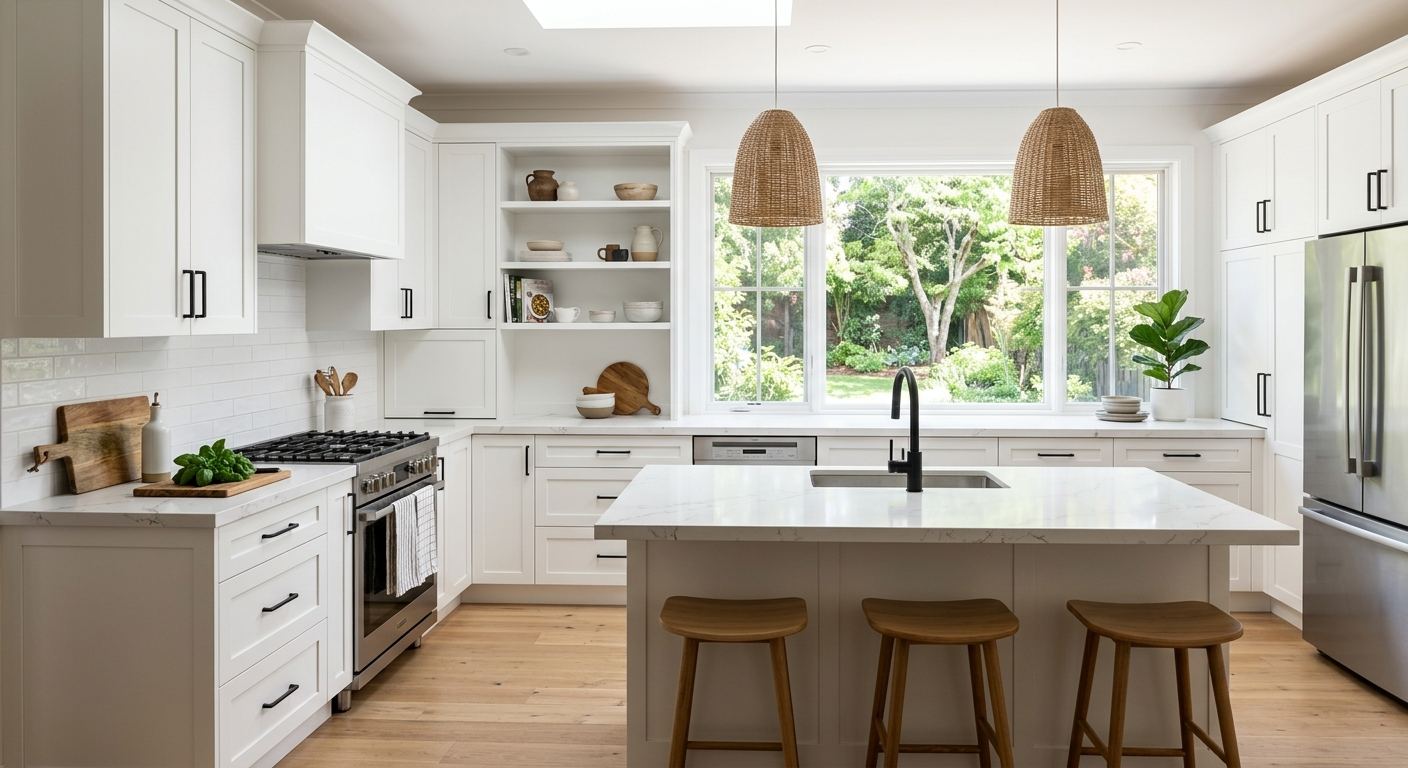
Kitchen renovation options and costs in Welland
Welland homeowners typically start their kitchen renovation planning with budget, but the best starting point is the finish tier that fits their home and resale expectations. In Welland, the median household income is $71,500 (Statistics Canada, 2021 Census), and with about 69.0% of households owning, many projects are planned as “stay-and-improve” renovations that still need to make sense for resale. It’s not just aesthetics—Hamilton–Niagara Peninsula buyers tend to pay attention to kitchen durability, countertop look, and cabinet style, so kitchens in stronger resale neighbourhoods often shift sooner toward quartz and semi-custom cabinetry rather than basic upgrades.
Climate matters in the day-to-day: Ontario humidity swings, winter road salt tracking in from the garage/entry, and freeze–thaw cycles can expose weaknesses in older homes. Welland has a lot of housing built before 1981 (65.6% of dwellings), so older plumbing runs, uneven subfloors, and dated electrical can increase labour when you’re doing a full refresh versus a surface-level update. That said, across the Hamilton–Niagara Peninsula, contractor availability and labour intensity—especially for demo, millwork install, and countertop templating—are usually what drives the real cost spread, not the weather itself.
In Welland, trades are particularly busy in older, established areas near downtown where many homes were built before 1981 and upgrades are overdue. If you’re deciding between a cosmetic refresh and a mid-range full renovation, the table below is a practical way to compare what you can expect at each tier.
| Renovation Tier |
What's Included |
Typical Duration |
Price Range |
| Cosmetic refresh (paint, hardware, new appliances only) |
Cabinet paint or repaint (if needed), hardware swap, backsplash spot-fix (if any), new fridge/range/dishwasher, minor touch-ups; no countertop replacement and no major plumbing/electrical changes |
3–7 days |
$3,000–$12,000 |
| Mid-range full renovation (new cabinets, counters, sink, tile) |
New semi-custom or upgraded stock cabinets, quartz counters, new sink and taps, backsplash tile, flooring patch/repair as needed, labour for install and countertop templating |
3–6 weeks |
$30,000–$60,000 |
| High-end full renovation (custom cabinets, stone counters, island) |
Custom cabinetry, stone counters (granite/stone or premium quartz), island with toe-kick/lighting options, upgraded plumbing and electrical work, full backsplash, higher-end appliance package, more complex trim and finish carpentry |
6–12 weeks |
$70,000–$90,000 |
| Cabinet refacing only (new doors + drawer fronts, same boxes) |
Door/drawer replacement, new colour/finish, new hardware, optional interior upgrades (shelves/organizers), match to existing box condition |
1–3 weeks |
$5,000–$25,000 |
| Countertop swap only (laminate to quartz or stone) |
Templating and install for quartz/stone, sink cut-out adjustments if applicable, basic sealing/finishing; assumes layout and cabinet tops remain compatible |
3–10 days (plus curing/lead times) |
$3,000–$8,000 |
| Backsplash tile installation only |
Remove old backsplash (as needed), prep/leveling, tile supply and install, finishing at outlets and edges; grout and caulking |
3–7 days |
$2,000–$10,000 |
Prices are estimates only and vary by project scope, site access and material selection.
What affects the price of kitchen renovation in Welland
In Welland and across the Hamilton–Niagara Peninsula, two homeowners can receive quotes that differ by 30–50% for the “same” kitchen renovation. That gap usually comes from what’s truly changing: whether you’re only upgrading surfaces (paint, tile, appliances) or doing structural work like new cabinet layouts, island builds, or relocating plumbing. Local home values and income levels also shape the finish tier far more than climate. In higher-value pockets of the region, quartz or stone counters and semi-custom cabinetry are common defaults because the added cost is easier to recover on resale. In more modest property segments, laminate and stock cabinets often win because they deliver a noticeable refresh without pushing the total project into premium territory.
Layout change is the wildcard that can reset the budget regardless of finish: removing a wall, adding an island, or moving a gas line and rerouting plumbing typically adds planning, trades coordination, and inspection time. In an older Welland home (many built before 1981), that risk is higher—hidden knob-and-tube remnants, older shutoffs, and older subfloor conditions can force extra remediation before cabinetry can sit level.
Concrete examples from recent market patterns: (1) upgrading from laminate counters to quartz often lands in the countertop swap and mid-range full renovation price bands (for many homeowners, that moves them from roughly the $1,500–$3,500 countertop range toward higher mid-range totals depending on sink cut-outs and edge profiles). (2) if your plan is a “mid-range full renovation” around $30,000–$60,000 but you also decide to add an island and new electrical for pendant/under-cabinet lighting, it can quickly drift toward the upper half of that band or into premium territory. (3) full-height backsplash tile can raise costs compared to standard-height installs, especially when outlet moves require patching.
Bottom line: in Welland, the housing stock age and the amount of work behind the walls often explain the bigger dollars, while the weather mostly shows up later as wear-and-tear—caulking, grout maintenance, and moisture-tolerant installation details.
| Price Factor |
Why It Matters |
Cost Impact |
| Cabinet tier — stock vs. semi-custom vs. fully custom millwork |
Higher tiers offer better materials, door styles, hardware, and fit—custom also means longer lead times and more carpentry |
Typically shifts the overall budget by large margins; can move a job from the mid-range $30,000–$60,000 band toward the $70,000–$90,000 band |
| Countertop material — laminate vs. quartz vs. granite vs. stone |
Material cost, thickness, edge finishing, and templating complexity vary; stone also needs heavier handling and careful sealing requirements |
Laminate upgrades are usually the lowest; quartz/stone increases both material and install costs (often a noticeable jump within the $1,500–$8,000 countertop band) |
| Layout change — wall removal, island add, plumbing/gas move |
Moving services requires coordination, sometimes permits, and often reveals hidden site conditions in older homes |
Can add the most unpredictable increases regardless of finish tier—commonly a major portion of the spread between quotes |
| Appliance package tier — builder vs. mid-range vs. pro-grade |
Pro-grade units can require venting/clearances and add electrical or gas considerations |
Usually adds tens of thousands only at the high end; otherwise it’s a controlled line-item within the overall renovation |
| Flooring — refinish existing vs. full replacement |
Demo and cabinet removal often reveal subfloor issues; matching existing flooring can be hard |
Replacement tends to raise total cost; refinish keeps costs nearer the lower end of cosmetic/full bands |
| Backsplash — ceramic tile vs. marble vs. full-height slab |
Material thickness, cutting around outlets, and finish continuity affect labour and waste |
Full-height premium tile or slab can move the backsplash line toward the upper part of the $2,000–$10,000 band |
| Electrical — new circuits for island, under-cabinet lighting |
Additional circuits and fixtures require licensed work and inspection |
Commonly adds cost variability; can be a key driver when island lighting and a microwave/hood are added |
| Permit fees and licensed trade requirements |
Any permitted work adds administrative time and inspection scheduling |
Usually not the biggest line item, but it increases schedule certainty and can affect total project duration and cost |
Permits & regulations in Ontario
In Ontario, not every kitchen change triggers a permit. Cabinet and countertop swaps—when you keep the existing plumbing and gas locations the same and you’re not altering walls structurally—generally do not require a permit. However, you do need a permit and licensed trades when you move or change core services. That means moving plumbing supply or drain lines, relocating a gas stove/range, rerouting the venting/hood work if it involves gas-related changes, removing a load-bearing wall (or modifying framing), and adding new electrical circuits—like new under-cabinet lighting runs that require a new circuit, or adding outlets for an island where power isn’t already available.
A homeowner in Welland can verify contractor responsibility in a straightforward sequence. First, ask for the contractor’s Ontario licence information (and confirm it matches the scope you’re hiring them for) and request a current certificate of insurance showing liability coverage. Next, confirm WSIB/WCB coverage (coverage status should be documented—either the contractor provides proof of coverage or the required exemption documentation, depending on the situation). Before signing, ask for the permit plan in writing: which trade pulls the permit, who schedules inspections, and what’s included in the quoted scope. Also request a clearance letter or proof of inspection completion where applicable for the work that requires permits.
Finally, don’t assume “permit included” means the full cost is absorbed—scope clarity matters. Always confirm responsibility and costs belong in the written contract, because delays in inspections can affect demolition schedules and countertop templating timelines.
Cabinets, countertops and layout decisions in Welland
The three most consequential decisions in a Welland kitchen renovation are (1) cabinet tier, (2) countertop material, and (3) layout changes. Start with cabinet tier because it drives most of the perceived quality: stock cabinets are typically the fastest and cheapest, semi-custom is the most popular mid-range choice in the Hamilton–Niagara Peninsula market, and fully custom millwork is the highest cost with the best fit for difficult rooms. In neighbourhoods with older homes (many built before 1981), semi-custom often balances speed and flexibility—especially if your walls aren’t perfectly square and you need better tolerance or interior organization.
Next, countertop material: laminate is budget-friendly and can look modern with good edge profiles, but it’s more vulnerable to heat and impact. Quartz is durable, typically less stain-prone, and is now a common “default” in mid-range full renovations—often because it’s easier to maintain for busy households. Granite/natural stone looks premium and ages well, but it may need sealing and careful handling around cuts and joints. Butcher block adds warmth and is forgiving for minor wear, but it requires regular oiling to protect against moisture—important in Ontario’s seasonal humidity swings.
Finally, layout changes. Open-concept wall removal or adding an island can be worth the cost if it improves flow and gives you functional space for seating, but plumbing/gas relocation and electrical work should be planned carefully. For a real dollar example: moving from a mid-range full renovation around $30,000–$60,000 to a layout with island lighting and more service work can make the project drift toward the upper end of that band. If your budget goal is to land closer to the mid-range, consider keeping plumbing locations where possible and upgrading cabinets and quartz counters instead.
At each price point, local resale expectations generally reward a cohesive look: straight cabinet alignment, clean countertop edges, and backsplash finishes that hold up to everyday Ontario use.
| Option |
Durability |
Maintenance |
Best For |
Price Range |
| Stock cabinets (big-box) |
Solid in well-leveled homes; less flexible for uneven walls and unique dimensions |
Low day-to-day care; hardware upgrades can refresh the look |
Budget-focused renovations, quick turnarounds, straightforward layouts |
$6,000–$15,000 |
| Semi-custom cabinets (local dealer) |
Good build quality; better door/drawer options and more sizing flexibility |
Low routine maintenance; organizers help keep surfaces clear |
Most Welland renovations aiming for a “finished” look without full custom pricing |
$15,000–$35,000 |
| Custom cabinets (local millwork shop) |
Highest fit and craftsmanship; best for complex ceilings, angles, and built-ins |
Low maintenance, but workmanship quality matters—choose reputable installers |
Premium transformations, challenging layouts, and owners staying longer in the home |
$35,000–$60,000 |
| Laminate countertop |
Good for everyday use; can be vulnerable to heat and cutting if not used carefully |
Wipe-clean routine; avoid hot pans directly and use cutting boards |
Cost-controlled refreshes, rentals/investor units, cosmetic-first projects |
$1,500–$3,500 |
| Quartz engineered countertop |
Very durable; resistant to staining and everyday impacts |
Low maintenance; regular wipe-down and care per manufacturer |
Most mid-range full renovations and busy households in Welland |
$3,500–$6,500 |
| Granite / natural stone countertop |
Extremely durable; unique veining and premium appearance |
May require periodic sealing; treat joints and edges carefully |
High-end looks, premium upgrades, and homes targeting higher resale finishes |
$5,500–$8,000 |
| Butcher block countertop |
Strong and forgiving; dents and scratches can occur but can be sanded |
Needs oiling and mindful moisture control |
Warm, traditional or farmhouse styles; homeowners who maintain surfaces |
$2,500–$5,500 |
| Marble countertop |
Premium beauty; can etch/stain if you use acidic cleaners or heavy liquids |
Higher maintenance—protect with sealers and careful cleaning |
Statement kitchens and owners who want luxury finishes and will care for them |
$6,000–$10,000 |
How to choose a kitchen renovation contractor in Welland
Choosing the right kitchen contractor in Welland is mostly about verifying coverage, clarity, and workmanship, not just price. Start by confirming Ontario licensing appropriate to the trades involved (cabinet installation alone is different from electrical and gas work). Then ask for proof of liability insurance—get a certificate of insurance—and verify WSIB/WCB coverage. A legitimate contractor won’t dodge these requests; they’ll provide documents before you sign and they’ll match the scope on your quote.
Next, request 2–3 itemised written quotes. You want labour and materials broken down so you can compare apples-to-apples: demolition, cabinet install, countertop templating and install, tile setting, electrical rough-in (if included), and disposal. Read the scope for exclusions and inclusions: is permit pulling included if you’re doing electrical or gas work? Is old material disposal included? What’s the approach if the installer discovers subfloor damage during demo?
Warranty matters twice: ask for the workmanship warranty length and what it covers (for example, cabinet alignment adjustments, caulking/grout workmanship, and countertop install issues). Also confirm product/manufacturer warranties and whether they’re transferable to you as the homeowner. For payment schedule, don’t put yourself at risk—never pay more than 10–15% upfront, and use a holdback until key stages are complete (especially after countertop install and final finish). Finally, get a written start date and a completion estimate that includes lead times for cabinets and countertop fabrication.
- Request insurance proof (liability certificate) and verify WSIB/WCB documentation before signing.
- Ask which licensed trades are used for electrical and any gas-related scope.
- Confirm permit responsibility in writing (who pulls, who pays, what gets inspected).
- Get an itemised quote with separate labour vs materials line items.
- Check for exclusions: demolition limits, drywall repair scope, flooring patching, and disposal.
- Verify countertop templating timing and who handles fabrication changes.
- Ask how they protect floors and doors during demo and install.
- Confirm cabinet installation tolerances and how they handle out-of-square walls.
- Review warranty terms for workmanship and cabinet/countertop products.
- Use a milestone-based payment schedule with a holdback until punch list completion.
- Ask for the project schedule with lead-time buffers for cabinets and stone/quartz.
- Get the scope change process documented (how change orders are priced and approved).
Red flags I commonly see in Welland: contractors who won’t provide insurance/coverage documents, vague “lump sum” quotes with no disposal/permit clarity, missing start dates or ignoring lead times, insisting on large upfront payments, and avoiding written warranty terms. If you hear “don’t worry about permits” or you’re not told which scope triggers licensed trades, pause and get it clarified in writing.
Frequently asked questions — kitchen renovation in Welland
Quartz vs granite countertops — which is better?
In Welland kitchens, quartz is usually the most practical “better” for daily life because it’s very consistent in look and is low maintenance compared with many natural stones. Granite is also durable and visually striking, but it can require periodic sealing depending on the specific stone, and unique slabs can vary in pattern and cost. If you’re choosing between materials on a budget, many homeowners find quartz fits cleanly within common countertop installation expectations (often within the $3,500–$6,500 range in mid-range builds). Granite and premium stone tends to push higher, especially with heavier slabs and more careful edge/joint work. For most households, quartz provides a great mix of durability and straightforward care—especially useful in Ontario’s seasonal humidity swings, where you want fewer surprises around seams and finishes. (Statistics Canada, 2021 Census)
Should I reface or replace my cabinets?
Refacing is often the better move when your existing cabinet boxes are solid, level, and structurally sound—common in older homes when the layout still works. If your boxes are sagging, water-damaged near sinks, or your storage design is outdated, replacement is usually the safer long-term choice. In Welland, refacing is typically less invasive and can fit a tighter budget (cabinet refacing often falls in the $5,000–$25,000 range depending on door style, hardware, and prep). Replacement is usually the path when you want new cabinet sizing for better organizers, a different layout, or a full aesthetic shift that includes new soffits and trim. A good contractor will assess box condition in person and show you why reface vs replace changes your durability, not just your appearance.
Do I need a permit for a kitchen renovation in Ontario?
In Ontario, a straightforward cabinet and countertop swap usually doesn’t require a permit. However, if your kitchen renovation in Welland involves moving plumbing supply/drain lines, relocating a gas stove or changing gas connections, removing a load-bearing wall, or adding electrical circuits (for example, for an island circuit or new under-cabinet lighting where none exists), permits and licensed trades are typically required. Gas work must be done by a licensed gas fitter, and electrical work by a licensed electrician, with inspections as required. The key homeowner step is to confirm in your contract which party pulls permits and what’s included, because “we’ll handle everything” is only useful if it’s written. If you want a comfort check, ask for proof of insurance/WSIB/WCB and the planned inspection steps before work starts.
What's the ROI on a kitchen renovation?
ROI varies widely in Ontario because buyers respond to different triggers—layout function, countertop appearance, and cabinet style often matter more than the exact material branding. In Welland, where many dwellings were built before 1981 (65.6% of dwellings) and where kitchens are a major day-to-day space, renovations can meaningfully improve buyer confidence when the work addresses structural issues, updates finishes, and modernizes storage. Market context matters: in higher-demand neighbourhoods, a well-executed mid-range full renovation with quartz, new cabinets, and quality tile often supports better resale appeal than cosmetic changes alone. As a pricing reality check, full renovations commonly fall in the $30,000–$60,000 mid-range band, while more complex premium projects can exceed $90,000. The best ROI typically comes from matching the finish tier to the home segment rather than “overbuilding.” Your contractor should be able to explain which choices align with your likely buyer in the Hamilton–Niagara Peninsula market.
How do I budget for a kitchen renovation?
Budgeting well in Welland means separating “visible finishes” from “behind-the-wall work.” Start with your target tier: a cosmetic refresh is usually only a small portion of total spend, while a typical mid-range full renovation is commonly around $30,000–$60,000 when you’re installing new cabinets and quartz counters and doing backsplash and sink changes. If you’re considering a high-end transformation with custom cabinetry, stone counters, and an island, plan for the higher end of the full renovation range (often $70,000–$90,000). Then add a realistic contingency for older homes—outdated wiring, uneven subfloors, and plumbing access can surface during demo. A smart approach is to get a detailed, itemised quote and ask how changes get priced. Aim to keep payment structured (for example, not more than 10–15% upfront) and confirm disposal, permit handling, and countertop lead times so there are fewer budget surprises.
Can I move my kitchen sink or stove?
You can, but whether it’s a good idea depends on the required services and whether your contractor can execute the plumbing/electrical/gas work efficiently. In Ontario, moving plumbing supply or drain lines typically triggers permits and licensed plumbing work, and moving a gas stove/range involves licensed gas fitting and inspection requirements. In an older Welland home (many built before 1981), it’s especially important to plan because older drain paths, venting constraints, and shutoff locations can add labour and cost. If your goal is to keep the project closer to a mid-range full renovation budget (often $30,000–$60,000), consider keeping the sink and stove in roughly the same footprint and invest instead in cabinets, quartz counters, and backsplash. If you’re set on moving them, ask your contractor for a service map, drainage/venting plan, and a clear breakdown of what changes are included in the quote.