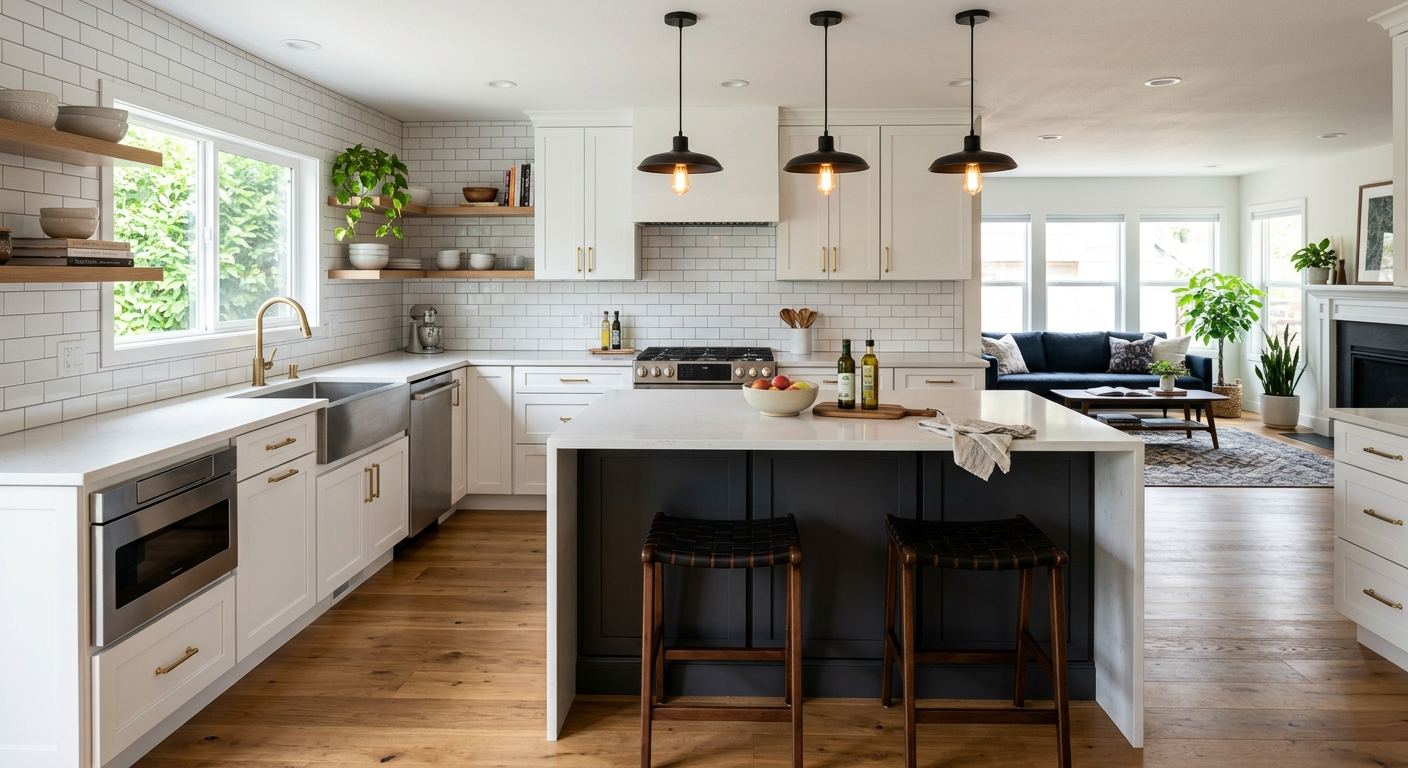
Kitchen renovation options and costs in Victoria Hills
Kitchen renovation in Victoria Hills usually starts with one question: what level of finish do you want to see every day. With a population of 10,533 in the area served by Victoria Hills (Statistics Canada, 2021 Census), many homeowners are either updating long-settled homes or preparing properties for the next family stage. In the Toronto economic region, renovation decisions typically track local home values and buyer expectations more than weather. In higher-value pockets of the GTA, owners commonly invest around 8%–15% of their home value into the kitchen, which steers budgets toward quartz, natural stone, and semi-custom or fully custom cabinetry. That pricing behaviour matters in Victoria Hills because contractors can staff up more consistently for the mid-to-upper finish tiers, and material selection is often broader.
Ontario’s kitchen costs are also shaped by market availability: when more homes are being refreshed, labour scheduling tightens, and “typical duration” can stretch if you select custom fronts, premium slabs, or island fabrication. Climate still plays a smaller role than the market, but Ontario’s freeze–thaw cycles do affect how closely walls, floors, and cabinets are inspected for moisture movement—especially in older housing stock. If you’re doing a full refresh near the main hubs of demand—such as the North Toronto/Scarborough-to-Vaughan corridor where GTA trades concentrate—timeline and pricing assumptions should be planned with that in mind. Use the options below as a baseline, then we’ll dial the numbers to your scope.
| Renovation Tier |
What's Included |
Typical Duration |
Price Range |
| Cosmetic refresh (paint, hardware, new appliances only) |
Paint/stain touch-ups, hardware swap, appliance replacement (matching models), minor caulking and trim |
1–2 weeks |
$3,000–$12,000 |
| Mid-range full renovation (new cabinets, counters, sink, tile) |
New or semi-custom cabinets, quartz or quality laminate counters, sink and faucet, backsplash tile, plumbing hookups, flooring refinishing or replacement allowance |
4–7 weeks |
$25,000–$65,000 |
| High-end full renovation (custom cabinets, stone counters, island) |
Fully custom cabinetry, natural stone (granite/stone) or premium quartz, oversized island with integrated storage, upgraded appliance package allowance, full-height backsplash options, enhanced lighting |
7–12 weeks |
$70,000–$90,000+ |
| Cabinet refacing only (new doors + drawer fronts, same boxes) |
Door and drawer front replacement, new veneer/laminate panels, new hardware, re-caulking and refinishing of visible surfaces |
1–3 weeks |
$8,000–$35,000 |
| Countertop swap only (laminate to quartz or stone) |
Remove existing tops, install new quartz/stone/engineered surface, cut-outs for sink and cooktop, seam work as required |
3–7 days |
$3,000–$15,000 |
| Backsplash tile installation only |
Surface prep, tile installation, grouting and sealing (as appropriate), allowance for minor outlet modifications |
3–6 days |
$2,000–$10,000 |
Prices are estimates only and vary by project scope, site access and material selection.
What affects the price of kitchen renovation in Victoria Hills
Even when two homeowners ask for the “same” kitchen—new cabinets, new counters, and the same rough layout—quotes across Toronto and Ontario can differ by 30%–50%. The main reason is that the finish tier and the hidden work differ: lighting plans, electrical routing, plumbing access, subfloor and wall repairs, and how much of the kitchen has to be opened to do it correctly. Local home values and median incomes also shape what homeowners choose. In higher-value Toronto-area markets, people more often default to quartz or stone counters and semi-custom cabinetry because the renovation cost tends to be easier to recover on resale. In more price-sensitive areas farther out, laminate and stock cabinets are common, which keeps full renovations in the mid-to-upper band—often closer to the lower end of a $25,000–$65,000 scope rather than the upper end.
In Victoria Hills, three practical conditions commonly raise or lower costs. First, older homes may have out-of-level walls: when installers have to fur out cabinets for a straight run, labour climbs quickly even if your materials stay mid-range. Second, if your kitchen sits near exterior walls, contractors may need to address moisture movement after demolition—small framing fixes can add several thousand dollars. Third, layout changes are the wildcard: removing a wall, adding an island, or moving a gas line or plumbing can push the project toward the higher side regardless of whether you choose laminate or quartz. For example, a straightforward countertop-only upgrade can fit the $3,000–$15,000 band, but the same surface becomes part of a full renovation once you’re relocating a sink and adding a new island run.
With that in mind, the biggest pricing levers are usually cabinet tier, countertop material, and how much of the rough-in work changes. The table below breaks down the factors that most often create those 30%–50% quote swings.
| Price Factor |
Why It Matters |
Cost Impact |
| Cabinet tier — stock vs. semi-custom vs. fully custom millwork |
Custom sizing, interior options (drawers, organizers) and build style determine labour time and material cost |
$5,000–$30,000+ |
| Countertop material — laminate vs. quartz vs. granite vs. stone |
Material pricing, fabrication complexity (seams, edges), and installation method affect totals |
$2,000–$12,000 |
| Layout change — wall removal, island add, plumbing/gas move |
Trigger permits, licensed trades, structural assessments, and demolition/patching scope |
$8,000–$35,000 |
| Appliance package tier — builder vs. mid-range vs. pro-grade |
Higher tiers add electrical/gas expectations, depth/venting needs, and sometimes custom panels |
$2,500–$15,000+ |
| Flooring — refinish existing vs. full replacement |
Removing cabinets often reveals subfloor condition; matching tones after the fact can be difficult |
$1,500–$8,000 |
| Backsplash — ceramic tile vs. marble vs. full-height slab |
Material weight, pattern alignment, and waterproofing/edge detailing can extend labour |
$2,000–$10,000 |
| Electrical — new circuits for island, under-cabinet lighting |
New receptacles, pot lights, and fixture routing add labour and inspection steps |
$800–$7,000 |
| Permit fees and licensed trade requirements |
Permits, inspections, and licensed work (gas/electrical/structural where required) add scheduling and admin cost |
$500–$3,500 |
Permits & regulations in Ontario
In Ontario, not every kitchen update requires a permit. Typically, cabinet and countertop swaps that do not move plumbing or gas lines do not require a permit—so replacing cabinets, swapping laminate for quartz, or installing a new backsplash usually stays in the “no permit” category. However, once you change the rough-in, you’re typically in permit territory. Moving plumbing supply or drain lines (for a relocated sink or dishwasher), relocating gas (range/stove line or gas components), removing a load-bearing wall, or adding electrical circuits (for an island, new range hood wiring, or dedicated lighting circuits) generally requires permits and licensed trades. Gas work must be performed by a licensed gas fitter; electrical work by a licensed electrician, with inspections where required.
For a homeowner in Victoria Hills, the practical process is straightforward. Step 1: ask your contractor for the exact permit plan before work begins and confirm who pulls permits in the written contract. Step 2: verify licences—check the electrician’s and gas fitter’s credentials using their professional registry listings, then compare those names to the trades on-site. Step 3: request a Certificate of Insurance showing liability coverage and the applicable WSIB/WCB clearance letter (or acceptable proof of coverage) before demolition. Step 4: ask for an inspection schedule for any licensed work so you’re not surprised by delays.
Always put responsibility for permits in writing: “contractor to pull permits for work scopes X/Y/Z” is the cleanest way to avoid disputes mid-project.
Cabinets, countertops and layout decisions in Victoria Hills
The three most consequential decisions in a Victoria Hills kitchen renovation are cabinet tier, countertop material, and layout. Cabinet tier drives both look and the way the room functions: stock cabinets are fastest and usually the most budget-friendly, semi-custom is the most common mid-range balance for Toronto buyers, and custom cabinets offer the best fit for awkward wall lengths and pantry/utility storage. Countertops then lock in durability and maintenance. Laminate works well for tight budgets, quartz is a popular “set it and forget it” choice, granite/stone adds natural variation, and butcher block brings warmth but needs oiling and careful water management. Layout changes—like opening a wall, adding an island, or relocating plumbing/gas—can increase value, but they also trigger the biggest scope uncertainties. In the Toronto resale market, buyers often expect a clean sightline, practical storage, and modern finishes; those expectations influence which upgrades are “worth it” at different budget levels.
Ontario’s housing stock also matters: in many older homes, walls and floors aren’t perfectly square, so straight, level cabinet installation may require more shimming and wall prep. That labour cost often shows up regardless of whether you choose laminate or quartz. As a specific example, swapping laminate to quartz as a standalone project can fall around the $3,000–$15,000 band if the sink cut-outs and footprint are unchanged. But if you expand the scope into a full renovation near the $25,000–$65,000 band and move a sink or add an island, the “countertop savings” becomes less meaningful because plumbing/electrical rough-in and custom cabinet measurements become the controlling factors.
Think about the room like a system: pick cabinets that suit your storage needs, pick a countertop that matches your maintenance comfort, and justify layout moves only when the space gain improves daily flow—or creates a layout buyers will recognize as modern.
| Option |
Durability |
Maintenance |
Best For |
Price Range |
| Stock cabinets (big-box) |
Good for standard dimensions; limited custom fit can stress doors/drawers if walls are off |
Low—wipe clean; hinges/rollers may need adjustment after installation |
Fast timelines, budget-conscious refreshes, straightforward layouts |
$8,000–$20,000 |
| Semi-custom cabinets (local dealer) |
High durability with flexible sizing; strong drawer systems and better organization options |
Low—routine cleaning; hardware upgrades are straightforward |
Most Victoria Hills projects aiming for modern look without custom-mill cost |
$18,000–$40,000 |
| Custom cabinets (local millwork shop) |
Excellent fit and build quality; best for unusual wall conditions and integrated storage |
Low—built for longevity; occasional adjustment is normal |
Maximum storage, architectural layouts, high-end finishes |
$35,000–$60,000+ |
| Laminate countertop |
Moderate; seams and edges can be the weak points if heavily used |
Easy—clean with non-abrasive products; avoid prolonged moisture at seams |
Cost control, rental/turnover timelines, light-to-moderate daily use |
$3,000–$7,000 |
| Quartz engineered countertop |
Very durable and consistent; resists stains and daily wear well |
Low—routine cleaning; avoid heat directly on the surface |
Families wanting a premium look with minimal upkeep |
$6,000–$14,000 |
| Granite / natural stone countertop |
High durability; unique patterning and natural hardness |
Moderate—may need periodic sealing depending on stone choice |
Premium aesthetics and “natural” character for resale appeal |
$8,000–$18,000 |
| Butcher block countertop |
Durable but susceptible to dents and cuts; benefits from proper care |
Higher—oil conditioning and wipe-dry habits recommended |
Warm, traditional design; homeowners comfortable with maintenance |
$4,500–$12,000 |
| Marble countertop |
Beautiful but softer; can scratch and etch with acidic spills |
Higher—regular sealing and careful cleaning |
High-end showpiece kitchens with lower “rough use” |
$10,000–$20,000+ |
How to choose a kitchen renovation contractor in Victoria Hills
Choosing a contractor in Victoria Hills is less about flashy photos and more about proving they can manage the permitting, trades, and finish details reliably. Start by verifying Ontario licensing and coverage. Ask for the contractor’s liability insurance certificate (with your project named or coverage verified) and proof of WSIB/WCB coverage. Then verify the licensed trades that perform gas and electrical work—confirm their licences match the work scope and that inspections are scheduled. You can check licences through the applicable online registries (search by trade name/individual), and your contractor should also provide those licence details in your contract package. If a contractor can’t provide clear proof of insurance and coverage before demolition, that’s a serious problem.
Next, request 2–3 itemised written quotes. You want a breakdown that separates labour and materials (cabinet supply, countertop fabrication/installs, plumbing/electrical allowances, tile work, disposal, and finish repairs) rather than a lump-sum number. Read the scope carefully: what’s included for permit pulls, dumpster/disposal, drywall repairs, caulking/trim, and appliance hookups? Ask about warranty in writing—what the workmanship warranty covers, the length of the coverage, whether manufacturer warranties are included, and whether warranties are transferable if you sell your home. For payment schedule, never agree to more than 10%–15% upfront; use progress payments and hold back a portion until the job is complete and the punch list is corrected. Finally, get a start date and a completion estimate in writing, with conditions that can change the timeline (custom cabinet lead times, stone fabrication delays, or permit lead times).
- Ask for an itemised quote with line-by-line labour and materials, including allowances.
- Confirm who pulls permits and who covers permit fees in the written contract.
- Require proof of liability insurance before work starts.
- Verify WSIB/WCB coverage (or acceptable proof) for the contractor’s crews.
- Confirm the names and licences of the gas fitter and electrician for your scope.
- Check workmanship warranty length and exclusions (what voids coverage).
- Confirm product/manufacturer warranty details and whether it’s transferable.
- Agree on a payment schedule with a 10%–15% upfront maximum and a holdback.
- Ensure disposal/demolition and site protection are explicitly included.
- Get a demolition-to-install timeline and cabinet/stone lead-time plan.
- Clarify who handles as-builts, final measurements, and change orders.
- Ask for references from recent Victoria Hills-area jobs and follow up.
Red flags I commonly see in Victoria Hills kitchen contractor problems: (1) only offering lump-sum pricing with no scope detail; (2) refusing to put permit responsibility or warranty terms in writing; (3) requesting large deposits (beyond 10%–15%) early; (4) vague timelines without cabinet/stone lead-time assumptions; and (5) missing or unverifiable insurance/WSIB/WCB documentation.
Frequently asked questions — kitchen renovation in Victoria Hills
What’s the ROI on a kitchen renovation?
ROI in Ontario depends heavily on finish tier and whether the renovation matches what buyers expect for your neighbourhood, not just on “spending more.” In Victoria Hills, most homeowners see the strongest value when the project is coherent: modern, clean lines, durable countertops, and sensible storage. A modest refresh (paint, hardware, new appliances) can protect resale appeal, while a full kitchen that lands in the mid-range—often around $25,000–$65,000—tends to be easier to recover because it improves usability without being “too bespoke.” Higher-end custom builds can also attract buyers, but they only pay off if the rest of the home supports that level of finish. The key is to avoid overspending relative to your home’s overall condition and to keep risky scope changes (like relocating plumbing/gas) only when they clearly improve the layout.
How do I budget for a kitchen renovation?
Budgeting starts with your scope categories. If you’re not moving plumbing or gas, you can often plan a more predictable cost. For example, a countertop-only swap (laminate to quartz/stone) commonly fits the $3,000–$15,000 range if measurements and cut-outs are manageable. If you want new cabinets, counters, a sink, and tile, many Victoria Hills projects fall into the $25,000–$65,000 band depending on whether you choose stock, semi-custom, or custom millwork. Then set aside a contingency for hidden conditions—older walls, uneven floors, or electrical updates. In the Toronto economic region, quotes also vary with finish tier more than climate, but lead-time and scheduling can still add cost if materials are ordered late or if demolition reveals repairs. A solid plan is to request itemised quotes and keep allowances realistic.
Can I move my kitchen sink or stove?
Yes, but moving a sink or stove can change the project complexity and—more importantly—your regulatory requirements in Ontario. If you relocate plumbing supply or drain lines, that typically requires permits and licensed plumbing and inspection steps. If your range/stove uses gas, relocating it or modifying the gas line generally requires a licensed gas fitter and permits. In Victoria Hills, many homeowners assume “same countertop, same cabinets” means low cost, but rough-in changes open the walls and can uncover surprises like subfloor repairs, rework to existing venting, or wiring adjustments. If you want the benefit of an improved layout, it can be worth it, but I recommend you confirm your rough-in plan before you finalize cabinets and counters. The best path is usually to design the layout first, then lock the finishes so fabrication doesn’t get thrown off by late changes.
What’s the most cost-effective kitchen upgrade?
The most cost-effective upgrade is usually the one that delivers the biggest “visual and functional” improvement with the least demolition. For many Victoria Hills homes, that’s either upgrading countertops or doing a cabinet refacing rather than replacing everything. Countertop swaps alone often land in the $3,000–$15,000 range and can instantly modernize the kitchen if your cabinet boxes and layout are solid. Cabinet refacing (new doors and drawer fronts on existing boxes) can fall around $8,000–$35,000, depending on size and finish, and it avoids the mess and cost of full cabinet removal. If your cabinets are structurally fine, these approaches usually beat a full gut renovation. The best “bang for buck” depends on what you already have: if cabinets are dated but functional, refacing; if cabinets are fine but surfaces look tired, countertops or backsplash tile often gives the fastest return.
Custom vs stock cabinets — is custom worth it?
Custom cabinets are worth it when you have constraints that stock can’t handle well—odd wall lengths, need-for-specific storage (pantry systems, appliance garages, pullouts), or you want a built-in look that reads like architecture. In Victoria Hills and across the Toronto region, homeowners sometimes choose custom for higher-end renovations, but it’s not automatically the best ROI. Stock cabinets are typically the fastest and can support projects that aim for the lower side of a full renovation budget (often closer to the $25,000–$65,000 band). Semi-custom tends to be the “sweet spot” for most mid-range homeowners, offering better fit and interiors without the full custom millwork premium. If your priority is maximizing storage and achieving a seamless finish, custom can justify the cost. If your goal is resale appeal with predictable scheduling, semi-custom is often the smarter trade.
How do I choose a kitchen contractor in Victoria Hills?
Choose a contractor who can prove competence in Ontario compliance, scope clarity, and workmanship—not just design style. In Victoria Hills, start by confirming they can provide liability insurance and proof of WSIB/WCB coverage before demolition. Ask for itemised, written quotes with labour and materials breakdowns (disposal, permit pulls if applicable, electrical/gas allowances, and what’s excluded). Make sure the contract clearly states who is responsible for permits and that any licensed gas or electrical work includes the correct trades and inspections. Verify warranty terms: workmanship coverage length, manufacturer warranty transferability, and exclusions. For payment schedule, keep upfront deposits to about 10%–15% and hold back a portion until the punch list is completed. Finally, ask for recent references and be cautious of vague timelines. A reputable contractor will talk through details and confirm your plan in writing.