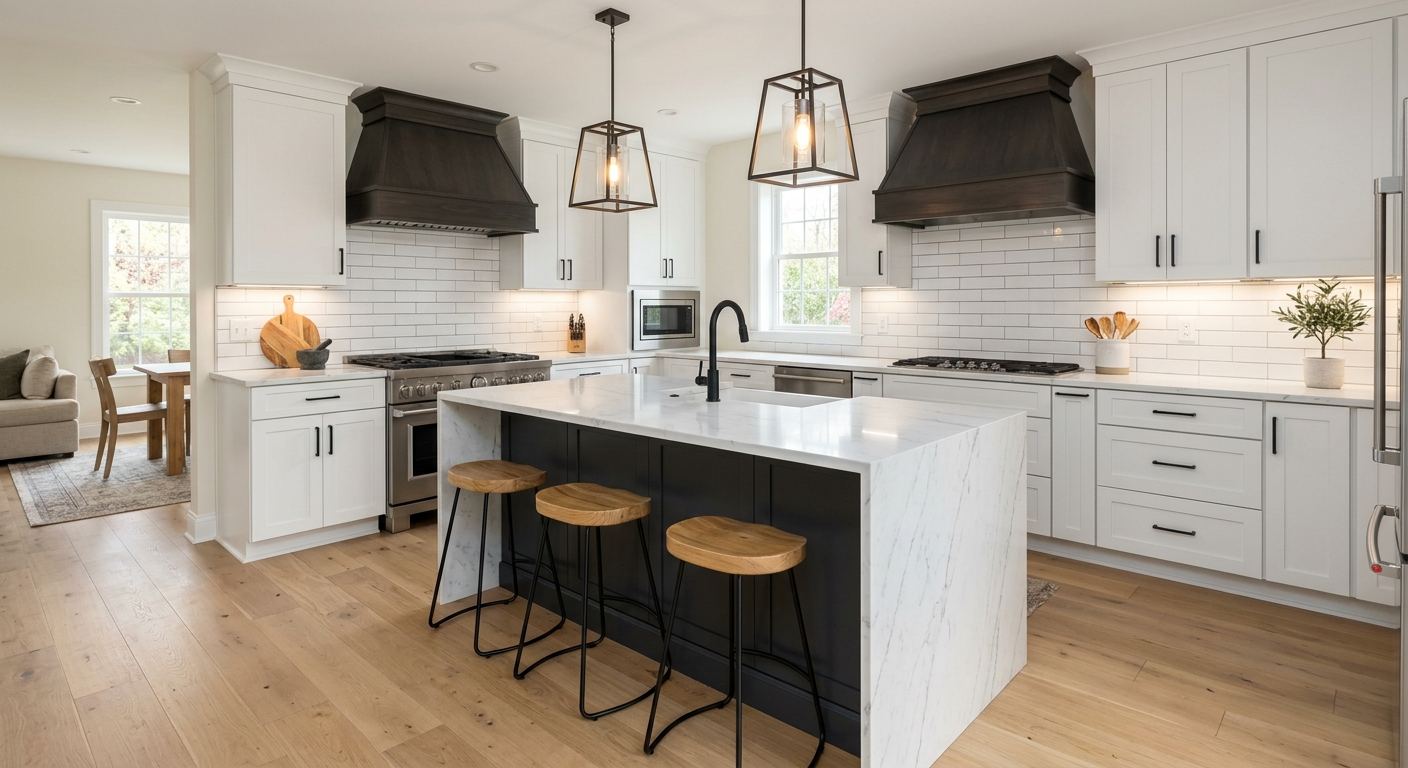
Kitchen renovation options and costs in Cornwall
Cornwall, Ontario homeowners typically start their kitchen planning by choosing the level of change they want, because the budget swings quickly between an appliance-and-paint refresh and a full rebuild. In Cornwall, the median household income is about $60,000 (Statistics Canada, 2021 Census), and homeowner households represent 53.6% of households, which often translates into practical, resale-aware upgrades rather than “stay forever only” designs. The older housing stock matters too: 70.4% of homes were built before 1981, so many projects begin with correcting dated layouts, improving storage, and addressing wear points like sagging cabinet bases and worn subfloors. In the Ottawa economic region, kitchen costs are driven less by climate and more by expectations—finish level, contractor availability, and how custom the work needs to be.
Even though Cornwall shares the broader Ottawa-area freeze–thaw pattern, the biggest cost drivers usually show up indoors: demolition reveals what’s behind walls, and insulation/air sealing decisions get bundled in when contractors are already opening ceilings for electrical or venting. Labour rates and supplier lead times in the Ottawa region also influence scheduling; in peak seasons you may see longer lead times for quartz and custom doors, which can move your project from a few weeks to several months. Work is especially in demand in the East end/Howard Avenue corridor where many residents are in older family homes and prefer turning dated kitchens into bright, functional spaces.
Use the tiers below as a planning baseline, then we’ll narrow it down with your layout, material selections, and what permits (if any) are required before you ask for final pricing.
| Renovation Tier |
What's Included |
Typical Duration |
Price Range |
| Cosmetic refresh (paint, hardware, new appliances only) |
Prep/paint, new pulls/knobs, appliance install, minor caulking and trim touch-ups (no cabinet box changes) |
1–3 weeks |
$5,000–$15,000 |
| Mid-range full renovation (new cabinets, counters, sink, tile) |
New semi-custom or stock cabinetry, countertop install, sink/faucet, backsplash tile, plumbing refresh, basic lighting updates |
6–10 weeks |
$60,000–$90,000 |
| High-end full renovation (custom cabinets, stone counters, island) |
Custom millwork, quartz or natural stone counters, island build, upgraded hardware, designer tile, venting/lighting upgrades |
10–16 weeks |
$120,000–$150,000+ |
| Cabinet refacing only (new doors + drawer fronts, same boxes) |
New door/drawer fronts, refinish of existing boxes, new hardware, optional lighting within existing layout |
2–5 weeks |
$20,000–$40,000 |
| Countertop swap only (laminate to quartz or stone) |
Remove old counters, template, fabricate/install quartz or stone, sink cut-outs, finish caulking and grout touch-up |
1–2.5 weeks |
$8,000–$18,000 |
| Backsplash tile installation only |
Tile supply/install, surface prep, waterproofing as required, caulking/finishing around outlets |
3–7 days |
$2,500–$8,500 |
Prices are estimates only and vary by project scope, site access and material selection.
What affects the price of kitchen renovation in Cornwall
You can see the same kitchen scope quoted 30–50% higher or lower across the Ottawa region because contractors price risk differently: the amount of hidden work they expect, how quickly they can source materials, and the finish tier you choose. In higher-income, higher-value areas around Ottawa, homeowners more often move toward quartz or stone counters and semi-custom cabinetry because those upgrades tend to hold value at resale. In more modest budgets, laminate and stock cabinets dominate because they deliver a noticeable refresh at lower cost—especially in older pre-1981 homes where the “bones” may still be workable with selective fixes. That’s why Cornwall budgets often cluster between $45,000–$60,000 for refreshed mid-tier work and $60,000–$90,000 when cabinetry and counters are both upgraded.
Layout changes are the most unpredictable cost. Removing a wall to open the kitchen, adding an island, or moving plumbing/gas lines typically adds complexity regardless of whether you choose laminate or stone. For Cornwall specifically, older framing and older runs behind walls can mean unexpected repairs to subflooring, electrical routing, and venting—work that doesn’t show up until demolition. For example, if your countertop tear-out reveals out-of-level bases, you may need structural shimming and new toe-kick adjustments before stone or quartz can be installed. Similarly, if a sink is moving closer to the island, you can add labour and materials for drain slope corrections and plumbing tie-ins, which can push a “counter swap” from a $4,000–$18,000 range toward a fuller mid-range package.
On top of that, Cornwall’s winter freeze–thaw doesn’t usually drive the cabinet pricing directly, but it does affect indoor conditions. When renovations slow during colder months, moisture control, drying time for patching/finishes, and scheduling coordination can extend timelines—especially in homes with older ventilation setups.
| Price Factor |
Why It Matters |
Cost Impact |
| Cabinet tier — stock vs. semi-custom vs. fully custom millwork |
Custom door sizing, internal organizers, and build quality affect material cost and install time |
$12,000–$120,000 |
| Countertop material — laminate vs. quartz vs. granite vs. stone |
Fabrication complexity, slab handling, edge profiles, and longevity change both supply and labour |
$4,000–$18,000 |
| Layout change — wall removal, island add, plumbing/gas move |
Triggers trade coordination and can uncover concealed framing/electrical issues |
$10,000–$50,000+ |
| Appliance package tier — builder vs. mid-range vs. pro-grade |
Brand tiers change hardware, ventilation requirements, and sometimes cut-out specs |
$2,500–$15,000+ |
| Flooring — refinish existing vs. full replacement |
Older subfloors and transitions determine whether patching is enough or full replacement is needed |
$3,000–$12,000 |
| Backsplash — ceramic tile vs. marble vs. full-height slab |
Pattern alignment, thinset prep, and material weight affect install time and risk |
$2,500–$12,000 |
| Electrical — new circuits for island, under-cabinet lighting |
Extra outlets/switches and lighting runs require certified work and can add inspection requirements |
$1,500–$8,000 |
| Permit fees and licensed trade requirements |
Permits and licensed plumbing/gas/electrical work add administrative and scheduling costs |
$500–$5,000 |
Permits & regulations in Ontario
In Ontario, the scope determines whether permits are needed. A cabinet and countertop swap that keeps plumbing and electrical where they are typically does not require a building permit. However, if you move plumbing supply or drain lines, relocate gas components (such as the stove location), remove a load-bearing wall, or add new electrical circuits (for example, new receptacles for an island, or dedicated under-cabinet lighting circuits), permits are often required and the work must be performed by the appropriate licensed trades. Gas work must be done by a licensed gas fitter, and electrical work must be done by a licensed electrician. These trades also require inspections as the project progresses—so planning permits into your schedule avoids delays.
For Cornwall homeowners verifying a contractor, take a simple step-by-step approach before signing:
1) Ask for proof of Ontario licensing for the trades involved (and confirm who is pulling permits, if needed). 2) Request current liability insurance certificates—make sure the policy lists your contractor’s legal name and covers renovation work at your address. 3) Confirm WSIB/WCB coverage for the workers who will be on your jobsite. 4) Ask for a copy of clearance documentation if your contractor provides it. 5) Keep everything in writing: who is responsible for permits, inspections, and any code upgrades that are discovered during demolition.
Cabinets, countertops and layout decisions in Cornwall
In a Cornwall kitchen renovation, three decisions decide most of your cost and the “wow” factor: (1) cabinet tier, (2) countertop material, and (3) whether you change the layout. Cabinet tier choices usually look like stock (fastest and cheapest), semi-custom (the most popular mid-range balance), and custom (best fit and highest cost). Countertops then set the tone for durability and maintenance—laminate is budget-friendly but can be less resistant to impacts; quartz is a practical middle ground; granite and other natural stones are premium and add visual depth; butcher block brings warmth but needs mindful sealing; marble is elegant yet requires more care. Layout is where ROI gets real in the Ottawa resale market: open-concept adjustments can modernize how buyers perceive space, while an island can improve daily function—but the cost of moving plumbing or gas can be justified only when it creates meaningful storage and workflow.
Climate matters indirectly. In older homes built before 1981, uneven bases and older ventilation can make it harder to keep surfaces perfectly stable during winter drying cycles. That’s one reason we often see schedules extend when cabinets or stone are installed late in a season. A concrete example: if you upgrade from laminate to quartz, many homeowners spend in the countertop swap band of roughly $8,000–$18,000, whereas “going full high-end” with custom cabinets and stone counters is where budgets typically land around $120,000–$150,000+. If your layout isn’t changing and the cabinet boxes are sound, it’s usually more cost-effective to invest the difference into quartz edges and upgraded hardware than to pay for full custom millwork.
Choose with the resale buyer in mind: in Cornwall and the broader Ottawa region, buyers generally expect modern storage, clean lines, and countertops that feel durable—especially in family-friendly homes where daily wear is unavoidable.
| Option |
Durability |
Maintenance |
Best For |
Price Range |
| Stock cabinets (big-box) |
Solid for standard sizes; can be limited in corner and organizer flexibility |
Low—focus on keeping hardware tight and aligning doors after installation |
Fast turnarounds and budget-first renovations |
$20,000–$40,000 |
| Semi-custom cabinets (local dealer) |
Better internal organizers and more size/door flexibility for uneven older homes |
Low to moderate—simple care for finishes and hinges |
Most Cornwall homeowners targeting a balance of look and function |
$40,000–$75,000 |
| Custom cabinets (local millwork shop) |
Highest fit and finish; great for odd layouts and premium hardware integration |
Low—durable finishes, but hinges/hardware still need routine checks |
High-end remodels where layout and storage are part of the design |
$75,000–$120,000+ |
| Laminate countertop |
Good day-to-day performance; seams and edges can be more vulnerable to damage |
Low—avoid heavy impacts and prolonged standing water at seams |
Budget remodels that still need a clean, updated look |
$4,000–$8,000 |
| Quartz engineered countertop |
Very durable and consistent; handles impacts and stains better than laminate |
Low—typical wipe-down cleaning; sealing generally not required |
Mid-to-upper tier renovations seeking “set and forget” durability |
$9,000–$15,000 |
| Granite / natural stone countertop |
Premium durability; unique veining and natural character |
Moderate—often requires periodic sealing and careful stain management |
Luxury finishes in kitchens where resale presentation matters |
$12,000–$18,000 |
| Butcher block countertop |
Durable with proper care; can show wear and dents as patina |
Moderate—regular oiling and immediate wipe-ups recommended |
Homeowners wanting warmth and a lived-in feel |
$6,000–$12,000 |
| Marble countertop |
Beautiful but softer and more prone to etching/staining |
Higher—requires careful cleaning and protective routines |
Formal, less-heavily used kitchens or specific design goals |
$12,000–$18,000+ |
How to choose a kitchen renovation contractor in Cornwall
Choosing the right contractor in Cornwall is mostly about verifying three things: licensing/competency, coverage, and scope clarity. Start by asking who holds the relevant Ontario licences for the trades they’ll subcontract (not just who your main contact is). Next, request a certificate of liability insurance and confirm the policy covers renovation work. Then verify WSIB/WCB coverage for workers on site—if a contractor can’t show it, that’s a major risk for you as the homeowner. If the work includes gas or electrical changes, confirm those licensed trades are booked and that inspections are included where required.
Get 2–3 itemised quotes rather than lump sums. Your quote should break labour and materials into lines you can compare: demolition/disposal, cabinet supply/install, countertop templating/fabrication/install, tile prep and setting, plumbing/electrical (if applicable), and any patching/painting. Read the scope carefully: is permit pulling included, is disposal included, and what happens if hidden damage is found? A solid contractor will include assumptions and a clear change-order process.
Finally, review warranty and payment schedule. Workmanship warranties should be clearly written (length and what’s covered), and product warranties should state who provides them and whether they’re transferable to future owners. For payments, keep upfront deposits modest—typically no more than 10–15%—and consider holding back a portion until key milestones are complete.
- Ask for the exact start date and a written completion estimate in the contract.
- Confirm which items are “included” vs “allowances” (lighting, flooring underlay, trim, caulking).
- Require a disposal plan: how debris is removed and where it’s dumped.
- Get countertop template dates and fabrication lead times in writing.
- Verify that plumbing/gas/electrical work (if any) is booked with licensed trades.
- Check insurance: liability certificate current and covers renovation at your address.
- Check WSIB/WCB clearance for workers who will be on your job.
- Confirm permit responsibility if you’re changing plumbing, gas, load-bearing walls, or electrical circuits.
- Ask who protects floors/doorways during demolition and tile work.
- Look for a written change-order process and an allowance reconciliation method.
- Confirm warranty terms: labour warranty length and how issues are corrected.
- Ensure payment milestones match real work completed (not just “materials ordered”).
Red flags I commonly see in Cornwall include: vague scopes that don’t break down labour vs materials, contractors asking for large upfront payments beyond 10–15% without a schedule, promises like “we don’t need permits” when you’re moving plumbing or adding circuits, missing proof of liability insurance or WSIB/WCB coverage, and quotes that omit allowances for countertops/flooring transitions—then surprise you later with change orders.
Frequently asked questions — kitchen renovation in Cornwall
What order do kitchen renovation steps happen in?
In Cornwall and across Ontario, a typical kitchen sequence starts with design confirmation, measurements, and (if required) permit steps—especially if you’re moving plumbing, adding electrical circuits, or relocating gas components. Next comes demolition (old cabinets, countertops, and backsplash), then rough-in work like plumbing/electrical/gas adjustments. After that, you prepare surfaces (patching, leveling, substrate work for tile and flooring), install cabinets, and only then proceed to countertop templating and fabrication. Flooring and backsplash usually follow cabinet installation so the layout lines up cleanly. Finally, you install appliances, trim details, caulking/grout finishing, and do a final walkthrough. If you’re budgeting from the mid-range band, many projects land around $60,000–$90,000 when cabinets and counters are both replaced, which usually requires this full staged workflow.
Can I live at home during a kitchen renovation in Cornwall?
Often, yes—especially if you choose a cosmetic refresh or a countertop-only upgrade. In Cornwall, most homeowners can stay in the home during mid-range renovations, but expect to use a temporary kitchen setup (microwave, hot plate, and access to a sink) while the main work zone is open. During a full renovation (cabinet install + tile + new countertops), the work area will be out of service for several weeks, so it helps to plan meals and protect adjacent rooms from dust. If your schedule includes electrical/plumbing changes, you may also need to restrict water use on the workday while connections are tested. The most disruptive tier is usually the full renovation, which commonly sits around $60,000–$90,000 in this market. A good contractor will set dust control, protect flooring/doorways, and confirm daily access rules in writing.
Should I renovate my kitchen before selling in Cornwall?
Generally, renovations that modernize kitchens tend to help in the Ottawa-area resale market because buyers look for durable surfaces and updated storage. In Cornwall—where many homes were built before 1981 (Statistics Canada, 2021 Census)—kitchens often show age through layout inefficiencies and worn surfaces, so targeted updates can improve day-to-day comfort and buyer perception. However, the best ROI comes from the right scope: if you can keep your layout and replace cabinets and countertops, you’ll usually get a cleaner “move-in ready” look without the highest layout-change costs. If you’re stretching toward a high-end finish tier like custom cabinetry and stone counters (often $120,000–$150,000+), that can be harder to fully recoup on resale unless the rest of the home supports that level of pricing. If you want a more budget-conscious upgrade, countertop swaps can start as low as the broader countertop band (around $4,000–$18,000), which may be enough to make the kitchen feel current.
What's the most popular kitchen style in Cornwall right now?
In Cornwall, the most popular style right now is a clean, modern look with warm finishes: shaker-style or simple slab-front cabinets in neutral tones, paired with quartz or natural stone counters and upgraded hardware. The Ottawa economic region tends to push homeowners toward quartz and designer tile, and Cornwall follows that pattern—especially in family homes where durability matters. Open-concept feelings are also common, meaning homeowners often prefer layouts that keep sightlines into the living/dining area, when the structure and budget allow. If you’re planning around the mid-range $60,000–$90,000 tier, this is where you’ll most often see semi-custom cabinetry, a quartz countertop, a backsplash update, and modern lighting. Ultra-luxury projects move into fully custom millwork and stone islands (often beyond $120,000), but most homeowners choose a balanced package that reads well to future buyers.
How do I know if I need to update my kitchen plumbing in Cornwall?
There are a few clear signs that plumbing updates may be necessary in a Cornwall kitchen, particularly in older homes (70.4% built before 1981, Statistics Canada, 2021 Census). Look for slow drains, repeated leaks under sinks, corrosion at supply lines, inconsistent water pressure, or shutoff valves that don’t hold. If your plan includes moving the sink, adding an island, or changing where dishwasher/wet lines run, plumbing work is more likely required even if everything “seems fine.” During demolition, contractors often discover brittle fittings, undersized shutoffs, or improper drain slopes that weren’t obvious when walls were closed. If you’re only doing cosmetic work, you can often avoid major plumbing changes, but if you’re in the full renovation tier around $60,000–$90,000, it’s common to include plumbing refresh (new supply lines, updated shutoffs, and sometimes drain adjustments) to prevent callbacks and improve reliability.
What is the difference between a galley and open-concept kitchen?
A galley kitchen is typically a narrow, passage-style layout with two rows of cabinets/appliances on opposite sides, which can be efficient for workflow but can feel tight—especially in homes where family gatherings happen in the adjacent living area. An open-concept kitchen removes or reduces barriers between kitchen and living/dining spaces, creating a wider sightline and often supporting a social layout around an island or peninsula. In Cornwall, with many pre-1981 homes, converting to open-concept can sometimes involve removing a wall; if it’s load-bearing, permits and licensed trade involvement may apply. That type of layout change is one of the largest cost unpredictables, regardless of whether you choose laminate or quartz. If you want an easier, lower-risk refresh, staying galley can still work with cabinet upgrades and countertop swaps—often within the countertop band of about $4,000–$18,000.