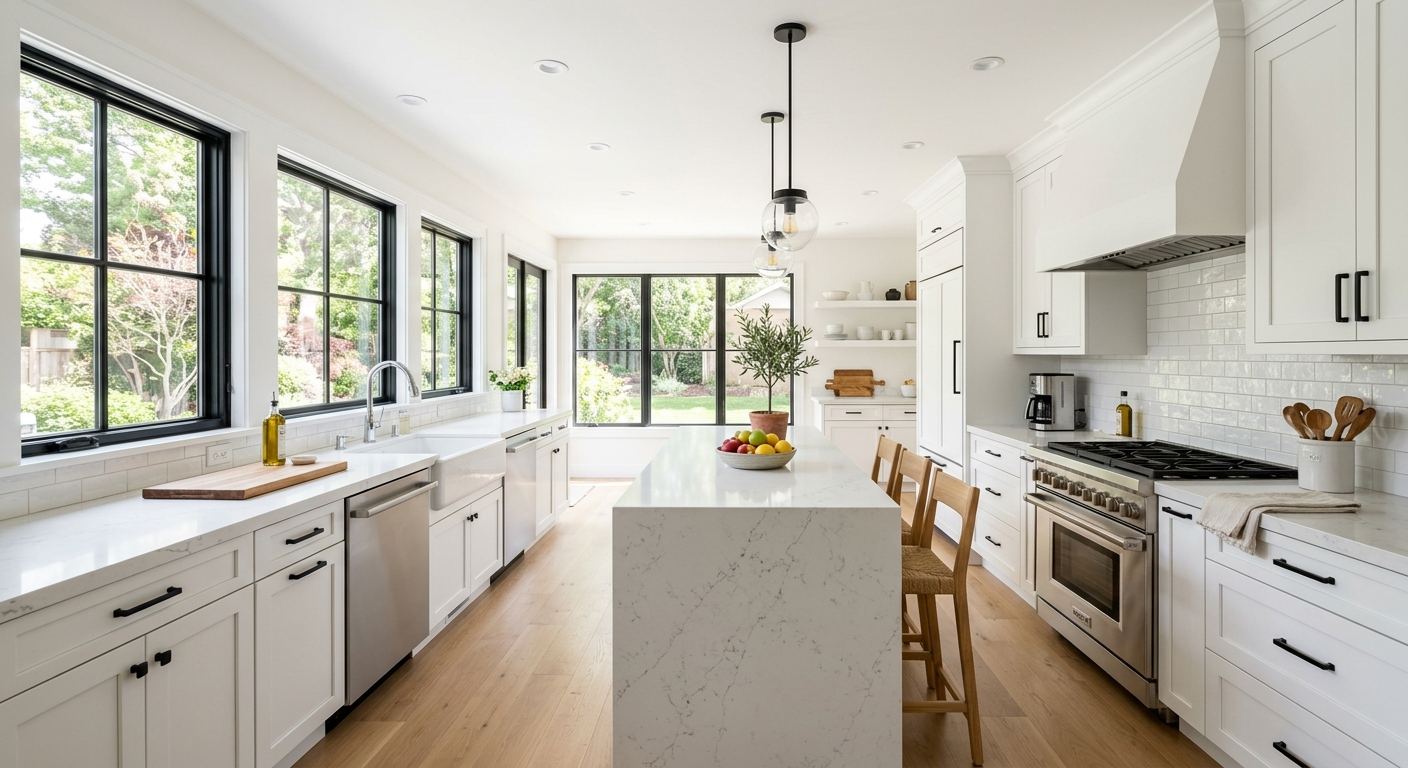
Kitchen renovation options and costs in Idlewood
Idlewood, Ontario homeowners typically choose kitchen work based on resale expectations, not weather—but the local market still influences both pricing and how fast contractors can start. With a population of 5,560 in Idlewood (Statistics Canada, 2021 Census), many renovations are scheduled around the availability of GTA trades and cabinet shop lead times. In the Toronto economic region, buyers often expect a more polished finish; in higher-value pockets, kitchens commonly receive premium upgrades that can amount to a meaningful share of property value, which pushes projects toward custom cabinetry, quartz, and upgraded appliance packages.
Unlike some renovation categories, kitchen costs in the Toronto area are less driven by climate and more by demand cycles. Labour rates and material pricing are broadly consistent across the GTA, but contractor availability can tighten during spring and early summer when everyone wants to install new cabinets and counters. Also, Toronto homes skew older in many pockets, and retrofits in existing wall/ceiling cavities can uncover outdated electrical or dated plumbing, adding cost even when the visible finishes stay the same.
In Idlewood, trade demand is especially strong among homeowners along popular residential corridors where older, builder-grade kitchens are being refreshed with semi-custom millwork and modern lighting—often paired with backsplash updates and appliance replacements. If you’re trying to plan the scope, the table below breaks down typical renovation tiers and what you can expect to pay in today’s GTA market.
| Renovation Tier |
What's Included |
Typical Duration |
Price Range |
| Cosmetic refresh (paint, hardware, new appliances only) |
Cabinet paint/stain only (no cabinet rebuild), new hardware, paint/trim touches, appliance swap (no gas/plumbing relocation), basic caulking and re-sealing |
3–7 days |
$6,000–$18,000 |
| Mid-range full renovation (new cabinets, counters, sink, tile) |
New semi-custom or stock cabinets, countertop installation, sink + faucet, backsplash tile, flooring refresh (partial or full as needed), basic electrical refresh, demolition and disposal |
3–5 weeks |
$25,000–$55,000 |
| High-end full renovation (custom cabinets, stone counters, island) |
Fully custom millwork, premium quartz or natural stone counters, island cabinetry and countertop, expanded backsplash to full-height sections, upgraded lighting plan, higher-tier appliances, potential layout changes, coordinated trades |
6–12 weeks |
$70,000–$95,000 |
| Cabinet refacing only (new doors + drawer fronts, same boxes) |
Refaced cabinet fronts, new hinges/soft-close hardware, updated mouldings/trim, re-paint or re-finish existing boxes where needed |
1–2.5 weeks |
$8,000–$28,000 |
| Countertop swap only (laminate to quartz or stone) |
Remove and dispose of old tops, templating, new quartz/stone installation, sealing/finish at seams, sink re-set where applicable |
4–10 days |
$3,000–$15,000 |
| Backsplash tile installation only |
Prep and leveling, tile installation, grout/sealing as required, transition finishing at counters/cabinets, caulk and water-resistant details |
3–7 days |
$2,000–$10,000 |
Prices are estimates only and vary by project scope, site access and material selection.
What affects the price of kitchen renovation in Idlewood
For the same kitchen in the Toronto area, quotes can vary by 30–50% because contractors price risk differently—particularly around demolition surprises, electrical/plumbing complexity, and the cabinet/counter lead-time schedules. In practice, local home values and household income expectations shape the finish tier far more than climate. When homeowners are investing for long-term enjoyment and resale alignment, many default to quartz or natural stone and semi-custom cabinetry; that’s why in higher-value areas of the GTA, kitchens often push toward the $70,000+ band once islands, upgrades, and coordinated trades are included. In more price-sensitive neighbourhoods, laminate or stock cabinets with a good backsplash strategy keep projects in the $25,000–$55,000 range while still modernizing the look.
Layout changes are where budgets get unpredictable in Idlewood, regardless of finish level. Removing a wall (or even just re-working a load-bearing section), adding an island, or moving a gas line can add permit time and create trade scheduling bottlenecks. For example: older Toronto-area homes may have undersized wiring paths behind the backsplash and under-cabinet runs; adding an island with outlets and lighting can require new circuits. Likewise, moving the sink often means adjusting drain slope and supply lines—both can be labour-intensive if access is tight under existing floors.
Two concrete Idlewood scenarios we commonly see: (1) a “minor” refresh that still includes replacing a dated sink and tap usually nudges countertops and plumbing detailing upward; (2) upgrading from laminate to quartz can be a budget-friendly win, often closer to the countertop-only $3,000–$15,000 band, whereas adding stone + island cabinetry typically escalates the project into a full renovation tier. That’s why the same finish choices can land in different totals depending on what’s moved behind the walls.
| Price Factor |
Why It Matters |
Cost Impact |
| Cabinet tier — stock vs. semi-custom vs. fully custom millwork |
Higher tiers improve fit, storage, and design flexibility, but they also change lead times and labour intensity for installs and adjustments |
- Stock: lowest
- Semi-custom: typical mid-range
- Custom: often drives the highest totals
|
| Countertop material — laminate vs. quartz vs. granite vs. stone |
Material cost, templating/installation complexity, and seam/edge detailing affect pricing more than most people expect |
- Laminate: lowest
- Quartz: common value upgrade
- Granite/stone: premium and heavier install
|
| Layout change — wall removal, island add, plumbing/gas move |
Changes trigger demolition risk, structural review, permit work, and re-routing services—labour-heavy regardless of finish |
- Often adds the largest swings in total
|
| Appliance package tier — builder vs. mid-range vs. pro-grade |
Cabinet sizing, ventilation requirements, and installation complexity rise with higher-end appliances |
- Mid-range: controlled budget
- Pro-grade: pushes costs up quickly
|
| Flooring — refinish existing vs. full replacement |
If you keep or re-finish, you reduce demolition; full replacement adds labour, material, and moisture-mitigation details around sinks |
- Replacement adds incremental build-out cost
|
| Backsplash — ceramic tile vs. marble vs. full-height slab |
Full-height applications increase materials and require extra substrate prep and moisture-resistant detailing |
- Ceramic: most cost-controlled
- Marble/full-height: premium
|
| Electrical — new circuits for island, under-cabinet lighting |
New circuits, GFCI/AFCI considerations, and wiring routes add electrician time and inspection coordination |
- Can significantly affect timelines and allowances
|
| Permit fees and licensed trade requirements |
When permits/inspections are triggered, the schedule and paperwork become part of the cost |
- Fees + trade coordination add to project totals
|
Permits & regulations in Ontario
In Ontario, not all kitchen updates require permits. A cabinet and countertop swap typically does not require a permit if you’re not moving plumbing, gas lines, electrical circuits, or structural elements. That’s why a countertop-only upgrade or a refacing project can often move quickly through the schedule.
Permits (and licensed trade involvement) usually become necessary when your renovation changes services or structure. Specifically, moving plumbing supply or drain lines, relocating a gas stove or gas-related range hood, removing a load-bearing wall, and adding new electrical circuits (for example, outlets and lighting for an island) typically require permits and inspections. Gas work must be completed by a licensed gas fitter, and any electrical work must be done by a licensed electrician. Both require inspections before walls are fully closed or concealed work is finalized.
For an Idlewood homeowner, verify it step-by-step before you sign: (1) ask your contractor for the exact work scope that triggers permits; (2) confirm the contractor’s licence status using the Ontario online registry relevant to the trade (and ensure any subcontractors are licensed too); (3) request a certificate of insurance—liability insurance coverage should match the project value and include proof of active coverage; (4) verify WSIB/WCB coverage, which protects you and workers if an incident occurs on-site; and (5) request clearance letters or proof documents in writing and file them with your contract package. Also confirm, in the contract, who pulls permits and who covers permit fees—responsibility should never be assumed.
Cabinets, countertops and layout decisions in Idlewood
In Idlewood, three decisions usually determine whether your kitchen looks “dated” in a year or feels current for resale: (1) cabinet tier, (2) countertop material, and (3) whether you change the layout. Cabinet tier comes down to speed and fit: stock cabinets are typically fastest and cheapest, semi-custom is the most popular mid-range because it balances storage and style, and custom millwork is the best fit when you want every niche tailored. Countertops are the visual anchor—laminate can look sharp with the right edge treatment, but quartz is the common value upgrade because it resists staining and holds up well to everyday use.
Layout changes are where you justify cost with space gain. Removing a wall or adding an island can create the open-concept feel buyers expect in the GTA, but it often triggers permit work and licensed trades. If you’re only updating surfaces, staying in the $25,000–$55,000 mid-range band usually delivers the best ROI. If you want stone + island + expanded lighting and appliances, it’s more realistic to plan toward the $70,000+ high-end range.
Toronto-area housing stock often includes older plumbing runs and tighter cavity access behind backsplash lines, so “moving the sink” or “adding under-cabinet lighting” can cost more than homeowners expect. As a practical example: upgrading from laminate to quartz for an average-sized kitchen commonly fits in the countertop install band (about $3,000–$15,000), and that upgrade often makes a bigger visual impact than changing cabinet colour alone. By contrast, if you add an island and must relocate plumbing or gas components, the layout-driven scope can push the project into full-renovation territory quickly.
| Option |
Durability |
Maintenance |
Best For |
Price Range |
| Stock cabinets (big-box) |
Good everyday durability; limited sizing flexibility |
Low maintenance; hinges/hardware updates help longevity |
Fast refreshes with predictable timelines |
$8,000–$22,000 |
| Semi-custom cabinets (local dealer) |
Very solid construction; better storage options and fitting |
Low to moderate; clean finish and ensure proper ventilation near sink/stove |
Most Idlewood renovations seeking resale-ready appeal |
$18,000–$40,000 |
| Custom cabinets (local millwork shop) |
Highest fit and finish; tailored storage for awkward Toronto-era spaces |
Low maintenance with proper hardware and regular cleaning |
Owners optimizing layout and specialty storage |
$35,000–$70,000 |
| Laminate countertop |
Decent for daily use; edge and seam quality affects wear |
Easy—avoid prolonged standing water at seams |
Budget-forward renovations where appearance matters |
$3,000–$8,000 |
| Quartz engineered countertop |
High durability; resists staining and everyday impacts |
Low maintenance; wipe clean and avoid harsh abrasives |
Busy kitchens needing a confident, resale-friendly upgrade |
$6,500–$15,000 |
| Granite / natural stone countertop |
Very durable; natural variation can hide minor wear well |
Periodic sealing may be needed depending on stone; wipe spills quickly |
Premium look with distinctive patterns |
$9,000–$20,000 |
| Butcher block countertop |
Durable but requires care; sensitive to heat and standing water |
Moderate—oil/maintain finish and use cutting boards |
Warm, traditional style kitchens with active upkeep |
$5,000–$14,000 |
| Marble countertop |
Beautiful but more porous; can scratch or etch without care |
Higher maintenance—frequent sealing and prompt spill cleanup |
Statement kitchens where you’re willing to maintain the surface |
$10,000–$25,000 |
How to choose a kitchen renovation contractor in Idlewood
Choosing the right contractor in Idlewood is mostly about verifying coverage, getting detailed scope documents, and controlling payment risk. Start with Ontario licensing: ask whether the contractor is licensed for the work they personally perform and confirm that any specialized trades are licensed as well. Then verify liability insurance—request a certificate of insurance and check that it’s active for the renovation period. Finally, confirm WSIB/WCB coverage. If the contractor can’t provide clear documentation, that’s a major warning sign for both safety and workmanship accountability.
Next, get 2–3 itemised quotes, not just a lump sum. You want labour and materials separated (cabinet supply vs. install, countertop material vs. templating/installation, demolition and disposal, electrical/plumbing allowances, and drywall/paint scope if included). Read the exclusions: who pulls permits, who covers permit fees, and whether disposal/skip rental is included. If you see “allowances” with no detail, push for clarity on what’s included—especially for lighting, under-cabinet work, and backsplash substrate prep.
Warranty matters: confirm the workmanship warranty length, whether it covers labour for defects, and whether product/manufacturer warranties are transferable if you sell the home. Keep payments controlled: never pay more than 10–15% upfront; structure a schedule that ties holdback to milestones and completion of punch-list items. And insist on a start date and a completion estimate in writing, with allowances for cabinet and countertop lead times.
- Request Ontario licence and proof of active liability insurance before work starts
- Confirm WSIB/WCB coverage and get proof documents in your contract package
- Get 2–3 itemised quotes with labour/material breakdown (not one number)
- Ask what is included for demolition, haul-away, and site protection
- Confirm whether permits (and inspections) are pulled by the contractor
- Review what happens if drywall/plumbing/electrical surprises are found
- Verify cabinet lead times and countertop templating/installation dates
- Check that sink/cooktop/range hood cut-outs and plumbing/gas hookups are specified
- Confirm electrical scope: new circuits, GFCI protection, lighting layout
- Get backsplash details: substrate prep, waterproofing approach, and grout/seal type
- Put warranty terms in writing (labour warranty + product warranty)
- Use a staged payment schedule with a holdback until final punch completion
Red flags we commonly see with kitchen contractors in Idlewood include: vague scopes or “allowances” with no material spec sheets, refusing to provide insurance/WSIB/WCB proof, no permit plan when plumbing/electrical/gas is involved, and payment requests that exceed 10–15% upfront. Also watch for contractors who start demolition before confirming cabinet/counter templates, since it can cause schedule loss and expensive rework.
Frequently asked questions — kitchen renovation in Idlewood
Should I renovate my kitchen before selling in Idlewood?
If you’re selling in Idlewood or across the Toronto region, a kitchen refresh can help buyers see the home as updated, but you don’t need a full high-end rebuild to get traction. For many sellers, a mid-range full renovation in the $25,000–$55,000 range (new cabinets and counters, plus a backsplash and updated sink) is often the sweet spot for modern resale appeal without overspending. If your cabinets are structurally sound, refacing plus a countertop upgrade is usually more cost-effective than tearing everything out. In Ontario housing stock, older electrical and plumbing behind existing backsplash areas can complicate “cosmetic-only” projects, so budget for inspection and minor updates. Prioritize durable, easy-clean surfaces and lighting—those are the details buyers notice in showings.
What's the most popular kitchen style in Idlewood right now?
In Idlewood and the broader Toronto market, the most common direction is a bright, modern look with warm-neutral cabinetry and clean lines—often paired with quartz counters and a simple, well-finished backsplash. Semi-custom cabinet layouts are popular because they fit common Toronto-era kitchen footprints better than fully stock options, especially when you want better pantry storage or improved corner solutions. Many homeowners lean toward practical, resale-friendly choices rather than niche statement pieces. That’s also why you’ll frequently see upgrades that sit in the mid-range: new cabinet faces, quartz counters, and updated hardware, rather than fully custom millwork and natural stone throughout. If you want a stronger “designer” effect, a single upgrade (like a statement island or premium stone accent) can move the look into a higher tier without committing to the highest budget band.
How do I know if I need to update my kitchen plumbing in Idlewood?
You may need plumbing updates if you’re noticing slow drains, inconsistent hot water at the sink, leaks under the cabinet, or loose fittings around the shutoffs. In older Toronto-area homes, it’s also common to find dated supply lines or drain configurations that don’t match current installation standards—especially when you’re adding a new sink, moving the faucet location, or changing the dishwasher hookup. If your contractor is planning a layout change (even something like moving the sink a few inches), expect more plumbing work and possibly part of the mid-range renovation budget. A countertop-only project typically doesn’t require plumbing replacement, but if valves are seized or concealed drains show wear, the work can expand. The best approach in Idlewood is a clear pre-reno assessment: have your contractor inspect accessible shutoffs and drain lines before the cabinets come out.
What is the difference between a galley and open-concept kitchen?
A galley kitchen is narrow and efficient—counters run along two parallel walls—while an open-concept kitchen typically removes a wall (or reworks openings) to connect the kitchen to living space. In the Toronto market, open-concept layouts are often more desirable for entertaining and modern buyer expectations, but they usually cost more because wall removal can involve structural considerations, permits, and coordination of electrical/plumbing/gas changes. A galley layout can still feel modern with the right cabinet selection, appliance placement, and strong lighting, and it can keep you closer to the $25,000–$55,000 mid-range band if you’re not moving major services. If you’re staying in place, consider non-structural upgrades: cabinetry storage, quartz counters, and under-cabinet lighting. For open-concept projects, plan for more lead time and a more complex trade schedule in Ontario.
How do I get accurate kitchen renovation quotes in Idlewood?
Accurate quotes in Idlewood come from itemisation and a scope that matches how you actually live in the kitchen. Ask for 2–3 written quotes that separate labour and materials (cabinet supply vs. install, countertop material vs. templating/installation, demolition/haul-away, electrical and plumbing allowances, and backsplash substrate prep). Make sure the contractor clarifies what is included for permits and licensed trades when you’re moving plumbing or adding electrical circuits—Ontario requirements can change the schedule and cost. Provide consistent details: cabinet dimensions, desired countertop type (laminate vs. quartz vs. stone), and whether you’re keeping the current sink location. For budgeting, use the region’s realistic bands: a full kitchen renovation commonly runs from mid-$20k to $90k+, so insist your quote explains how it lands where it does. Finally, confirm warranty terms and the payment schedule so you’re not surprised by change orders late in the job.
What's the best countertop material for a busy Idlewood kitchen?
For a busy kitchen in Idlewood and across Ontario, quartz is usually the best balance of durability and low maintenance. It’s engineered for everyday use, resists staining well compared to many natural surfaces, and performs reliably under routine cooking rhythms. Laminate can be a strong budget choice in the $3,000–$8,000 range, but it’s more sensitive to long-term wear at seams and edges if water exposure happens. Natural stone like granite or marble looks premium and can fit higher-end designs, yet marble often requires more maintenance (sealing and careful spill cleanup), which may not be ideal for a high-traffic family kitchen. If you’re comparing within realistic GTA budgets, a countertop upgrade from laminate to quartz can often fit within the countertop-only band (around $3,000–$15,000 depending on size and edge profiles). Pair quartz with good under-cabinet lighting and prompt spill wiping for the most practical day-to-day experience.