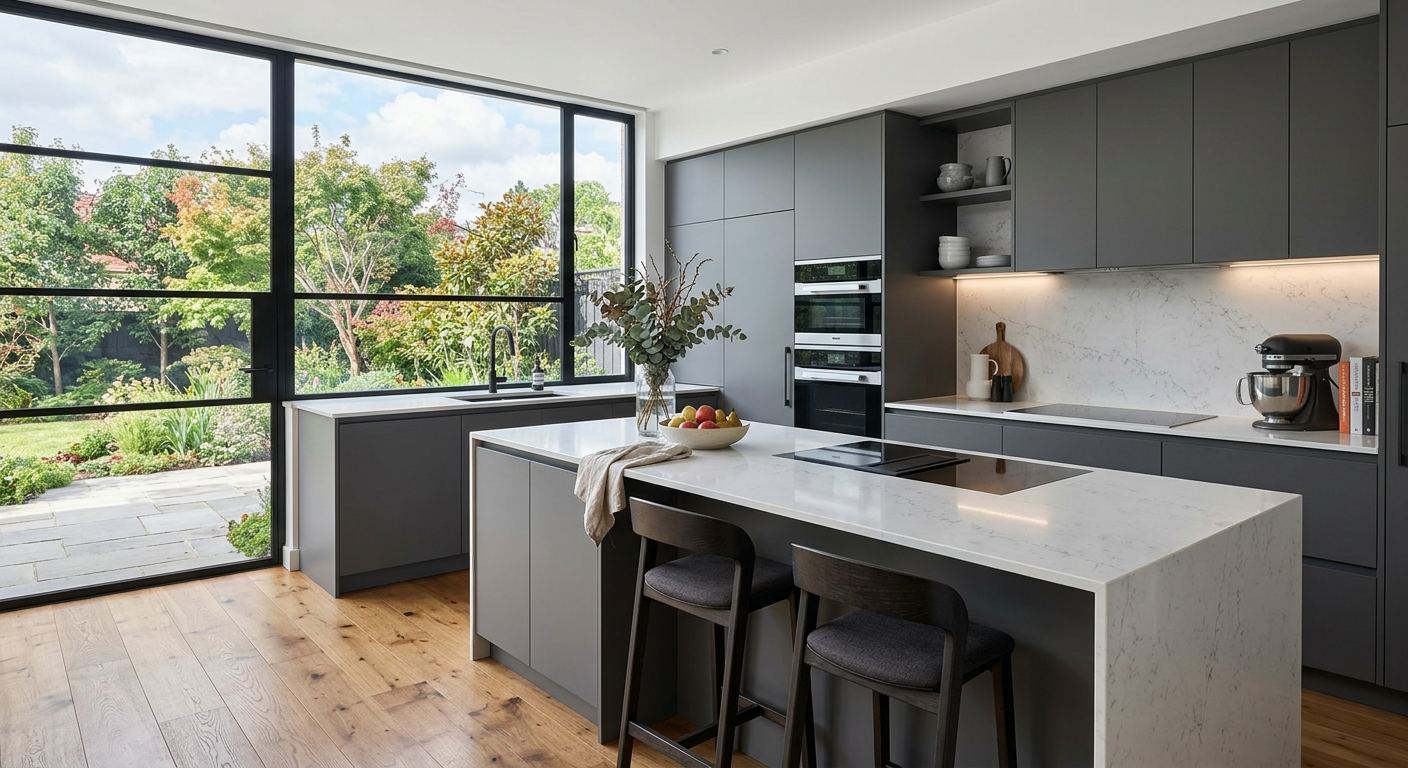
Kitchen renovation options and costs in St. Catharines
In St. Catharines, kitchen renovation choices usually start with how you want the space to feel and how quickly you need the work done—not with weather. With a median household income of $72,500 (Statistics Canada, 2021 Census), many homeowners here target mid-range finishes that still make sense for resale. St. Catharines also has a large share of older housing stock: 71.0% of homes were built before 1981 (Statistics Canada, 2021 Census). That matters because older framing and service routes often mean small surprises around plumbing, electrical capacity, and where walls can actually be opened up.
Across the Hamilton–Niagara Peninsula, kitchen budgets track closely with local home values and household income. In higher-value neighbourhoods, owners more often choose semi-custom or fully custom cabinetry and quartz or stone counters; in more entry-level or investor segments, laminate and simpler stock cabinets stay common to keep total spend down. Climate doesn’t directly drive the price of a kitchen, but it affects how materials and trades schedule around seasonal humidity, and it can influence backsplash and floor installation timelines when basements or crawlspaces are being worked at the same time.
Trade demand is especially strong in areas like Port Dalhousie, where many homes are close to active downtown streets and contractors often schedule around parking and access constraints. If you’re comparing options right now, the price swing is best understood by “tier” rather than by guessing a single number—so below is a realistic range for common scopes, followed by what’s actually included.
| Renovation Tier |
What's Included |
Typical Duration |
Price Range |
| Cosmetic refresh (paint, hardware, new appliances only) |
Paint, cabinet hardware swaps, new appliances (no cabinet or counter replacement), minor caulking/trim |
3–7 days |
$6,000–$20,000 |
| Mid-range full renovation (new cabinets, counters, sink, tile) |
New cabinets (stock or semi-custom), quartz counters, sink + faucet, backsplash tile, new or updated lighting basics, demo + haul-away |
3–6 weeks |
$30,000–$60,000 |
| High-end full renovation (custom cabinets, stone counters, island) |
Custom cabinetry, stone counters, island (often with upgraded plumbing/electrical), full backsplash, premium finishes, deeper layout updates |
6–10 weeks |
$75,000–$110,000 |
| Cabinet refacing only (new doors + drawer fronts, same boxes) |
Refaced doors/drawer fronts, new hardware, cabinet cleaning/repairs, optional new crown + panel finishes |
1–3 weeks |
$8,000–$25,000 |
| Countertop swap only (laminate to quartz or stone) |
Remove old surface, install new countertop, sink cut-out changes as needed, edge finishing, basic reseal |
3–7 days |
$1,500–$8,000 |
| Backsplash tile installation only |
Tile supply + labour, surface prep, grout/seal, cut-outs around outlets (as scope allows) |
2–5 days |
$2,000–$10,000 |
Prices are estimates only and vary by project scope, site access and material selection.
What affects the price of kitchen renovation in St. Catharines
You can see the same “new kitchen” advertised for very different numbers across the Hamilton–Niagara Peninsula because Ontario pricing is driven more by market expectations and renovation complexity than by climate. Even when finishes look similar, quotes can vary by 30–50% once labour hours, materials substitutions, and site conditions are factored in. In higher-value neighbourhoods where homeowners expect a longer-term, higher-quality resale outcome, quartz has largely replaced basic laminate for full renovations, and semi-custom cabinetry becomes the default. In more modest segments, laminate and stock cabinets often deliver better ROI and keep the total within the mid-$30k to $60k band.
Local housing stock also shapes how often you’ll hit “hidden work.” With 71.0% of homes built before 1981 in the St. Catharines area (Statistics Canada, 2021 Census), many kitchens have older rough-ins, dated electrical panels, and floor elevations that aren’t perfectly square. That can add time even if your visible finish choice stays in the $30,000–$90,000 full-renovation range.
Here are a few St. Catharines realities that push costs up or down. Example one: switching to an island often triggers electrical and sometimes plumbing changes—moving these services is usually the most unpredictable part of a kitchen, regardless of whether you choose laminate or stone. Example two: if your existing cabinets are in solid condition and the wall is not load-bearing, cabinet refacing can keep you in the $5,000–$25,000 range; if the wall needs structural adjustment or floors need full replacement, costs climb toward a full renovation scope. Example three: an older backsplash area with repeated patching can force extra prep, making a “simple” backsplash tile install behave more like a mid-range tile project.
| Price Factor |
Why It Matters |
Cost Impact |
| Cabinet tier — stock vs. semi-custom vs. fully custom millwork |
Material quality, fit accuracy, and lead times change labour and rework risk |
Can swing the cabinet portion by several thousand dollars and often shifts projects from mid-range to high-end |
| Countertop material — laminate vs. quartz vs. granite vs. stone |
Pricing, installation requirements, and weight/cutting precision affect labour and fabrication |
Laminate keeps totals lower; quartz/stone typically adds cost but reduces long-term maintenance |
| Layout change — wall removal, island add, plumbing/gas move |
Hidden rough-ins and structural checks drive additional trades and inspections |
Most unpredictable line item; often the main reason bids diverge |
| Appliance package tier — builder vs. mid-range vs. pro-grade |
Dimensions, venting/requirements, and installation complexity vary |
Can add or subtract several thousand depending on vent hood and power requirements |
| Flooring — refinish existing vs. full replacement |
Under-cabinet fit, subfloor conditions, and moisture protection matter |
Full replacement can add days and materials; refinish typically costs less but limits design |
| Backsplash — ceramic tile vs. marble vs. full-height slab |
Pattern matching, edge finishing, and waterproofing details change labour hours |
Tile is usually mid-cost; full-height premium stone can move you into the higher backsplash band |
| Electrical — new circuits for island, under-cabinet lighting |
Licensed work and panel capacity requirements affect time and scope |
Often increases cost materially when multiple circuits or significant relocation is required |
| Permit fees and licensed trade requirements |
Some work triggers permits and inspections; scheduling licensed trades affects labour planning |
Can add administrative and scheduling costs; also reduces “surprise” rework when handled properly |
Permits & regulations in Ontario
In Ontario, a cabinet or countertop swap by itself typically does not require a building permit. That said, permits and licensed trades come into play when you’re altering services or changing structural elements. In a St. Catharines kitchen renovation, the work that commonly does require permits includes moving or extending plumbing supply and drain lines, relocating a gas line or doing gas work (including changes involving a gas range or a gas range hood), removing a load-bearing wall, and adding new electrical circuits (for example, island outlets and under-cabinet lighting where wiring is extended or changed). Electrical work must be performed by a licensed electrician; gas work must be done by a licensed gas fitter, followed by required inspections.
Step by step, here’s how to verify before you sign: (1) Ask the contractor to provide their Ontario licence details and proof of liability insurance and WSIB/WCB coverage—request certificates of insurance and ensure the named insured matches the company you hired. (2) For the contractor’s trades, ask for the electrician and gas fitter information separately (their licences and proof of coverage). (3) Confirm who pulls any permits in writing and who pays for fees—do not assume it’s “included.” (4) Keep copies of inspection notices or clearance documents once work is complete.
Good contractors will be specific in the contract about permit responsibility, inspection timing, and how changes in scope are handled.
Cabinets, countertops and layout decisions in St. Catharines
In St. Catharines, the three most consequential decisions in a kitchen renovation are cabinet tier, countertop material, and whether you change the layout. Start with cabinet tier. Stock cabinets are usually the fastest path and are typically the lowest cost, but fit is more “standard.” Semi-custom cabinets (a popular mid-range choice in the Hamilton–Niagara Peninsula) balance lead time and customization for a better match to your wall lengths and storage needs. Custom cabinets cost more and take longer, but they’re often the best option when your home’s older walls aren’t perfectly square—something you see frequently in homes built before 1981.
Next, choose countertops. Laminate is budget-friendly and can look sharp with the right edge and backsplash pairing, but it’s less ideal for heavy wear and heat exposure. Quartz is often the sweet spot for St. Catharines homeowners because it’s durable, low-maintenance, and fits the way most people actually use kitchens. Granite/natural stone and marble can deliver a premium look, but they require more attention to sealing and maintenance, and installation can be more involved.
Finally, layout changes. Removing a wall to open up the room or adding an island can be worth it when the space gain improves daily flow and supports how local buyers expect modern kitchens to function. But layout changes are where costs swing most—especially if plumbing or gas needs relocating. A practical example: keeping finishes mid-range and staying in the $30,000–$60,000 band is realistic when you swap counters and cabinets and only make minor adjustments. If you add an island and require new electrical and plumbing runs, that same project can quickly climb toward the upper ranges because additional trades and rework time stack up.
| Option |
Durability |
Maintenance |
Best For |
Price Range |
| Stock cabinets (big-box) |
Good for daily use; limited customization |
Low maintenance; touch-up finishes may be needed over time |
Speed and budget, straightforward layouts |
$5,000–$15,000 |
| Semi-custom cabinets (local dealer) |
Very durable with better sizing and options |
Low maintenance; hinges/draw slides depend on hardware tier |
Most St. Catharines renovations where you want a tailored look |
$10,000–$25,000 |
| Custom cabinets (local millwork shop) |
Highest fit quality; built for unusual spaces |
Low to moderate; quality hardware and finishes matter |
Complex layouts, older homes, premium finishes |
$20,000–$45,000 |
| Laminate countertop |
Good everyday durability; less forgiving with heat and impact |
Easy cleaning; keep away from hot pots and sharp impacts |
Budget-conscious upgrades, rental/investor packages |
$1,500–$3,500 |
| Quartz engineered countertop |
High durability; resistant to staining |
Low maintenance; avoid abrasive pads as with most surfaces |
Balanced premium look with practical upkeep |
$3,500–$7,500 |
| Granite / natural stone countertop |
Very durable; long-lasting finish variations |
Periodic sealing may be required; cleaning products should be stone-safe |
Homeowners wanting natural character and upscale finishes |
$4,500–$9,000 |
| Butcher block countertop |
Solid feel; susceptible to water/surface damage if neglected |
Requires oiling and careful drying to prevent swelling |
Warm, traditional styles and light-to-moderate use |
$3,000–$6,500 |
| Marble countertop |
Premium look; more vulnerable to etching and staining |
Regular sealing and gentle cleaners required |
Low-heat, more “showpiece” kitchens or higher-end lifestyles |
$6,000–$12,000 |
How to choose a kitchen renovation contractor in St. Catharines
Choosing the right contractor in St. Catharines comes down to three things: verified qualifications, a scope you can actually price, and a payment/timeline plan that protects you. First, verify Ontario licensing: ask for proof that required work will be done by licensed trades (notably electricians and gas fitters where applicable). Request liability insurance certificates and confirm WSIB/WCB coverage for workers working at your home. Where to look: ask for the certificate documents directly, then confirm the licence details through the appropriate online registry for the trade (use the licence number). If you can’t get paperwork promptly, that’s your first warning sign.
Second, request 2–3 itemised written quotes rather than lump sums. You want line items for labour and materials (demolition, cabinetry installation, countertop fabrication/installation, electrical scope, tile/backsplash labour, disposal and protection). Make sure it states whether permits are included, who pulls them, and what happens if discovery work is needed in an older home (common in St. Catharines). Also confirm the warranty: ask for workmanship warranty length and how manufacturer warranties apply to cabinets, counters and appliances—and whether warranties are transferable if you sell.
Third, payment schedule and timeline: never pay more than 10–15% upfront. Use progress payments tied to milestones and keep a holdback until close-out. Get a start date and a completion estimate in writing, including an approach for delays due to cabinet or stone lead times.
- Ask for a detailed scope sheet: included items vs exclusions
- Confirm if permit pulling is included and who is responsible for fees
- Request product cut sheets/SKU details for cabinets, countertops and tile
- Verify liability insurance and WSIB/WCB coverage (certificates in your name or company matching the quote)
- Confirm licensed trade coverage for electrical and any gas-related work
- Get demolition, disposal/haul-away and protection (floor and doorway protection) listed
- Ask who handles dust control and cleanup at the end of each workday
- Check that electrical scope covers outlets for backsplash/island and under-cabinet lighting if included
- Require countertop template timing in the schedule (so cabinetry installation isn’t stalled)
- Confirm warranty terms: workmanship duration and manufacturer warranty details
- Limit deposits to 10–15% and secure a written holdback schedule for completion
- Use a change-order process in writing for any discovered plumbing/electrical issues
Red flags in St. Catharines include: (1) a contractor who won’t provide certificates of insurance or WSIB/WCB proof, (2) quotes that omit permit responsibility while including layout changes, (3) “lowest price” bids that don’t itemise labour vs materials, (4) vague warranty language (no duration or exclusions), and (5) requests for large upfront payments with no milestone-based holdback.
Frequently asked questions — kitchen renovation in St. Catharines
What order do kitchen renovation steps happen in?
In most St. Catharines kitchen renovations, the order protects your schedule and reduces rework. Typically you start with planning and measurements, then protection and demo. Next comes any rough work that affects services (electrical changes, plumbing supply/drain adjustments, and permit-triggered work if applicable). After that, contractors install or reconfigure cabinets, then template and install countertops once base cabinets are set and level. Backsplash tile follows countertop installation so edges are clean. Flooring can be handled early or later depending on how the cabinets are installed, but in older homes (many built before 1981) the contractor should assess subfloor conditions before final cabinet placement. Finally, appliances are set, trim is finished, caulking is cleaned up, and electrical features like under-cabinet lights are tested.
Can I live at home during a kitchen renovation in St. Catharines?
Many homeowners do stay in the home during a kitchen renovation in St. Catharines, especially for cosmetic refreshes, cabinet refacing, or backsplash-only work. For a mid-range full renovation, you can often live at home if there’s a functional alternative cooking setup (for example, a microwave, kettle, and grill on a protected area) and if the contractor maintains dust control. If you’re doing a high-end redesign with significant layout changes—like adding an island that requires electrical and possibly plumbing—some days will be disruptive, and having access to bathrooms and a safe path through the home matters. Stacking trades is sometimes unavoidable, but a good contractor will schedule noisy work first and communicate daily access and cleanup. If your project is closer to the $30,000–$60,000 range, ask whether your contractor can stage the work so one work zone is used at a time.
Should I renovate my kitchen before selling in St. Catharines?
It depends on your timeline and your neighbourhood’s buyer expectations. St. Catharines has a strong base of homeowner households—37,945 homeowner households and 64.4% of households owning (Statistics Canada, 2021 Census)—so many buyers do want turnkey kitchens. The “when” is usually best if your kitchen is dated enough that buyers notice it immediately, especially cabinets, counters, and lighting. However, renovation cost recovery is more realistic when you focus on the finishes most buyers value, such as quartz countertops and updated cabinetry, without over-customising for a slow local resale market. For reference, a mid-range full renovation commonly falls around $30,000–$60,000, while more structurally complex high-end projects can go beyond that. If you’re just trying to refresh the look, a cabinet refacing or countertop swap can be a smarter pre-sale approach. Always ask your contractor for a scope that matches your target buyer price point—not the highest finish available.
What's the most popular kitchen style in St. Catharines right now?
In St. Catharines and the wider Hamilton–Niagara Peninsula, the most common styles tend to be modern transitional: simple slab or shaker-style cabinets, clean lines, and warm neutrals. Many homeowners choose quartz countertops and a coordinated backsplash to keep maintenance easy and the kitchen looking consistent in photos and daylight. Homeowners with older homes often prefer design solutions that visually “level” the space—like brighter lighting and full-height backsplash or carefully matched tile patterns—because pre-1981 layouts sometimes have awkward sight lines. While there isn’t a single “one style wins” answer for the entire city, a safe bet is choosing a timeless palette and avoiding extreme trends if you might sell within a few years. If your budget is in the mid-range full renovation band (around $30,000–$60,000), semi-custom cabinetry plus quartz is a very common pairing for the look buyers expect.
How do I know if I need to update my kitchen plumbing in St. Catharines?
You may need plumbing updates if your shutoffs are old, leaks have been patched repeatedly, water pressure is inconsistent, or the existing shutoff/drain routes can’t align cleanly with a new sink and dishwasher layout. Many St. Catharines kitchens are in homes built before 1981 (Statistics Canada, 2021 Census), which increases the likelihood of older rough-ins and hard-to-match fittings. You’ll also want to discuss plumbing updates if you’re moving a sink location, adding an island that requires a new water supply/drain, or replacing a gas range hood where ventilation changes might affect the nearby service routing. A good contractor checks under-sink access, dishwasher hookups, and how the new cabinet layout will align before final fabrication. If you do a countertop swap only, plumbing rarely changes; but if your renovation includes relocating the sink or adding an island, expect the plumbing scope to be part of the quote.
What is the difference between a galley and open-concept kitchen?
A galley kitchen is a narrow, corridor-style layout with counters on opposite walls, which often works well in compact homes and helps keep everything within reach. An open-concept kitchen removes barriers so the kitchen blends with living or dining space, improving sight lines and traffic flow. In St. Catharines, choosing between them often depends on your home’s structure and whether walls can be removed safely. If your project involves removing a load-bearing wall, it’s a permit-triggering task and typically requires a licensed professional to ensure structural integrity. Galley kitchens can still feel modern through lighting, cabinet storage optimisation, and a better appliance layout without major service moves. Open-concept layouts can be more expensive because kitchen plumbing/electrical may need rerouting and framing changes can add labour. In either case, the scope—not just the style—determines your total cost, and it’s why detailed quotes matter.