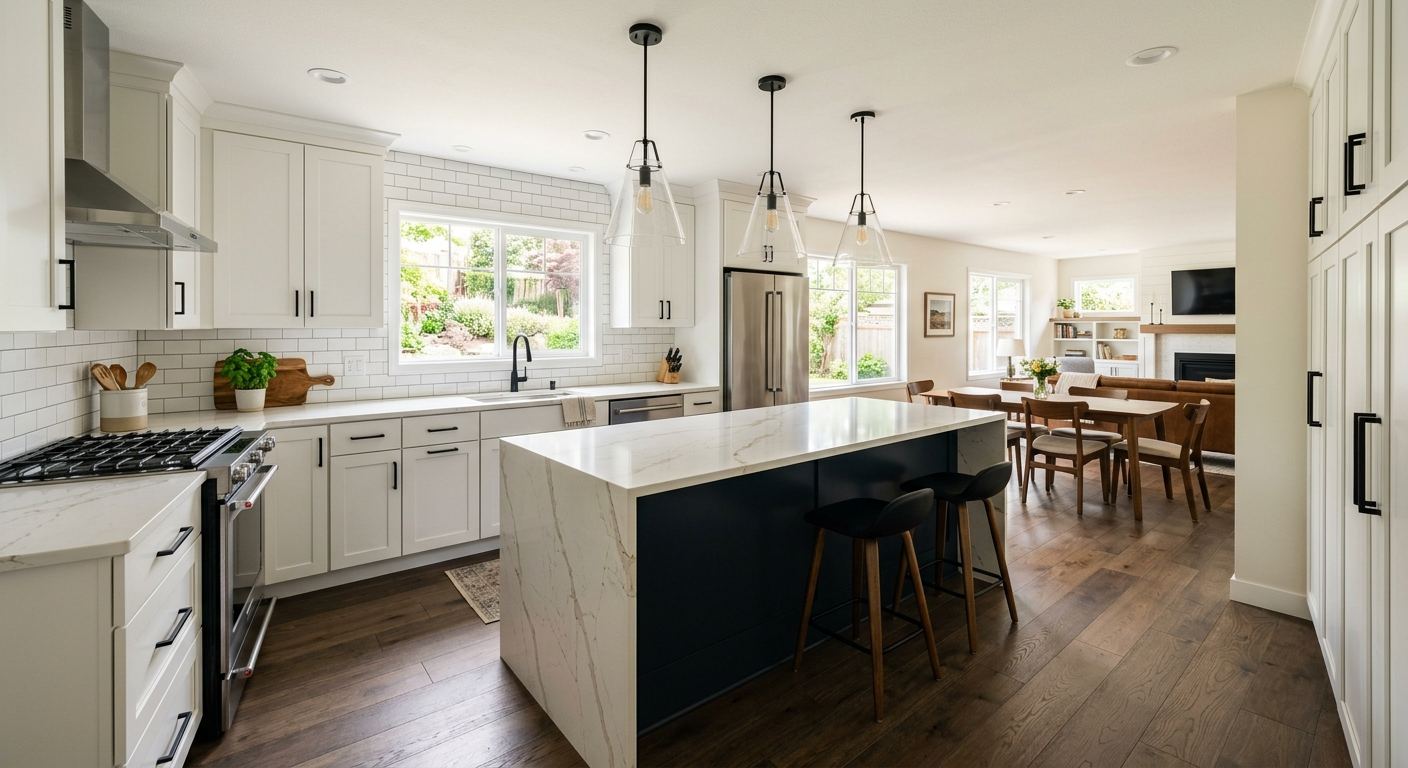
Kitchen renovation options and costs in Niagara Falls
Niagara Falls homeowners have lots of kitchen renovation options, from quick cosmetic makeovers to full rebuilds with new cabinetry and stone-style counters. With a population of 94,415 (Statistics Canada, 2021 Census) and a median household income of $74,500 (Statistics Canada, 2021 Census), many households can comfortably move beyond basic “builder grade” finishes when the kitchen is a resale priority. That said, quotes still vary by project tier because Hamilton–Niagara Peninsula buyer expectations tend to track home value and the resale market: in move-up neighbourhoods, homeowners more often choose semi-custom cabinetry and quartz, while investor-friendly or lower-budget projects still lean toward stock cabinets and laminate.
Climate doesn’t drive the number of kitchen quotes the way it does exterior work, but it does affect material choices and installation details. In Niagara Falls, the winter freeze–thaw cycle and indoor humidity swings can exaggerate issues around sink plumbing, caulking, and countertop sealing if the rough-in work isn’t done properly. Also, older housing stock is common here—about 60.8% of homes were built before 1981 (Statistics Canada, 2021 Census)—so contractors often spend more time on wiring verification, subfloor condition checks, and leveling cabinets. Areas with strong trade demand include the South Niagara Falls corridor, where many homeowners are upgrading homes built in the mid-century period to match modern open layouts and bright, white-or-warm-toned finishes.
Below is a practical guide to typical scope, timing, and pricing so you can compare apples-to-apples before you request bids.
| Renovation Tier |
What's Included |
Typical Duration |
Price Range |
| Cosmetic refresh (paint, hardware, new appliances only) |
Surface-level prep and paint, new cabinet hardware, appliance swap (dishwasher/range/fridge as selected), minor touch-ups only |
1–3 weeks |
$7,000 – $15,000 |
| Mid-range full renovation (new cabinets, counters, sink, tile) |
Stock or semi-custom cabinets, quartz counters, sink and faucet replacement, backsplash tile, new under-cabinet lighting (if planned), basic floor refinishing or limited replacement, disposal and trim restoration |
4–7 weeks |
$35,000 – $65,000 |
| High-end full renovation (custom cabinets, stone counters, island) |
Custom millwork, stone counters (granite/other natural stone or premium-grade slab look), island design with enhanced lighting, upgraded appliance package, full backsplash, higher-end flooring replacement, more involved plumbing/electrical for island |
7–12 weeks |
$75,000 – $110,000 |
| Cabinet refacing only (new doors + drawer fronts, same boxes) |
Door/drawer replacement, new end panels where needed, new hardware, interior touch-ups, reusing existing cabinet boxes (when structurally sound) |
2–4 weeks |
$10,000 – $25,000 |
| Countertop swap only (laminate to quartz or stone) |
Template and install for quartz/stone, disposal of old countertop, cut-outs for sink/cooktop (if included), recaulk and seal at junctions |
1–2 weeks |
$3,000 – $10,000 |
| Backsplash tile installation only |
Surface prep, tile installation, grout/seal as required, removal and replacement limited to backsplash area, caulking at counter/wall transitions |
3–7 days |
$2,500 – $8,000 |
Prices are estimates only and vary by project scope, site access and material selection.
What affects the price of kitchen renovation in Niagara Falls
In Niagara Falls and across the Hamilton–Niagara Peninsula, two quotes for what looks like the same kitchen can differ by 30–50% because contractors price risk, not just materials. Where labour costs land depends on how complicated your existing walls, wiring, and plumbing are, and how many trades need to coordinate. In markets with higher resale expectations, homeowners often choose quartz or stone counters and semi-custom cabinetry because the cost is easier to justify on return—especially when buyers notice counter thickness, finish quality, and cabinet hardware. In more modest scenarios, laminate and stock cabinets dominate because they provide a clean look without escalating the entire renovation budget.
Layout decisions are the biggest wild-card regardless of finish tier. Removing a wall, adding an island, or relocating a gas line and/or venting can add weeks and require multiple licensed trades, which quickly pushes even a “mid-range” project into the upper price band. For context, a typical mid-range full renovation with new cabinets and quartz often lands in the $35,000–$65,000 range, while structurally complex, custom millwork + island projects can exceed $75,000. Even “component” work carries real Ontario costs: a countertop swap can still fall into the $3,000–$10,000 band once you account for template, sink cut-outs, and sealing work around older plumbing hookups.
Concrete Niagara Falls examples contractors see often: (1) homes built before 1981 may have older supply lines and uneven framing, so cabinet installation takes longer and sometimes triggers subfloor repair—adding labour even if you select stock cabinets. (2) If your range hood requires ducting changes, the cost can jump more than switching from laminate to quartz because the electrical and ventilation work stacks. (3) If you’re installing a full-height backsplash or a stone slab effect wall, the material and prep time can outpace a basic ceramic backsplash package.
| Price Factor |
Why It Matters |
Cost Impact |
| Cabinet tier — stock vs. semi-custom vs. fully custom millwork |
Higher tiers improve fit, finishes, internal organization, and ability to match unusual wall conditions |
Usually the largest lever; can swing overall budget by ~20–40% |
| Countertop material — laminate vs. quartz vs. granite vs. stone |
Material cost and install complexity (seaming, thickness, sealing, edge profiles) |
Typical countertop install ranges from about $1,500–$8,000+, depending on material |
| Layout change — wall removal, island add, plumbing/gas move |
Triggers structural checks, new rough-ins, and trade coordination |
Can add thousands and the most schedule risk, often exceeding finish upgrades |
| Appliance package tier — builder vs. mid-range vs. pro-grade |
Pro-grade models change power/venting needs, opening sizes, and install time |
Appliance selections can materially change total project cost even if cabinetry stays mid-tier |
| Flooring — refinish existing vs. full replacement |
Older subfloors and height transitions affect prep time and trim/threshold details |
Full replacement typically adds both material and labour |
| Backsplash — ceramic tile vs. marble vs. full-height slab |
Complex cuts, pattern matching, grout/seal requirements, and height coverage |
Small area can still climb quickly into the $2,000–$10,000 band |
| Electrical — new circuits for island, under-cabinet lighting |
Requires licensed work, load planning, and inspection readiness |
Adds cost unpredictably, especially if the panel/grounding needs upgrades |
| Permit fees and licensed trade requirements |
Some scope triggers permits, inspections, and coordination between trades |
Generally increases total cost and timeline; can be minor or significant depending on work |
Permits & regulations in Ontario
In Ontario, simply swapping out cabinets or countertops usually does not require a permit. If you are keeping the plumbing and electrical locations where they are (for example, replacing a countertop and attaching the sink at the existing rough-in), most homeowners can proceed without municipal permitting for the cabinet/counter portion. However, renovations involving changes to key systems do require permits and licensed trades.
Work that typically DOES require a permit and licensed professional involvement includes moving or adding plumbing supply or drain lines, relocating gas components (such as moving a gas range or making changes that affect gas supply), removing a load-bearing wall, or adding new electrical circuits (commonly for an island, new pot lights, or under-cabinet lighting if it changes circuit scope). Gas work must be done by a licensed gas fitter, and electrical work must be completed by a licensed electrician; both usually require inspections after rough-in and/or before close-up.
To verify compliance in Niagara Falls before you sign, ask for: (1) the contractor’s Ontario licensing details (where applicable), (2) proof of liability insurance, (3) proof of WSIB/WCB coverage for workers, and (4) a clear statement on who pulls permits when permits are required. You can confirm licensing and coverage using the relevant online professional registries, then cross-check the documents with certificates of insurance (ensure coverage dates are current) and any clearance letters provided. Always confirm in writing who is responsible for permits—don’t rely on verbal assurance.
Cabinets, countertops and layout decisions in Niagara Falls
In a Niagara Falls kitchen renovation, three choices typically determine 80% of your outcome: (1) cabinet tier, (2) countertop material, and (3) whether you change the layout. Cabinet tier matters because Ontario’s housing stock includes a lot of older frames and walls; stock cabinets are fastest when your measurements are straightforward, semi-custom is the “sweet spot” for most families, and custom is best for unusual wall runs or if you want integrated storage and a truly built-in look. Countertop material matters for day-to-day living too—freeze–thaw and indoor humidity swings can be harsh on poorly sealed seams, so installation quality and sealing are just as important as the material.
Then there’s layout. If you’re aiming for open-concept living, removing a non-load-bearing wall can add value visually, but moving plumbing/gas is where costs jump. A common Niagara Falls decision is whether an island is worth it: islands look great and improve function, but if it requires gas line changes or new electrical circuits, it can pull your project from the mid-range into higher pricing.
Resale market expectations across the Hamilton–Niagara Peninsula also influence what buyers notice at different price points. For many move-up homes, semi-custom cabinetry plus quartz tends to be the “default upgrade” look, while fully custom millwork and natural stone are more often chosen in higher-value listings or when the kitchen is a long-term, signature feature. For a realistic dollar example: moving from laminate to quartz countertops might add only a few thousand in a component-based plan (often within the $1,500–$8,000 countertop install band), whereas adding an island with new electrical and plumbing can cost more than the countertop upgrade itself—so justify the layout change with real space gain and workflow improvement, not just photos.
| Option |
Durability |
Maintenance |
Best For |
Price Range |
| Stock cabinets (big-box) |
Good for standard spacing; durability depends on box quality and installation |
Wipe clean; hardware changes are easy to refresh the look |
Fast projects, straightforward layouts, budget-conscious full renovations |
$5,000 – $15,000 |
| Semi-custom cabinets (local dealer) |
Very solid; better fit options for Niagara Falls homes with minor wall irregularities |
Low upkeep; upgrade hardware and organizers for longevity |
Most “move-up” renovations where buyers expect quartz and a clean cabinet finish |
$12,000 – $30,000 |
| Custom cabinets (local millwork shop) |
Highest precision; best for odd angles, ceiling height optimization, and premium doors |
Low upkeep if materials are properly sealed and installed |
Long-term homes or high-value resale strategies with a designer kitchen feel |
$25,000 – $60,000+ |
| Laminate countertop |
Practical and durable for daily use; edges/seams require careful installation |
Simple cleaning; avoid cutting directly; keep seams dry |
Budget-focused refreshes and investor-friendly upgrades |
$1,500 – $3,500 |
| Quartz engineered countertop |
Very durable and consistent; excellent for busy households |
Low maintenance; wipe clean, no annual sealing; protect seams around sinks |
Mid-range to premium renovations where Niagara Falls buyers want a “stone look” |
$3,500 – $8,000 |
| Granite / natural stone countertop |
Hard and heat-tolerant; pattern and porosity vary by slab |
Often needs periodic sealing depending on slab choice; clean and protect |
Premium upgrades, higher-value homes, and clients wanting natural variation |
$6,000 – $12,000 |
| Butcher block countertop |
Durable if cared for; susceptible to moisture at seams if not installed carefully |
Oil/maintain regularly; wipe spills quickly; protect the sink area |
Warm, traditional looks and households that maintain wood |
$2,500 – $7,500 |
| Marble countertop |
Beautiful and strong, but more prone to etching and staining than quartz |
Requires careful cleaning and sealing maintenance |
Designer kitchens and long-term homes where aesthetics outweigh fuss |
$8,000 – $16,000+ |
How to choose a kitchen renovation contractor in Niagara Falls
Choosing the right kitchen contractor in Niagara Falls is mostly about verification and clarity. Start by confirming Ontario coverage. Ask for proof of liability insurance (with current expiry dates), WSIB/WCB coverage for workers, and the correct licensing for the trades they manage (especially if your scope includes gas or electrical changes). To check, request certificates of insurance and clearance documents directly from the contractor, then verify details against the issuing carrier or registry where applicable. Don’t accept expired certificates or “we used to have coverage.”
Next, get 2–3 itemised written quotes, not one lump-sum number. A solid quote breaks labour and materials, lists cabinet model/tier, countertop material grade and thickness, backsplash specs, and notes what’s included for disposal, floor protection, and reinstatement. Read the scope carefully for exclusions: is the permit pull included (when needed), does it cover relocating electrical under the scope, and is demolition included? Also confirm warranty terms: workmanship warranty length, the product/manufacturer warranty coverage, and whether the warranty is transferable if you sell your home.
Payment schedules should be conservative. In Ontario kitchen projects, a good rule is to avoid paying more than 10–15% upfront; any larger deposit increases your risk if timelines or quality miss expectations. Finally, insist on a written timeline with start date and completion estimate, including when cabinets and countertops are expected to arrive.
- Confirm liability insurance is active and request the certificate copy
- Verify WSIB/WCB coverage in writing (ask for clearance documentation)
- Ensure the quote specifies who pulls permits when plumbing/electrical/gas scope triggers them
- Require itemised labour + materials (cabinet tier, countertop type, backsplash tile specs)
- Check what’s included for demolition, disposal, and protection of nearby finishes
- Ask whether scheduling includes lead times for cabinets and countertop templating
- Confirm electrical scope details (circuits, lighting type, island outlets if applicable)
- Review workmanship warranty length and what it covers in plain language
- Confirm product warranties (and whether they’re tied to the homeowner or contractor)
- Set a holdback: retain payment until key milestones and final punch-list are complete
- Get a detailed schedule: demo, rough-in, cabinet install, countertop templating, final trim
- Ask how changes are priced (change orders in writing, with rates/markups specified)
Red flags we see in Niagara Falls: contractors who won’t provide insurance/WSIB documentation; quotes that omit countertop thickness/edge profile and cabinet model numbers; vague wording like “permits included” without stating who is responsible; requesting large upfront payments beyond 10–15%; and skipping a written timeline or refusing to define exclusions (disposal, floor repair, or electrical scope).
Frequently asked questions — kitchen renovation in Niagara Falls
What's the most cost-effective kitchen upgrade?
If you want the biggest visual change for the least disruption in Niagara Falls, a countertop swap is often the most cost-effective “high impact” move—especially if your cabinet boxes and layout are already decent. Moving from laminate to quartz commonly fits within the countertop install bands (roughly $1,500–$8,000 for installation, depending on size, edge, and cut-outs). Pairing that with new hardware and a fresh paint coat to cabinets and walls can look like a full renovation without the demolition-heavy costs. If your cabinets are worn but the boxes are solid, cabinet refacing can also deliver a dramatic upgrade typically in the $10,000–$25,000 range. For many homeowners in older Niagara Falls housing stock (built before 1981), this approach reduces the chance of uncovering hidden wiring or subfloor issues that drive budgets up.
Custom vs stock cabinets — is custom worth it?
Custom cabinets are worth it when your Niagara Falls kitchen has challenging dimensions, unusual wall runs, or you want a very specific layout of drawers, pull-outs, and finishing details. Stock cabinets are fastest and usually cheapest because they’re made for standard openings; they’re a good fit when the walls are square and the measurements are straightforward. Semi-custom is usually the “most worth it” option for most homeowners because it balances fit and timing—without the highest millwork pricing. The decision should also connect to resale expectations: in neighbourhoods where buyers expect a more premium finish, upgrading from stock to semi-custom can be easier to justify than going directly to fully custom. A full renovation budget often falls around $30,000–$90,000 in this tier, so “custom everywhere” can push you toward the upper end quickly, especially once you add island plumbing or new electrical circuits.
How do I choose a kitchen contractor in Niagara Falls?
Start by verifying Ontario protections and trade readiness. Ask for proof of liability insurance and WSIB/WCB coverage, and ensure any gas or electrical work is handled by the appropriate licensed trades. Then request 2–3 itemised written quotes that show labour and materials separately—cabinet tier/model, countertop material, backsplash scope, and what’s excluded. A quote should also clearly state permit responsibility when you move plumbing supply/drain lines, relocate gas, remove a load-bearing wall, or add new electrical circuits. Finally, confirm warranty details in writing: workmanship warranty length, product/manufacturer warranty, and whether warranties are transferable. If you’re comparing contractors and one is vague about disposal, timelines, or countertop templating dates, that’s usually a sign you’ll feel it later in delays or change orders.
What order do kitchen renovation steps happen in?
For most Niagara Falls kitchens, the sequence is consistent. First comes measurement and design finalization, then demolition and site protection. Next, rough-in work happens: electrical circuits and any new outlets/lighting, plumbing supply/drain changes, and ventilation updates if your hood ducting changes. After inspections where required, contractors install cabinets, followed by countertop templating once cabinets are set and level. Countertop fabrication and install comes next, then sink/cooktop cut-outs and final sealing/caulking. Backsplash installation follows, followed by trim, painting/touch-ups, flooring transitions (if included), and final appliance connection/testing. If you’re adding an island with electrical, the rough-in stage can be the biggest schedule driver—so ensure your contractor’s timeline accounts for lead times and inspection readiness.
Can I live at home during a kitchen renovation in Niagara Falls?
Often yes, but it depends on how invasive your scope is. In Niagara Falls, homeowners commonly stay home for component work like cabinet refacing, a backsplash-only install, or a countertop swap—because these phases usually have less demolition and less exposed plumbing/electrical time. For a full kitchen renovation with new cabinets, quartz counters, and layout or rough-in changes, staying fully “in place” can be difficult because demolition and rough-in require access to walls and sometimes the floor. Many homeowners plan a partial stay by using another entrance, setting up a temporary kitchen in a different room, and protecting floors during installation. If you’re targeting a mid-range full renovation in the $35,000–$65,000 range, discuss dust control, electrical safety, and how long active demolition is expected before you commit to staying in.
Should I renovate my kitchen before selling in Niagara Falls?
It depends on your home’s condition and where you are in the buying cycle, but in Niagara Falls it’s common to renovate selectively—because buyers notice counters, cabinet finish, and overall layout. If your kitchen is dated but structurally sound, a focused upgrade can help: quartz countertops and an updated backsplash, plus fresh paint and hardware, can deliver a modern look without pushing you into the upper-cost territory. For example, a countertop upgrade within the $1,500–$8,000 install band can often be more strategic than a full custom redesign unless your layout is truly limiting. If you’re considering a full renovation, remember typical budgets in this area for full remodels often land around $30,000–$90,000. Since many homes were built before 1981 (Statistics Canada, 2021 Census), hidden issues can appear during demo, so it’s smart to plan a contingency and avoid over-improving beyond what buyers in your neighbourhood tend to pay for.