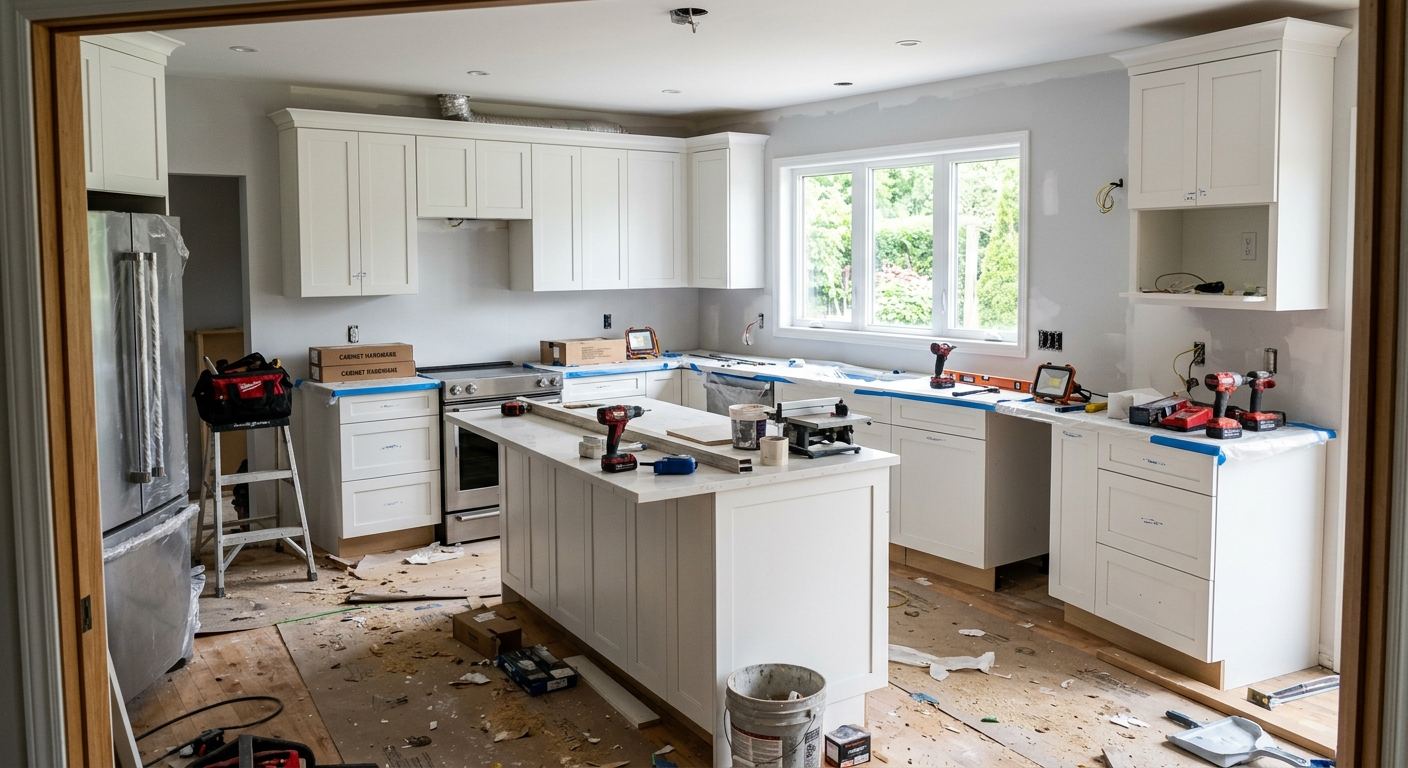
Kitchen renovation options and costs in Lambton Baby Point
Lambton Baby Point homeowners can approach a kitchen renovation in a few practical tiers, from simple refreshes to full layout rebuilds. With a 2021 population of 7,985 in the area (Statistics Canada, 2021 Census), and a Windsor–Sarnia region market where resale value supports better finish expectations, many projects land in the mid-range rather than the lowest-cost tier. In higher-value pockets near the core, owners tend to choose quartz or better laminates and mid-grade cabinetry because it’s easier to recoup the spend on resale; in turn, availability and pricing for skilled trades follow the demand. Across Ontario, cabinetry is usually a major share of the kitchen budget (commonly around 30–40%), and countertops another meaningful line item (often 10–20%), so even small choices can move your overall cost quickly.
In Windsor–Sarnia, costs are influenced more by home value and buyer preferences than by climate-driven wear. Ontario winter cold and summer humidity still matter—especially for adhesives, caulking and material expansion—but they typically don’t force the contractor to price a job higher the way some coastal climates do. Instead, job pricing swings because labour rates and finish “tiers” track what nearby buyers expect, and because older houses in established streets often need electrical updates, subfloor repairs, or plumbing tidy-ups before new cabinets go in. Trades are especially busy around the Lambton Baby Point core near the older housing stock and walkable amenities, where many homeowners do upgrades alongside repainting and flooring renewal.
Here’s a realistic side-by-side comparison to help you budget before you request quotes.
| Renovation Tier |
What's Included |
Typical Duration |
Price Range |
| Cosmetic refresh (paint, hardware, new appliances only) |
Cabinet/room paint or stain refinishing, hardware swap, vented hood trims where applicable, new appliance installation, basic caulking and touch-ups; no cabinet box changes |
3–7 days |
$8,000–$18,000 |
| Mid-range full renovation (new cabinets, counters, sink, tile) |
New stock or semi-custom cabinets, countertop installation (often laminate or quartz), sink and faucet, backsplash tile, standard lighting refresh, flooring repairs as needed, disposal and site cleanup |
2–5 weeks |
$25,000–$55,000 |
| High-end full renovation (custom cabinets, stone counters, island) |
Custom cabinetry, stone counters (granite/stone/marble-grade), island build and possibly venting, upgraded lighting, full backsplash coverage, plumbing/gas relocation as required, more extensive millwork finishing |
5–10 weeks |
$55,000–$85,000 |
| Cabinet refacing only (new doors + drawer fronts, same boxes) |
Refacing panels/doors/drawer fronts, hinges and pulls, new toe-kick trims, refinished or capped countertop if kept (no new counter unless quoted separately) |
1–2 weeks |
$8,000–$22,000 |
| Countertop swap only (laminate to quartz or stone) |
Remove and dispose of old surface, new counter install (sink cut-outs and sealing), minor backsplash tie-in if needed; assumes cabinet bases stay level and unchanged |
2–6 days |
$3,000–$15,000 |
| Backsplash tile installation only |
Demo and prep of existing wall where required, tile supply and installation, grout/seal (as applicable), caulking at counters and edges |
3–7 days |
$2,000–$8,000 |
Prices are estimates only and vary by project scope, site access and material selection.
What affects the price of kitchen renovation in Lambton Baby Point
If you get multiple quotes in Windsor–Sarnia for what sounds like the same kitchen, it’s common to see a 30–50% difference. The most frequent reason is not “contractor optimism”—it’s finish tier, how much layout work is actually included, and how much hidden repair a contractor anticipates based on the home’s age. In higher-value Ontario markets within the region, homeowners often choose quartz or natural stone counters and semi-custom cabinetry because the renovation cost is more easily recovered on resale. In more modest scenarios, laminate plus stock cabinets can deliver strong value while keeping the budget near the mid-range band (roughly $25,000–$55,000). Move the job into the high-end tier (well above $55,000), and the pricing is pulled up by custom millwork, larger slabs, and island complexity.
Layout changes are the most unpredictable cost driver. Removing a wall, adding an island, or moving a gas line or plumbing can add design labour, permit steps, and trade coordination regardless of whether you choose laminate or quartz. Concrete examples I see often in Lambton Baby Point: (1) older homes may have electrical runs that can’t safely support new under-cabinet lighting or a new island circuit—requiring rewiring and new breakers; (2) floors can be out of level, which makes cabinet installation slower and can trigger extra shimming/subfloor prep; (3) existing backsplash substrates (old drywall over uneven framing) can add prep time so tile adheres properly—especially when you want a clean, straight line under winter humidity shifts.
Bottom line: local market expectations determine what finishes people buy, but the “how” of construction—layout, hidden repairs and trade work—determines the final number.
| Price Factor |
Why It Matters |
Cost Impact |
| Cabinet tier — stock vs. semi-custom vs. fully custom millwork |
Higher tiers add better hardware, stronger construction, more options for interiors, and longer lead times |
$7,000–$30,000+ |
| Countertop material — laminate vs. quartz vs. granite vs. stone |
Material cost and install complexity vary widely; slabs also depend on seam layout and edge profiles |
$1,500–$12,000+ |
| Layout change — wall removal, island add, plumbing/gas move |
Triggers framing, engineering (where applicable), new trades work and coordination; biggest swing factor |
$5,000–$25,000+ |
| Appliance package tier — builder vs. mid-range vs. pro-grade |
Pricing changes by finish, capacity, warranty, and electrical/venting requirements |
$1,500–$10,000+ |
| Flooring — refinish existing vs. full replacement |
Demolition, subfloor repairs, and match-to-existing influence both labour and material cost |
$1,000–$8,000 |
| Backsplash — ceramic tile vs. marble vs. full-height slab |
Complex patterns, higher-end stone, and full-height installations add fabrication and install time |
$800–$6,000 |
| Electrical — new circuits for island, under-cabinet lighting |
Additional circuits and safety upgrades require licensed electrician time and parts |
$700–$5,500 |
| Permit fees and licensed trade requirements |
When work crosses into plumbing, gas, structural, or electrical scope, inspections and trades affect cost |
$300–$2,500+ |
Permits & regulations in Ontario
For many Lambton Baby Point kitchen touch-ups in Ontario, you can proceed without permits—especially for in-place cosmetic changes. Typically, cabinet door and hardware swaps, repainting, and countertop replacement (without moving the plumbing/gas locations) are done without a permit. Likewise, backsplash installation usually falls into the “no-permit” category as long as you’re not opening walls for new services.
Permits and licensed trade work are typically required when you change where services run or when the project affects safety. Examples that usually do require permits/inspections include: moving plumbing supply or drain lines (including relocating a sink), relocating a gas stove/range and any related gas venting or changes, removing a load-bearing wall, and adding new electrical circuits (like powering additional island outlets, dedicated appliance circuits, or new under-cabinet lighting circuits where wiring is extended or modified).
How to verify before you sign: (1) ask for the contractor’s Ontario licence/registration documentation where applicable to their trade scope, and request a certificate of insurance showing liability coverage; (2) confirm WSIB/WCB coverage for workers (this should be documented, not just verbally promised); (3) request the clearance letter or coverage proof and check that it’s current; (4) for subcontractors (gas, electrical), require their licence information and insurance details too; and (5) ensure the contract clearly states who pulls permits. Always confirm responsibility in writing—permit responsibility is a contractual item, not something you want to discover mid-demolition.
Cabinets, countertops and layout decisions in Lambton Baby Point
Your three biggest renovation decisions in Lambton Baby Point are cabinet tier, countertop material, and whether you change the layout. Start with cabinets: stock units are fastest and typically cheapest, semi-custom is the most common mid-range choice, and custom millwork offers the best fit and premium storage but raises cost and timeline. Next, countertops: laminate is budget-friendly and durable for everyday use, but it can be more vulnerable to heat and seaming. Quartz gives a strong balance of stain resistance and durability, making it a frequent Windsor–Sarnia “sweet spot” at the mid-market price levels. Granite/natural stone looks premium and is long-lasting, while butcher block adds warmth but needs regular maintenance to avoid swelling and staining. Marble is beautiful but is more maintenance-heavy and best used if you’re comfortable with sealing and careful use.
Finally, layout changes decide whether your spend stays reasonable or jumps. Opening an area, adding an island, or relocating plumbing/gas can justify the cost when the space gain improves circulation and daily usability—especially in older homes where the original footprint feels cramped. If your budget is closer to the mid-range band (around $25,000–$55,000), it’s often smarter to reserve layout changes for one major improvement rather than multiple moves. As a simple dollar example: replacing laminate with quartz might add a few thousand dollars, but it can be a better value than moving plumbing for a sink shift, which can quickly add several thousand more once trade coordination and prep work are included. In the higher-value resale context, buyers often expect cleaner lines, better storage and durable counters—so choosing quartz or a durable stone over a purely cosmetic upgrade can make your renovation “feel” more complete.
| Option |
Durability |
Maintenance |
Best For |
Price Range |
| Stock cabinets (big-box) |
Good everyday durability with limited custom fit; hinges and drawer quality vary by model |
Low; keep up with gentle cleaning and check fasteners after installation |
Speed, budget control, and straightforward layouts |
$8,000–$18,000 |
| Semi-custom cabinets (local dealer) |
Better fit and more options; commonly stronger hardware and finishes |
Low to moderate; avoid excess moisture at seams and maintain caulking around openings |
Most homeowners aiming for a mid-range renovation look and storage upgrades |
$18,000–$35,000 |
| Custom cabinets (local millwork shop) |
Highest fit quality, premium hardware options, tailored storage; ideal for awkward walls/ceilings |
Low; quality finishes hold up well with proper cleaning |
Complex layouts, statement kitchens, and buyers wanting a bespoke look |
$35,000–$60,000+ |
| Laminate countertop |
Durable for routine cooking; can be more sensitive to heat and heavy impacts at seams |
Low; use trivets for hot items and avoid soaking at edges |
Value-focused projects and rental-style durability needs |
$3,000–$7,000 |
| Quartz engineered countertop |
Very durable and stain-resistant; excellent for daily use with consistent look |
Low; wipe-clean routine, avoid harsh abrasives |
Most mid-range kitchens wanting “premium” without natural stone sensitivity |
$7,000–$15,000 |
| Granite / natural stone countertop |
High durability and heat resistance; natural variation adds uniqueness |
Moderate; sealing and periodic maintenance are needed |
Homeowners who want a premium appearance and natural character |
$10,000–$20,000+ |
| Butcher block countertop |
Great for food prep but can scratch; moisture management is important |
Moderate; regular oiling and careful edge protection |
Warm, casual styles and families who’ll maintain the surface |
$4,000–$10,000 |
| Marble countertop |
Premium look; more prone to etching and staining than quartz |
Higher; requires sealing and gentler use/cleaners |
Statement kitchens and lighter-use cooking areas |
$12,000–$25,000+ |
How to choose a kitchen renovation contractor in Lambton Baby Point
Choosing the right contractor matters as much as choosing cabinets. In Ontario, you should verify licensing and coverage based on the scope they’re doing. For general renovation work, ask for proof of liability insurance (certificate of insurance) and confirm WSIB/WCB coverage for their workers (not just subcontractors). If they’re using trades for electrical or gas-related work, you should require the appropriate licensed contractor details as well—those trades should provide their own documentation and confirm permits where needed.
Next, get 2–3 itemised written quotes rather than a single lump sum. You want a breakdown showing labour, demolition, framing repairs, cabinet supply and install, countertop and sink installation, tile work, electrical/lighting changes, plumbing/gas changes, disposal, and any permit handling. Read the scope carefully: what’s excluded? Is permit pulling included or billed separately? Is old material disposal included? Are finish allowances clearly defined (and what happens if you choose a more expensive cabinet or slab)?
Warranty and payment schedule are also key. A workmanship warranty should be clearly stated with a duration, and you should know whether it’s transferable if you sell your home. For payments, never agree to more than about 10–15% upfront; hold back a portion until the job is complete and punch-list items are addressed. Finally, insist on a start date and completion estimate in writing, including what could change the timeline (countertop lead times, material backorders, or inspection scheduling).
- Verify Ontario licence/coverage documentation relevant to the contractor’s scope and request copies.
- Confirm liability insurance limits shown on the certificate match the job size.
- Request WSIB/WCB clearance or proof of coverage in writing.
- Ask who pulls permits and who pays—ensure it’s stated in the contract.
- Get a line-by-line quote (labour vs materials) for easy comparisons.
- Confirm cabinet brand/model numbers and finish names are written in the quote.
- Confirm countertop material type and thickness, plus edge profile, included or optional.
- Check whether disposal (dump fees) is included for demo and packaging.
- Ask about protection for floors and adjacent rooms during demolition.
- Confirm plumbing/gas scope: what is relocated, capped, or left in place.
- Make sure electrical scope includes outlet/circuit count and under-cabinet lighting plan if included.
- Review warranty length for workmanship and product; ask how warranty claims are handled.
Red flags I see with kitchen renovators in Lambton Baby Point: (1) they won’t provide itemised quotes or just give a broad “materials and labour” total; (2) they dodge questions about permits or licensed trade responsibilities; (3) they ask for large upfront payments beyond 10–15%; (4) they can’t produce insurance/WSIB/WCB proof when requested; and (5) they won’t provide a written timeline or a clear start/completion estimate.
Frequently asked questions — kitchen renovation in Lambton Baby Point
What order do kitchen renovation steps happen in?
In Lambton Baby Point, a typical sequence starts with final measuring and ordering (cabinets and countertops), then demolition and any required rough work (electrical, plumbing, and—if you’re changing service locations—gas). After services are ready, framing and subfloor repairs happen, then cabinets go in and are levelled/secured. Countertops are installed after cabinet fit is confirmed, with sink cut-outs and sealing completed as part of the countertop install. Tile/backsplash usually comes next once counters are set, followed by paint, trim, and final hardware. Appliances go in at the end when electrical connections and venting are confirmed. If you’re aiming for a mid-range full renovation (often around $25,000–$55,000), this order helps avoid rework and keeps trades from blocking each other.
Can I live at home during a kitchen renovation in Lambton Baby Point?
Often yes, especially for cosmetic refreshes or partial work (like refacing or a countertop swap). For full renovations, many homeowners stay home but set up a temporary kitchen in another room or with a portable cooktop depending on how much demolition is underway. If cabinets and countertops are being removed entirely and plumbing is being accessed, you’ll have downtime for sink use and some cooking needs. A contractor should coordinate staging so electrical and plumbing work happens early and safely, and so the kitchen becomes functional again as soon as cabinets and countertops are installed. Living at home is most practical when the project is well-scoped and the contractor protects flooring and keeps dust control reasonable. For a mid-range job, ask for a schedule that targets “major functionality” milestones before you commit.
Should I renovate my kitchen before selling in Lambton Baby Point?
It depends on your timeline and how much work your buyer pool will expect. In Lambton Baby Point, kitchens often influence showing impressions because many homes are older and buyers look for “move-in ready” durability. A targeted refresh (paint, hardware, appliances) can improve your look without pushing costs too high, while a mid-range renovation with durable counters and updated cabinetry can better support resale—especially if you’re currently working with worn laminate, outdated layout flow, or tired finishes. Since the region’s buying preference usually favours better-looking counters (commonly quartz) and solid cabinetry in higher-value resale situations, it can make sense to upgrade before listing. If your budget is closer to the $25,000–$55,000 band, focus on high-visibility items (cabinets, countertop, backsplash, lighting) rather than extensive layout moves unless the current plan is truly limiting. Always match your finish tier to what comparable listings support.
What's the most popular kitchen style in Lambton Baby Point right now?
In Ontario kitchens around Lambton Baby Point, the most requested style tends to be modern transitional: clean-lined cabinets, neutral colours (greys, warm whites, soft greige), and a durable countertop finish like quartz. Hardware is typically brushed nickel or matte black for contrast, and many homeowners choose a simple tile backsplash—often to full height behind key areas if they want a more “designer” look. Layout expectations in the Windsor–Sarnia market also often lean toward improved flow: more practical storage, better lighting, and islands or peninsula seating when space allows. That style is popular because it reads well to a broad range of buyers and pairs with mid-range project budgets (commonly around $25,000–$55,000) without needing ultra-premium custom millwork. If you’re chasing a high-end look, that typically starts to show up in custom cabinetry and stone counters beyond the mid-tier.
How do I know if I need to update my kitchen plumbing in Lambton Baby Point?
You may need plumbing updates if you’re moving the sink, dishwasher, or changing your faucet footprint, or if you see signs of aging: slow drains, recurring leaks under the sink, water pressure issues, or visible corrosion at supply lines. In older Lambton Baby Point homes, I often find that the “plumbing is fine” visually but doesn’t match the new cabinet layout—so connectors, trap placement, or shutoff valves may need adjustment for safe access and proper fit. If you’re opening walls for electrical or venting too, plumbing is frequently checked because it’s usually close by. Also consider that Ontario water habits and temperature swings can reveal weak seals over time. If your quote includes any plumbing relocation, confirm permit responsibility in writing and ensure the licensed plumber scope is clearly named.
What is the difference between a galley and open-concept kitchen?
A galley kitchen is typically a narrow, straight-through layout with counters on both sides and clear passage space at the ends. It can be efficient for cooking, but it often feels closed off and may limit seating or storage expansion. An open-concept kitchen removes or reduces separating walls so the kitchen flows into adjacent dining or living areas. In Ontario homes—including those in Lambton Baby Point—open-concept plans can be more appealing for entertaining and modern buyer expectations, but they’re also where layout changes can raise costs. Removing a wall can involve structural considerations and permits where applicable, plus coordination for electrical, plumbing, or gas venting. If you keep your budget closer to a mid-range renovation (around $25,000–$55,000), consider whether you can improve function by reconfiguring storage and lighting without major wall moves.