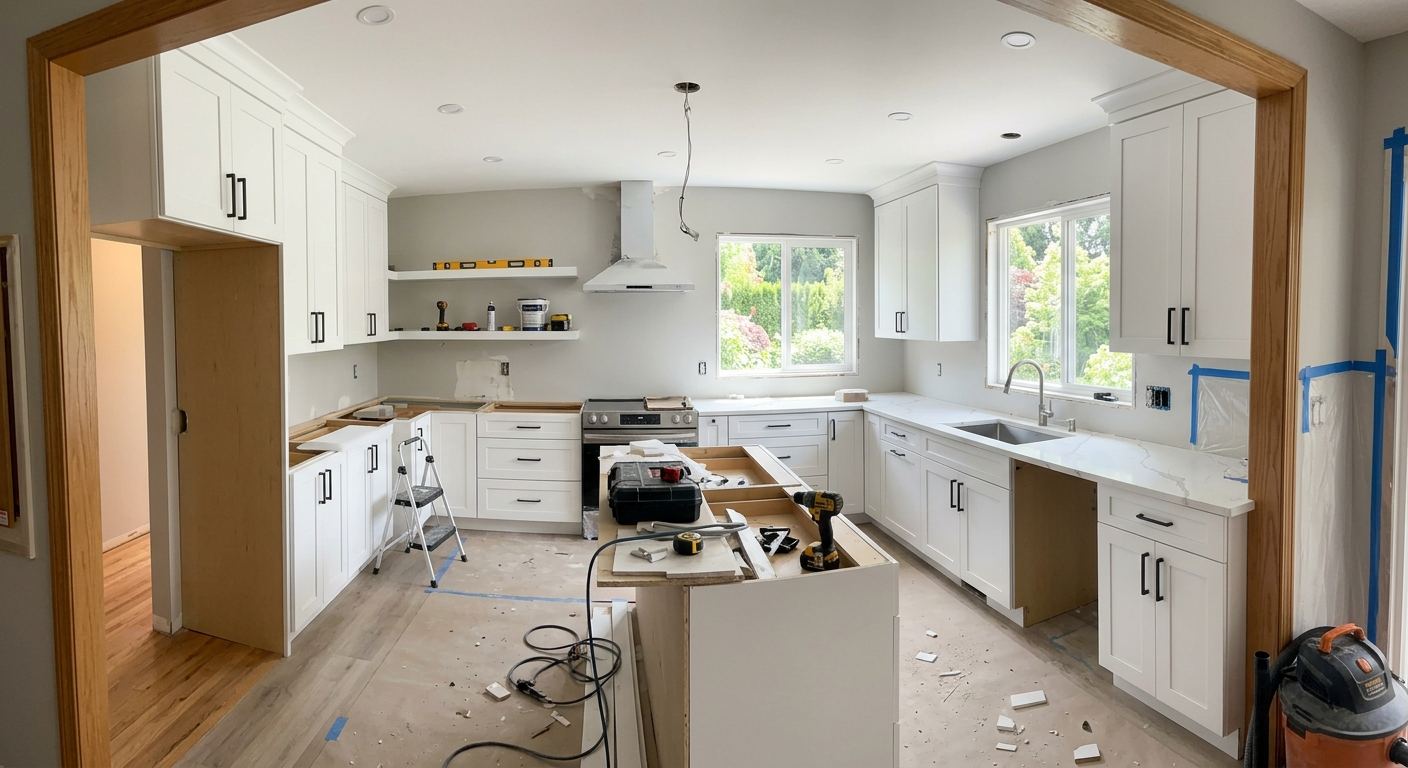
Kitchen renovation options and costs in Port Hope
Kitchen renovation in Port Hope typically starts with matching your finish expectations to what buyers and appraisers see in nearby neighbourhoods. With a median household income of $88,000 (Statistics Canada, 2021 Census) and 17,294 residents in the town (Statistics Canada, 2021 Census), most homeowners plan renovations as a practical upgrade—not just a cosmetic refresh. That income level, along with the housing mix (72.2% single-detached) and an older stock (63.7% of homes built before 1981), often steers decisions toward semi-custom cabinetry and durable counters rather than the cheapest “look-only” approach.
In Muskoka–Kawarthas, costs move with home values and resale expectations more than with climate alone. Still, winter freeze-thaw and seasonal humidity swings can be harder on poorly sealed countertops, backsplashes with inconsistent grout, and kitchens without the right ventilation. Contractors also face seasonal scheduling and logistics considerations—labour availability can tighten in spring and early summer, and access can be slower in older homes where walls and floors may not be level. The trade is especially in demand around Downtown Port Hope and the heritage-adjacent blocks where homeowners tend to keep layouts functional while upgrading finishes for longevity.
As you compare options, the most important thing is that “same kitchen” quotes can differ widely based on cabinet tier, countertop type, and whether you’re changing plumbing, electrical, or layout. Use the tiers below as a starting point for your budget, then align your scope with the contractor’s estimate.
| Renovation Tier |
What's Included |
Typical Duration |
Price Range |
| Cosmetic refresh (paint, hardware, new appliances only) |
Cabinet paint or repaint, new hardware, new faucet and sink if already sized, appliance swap (no major electrical/plumbing moves) |
1–2 weeks |
$13,000–$20,000 |
| Mid-range full renovation (new cabinets, counters, sink, tile) |
Semi-custom or upgrade-stock cabinets, new countertops, sink and tap, backsplash tile, flooring updates where required, basic lighting refresh |
4–7 weeks |
$25,000–$55,000 |
| High-end full renovation (custom cabinets, stone counters, island) |
Fully custom cabinets, premium stone (quartz/stone), island with upgraded electrical and/or seating, full backsplash scope, enhanced lighting, careful millwork finishing |
7–12 weeks |
$70,000–$110,000+ |
| Cabinet refacing only (new doors + drawer fronts, same boxes) |
Refacing system, new doors/drawer fronts, re-staining/finishing, new hardware, optional cabinet-top sealing, selective countertop touch-ups (no full swap) |
1–3 weeks |
$8,000–$35,000 |
| Countertop swap only (laminate to quartz or stone) |
Remove existing, prep, install new countertop and sink cut-outs, recaulk, and re-tile/trim where needed around edges |
3–10 days |
$3,000–$15,000 |
| Backsplash tile installation only |
Surface prep, tile installation, grout/seal, trim at outlets, caulking and cleanup; includes patching for minor irregularities |
3–7 days |
$2,500–$12,000 |
Prices are estimates only and vary by project scope, site access and material selection.
What affects the price of kitchen renovation in Port Hope
In Muskoka–Kawarthas and across Ontario, two contractors can quote the “same” kitchen renovation and still differ by 30–50% because the cost drivers aren’t evenly distributed: cabinet build quality, countertop material, and how much your layout forces plumbing/electrical rework. Finish tier matters most for Port Hope homeowners. In higher-value pockets, many buyers default to quartz or stone counters and semi-custom cabinetry because that upgrade tends to hold resale value and gives the kitchen a longer “good-looking” lifecycle. In more modest budget scenarios, laminate and stock cabinetry often dominate because they deliver the ROI while keeping labour and trade coordination predictable.
Layout changes are the most unpredictable costs regardless of whether you target a $25,000–$55,000 mid-range renovation or push toward $70,000–$110,000+ high-end finishes. Examples include wall removal (structure, inspection, and re-framing), adding an island (new electrical and sometimes ducting), or moving a gas line or venting path (often the biggest chain-reaction cost). In Port Hope’s older housing stock—many homes built before 1981—uneven subfloors and out-of-square walls can add hidden time for shimming, cabinet leveling, and reworking backsplash lines.
Concrete Port Hope scenarios that raise cost: discovering old, moisture-prone subfloor under an older sink base; finding knob-and-tube or outdated wiring that can’t be safely tied into a new island circuit without extra work; and adjusting cabinetry so the room’s corners don’t match modern box sizes. Costs can drop when you keep the plumbing locations, reuse a good-condition cabinet box layout, and choose a countertop thickness that aligns with existing reveals. Those decisions are why “finish photos” alone rarely predict the final price.
| Price Factor |
Why It Matters |
Cost Impact |
| Cabinet tier — stock vs. semi-custom vs. fully custom millwork |
Build quality, door styles, internal hardware, and how well cabinets fit uneven older walls |
Often the largest swing; can move overall cost by roughly 10–25%+ |
| Countertop material — laminate vs. quartz vs. granite vs. stone |
Material cost, fabrication complexity, and installation requirements |
Can shift countertop budget by several thousand; commonly 10–15%+ of total project |
| Layout change — wall removal, island add, plumbing/gas move |
Demolition, framing, inspection, and new rough-in work |
Often adds the biggest “surprise” cost and can drive 20–40% differences between quotes |
| Appliance package tier — builder vs. mid-range vs. pro-grade |
Electrical requirements, venting/clearances, and installation complexity |
Typical swing of a few thousand to 10,000+ depending on brands and venting needs |
| Flooring — refinish existing vs. full replacement |
Whether cabinets are removed and whether subfloor/underlay must be corrected |
Replacement floors commonly add 3–10% to project costs |
| Backsplash — ceramic tile vs. marble vs. full-height slab |
Labour time, material weight/handling, and detailing around outlets |
Minor upgrades can be a few thousand; premium slabs can add several thousand more |
| Electrical — new circuits for island, under-cabinet lighting |
Licensed work, added wiring runs, and rework if cabinetry layout changes |
Often adds 1,000–6,000+ depending on how much new wiring is required |
| Permit fees and licensed trade requirements |
Costs tied to scope, inspections, and trade availability |
Can be modest, but missing required permits can derail a sale and increase total cost later |
Permits & regulations in Ontario
In Ontario, cabinet and countertop swaps typically do not require a permit. That means replacing cabinets, installing new counters (including quartz or stone), and adding a standard backsplash are usually treated as finish work. However, once you move beyond “swap-in-place,” permits and licensed trades commonly enter the picture—especially in kitchens with older rough-ins.
Work that often does require permits includes: moving plumbing supply or drain lines (sink, dishwasher connections, or relocating the wet wall), relocating gas appliances (stove/range) and any related venting, removing a load-bearing wall, and adding new electrical circuits (for example, outlets on an island, under-cabinet lighting circuits, or upgrading service capacity where required). Gas work must be performed by a licensed gas fitter, and electrical work must be performed by a licensed electrician; both should have inspections arranged as required.
For a Port Hope homeowner, a practical verification process is: (1) ask the contractor for their Ontario licence details (or registration identifiers) and confirm they’re active through the appropriate online registry; (2) request a current certificate of insurance—liability coverage should name you as applicable/ask about your interest; and (3) confirm WSIB/WCB coverage for the crew. Get a written scope stating exactly who pulls permits (and when), who pays fees, and what inspections are expected—don’t assume responsibility from a verbal explanation.
Cabinets, countertops and layout decisions in Port Hope
The three most consequential decisions in a Port Hope kitchen renovation are cabinet tier, countertop material, and whether you change layout. Start with cabinets: stock cabinets are the fastest and usually cheapest, but they can be harder to fit neatly in older homes where walls aren’t perfectly square. Semi-custom cabinets are the most popular mid-range option in the Muskoka–Kawarthas market because you get better interior storage and more door/style flexibility without the lead times and higher millwork costs of fully custom cabinetry. Fully custom cabinets deliver the tightest fit and the best storage design, but they’re typically the costliest choice and require clearer expectations up front.
Next is countertops. Laminate is budget-friendly and can be a smart choice if you’re mostly keeping the layout and want a durable surface with simpler maintenance. Quartz is a common “best value” upgrade in Port Hope because it resists staining well and handles seasonal humidity better than many lower-grade finishes—without the sealing routines natural stone sometimes requires. Granite and natural stone bring premium looks, but pricing and installation depend on thickness, edge profiles, and slab availability. Butcher block can be warm and functional, yet it needs consistent care to prevent swelling near sinks and along splash zones—important in older homes where water exposure history may vary.
Finally, layout. Keeping plumbing where it is usually protects your budget. If you add an island or open an interior wall, you’re justifying those dollars with space gain and daily functionality—especially if you’re moving from a narrow galley to a more social cooking space. For example, going from a laminate-based package in the $25,000–$55,000 range to quartz and upgraded cabinetry might add a few thousand, but the payoff is often worth it. In contrast, changing plumbing/gas lines can move you far beyond the same budget tier, even if your finishes stay mid-range.
| Option |
Durability |
Maintenance |
Best For |
Price Range |
| Stock cabinets (big-box) |
Good for level, straightforward layouts; hardware quality varies by line |
Low to moderate; depends on door finish and drawer slides |
Budget-first refreshes where plumbing stays put |
$8,000–$22,000 |
| Semi-custom cabinets (local dealer) |
High; better internal options and finishes that fit most remodel geometries |
Low; wipe-clean finishes and upgraded hardware reduce wear issues |
Most Port Hope renovations aiming for strong resale appeal |
$18,000–$45,000 |
| Custom cabinets (local millwork shop) |
Very high; tailored fit for older walls and custom storage needs |
Low; premium hardware and finishes withstand daily use well |
Complex layouts, built-ins, and homeowners who prioritize long-term fit |
$35,000–$80,000+ |
| Laminate countertop |
Moderate; can chip at edges if heavily impacted |
Low; avoid cutting directly and keep seams protected |
Cost-controlled renovations with reliable sink placement |
$3,000–$7,000 |
| Quartz engineered countertop |
High; resistant to staining and everyday wear |
Low; generally no sealing required |
Busy kitchens where you want durability without extra upkeep |
$6,000–$14,000 |
| Granite / natural stone countertop |
High; durable and heat resistant, but requires correct installation and support |
Moderate; may need periodic sealing depending on the slab |
Premium look buyers who want unique stone patterning |
$8,000–$18,000 |
| Butcher block countertop |
Moderate to high; excellent for prep but vulnerable to water if neglected |
Higher; regular oiling and careful care near sinks |
Family kitchens where food prep is central |
$4,500–$11,000 |
| Marble countertop |
Moderate; elegant but can etch or stain with acids and heavy use |
Higher; needs sealing and careful cleaning |
Lower-traffic or “showpiece” kitchens with attentive maintenance |
$10,000–$25,000+ |
How to choose a kitchen renovation contractor in Port Hope
Choosing the right contractor in Port Hope is mostly about proof and clarity. First, verify Ontario licensing and coverage. Ask for their proof of liability insurance (a current certificate of insurance should clearly show coverage dates and limits), and confirm WSIB/WCB coverage for their workers—then match those documents to the crew who will be on site. If you’re not sure what to request, tell them you want your kitchen contract to identify the responsible parties and that you’ll need insurance and clearance details before work starts. This matters more than people think in older homes because unexpected conditions can trigger extra labour.
Next, get 2–3 itemised written quotes rather than one lump-sum. You want a labour + materials breakdown that clearly separates cabinets, countertops, electrical, plumbing, tile/backsplash, demolition/disposal, and any permit work. Read the scope carefully: what’s excluded (subfloor remediation, flooring replacement, drywall patching, re-tiling around outlets), whether permits are included or billed separately, and whether disposal is part of the contract.
Warranty should be specific. Ask how long the workmanship warranty lasts, what the manufacturer warranty covers (and for how long), and whether warranties are transferable to you as the homeowner. For payment, never pay more than 10–15% upfront. Hold back a portion until the job is complete and any punch-list items are addressed. Finally, insist on a written start date and a realistic completion estimate that accounts for cabinet lead times, countertop fabrication scheduling, and inspection/permit timelines.
- Request itemised quotes with line-by-line labour and materials (not “allowances” only).
- Confirm who pulls permits and who pays permit fees in the contract.
- Verify liability insurance—check the expiry date on the certificate.
- Confirm WSIB/WCB coverage for their workers.
- Ask for Ontario licence/registration details and ensure they match the company name on the contract.
- Check whether disposal/dump fees are included.
- Clarify demolition limits: what they remove and what you’re responsible for.
- Confirm who handles drywall patching, priming, and paint touch-ups.
- Ask about backsplash and tile prep: includes surface flattening and waterproofing at wet areas?
- Get countertop details in writing: slab thickness, seam placement, and sink cut-out assumptions.
- Review lead times for cabinets and countertops; cabinet delays should be reflected in the schedule.
- Ensure warranty terms are written and include a process for service calls.
Red flags I see in Port Hope: vague scopes that rely on large “allowances” without specifying what they cover; missing permit responsibility in the contract; contractors asking for most of the money upfront; no proof of WSIB/WCB or insurance provided; and “one-time” schedules that ignore cabinet and countertop fabrication lead times—especially common when timelines are tight for older homes.
Frequently asked questions — kitchen renovation in Port Hope
What's the best countertop material for a busy Port Hope kitchen?
For most busy Port Hope households, quartz is the best balance of durability and day-to-day ease. It resists staining and handles everyday impacts better than laminate, while typically avoiding the routine sealing that some natural stones require. In an older home (many in Port Hope are pre-1981), the key is not just the surface—it’s the installation and sealing around the sink and edges to reduce water seepage over time. If you’re aiming for a mid-range renovation, quartz often fits comfortably within a kitchen plan that lands around $25,000–$55,000 when you keep plumbing and lighting changes limited. If you want a premium look, granite can be great, but quartz is usually the lower-maintenance “busy kitchen” choice.
How do I add an island to my Port Hope kitchen?
Add an island by planning for the “invisible” work up front: power, and sometimes ventilation and plumbing. In Ontario, electrical work for island outlets or under-cabinet lighting typically needs a licensed electrician and inspections. Start by confirming your kitchen layout can support the island footprint for clearance and walkways—older Port Hope homes can feel tight once cabinets are replaced or floors are corrected. Then decide whether you’re keeping your sink/dishwasher where they are; moving plumbing lines can escalate costs quickly due to rough-in changes. As a ballpark, a full renovation with an island often sits in the higher range of $70,000–$110,000+ when cabinets, stone counters, and electrical are upgraded together. If you keep finishes mid-tier, you may reduce the cost, but the electrical and layout coordination still drive the schedule.
How much does a kitchen renovation cost in Port Hope?
In Port Hope, total kitchen renovation costs usually track project scope and finish tier more than square footage. A cosmetic refresh (paint, hardware, and new appliances only) commonly falls around $13,000–$20,000. If you want a mid-range full renovation—new cabinets and counters plus a backsplash and sink—most homeowners budget roughly $25,000–$55,000. Higher-end projects with custom cabinetry, stone counters, and an island often move into the $70,000–$110,000+ range, especially when electrical, flooring correction, or careful millwork is included. Because Port Hope has a high share of older homes (63.7% built before 1981 per Statistics Canada), unexpected subfloor or framing corrections can add labour even when your finish choices stay mid-tier.
How long does a kitchen renovation take in Port Hope?
Typical timelines depend on whether you’re just swapping surfaces or rebuilding the kitchen infrastructure. Cosmetic refreshes are often 1–2 weeks because cabinetry boxes and plumbing/electrical don’t change much. A mid-range full renovation usually takes about 4–7 weeks, while higher-end full renovations often run 7–12 weeks due to cabinet lead times, countertop fabrication, and more complex electrical and island work. In Port Hope, older home conditions can add time for leveling and detailing—especially for cabinets and backsplash lines. Also factor in trade scheduling in the Muskoka–Kawarthas region, where spring and early summer can be busier for contractors. Before signing, ask your contractor for a written start date and a completion estimate that includes known permit/inspection steps where required.
Quartz vs granite countertops — which is better?
“Better” depends on how you use your kitchen. Quartz is usually the best choice for busy Port Hope kitchens because it’s highly consistent in look, resists staining well, and generally doesn’t require the same sealing routine that some granite slabs need. Granite is extremely durable and heat resistant and offers unique natural patterning, but it can vary from slab to slab and may need periodic sealing depending on the stone. If you’re doing a renovation where you want a predictable, lower-maintenance result—especially around sink areas where seasonal humidity and water exposure matter—quartz is often the safer daily-use pick. If your budget allows and you want the premium stone character, granite can be a great upgrade. In a typical renovation tier, quartz and stone both contribute to the mid-to-high countertop budgets that influence whether you land closer to $25,000–$55,000 or higher.
Should I reface or replace my cabinets?
Refacing is often worth considering when your cabinet boxes are structurally sound, your layout still works, and you want a faster, lower-disruption update. It can be a good fit if you’re aiming to control overall cost while improving doors, drawer fronts, and hardware. Replacement is usually the better path when boxes are damaged by moisture, the kitchen is out of square, or you want major storage redesigns and layout tweaks. In Port Hope’s older housing stock, I often see refacing succeed when water hasn’t compromised the cabinet bases near the sink and dishwasher. If you want to upgrade counters at the same time, you may be better off replacing cabinets to keep reveals and countertop edges tight. A cabinet refacing project commonly falls around $8,000–$35,000, while full replacements contribute more heavily to mid-range and high-end renovation totals.