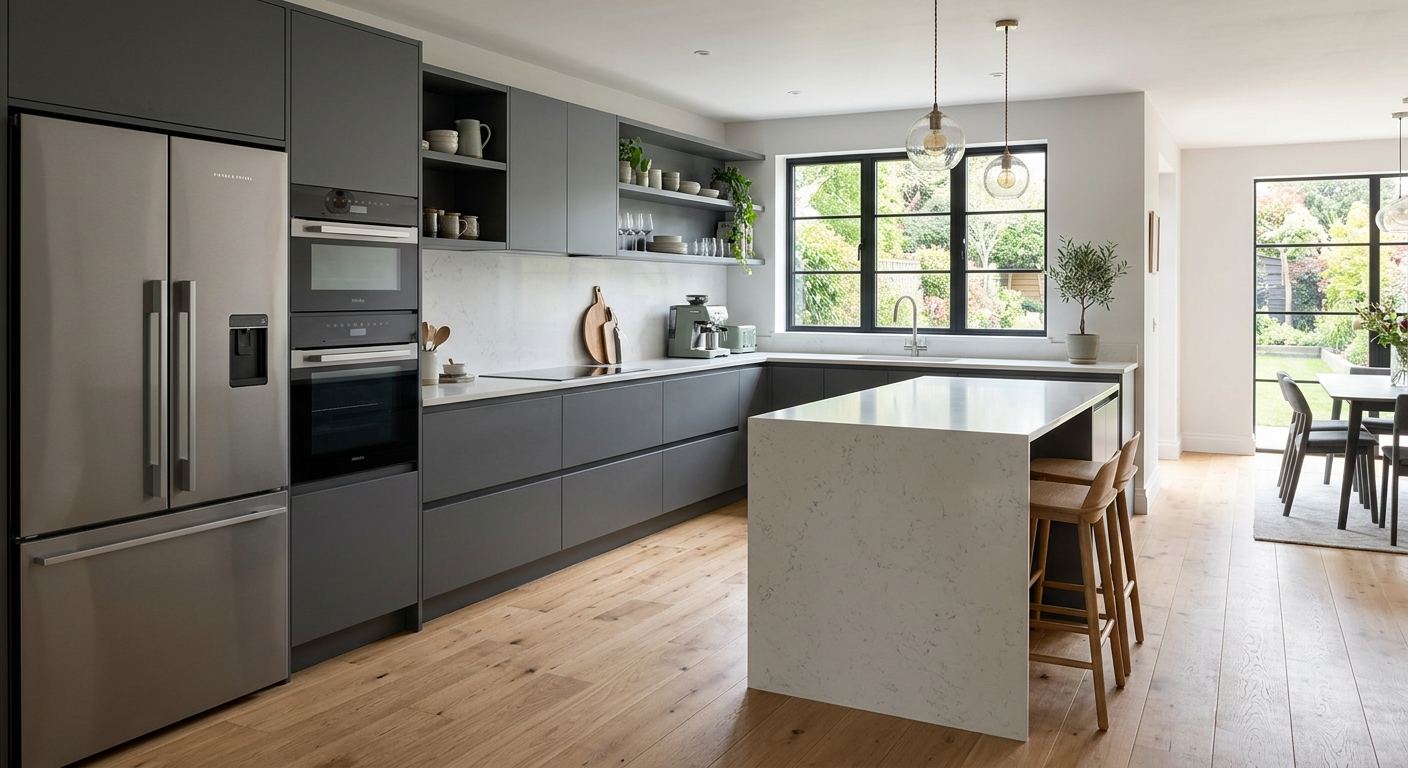
Kitchen renovation options and costs in Long Branch
Long Branch, Ontario sits within the Toronto economic region, and that matters for budgets because kitchen upgrades are usually priced off local real estate expectations—not just what materials cost. With a population of 10,084 (Statistics Canada, 2021 Census), the local homeowner base is relatively small, so good trades can get booked ahead during peak renovation months. Owners here also tend to prioritize finishes that match the resale market, and in higher-value pockets the kitchen often ends up absorbing roughly 8%–15% of home value through choices like quartz or natural stone and upgraded appliances. Even when the layout stays the same, that “fit-and-finish” expectation pushes most full kitchen projects toward the mid-to-upper ranges.
Toronto-area costs don’t swing much because of weather the way some regions do—contracts, labour, and material pricing are fairly consistent across the GTA. Instead, the market and housing stock do the heavy lifting. Many homes around Lake Shore/Long Branch Boulevard were built decades ago, so you commonly see older plumbing shutoffs, dated electrical panels, and uneven subfloors that can extend prep time. That’s why a cosmetic refresh can stay affordable, while a “same kitchen, new counters” job can still creep upward if your contractor discovers hidden water damage, poor venting, or substandard wiring during demo.
Demand is especially strong around the Long Branch “village” strip and the broader lakefront residential streets, where walkable neighbourhood living drives frequent refreshes ahead of listing season. With that context, the table below compares realistic renovation tiers and typical timelines.
| Renovation Tier |
What's Included |
Typical Duration |
Price Range |
| Cosmetic refresh (paint, hardware, new appliances only) |
Cabinet paint or colour change, new hardware, appliance swap, minor touch-ups |
3–7 days |
$8,000–$18,000 |
| Mid-range full renovation (new cabinets, counters, sink, tile) |
Semi-custom or quality stock cabinets, countertop (quartz or laminate), sink/faucet, backsplash tile, basic lighting updates |
3–6 weeks |
$25,000–$55,000 |
| High-end full renovation (custom cabinets, stone counters, island) |
Fully custom millwork, premium quartz or natural stone counters, island (carpentry + power/lighting), full-height backsplash or upgraded tile, upgraded appliance package |
6–12 weeks |
$60,000–$90,000 |
| Cabinet refacing only (new doors + drawer fronts, same boxes) |
Door/drawer replacement, new veneer finish, hardware, sealants; existing boxes remain |
2–4 weeks |
$8,000–$35,000 |
| Countertop swap only (laminate to quartz or stone) |
Remove old top, install new quartz/stone, cut-outs, new sink setting if required (varies) |
2–5 days |
$3,000–$15,000 |
| Backsplash tile installation only |
Tile supply and install, edge trims, waterproofing as required, grout/seal |
3–7 days |
$2,000–$10,000 |
Prices are estimates only and vary by project scope, site access and material selection.
What affects the price of kitchen renovation in Long Branch
In Long Branch and across the Toronto economic region, two contractors can quote the “same” kitchen renovation with a 30%–50% difference. The usual drivers aren’t the season or the local climate—they’re how each company scopes your hidden work, the finish tier you choose, and whether your plan includes electrical/plumbing moves and any permitable changes.
Here’s the key: local home values and homeowner income expectations shape typical finish tiers far more than Ontario weather. In higher-value GTA pockets, homeowners more often choose quartz or natural stone and semi-custom cabinetry because the cost is easier to rationalize on resale (upgrades present well to buyers). In more price-sensitive areas, projects commonly stay mid-range with laminate or stock cabinets, focusing on layout and functionality without upgrading every surface. For many Long Branch homes, that means you’ll see budgets cluster around the $25,000–$90,000 full-renovation bands depending on whether the owner stays in stock/refaced territory or goes fully custom with stone and an island.
Layout changes are where costs become unpredictable. Removing a wall, adding an island, or moving plumbing for a new sink line can require additional carpentry, new supply/drain runs, and trade scheduling. For dollar context, a “simple” mid-range refresh at about $35,000 can jump several thousand dollars if the contractor finds old drain slope issues behind base cabinets. Conversely, an owners’ choice to stay on the existing footprint can keep you closer to the low end of $25,000–$55,000, even while upgrading counters to quartz.
Two common Long Branch realities that raise cost: older electrical service or insufficient receptacle spacing near the island, and dated venting/ducting that becomes obvious only after cabinetry is removed. You also may see extra subfloor prep if previous leaks occurred in sink or dishwasher zones, especially in homes with older shutoffs.
| Price Factor |
Why It Matters |
Cost Impact |
| Cabinet tier — stock vs. semi-custom vs. fully custom millwork |
Materials, finishing, interior options (pull-outs, soft-close upgrades), and build method |
$10,000–$40,000 |
| Countertop material — laminate vs. quartz vs. granite vs. stone |
Material cost, fabrication complexity, edge profiles, and install labour |
$3,000–$15,000 |
| Layout change — wall removal, island add, plumbing/gas move |
Structural work, new runs, inspection scheduling, and framing/electrical rework |
$5,000–$25,000 |
| Appliance package tier — builder vs. mid-range vs. pro-grade |
Controls, finish (panel-ready vs. standard), warranty scope, and delivery/fitment |
$2,500–$12,000 |
| Flooring — refinish existing vs. full replacement |
Subfloor repairs, matching transitions, and whether demo extends under cabinetry |
$1,500–$10,000 |
| Backsplash — ceramic tile vs. marble vs. full-height slab |
Tile labour intensity, waterproofing details, and slab measurement/cutting |
$2,000–$10,000 |
| Electrical — new circuits for island, under-cabinet lighting |
Licensed work, outlet planning, lighting runs, and panel capacity considerations |
$800–$6,500 |
| Permit fees and licensed trade requirements |
When work crosses into plumbing/electrical/gas/structural categories |
$300–$5,000 |
Permits & regulations in Ontario
In Ontario, not everything triggers permits, but key kitchen changes often do. Cabinet and countertop swaps typically do not require a permit, because you’re generally not altering building systems. Where homeowners get into trouble is assuming “renovation” equals “no rules.” In practice, if you’re moving plumbing supply or drain lines, relocating gas for a stove/range, removing a load-bearing wall, or adding new electrical circuits (for example, outlets and lighting around an island), permits and licensed trades are usually required. Gas work must be performed by a licensed gas fitter, and electrical work must be performed by a licensed electrician—both typically require inspections.
Step-by-step, here’s how a Long Branch homeowner should verify a contractor’s Ontario compliance before signing:
1) Ask for the contractor’s licence and confirm it through the appropriate provincial online registry for the relevant trade (for gas and electrical, confirm the individual licence tied to the work). 2) Request a current certificate of insurance showing liability coverage and ask whether the contractor lists your address as a job location. 3) Verify WSIB/WCB coverage (where applicable) for the contractor and subcontractors—this protects you if a worker is injured on site. 4) Confirm who is responsible for pulling permits in writing, including what inspections are expected.
Always confirm permit responsibility in the written contract—“we’ll handle it” is not the same as a clear scope.
Cabinets, countertops and layout decisions in Long Branch
In a Long Branch kitchen renovation, three decisions determine both your day-to-day satisfaction and your resale appeal: (1) cabinet tier, (2) countertop material, and (3) whether you change the layout. Cabinet tier drives build quality, storage functionality, and how well doors align after years of seasonal movement. Stock cabinets are the fastest path to a refreshed look; semi-custom cabinets are the most common “sweet spot” for practicality; custom cabinets cost more but can fully match awkward wall lengths and create tailored storage that buyers notice.
Countertops matter even more in Toronto showings. Quartz is popular because it’s durable, low-maintenance, and doesn’t need ongoing sealing like many natural stones. Laminate can be great for budget and resale when the install is clean, but it’s less forgiving to heavy heat or deep gouges. If you’re aiming for a high-end finish—particularly if your budget is moving toward the $60,000–$90,000 band—natural stone like granite or marble can visually elevate the space. But remember: marble is softer and can etch; granite is generally more practical for active households.
Layout changes are where you “buy” space. Removing an open-concept wall can create a better flow for how buyers live, and adding an island can improve function—if you justify the expense by creating seating, storage, and a clear walkway. In many Long Branch homes, relocating plumbing or gas for a sink or range hood adds complexity and can push budgets upward quickly, especially on older houses with dated rough-ins.
Concrete example: if you’re choosing between staying mid-range and upgrading counters, a $6,000–$8,000 countertop upgrade from laminate toward quartz might be worth it when you keep the cabinet boxes and footprint. However, if you already plan to add an island and move electrical and plumbing, the extra countertop upgrade may matter less than getting the layout right and protecting against hidden water damage behind older sink runs—issues that can cost far more than the difference between countertop materials.
| Option |
Durability |
Maintenance |
Best For |
Price Range |
| Stock cabinets (big-box) |
Good for standard spaces; may struggle with odd wall lengths |
Low; wipe clean and keep hardware tightened |
Quick refreshes and tighter budgets |
$8,000–$18,000 |
| Semi-custom cabinets (local dealer) |
Very solid; better sizing and storage options |
Low; regular cleaning and hardware adjustments over time |
Most Long Branch renovations aiming for mid-range value |
$18,000–$35,000 |
| Custom cabinets (local millwork shop) |
Excellent fit and finish; best for built-in details |
Low; protect surfaces and keep dovetail/hinges maintained |
High-end builds, awkward layouts, premium storage |
$35,000–$60,000 |
| Laminate countertop |
Resists daily wear; can chip at edges if impacted |
Low; avoid prolonged heat and heavy cutting directly |
Value-focused projects staying closer to the mid-range |
$3,000–$7,000 |
| Quartz engineered countertop |
Highly durable; resists stains and most everyday impacts |
Low; no sealing needed for typical homeowner use |
Popular Toronto/Long Branch choice for a clean, modern look |
$6,000–$12,000 |
| Granite / natural stone countertop |
Very durable with proper sealing; natural variations |
Moderate; sealing may be recommended periodically |
Long Branch homeowners wanting a distinctive premium look |
$8,000–$15,000 |
| Butcher block countertop |
Durable for food-prep use; can scratch with knives |
Higher; oiling and conditioning required |
Warm, farmhouse styles and active kitchens |
$5,000–$10,000 |
| Marble countertop |
Beautiful but softer; can etch from acids |
Higher; careful cleaning and sealing practices |
Design-forward kitchens when maintenance is acceptable |
$9,000–$18,000 |
How to choose a kitchen renovation contractor in Long Branch
Choosing the right kitchen contractor in Long Branch is mostly about verification and transparency. Start by confirming Ontario licensing where applicable (especially for electrical and gas work), and request proof of liability insurance and WSIB/WCB coverage so you’re not exposed if something goes wrong. How to check: (1) ask for a current certificate of insurance and verify it covers the trade/company doing the work at your address; (2) obtain the contractor’s WSIB/WCB clearance documentation; and (3) verify the licensed trades are tied to the specific scope (gas fitter for gas appliances, electrician for new circuits and lighting). A reputable contractor will provide these quickly.
Next, get 2–3 itemised written quotes. You want a breakdown of labour and materials, not one lump-sum number that hides risk. Make sure the scope includes whether permits are pulled and by whom, whether disposal/dump fees are included, and which parts of demo and prep are included (floor protection, protection for neighbouring rooms, and patching). Warranty also matters: ask for workmanship warranty length, manufacturer warranty details on cabinets/counters/appliances, and whether warranties transfer if you sell the home.
Finally, manage cash flow. Never pay more than 10%–15% upfront. Use a holdback for completion and close-out items, and insist on a written timeline with a start date and estimated finish date.
- Request licence confirmation for the relevant trades (gas/electrical) tied to your scope.
- Ask for liability insurance certificate and confirm jobsite coverage.
- Verify WSIB/WCB clearance (or equivalent coverage) before work starts.
- Get 2–3 itemised quotes (labour, materials, allowances, and taxes).
- Confirm permit responsibility and inspection expectations in writing.
- Check inclusions: site protection, dust control, and floor protection during demo.
- Confirm disposal: dumpster, hauling, and any landfill fees.
- Read exclusions: what happens if drywall, subfloor, or old wiring needs replacement?
- Ask for product warranty terms and workmanship warranty length (and what it covers).
- Clarify cabinet/counter turnaround times and what triggers schedule delays.
- Set a payment schedule with a holdback until punch list completion.
- Require a written timeline with start date and completion estimate.
Concrete red flags I see in Long Branch: contractors who won’t provide insurance/WSIB documentation, quotes without a clear scope (especially around plumbing/electrical changes), lowball pricing that relies on big “allowances,” vague timelines with no start/finish targets, and payment requests exceeding 10%–15% upfront without a signed contract and schedule.
Frequently asked questions — kitchen renovation in Long Branch
How do I choose a kitchen contractor in Long Branch?
Start with verification: in Ontario, make sure the contractor can show liability insurance and WSIB/WCB coverage documentation, and that any licensed trades match your scope (electrical for new circuits/lighting, and a licensed gas fitter for gas appliance changes). Then compare 2–3 itemised quotes so you can see what’s included for labour, permits, and disposal—kitchens often look similar in photos but differ in rough-in work. In Long Branch, many homes are older, so ask how they handle unexpected conditions behind base cabinets (subfloor, shutoffs, and wiring). Finally, look for clear warranties: workmanship coverage for the install plus manufacturer warranty details. If you’re targeting a mid-range kitchen around $25,000–$55,000, insist the quote explains where value is coming from (cabinet tier, countertop choice, and layout). (Statistics Canada, 2021 Census)
What order do kitchen renovation steps happen in?
For Long Branch projects, a common order is: (1) measurements and design confirmation, (2) permit planning (only if your scope includes permitable work), (3) demo and protection of adjacent areas, (4) rough-in for electrical/plumbing/gas if moving anything (licensed trades first), (5) inspections where required, (6) framing/repairs, (7) drywall/patching and paint, (8) installation of cabinets, (9) countertop fabrication and install, (10) backsplash tile, (11) flooring completion/trim work, and (12) final appliance and hardware hookup plus punch list. If you’re staying purely within non-permit cabinet/countertop swaps, you can often compress the schedule. But if you’re adding an island with new outlets or changing sink/drain locations, you must account for trade scheduling and possible inspection timing. Expect a typical mid-range full renovation to land in the $25,000–$55,000 zone with about 3–6 weeks from demo start to completion, depending on cabinet lead times.
Can I live at home during a kitchen renovation in Long Branch?
Often yes, but it depends on how disruptive your scope is. For a cosmetic refresh or backsplash-only work, you can usually stay in the home with minimal downtime. For cabinet and countertop installations, many homeowners in Long Branch continue living in the house by setting up a temporary kitchen (microwave, kettle, and a small prep station) in another room. The bigger question is whether your project includes plumbing/gas/electrical rough-in. If you’re moving the sink, relocating gas equipment, or adding island circuits, access to the kitchen will be more disruptive and you may lose water usage during tie-ins on installation days. That said, even full renovations commonly proceed with daily cleanup and dust control measures when properly planned. If you’re moving toward a high-end build around $60,000–$90,000, plan for longer downtime and more trade visits. Your contractor should propose staging options in writing and show you a timeline with the days you’ll have partial or full access to key functions.
Should I renovate my kitchen before selling in Long Branch?
It can make sense, especially when buyers expect modern, easy-to-maintain finishes. In Long Branch, the kitchen is a major decision point because it affects perceived value and day-to-day usability. If your renovation stays within a sensible band—often the mid-range $25,000–$55,000—you can upgrade cabinets, counters, and backsplash without over-improving beyond what the home market will reward. A practical approach is: keep layout changes limited unless there’s a functional problem (bad traffic flow, insufficient outlets, or storage that doesn’t work). If you’re considering premium stone and custom millwork, that’s typically more justified for larger renovations closer to the $60,000–$90,000 range, particularly when you can show the improvements align with how buyers tour kitchens (work zones, lighting, and cohesive finishes). Also, verify what hidden issues are present before you spend—older plumbing shutoffs, sink leaks, or outdated electrical can quickly turn a “cosmetic” schedule into a longer, more expensive project.
What's the most popular kitchen style in Long Branch right now?
Right now, many Long Branch homeowners lean toward a clean, modern look with warmer materials: flat-panel or simple shaker-style cabinetry, light-to-medium cabinet colours, and durable counters like quartz. Pairing quartz with a simple backsplash (often ceramic tile with a subtle pattern or a clean linear look) tends to appeal broadly to buyers across the Toronto region. Lighting is also a big driver—undercabinet LED and good task lighting can make even a smaller kitchen feel brighter. If you’re choosing between value and premium, many projects that land in the mid-range $25,000–$55,000 focus on semi-custom cabinets and quartz, while higher-value renovations around $60,000–$90,000 more often include a statement island, custom millwork detailing, and upgraded stone. Style should still follow your home’s age and layout; in older Long Branch homes, matching proportions and creating functional storage tends to read better than following ultra-trendy styles that may date quickly.
How do I know if I need to update my kitchen plumbing in Long Branch?
A good sign is not just visible problems—it’s whether the system is aged or undersized for your planned layout. If you have slow drains, recurring odours, or water pooling under the sink or dishwasher area, plumbing updates are likely. If you’re keeping the same sink location and simply swapping countertops and cabinets, you may only need shutoff replacement and careful inspection during install. But if your plan includes moving plumbing supply/drain lines (for example, changing sink location or adding an island that requires a new dishwasher connection), you should assume at least some plumbing work. In older Toronto-area homes, dated valves, corroded supply lines, and questionable drain slope show up once cabinets are removed. That’s why a thorough contractor should inspect the existing shutoffs and drain runs before final ordering. Budget-wise, plumbing changes can push a job upward within your renovation tier; even if your overall target is around $25,000–$55,000, hidden plumbing fixes and the required licensed work can add time and cost. Always confirm who handles permits and licensed trades when plumbing is moved.