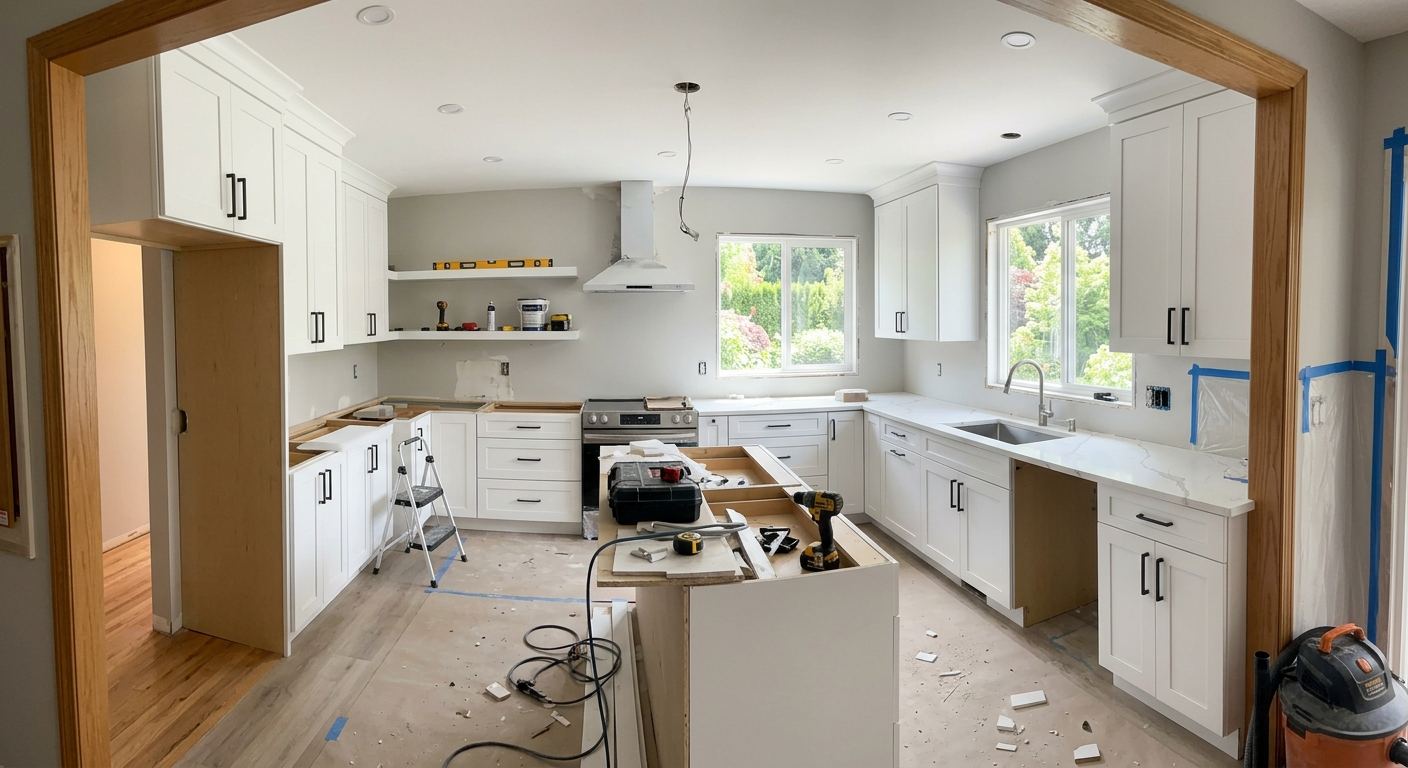
Kitchen renovation options and costs in Woodbine Corridor
Kitchen renovations in Woodbine Corridor are shaped less by weather and more by what buyers expect in the Toronto housing market. With Woodbine Corridor’s population at 12,541 (Statistics Canada, 2021 Census), there’s a steady demand from homeowners who are either upgrading for resale or upgrading to stay put. In the Toronto area, many projects also track closely to household purchasing power: when residents have more to spend, kitchens tend to move up the finish tiers—custom cabinetry, quartz or natural stone counters, and upgraded appliances—rather than staying at a basic refresh level. In higher-value pockets of the broader Toronto economic region, it’s common to invest roughly 8–15% of a home’s value into the kitchen, which is why you’ll see more stone and island builds than you might in more price-sensitive areas.
That said, Ontario’s climate still plays a role indirectly: winter humidity swings and frequent salt/dirty airflow from the street affect ventilation choices, caulking longevity, and how well countertops and backsplash tile assemblies hold up. Also, GTA contractor availability can tighten seasonally, which influences scheduling and labour costs—especially for projects that require multiple trades and permit coordination. For neighbourhood-level demand, the Woodbine Corridor area sees strong interest in client-ready, turn-key kitchen upgrades—particularly in the busier, storefront-adjacent pockets where homes often change hands and buyers want “move-in ready” finishes. With that demand in mind, it helps to compare your options side-by-side before you call for pricing.
| Renovation Tier |
What's Included |
Typical Duration |
Price Range |
| Cosmetic refresh (paint, hardware, new appliances only) |
Paint, cabinet hardware, appliance swap, minor caulking and touch-ups (no cabinet box changes), basic cleaning and re-sealing where needed |
1–2 weeks |
$25,000–$35,000 |
| Mid-range full renovation (new cabinets, counters, sink, tile) |
New semi-custom or stock cabinets, countertop and sink installation, backsplash tile, new faucet, disposal swap, labour for plumbing/electrical make-ready (as needed), floor patching/tie-in |
4–7 weeks |
$45,000–$70,000 |
| High-end full renovation (custom cabinets, stone counters, island) |
Custom millwork, quartz or natural stone counters, island build, elevated backsplash (often to full height at key walls), upgraded appliance package, ventilation upgrades, possible gas/plumbing relocation coordination |
8–12+ weeks |
$70,000–$90,000 |
| Cabinet refacing only (new doors + drawer fronts, same boxes) |
Door and drawer front replacement, new end panels, trim details, new hinges/soft-close upgrades, repaint/stain of cabinet interiors where applicable (no full demo of boxes) |
2–4 weeks |
$8,000–$25,000 |
| Countertop swap only (laminate to quartz or stone) |
Remove and dispose of existing top, install new quartz/stone (or upgrade from laminate), standard backsplash accessory tie-in, silicone/edge sealing |
1–3 weeks |
$6,000–$15,000 |
| Backsplash tile installation only |
Remove/replace existing backsplash (if needed), tile layout and install, grout and sealing, outlet cut-outs and detailing, caulking at countertop and corners |
3–7 days |
$2,500–$10,000 |
Prices are estimates only and vary by project scope, site access and material selection.
What affects the price of kitchen renovation in Woodbine Corridor
If two homeowners in Woodbine Corridor request the same “new cabinets and counters” job, quotes can still swing by 30–50% across Toronto and Ontario. The biggest driver isn’t the city itself—it’s what finish tier you choose, how complex your layout is, and how much coordination your kitchen requires among trades. In the Toronto economic region, local home values and the related buyer expectations influence finish selections more than climate does. In higher-value segments, homeowners often default to quartz or natural stone counters and semi-custom cabinetry because the renovation cost is easier to justify on resale. In more price-sensitive areas, laminate counters and stock cabinetry are still common because they keep the project budget in reach while improving day-to-day function.
Layout changes add the most unpredictable cost regardless of finish level. Removing a wall (or opening a passage), adding an island, or moving plumbing/gas lines can trigger permit requirements, engineering in rare structural cases, and additional labour that a finish-only quote won’t cover. For example, a mid-range full renovation often lands around the $45,000–$70,000 band, but once you relocate a sink or gas cooktop, you can quickly spend enough extra to approach the $70,000–$90,000 territory even if cabinets stay semi-custom. Conversely, a targeted countertop swap can stay closer to the $6,000–$15,000 range if the plumbing and electrical points don’t change.
Concrete Woodbine Corridor examples I see often: older homes may have out-of-date venting or undersized electrical routes, which makes under-cabinet lighting and island outlets more involved. Also, kitchens exposed to more winter salt/condensation near entryways often benefit from better sealing details and ventilation—small line items that reduce call-backs later. That’s why two “quartz countertop” quotes can differ when one includes proper edge/transition sealing and the other assumes an easy install.
| Price Factor |
Why It Matters |
Cost Impact |
| Cabinet tier — stock vs. semi-custom vs. fully custom millwork |
Door styles, internal storage, machining, and how precisely the cabinetry fits irregular walls |
Biggest line-item swing; can change total budget by tens of thousands |
| Countertop material — laminate vs. quartz vs. granite vs. stone |
Material cost, thickness/edges, and fabrication complexity; heavier stone can require more careful handling |
Moderate to major increase depending on material and sink cut-outs |
| Layout change — wall removal, island add, plumbing/gas move |
Unpredictable demo, framing, venting, permits, and trade coordination |
Can shift a project from mid-range to high-end quickly |
| Appliance package tier — builder vs. mid-range vs. pro-grade |
Refrigeration sizes, ventilation requirements, and installation/trim complexity |
Small to significant impact; affects electrical/gas make-ready too |
| Flooring — refinish existing vs. full replacement |
What’s under the kitchen (subfloor condition, existing finish) and whether flooring can be patched cleanly |
From low impact to major demo and reinstallation |
| Backsplash — ceramic tile vs. marble vs. full-height slab |
Material labour intensity, pattern matching, and water-resistant detailing |
Often a mid-range add-on; full-height upgrades can be costly |
| Electrical — new circuits for island, under-cabinet lighting |
New lighting, outlets, and load planning typically require licensed electrical work |
Can add noticeable cost even when materials are modest |
| Permit fees and licensed trade requirements |
Any plumbing/gas/electrical changes need appropriate permits and inspections |
Generally adds cost and scheduling time, especially for multi-trade jobs |
Permits & regulations in Ontario
In Ontario, some kitchen updates are straightforward from a permit standpoint, but many “function upgrades” are not. Typically, cabinet and countertop swaps do not require a permit when you’re replacing like-for-like and you aren’t altering structural elements or rough-in services. That means a cabinet installation, cabinet refacing (doors and drawer fronts on existing boxes), or a countertop replacement usually falls into the non-permit category.
However, permits and inspections commonly apply when you change the hidden systems. Moving plumbing supply or drain lines usually requires a permit, and relocating a gas stove or modifying the gas configuration requires gas work by a licensed gas fitter. Removing a load-bearing wall (or altering structure) requires proper permitting and professional review. Adding new electrical circuits—for example, powering an island with new outlets or adding a dedicated lighting circuit—also requires a permit and licensed electrical work.
To verify a contractor in Woodbine Corridor, do it in this order: (1) confirm the company and any key trade credentials (look for the contractor’s Ontario registration details), (2) request a certificate of insurance showing liability coverage, (3) ask for WSIB/WCB clearance or coverage proof for the people who will work on-site, and (4) keep a copy of the contractor’s permit responsibility statement in your contract. If you’re told “we’ll handle permits,” confirm what permits they’re pulling, who is licensed for the specific trade work, and whether inspections are included.
Cabinets, countertops and layout decisions in Woodbine Corridor
In a Woodbine Corridor kitchen renovation, the three decisions that drive satisfaction (and resale value) are cabinet tier, countertop material, and layout changes. Cabinets first: stock (fastest and lowest cost), semi-custom (the most popular mid-range because it balances price and fit), or custom (highest cost, best for awkward walls and perfect storage). Second, choose a countertop that matches your lifestyle and maintenance comfort. Laminate can be a budget-friendly win, quartz is a strong mid-to-upper performer for busy households, and natural stone is a premium look that needs sealing and care. Third, consider layout: open-concept wall removal, adding an island, and relocating plumbing or gas lines can deliver real usability—if the space gain justifies the cost and permit complexity.
Toronto resale expectations matter here. At entry to mid-range budgets, buyers commonly expect clean lines, durable countertops, and a modern backsplash that reads well in photos. At the $70,000–$90,000 end, you’ll often see island seating, better storage planning, and higher-grade stone finishes. Ontario’s climate makes these choices more practical: kitchens with frequent winter moisture exposure around doors and mudroom transitions benefit from good ventilation and well-sealed countertops and backsplash edges—especially near areas prone to condensation.
Example: if you’re trying to stay near a mid-range renovation of roughly $45,000–$70,000, picking quartz over laminate can be a smart upgrade without breaking the whole budget. But if you jump to custom cabinets plus natural stone and you also move a sink or gas line, the project can escalate toward the high-end band ($70,000–$90,000) because you’re paying for both premium finishes and additional rough-in work. In most homes, layout is the “value lever,” and finish tier is the “quality lever”—and you get the best ROI when you prioritize the lever that solves your actual daily pain point.
| Option |
Durability |
Maintenance |
Best For |
Price Range |
| Stock cabinets (big-box) |
Good day-to-day durability; fit may be less exact on older Toronto-era walls |
Low maintenance; wipe-clean finishes, tighten hardware as needed |
Faster timelines and tighter budgets |
$8,000–$20,000 |
| Semi-custom cabinets (local dealer) |
Very good durability with better sizing flexibility and storage upgrades |
Low maintenance; hinges and soft-close components are typically serviceable |
Most Woodbine Corridor homeowners aiming for strong resale appeal |
$20,000–$40,000 |
| Custom cabinets (local millwork shop) |
Excellent durability; can be built to irregular spaces and long-term use |
Low-to-moderate maintenance; typically higher-quality finishes and hardware |
Complex layouts, specialty storage, and premium kitchens |
$35,000–$60,000 |
| Laminate countertop |
Moderate durability; can chip at edges if abused |
Wipe clean; avoid prolonged standing water at seams |
Budget-conscious refreshes with better ROI than full stone |
$3,000–$6,000 |
| Quartz engineered countertop |
High durability; resists staining and daily wear well |
Low maintenance; no sealing required for typical quartz products |
Busy households that want “set it and forget it” performance |
$6,000–$12,000 |
| Granite / natural stone countertop |
Very durable but varies by slab; can be sensitive to improper sealing |
Periodic sealing recommended; clean and protect from harsh chemicals |
Premium look and classic Toronto buyer appeal |
$8,000–$15,000 |
| Butcher block countertop |
Good durability with proper care; can dent or scratch |
Regular oiling and gentle cleaning to prevent drying and staining |
Warm, casual kitchens and homeowners who enjoy maintenance |
$4,000–$10,000 |
| Marble countertop |
Beautiful but softer than quartz/granite; more prone to etching |
Higher maintenance; requires careful cleaning and sealing schedule |
High-end aesthetic where homeowners will maintain the surface |
$10,000–$15,000 |
How to choose a kitchen renovation contractor in Woodbine Corridor
Choosing the right kitchen renovator in Woodbine Corridor is about verifying credentials and forcing clarity into the quote. Start with Ontario licensing checks: request the contractor’s proof of registration (and confirm the relevant licensed trades for gas and electrical work). Then verify insurance and workers’ coverage. Ask for a certificate of liability insurance showing active coverage, and request WSIB/WCB clearance or proof of coverage for the workers who will be on your site. If they won’t provide these documents before signing, that’s your first warning sign.
Next, get 2–3 itemised written quotes. You want a labour + materials breakdown, not a lump sum. Ask whether permits are included or billed separately, and whether demolition disposal and recycling are covered. Read the scope line-by-line: what exact cabinets, countertop thickness, installation method, and backsplash coverage are included—and what are the exclusions (subfloor repairs, drywall patching, custom millwork upgrades, electrical additions, and appliance plumbing hookup allowances). For warranty, confirm workmanship warranty length, product/manufacturer warranty terms, and whether the warranty transfers to you if you sell the home.
Payment schedule matters. Never pay more than 10–15% upfront. Hold back a portion until completion and sign-off. Finally, insist on a written timeline: start date, countertop/cabinet delivery windows (which can control the schedule), and a completion estimate.
- Verify Ontario credentials for the company and the specific trades (gas/electrical if applicable).
- Request a certificate of liability insurance and confirm the policy is current.
- Ask for WSIB/WCB clearance or coverage proof for the project workers.
- Use itemised quotes with labour and materials listed separately.
- Confirm permit responsibility in writing (who pulls permits and who pays).
- Clarify disposal: demolition debris removal and recycling haul-off included or not.
- Detail exclusions: drywall patching, subfloor repairs, framing adjustments, and electrical upgrades.
- Ask for countertop template and fabrication timeline commitments (lead times vary).
- Confirm who protects floors and cabinets during demo and installation.
- Check workmanship warranty duration and what it covers (labour, hardware, callbacks).
- Confirm manufacturer warranty details and whether they transfer on sale.
- Keep payment milestones tied to measurable progress; limit upfront payments to 10–15%.
Red flags I see with kitchen contractors in Woodbine Corridor include: refusing to provide insurance/WSIB proof, quoting only as a lump sum without scope detail, “allowance pricing” that’s too low for cabinets or counters (then billed as extras), unclear responsibility for permits, and vague timelines that don’t account for cabinet/counter fabrication lead times.
Frequently asked questions — kitchen renovation in Woodbine Corridor
Can I move my kitchen sink or stove?
Yes, you can move a kitchen sink or stove in Ontario, but the cost and permitting requirements change a lot depending on what’s involved. Moving a sink usually means altering plumbing supply/drain lines, which typically requires a permit and licensed plumbing work, plus careful layout planning to avoid hidden conflicts with framing and venting. Moving a stove can be more involved: if it’s a gas range, any gas relocation requires a licensed gas fitter and inspection. In budgeting terms, a move can push a project beyond a simple refresh and toward the mid-range or high-end bands; for many homes, a mid-range full renovation (often around the $45,000–$70,000 range) can rise when plumbing or gas routes change.
What's the most cost-effective kitchen upgrade?
In Woodbine Corridor, the most cost-effective upgrade is usually one that delivers a “new kitchen look” without triggering major rough-in work. A backsplash tile refresh paired with updated hardware and fixtures often gives the biggest visual impact per dollar. If your cabinets are structurally sound, cabinet refacing is also a cost-efficient pathway because it avoids full demo while upgrading doors, drawer fronts, and finishes. Another economical move is a countertop swap—especially upgrading from laminate to quartz—because it modernizes the whole kitchen face while keeping the plumbing points mostly unchanged. If you’re working within a tighter budget, staying in a cabinet refacing range (commonly $8,000–$25,000) or a backsplash-only scope (commonly $2,500–$10,000) can help you improve resale appeal without stepping into full high-end renovation pricing.
Custom vs stock cabinets — is custom worth it?
Custom cabinets can be worth it when your kitchen has awkward dimensions, you need specialized storage (pantries, appliance garages, or pull-out systems), or you want a precise fit around older framing and uneven walls common in Toronto-area housing stock. Stock cabinets are usually the best choice for speed and budget, but you may lose some design flexibility and fit quality. Semi-custom is often the sweet spot for Woodbine Corridor homeowners aiming for a strong resale look while controlling cost. A good practical way to think about it: if you’re trying to stay around the mid-range renovation band (roughly $45,000–$70,000), semi-custom cabinets plus quartz counters often gives a buyer-friendly result. If you’re already near the $70,000–$90,000 high-end band, custom cabinetry becomes easier to justify—especially when you’re also upgrading the island, ventilation, and countertop stone.
How do I choose a kitchen contractor in Woodbine Corridor?
Start by confirming Ontario compliance and proof. Ask the contractor for liability insurance (certificate of insurance), and proof of WSIB/WCB coverage or clearance for the crew working on your home. For gas and electrical scopes, ensure the correct licensed trades are involved. Next, get 2–3 itemised written quotes with labour and materials separately—no vague lump sums. Review scope exclusions carefully: disposal, drywall patching, permit responsibility, electrical add-ons, and appliance hookup expectations should be written. Check warranty terms too: workmanship coverage length, manufacturer warranty coverage, and whether warranties transfer if you sell the home. Finally, manage payments: don’t pay more than 10–15% upfront, and keep a holdback until the job is complete. If a contractor can’t clearly answer these items, you’ll likely pay later through change orders.
What order do kitchen renovation steps happen in?
A typical kitchen renovation sequence in Woodbine Corridor goes like this: first, site protection, measurements, and confirmation of layout (and permits if you’re changing plumbing/gas/electrical or opening structures). Then demolition comes first—removing old cabinets, countertops, and finishes—followed by rough-ins and framing adjustments for plumbing, gas, electrical, and ventilation as required. After rough-ins are inspected, you do drywall/patching and floor prep, then cabinet installation. Next is countertop fabrication and installation (lead times vary, especially for stone), then sink/faucet installation and final sealing. Backsplash and trim are completed after countertops are set to get clean, tight edges. Finally, appliances are installed, electrical fixtures and lighting are commissioned, and the site is cleaned. This order matters because cabinets and countertops must be measured accurately off finished walls and floors.
Can I live at home during a kitchen renovation in Woodbine Corridor?
Often, yes—but it depends on your scope. A cosmetic refresh (paint, hardware, and new appliances only) is usually the easiest to manage while living at home. For a mid-range or high-end renovation that includes cabinet and countertop replacement, you can typically still live at home if you have a temporary kitchen setup (microwave, kettle, small fridge) and a clear path for daily access. However, if your plan includes opening walls, relocating plumbing/gas lines, or significant flooring replacement, it may be harder to function comfortably—especially during demo and rough-in periods. If you’re doing a full renovation that aligns with $25,000–$90,000 budgets, plan for dust management, noise, and at least a partial shut-down of the kitchen. Confirm with your contractor how they protect floors, contain dust, and schedule the noisiest work so you can plan meals and daily routines.